
There’s no term in American hospitality more abused today than “listening bar.” Every other restaurant, bar or café with a budget has seemingly rebranded itself as some sort of high-fidelity experience. In San Francisco, there is the “intimate hi-fi lounge” at Bar Crenn, the darkly cavernous upstairs Moongate Lounge from the team at Mister Jiu’s and the hi-fi-forward coffee shop experience at Hedge in the Mission District.
These places may have great stereo systems, but they’ve strayed from the light of the original listening bar: the Japanese jazz kissa, a hybrid bar and coffee shop that emerged in post-World War II Japan and focuses on jazz music above all else, with, yes, midcentury sound systems and record collections at the fore. But you don’t come to a proper jazz kissa to talk, dance, drink a beautiful cocktail or film front-facing content. They are expressive, idiosyncratic spaces, often run for decades by the same owners, who have curated an exhaustive selection of jazz that is reflective of a lifelong appreciation.
At a little shotgun bolthole on Nob Hill with cable cars trundling past, a new concept faithfully embodies the spirit of the jazz kissa. There are just eight seats inside, each one situated for maximum listener appreciation of owner Alex Bernardo’s inestimable collection of 20th-century jazz on vinyl and compact disc. Owner-operated in the Japanese kojin-jigyo mold, Kissakeko is a living, breathing representation of Bernardo’s storied career in the beverage industry – and a subtly outstanding example of genuine kissa culture in America.

Kissakeko occupies a narrow 400-square-foot space that was once an architecture office. (Minh Connors/For the S.F. Chronicle)
Born in the Philippines, Bernardo, 68, moved to the Bay Area during the original tech boom in the mid-’90s, and opened Millbrae wine shop Vineyard Gate shop with his wife, Amy Bernardo, in 1998. Widely recognized as the first natural wine retailer in the United States, the shelves at Vineyard Gate were an early home to wines that have since become commonplace: Cru Beaujolais, limited edition Jura, cult Burgundy and Loire, and Spanish Vinho Verde, all eminently trendy now but still wild and unknown back in the Obama administration.
When the pandemic hit, the Bernardos began considering retirement; perhaps they’d move back to Manila, where they owned a small condo, and travel more to Japan. In 2022, Amy Bernardo, who for decades juggled her work with Vineyard Gate alongside a job as the finance manager for the city of Burlingame, fell ill and died. Benardo decided to close Vineyard Gate. “It was impossible to continue Vineyard Gate without my wife,” he said. “It was around that time I started thinking about what I might want to do next.”
For the past decade and a half, Bernardo had been regularly traveling to Japan, visiting dozens of jazz kissa bars across the country. He made multiple trips to favorites including Jamaica (Sapporo), Yamatoya (Kyoto) and Toh (Tokyo). His Japan travels had also quietly led to an expanding selection of sake at Vineyard Gate, including a line of direct import bottles available only at the shop. “I fell in love with sake, more or less,” he said, drawn by his early-adopter instincts and appreciation for the recently resurgent rice wine as a move away from the saturated natural wine market.

The sake selection at Kissakeko is focused on the rare and distinctive – some bottles were brought back from Japan by Bernardo in a suitcase. (Minh Connors/For the S.F. Chronicle)
A plan fell into place, and Bernardo has reinvented himself as the proprietor of a true jazz kissa, dedicated to high-fidelity audio and rare sake, but rooted in San Francisco. It’s a summation of his career in the beverage industry, but also deeply personal, with Bernardo’s own taste – in music, beverage, art and culture – bonded into every stereo speaker fiber and woodgrain.
The process of opening Kissakeko took nearly two years. Bernardo was drawn to Nob Hill by his favorite coffee shop, the Coffee Movement, whose original location is a few blocks away. Walking around the neighborhood with a coffee in hand back in 2024, he found a narrow, 400-square-foot architecture office on Mason Street between Jackson and Pacific with a picture window view of the Bay Bridge. Bernardo took over the lease, then spent two years upgrading the space and transferring an alcohol license to serve beer, wine and sake. The back bar is built from a single piece of 300-year-old Monterey Cyprus that was salvaged from Golden Gate Park and milled into a standing counter in the style of the Japanese tachinomi – a traditional Japanese standing bar, popular in small drinking establishments across Japan – and runs along the length of the bar.
Bernardo used the time to mule over from Japan various elements of the bar’s sound system. Audio fidelity is everything to a jazz kissa, and for owners, stereo systems are themselves a form of self-expression. Bernardo’s bar is built around a beyond-rare North America-exclusive speaker system by Listude of Hokuto – a 14-panel work of sonic art with full-driver speakers that hang above the eight-seat bar. The music seems to float above you, filling the space with a sophisticated sonic soundstage – pianos twinkle, cymbals sparkle, horns and voices are articulate – but the room never feels overwhelmed by the music. A polite conversation can be carried on comfortably without ever raising your voice.

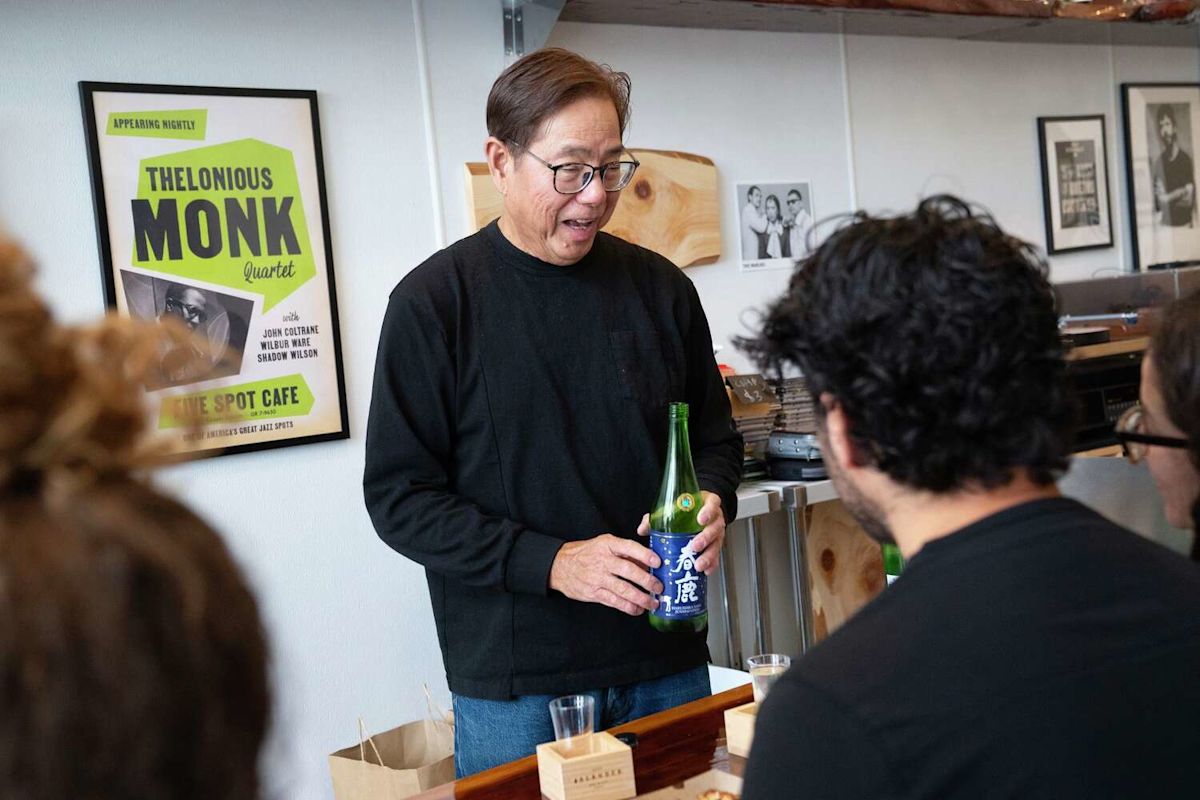
While jazz kissa in Japan typically serve highballs and beer, Bernardo thought sake would be more fitting in San Francisco. (Minh Connors/For the S.F. Chronicle)
Bernardo has his speakers hooked up to a variety of vintage hi-fi equipment that might make even the geekiest audiophile gasp: a Dynakit Mark 3 mono block amp, a vintage 1960s McIntosh MX110 tube pre-amplifier, a Concept Wood turntable from Clear Audio outfitted with a Blue No. 3 “High” cartridge from Sumiko, and a high-fidelity CD player from the early 1980s made by revered British brand Meridian. The McIntosh and Dynakit tubes deliver sound with warmth and depth, buttressed by astonishing lucidity from the deep elliptical stylus on the Sumiko, while both the Meridian and Clear Audio units are considered “reference level,” befitting studio sound engineers. The end result is a level of sound quality that borders on emotional, capable of evoking uncommon depth of feeling. For those more familiar with streaming audio through their AirPods, the experience of listening to a system like this is startling, like drinking a bottle of vintage Ridge Montebello after a life of Boons Farm.
The records matter too, of course. Bernardo uses this rig to spin jazz vinyl by the Suzuki Isao Trio Quartet, Yamamoto Tsuyoshi, Bobby Hutcherson, Miles Davis, John Coltrane, Tina Brooks, Yazz Ahmed, Count Basie and countless others, pulling albums he’s amassed from a lifetime of jazz fandom. The bar is jazz only, but the genre contains multitudes: acid jazz, bop, modal jazz in the style of Miles Davis, John Coltrane, Bill Evans (my personal favorite), energetic J-Jazz from the 1970s, and much more. Zero knowledge of the jazz oeuvre is required to enjoy sitting in the room; the music glows, and every seat in the house sounds perfect.

Bernardo, like many kissa proprietors, has spent years building his jazz selection. (Minh Connors/For the S.F. Chronicle)
Hand-brewed coffee is available during the daytime – Bernardo serves coffee roasted by Tanat, based in Paris – and sake is poured all day and night. “There’s a growing interest in sake here in the United States,” Bernardo said, “and though it’s uncommon to find sake served at jazz kissa in Japan, where simple highballs and beer are more typical, I thought it would be a natural fit for this concept here in San Francisco.”
The Bay Area has long been a great place to drink sake – at bars such as San Francisco’s Millay, and at restaurants and hubs like Umami Mart in Oakland – and Bernardo has fused his own sake habit to this wider trend, securing limited allocations and bringing back suitcase bottles from Japan to serve them at Kissakeko. “I make sure what we serve here is as unique as possible,” Bernardo said. “There’s no point to come here if we have the same thing as everyone else.”
In practice, this means pours from breweries such as Jikon, Eiko Fuji, Matsuura Shuzo, Aramasa, Juyondai and Ubusuna – sakes that are heavily allocated, difficult to obtain and unusual to find by the glass outside of the rarefied air of omakase restaurants. As with the music, you don’t need to be a sake expert to enjoy what’s happening here. Bernardo’s pours are generous, and he loves talking about sake just as much as he loves hi-fi audio and jazz; drinkers might try a succession of finely pointed and refined junmai daiginjos, round and flavorful junmai ginjos sakes with distinctly savory notes, and unpasteurized nama-zakes that have a lively sweetness at the fore.

Kissakeko, like classic Japanese kissa, exclusively plays jazz, drawn from Bernardo’s own extensive collection of vinyl and compact disc. (Minh Connors/For the S.F. Chronicle)
Kissakeko is a reflection of Bernardo – his passions and interests are jazz and sake, and this place is a pure expression of these two loves. But there’s a touch of sadness to the story, too; I had to ask what his wife might think of it all. “Actually, she would not be happy!” he told me, laughing. “Her great dream was that I could someday retire. She didn’t want me working so much.”
Bernardo puts on another record. “Perhaps in the end she would be for it,” he said. “I’m only open for limited hours – perhaps she would understand why I needed to do this.”
The trumpets swell, the drums crash, the pianos emit a kind of chordal longing. The Bay Bridge might loom through the fog outside Kissakeko’s front window at the start of the evening, then glow in the gloaming, twinkling and radiating in time with the drinks and the music. It’s a little melancholy – even contemplative – and very beautiful, like the sound of jazz itself.
Subscribe
There’s more to San Francisco with the Chronicle. Subscribe today for just 25¢.
This article originally published at Forget the ‘listening bar.’ S.F. is now home to a true Japanese jazz kissa.