
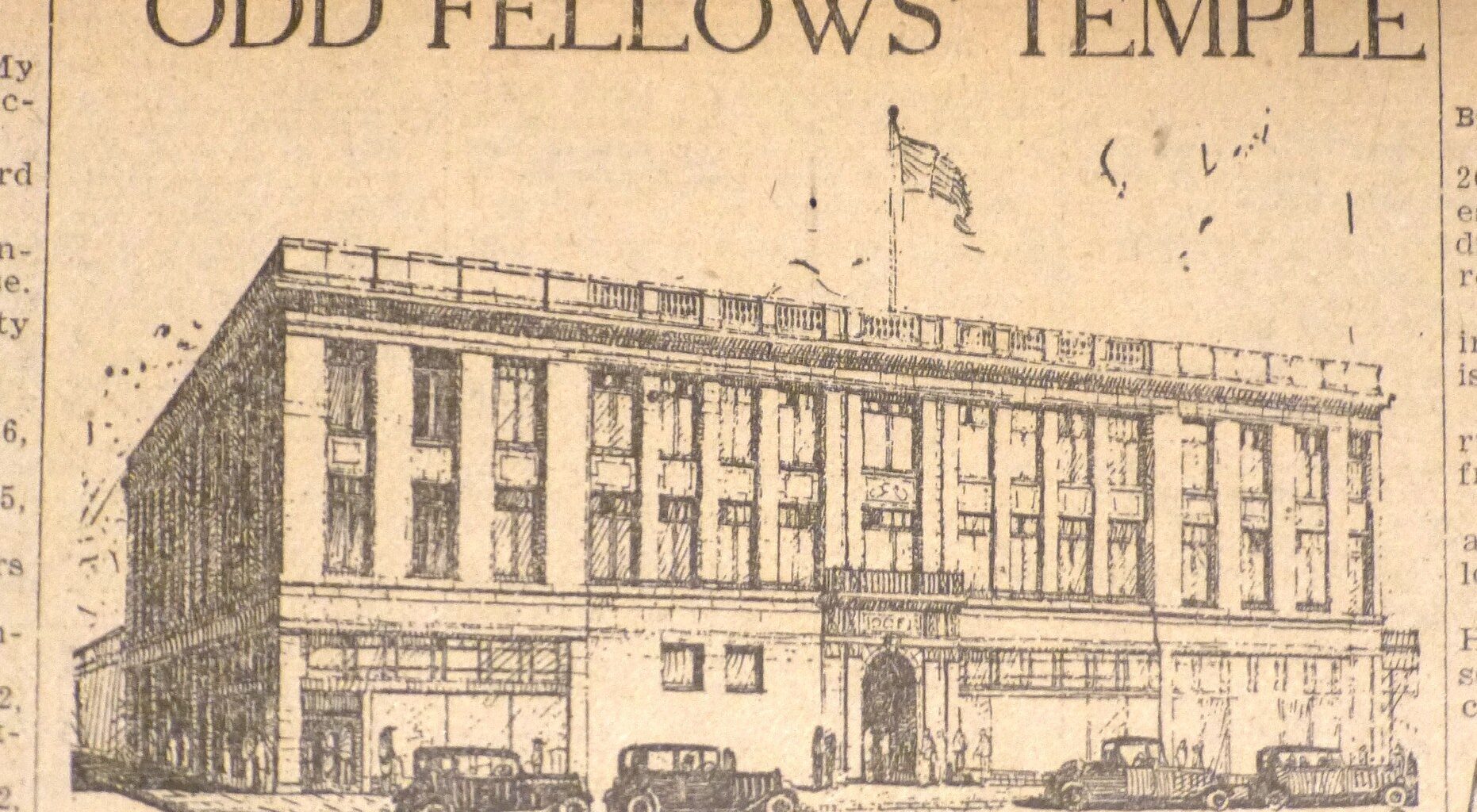
On Sept. 20, 1926, a ceremony was held to lay the cornerstone for Berkeley’s new Odd Fellows Temple at Bancroft Way and Fulton Street on the edge of what is now the city’s downtown. The three-story building still stands today, a century later.
The Berkeley Daily Gazette reported that the cornerstone included 1893 and 1926 photographs of the group’s previous building, newspaper articles and numerous pieces of local Odd Fellow memorabilia, including membership rosters and bylaws.
The new building was expected to cost $200,000 and include lodge offices and event spaces upstairs, and several commercial storefronts at street level. The old wooden Odd Fellows lodge hall was on Addison Street, a block west of Oxford Street. It would later be torn down and replaced with a commercial building.
Local crime: “Moral turpitude in Berkeley is only one-third or possibly one-fifth as serious a problem as it was 10 years ago, it is shown by records of the justice’s court here and made public today,” the Gazette reported Sept. 23, 1926. “There were 66 felonies recorded in Berkeley during the fiscal year ending June 30, 1926, and 59 in 1916” despite the population growing by tens of thousands of residents.
“Berkeley has had no ‘crime wave’ in the last 10 years,’ court officials declared today. This is due to two factors. There is strict supervision of law observance by local authorities and conscientious enforcement of the law. Berkeley is an educational center, does not attract the criminal element and is an unprofitable field (in which) for ‘crooks’ to work.
“Although there has been an enormous increase in offenses against statutes and ordinances, these are due largely to matters involving automobiles.”
Road hazards: On Sept. 18, 1926, the Gazette had an article warning automobile drivers “against peril of free rides” in reference to hitchhikers. The California State Automobile Association said “knights of the knapsack have become numerous in recent years” as well as schoolboys “begging for rides” to school.
“Any day now groups of boys, many of them of tender age, will be seen milling around in the midst of traffic holding up an appealing hand to passing motorists. Success makes the boys bolder, and they step out almost to the center of the road.”
Berkeley’s campaign to reduce traffic accidents and hazards had a poetic dimension, as members of the California Writers’ Club published humorous verses that chastised everyone from reckless drivers to thoughtless jaywalkers.
Inventors: Berkeleyans gathered on Sept. 23, 1926, to plan a chapter of the National Association of Inventors, the Gazette reported. “It is believed that the local chapter can be made one of the largest on the Pacific Coast because of the fact that so many inventors reside here.”
“All the Berkeley manufactuers, representatives of the banks, university professors in engineering and allied fields are invited to the meeting. No special invitation has been sent out to inventors, since the Chamber of Commerce has no list of inventors.
“In calling attention to this meeting, (Chamber of Commerce) Managing Director (Charles) Keeler points out that the presence of the University of California and of an important industrial center is a combination that makes Berkeley peculiarly favorable as a center for inventors.”
New Renaissance?: Professor George P. Adams, who chaired UC Berkeley’s philosophy department, gave a talk in mid-September 1926 that the Gazette reported argued “a distinct period of scrutiny and criticism of established ideas comparable to the Renaissance of the 16th century is being entered upon in the world today.”
Fire weather: On Sept. 24, 1926, “a northeast wind which sprung up during the forenoon like a furnace blast” brought temperatures up to 89 degrees.
Bay Area native and Berkeley community historian Steven Finacom holds this column’s copyright.