

Published Sep. 23, 2026at6:00am
When Tubi’s first CEO, Farhad Massoudi, decided to enter the streaming wars in 2014, he had long odds and little financing. “No one was going to license me any content, because I didn’t have any money,” he said.
Undeterred, he built Tubi’s catalog with whatever he could get his hands on for cheap: B-movies, trashy horror flicks, and long-canceled TV shows collecting dust in studio archives. “No recognizable movies, few recognizable actors,” Massoudi quipped.
People tuned in anyway. As a free, ad-supported streaming service, Tubi attracted cord-cutters looking to save a buck. But viewers also genuinely fell in love with its niche programming, leading the company to lean into the type of content Hollywood didn’t care about. It’s a strategy that turned a once-afterthought service into one of the biggest forces in online television.
 Sud said an Onion article was one of the first things she read about Tubi. | Source: Courtesy Tubi
These days, Tubi’s catalog does feature some blockbuster and critically adored films, including “American Fiction,” “Jumanji: Welcome to the Jungle,” and “Superbad,” as well as popular TV shows like “This Is Us,” “The Bachelorette,” and “My Little Pony.”
But it also continues to host plenty of B-movies, trash horror, and other oddities. With more than 375,000 movies and TV show episodes, Tubi has one of the largest streaming catalogs in the industry. (In contrast, Netflix’s U.S. catalog consists of just 8,000 titles, according to streaming data aggregator Justwatch.)
“It started as a necessity,” said Anjali Sud, who succeeded Massoudi as Tubi’s CEO in 2023. “It’s become our secret weapon.”
It’s a weapon that could soon get a lot more powerful. Tubi’s corporate parent, Fox, is in the process of acquiring streaming device and smart TV maker Roku, which could lead to Tubi getting primetime placement on more than 100 million screens (opens in new tab).
The streamer of the people
Massoudi’s journey to streaming began with a seed round of investment from his former college roommate. Modest by nature and acutely aware of the risks involved, Massoudi initially tried to talk his friend out of investing. “He couldn’t afford to lose the money,” Massoudi said. “I knew nothing about the TV and movie ecosystem.”
What he lacked in experience, he made up for with grit and determination. Like any San Francisco startup founder, he tweaked, iterated, and pivoted — Tubi’s first iteration was a B2B business that built streaming apps for other publishers — until he arrived at what he believed to be the winning formula: a streaming service with a large catalog of free, ad-supported content.
There wasn’t much confidence in this vision. “My board freaked out,” Massoudi said. “Some of them want me to shut down the company.” Raising money proved just as challenging. “I pitched every VC known to mankind,” he said. “Literally over 400.” The answer was always no, a fact Massoudi chalks up to snobbishness.
“Unfortunately, a lot of VCs invest in products they personally want to use. A free streaming service does not resonate with someone worth $10 million.”
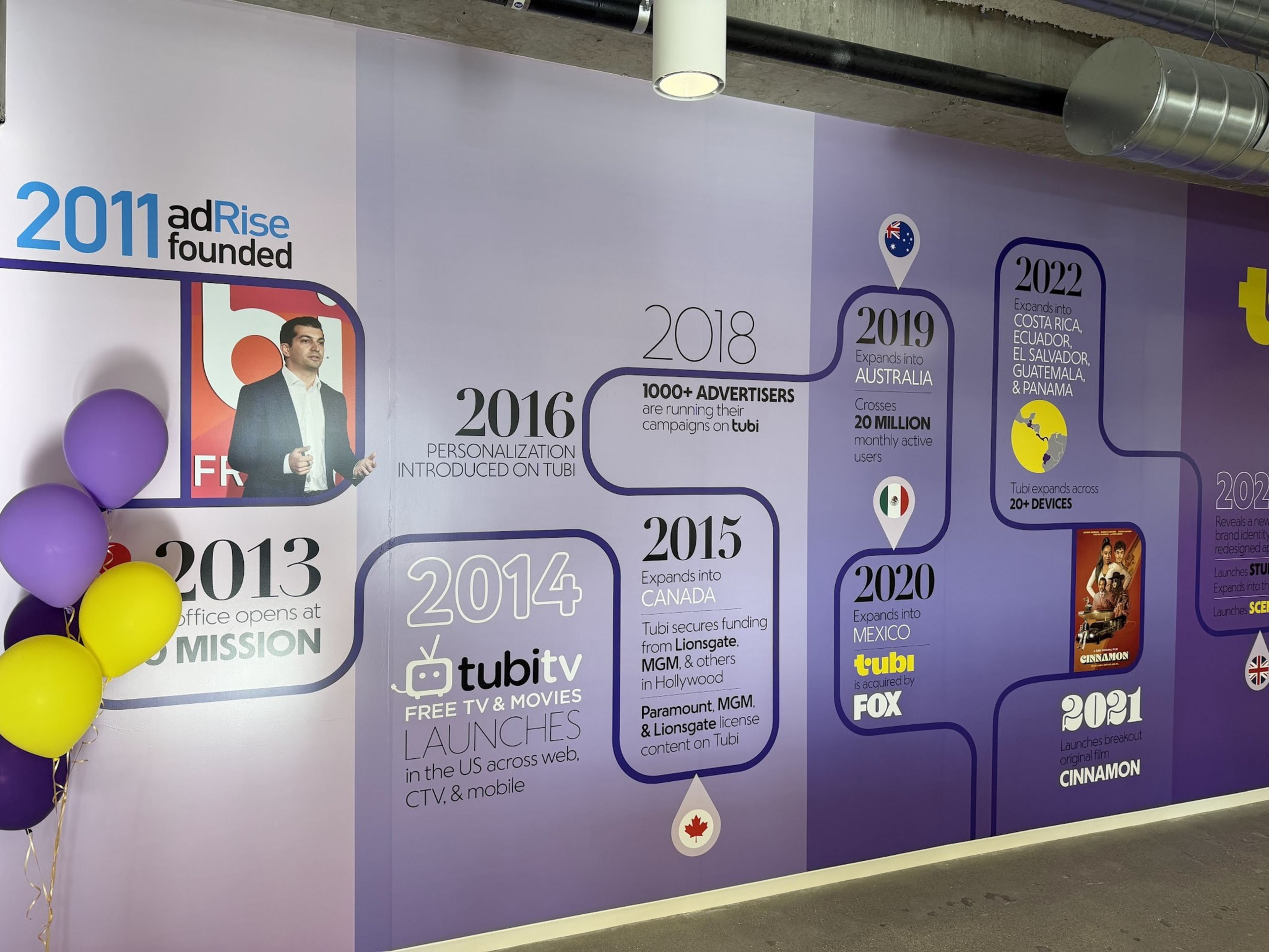 AdRise wall at HQ in San Francisco. | Source: Courtesy Tubi
 HQ of Tubi during the Super Bowl. | Source: Courtesy Tubi
Investors instead fawned over Netflix, which in 2007 started its transition from mailing DVDs to streaming and was beginning to amass millions of subscribers. “A lot of them told me, ‘Ads are over. No one wants to see ads anymore,’” Massoudi recalled.
Nowadays, almost every streaming service embraces advertising.
Ads offer a second revenue stream as subscriber growth starts to hit a ceiling. And as consumers abandon traditional networks for streamers, brands with billions in ad dollars need new ways to reach them. Rather than cede that money to Google and Instagram, media companies like Disney and Warner Bros. Discovery jumped at the chance to rebuild ad-supported TV online.
Tubi launched in 2014, a year after Netflix debuted “House of Cards,” its first major original series. The Los Gatos-based streamer spent a reported $100 million on the first two seasons of the show, signaling to Hollywood that building the HBO of streaming was going to require big, HBO-like budgets.
“The feedback I got from every investor was: You need to do a very expensive original [like] ‘Game of Thrones’ [or] ‘House of Cards’ and put all the marketing budget behind it,” Massoudi said.
Tubi didn’t have the cash to produce the next “Breaking Bad,” and most studio executives believed that free streaming turned their cherished IP into internet junk, as worthless as cat videos and dumb memes. “We kept getting rejected, and rejected, and rejected,” Massoudi recalled.
Still, he wasn’t ready to give up on free streaming. “I was willing to die on this path,” he said. And Tubi almost did. “We were within a week of bankruptcy twice.” Shunned by Hollywood and with little money, the company struck deals on the fringes of the entertainment industry: horror movie producers, Blaxploitation film studios, and little-known indies with nowhere else to go.
One early success was the Detroit urban drama “Plug Love” from indie filmmaker Derek Scott. Without theatrical distribution, it seemed destined for DVD bargain bins. But on Tubi, Scott dominated the viewing charts. “He was crushing it,” Massoudi said.
Tubi was able to strike a deal with Paramount in 2015 that allowed it to stream “Top Gun” and a few other titles from the back catalog. “When we licensed those movies, it helped a ton with press and marketing,” Massoudi said. Investors were starting to take notice, as were other Hollywood executives. Doors started to open.
But when Tubi employees crunched the numbers, they discovered something strange. “People weren’t watching ‘Top Gun,’” Massoudi said. Instead, they were burning through hours of obscure horror flicks, oddball reality TV, and B-movie fare. One surprise hit: the Lifetime reality show “Little Women: Atlanta.” “The real business was what the industry called crap,” he said.
Massoudi decided to double down on his audience’s penchant for the weird and obscure and kept spending on the niche programming that entertainment industry insiders refer to as “long-tail content.” The idea: Instead of forking over a lot of money on a few blockbusters, Tubi would spend small amounts on a large number of titles. Compared title by title, those movies may not fare as well as well-known franchises, but in the aggregate, this “long tail” often performs better than a few expensive hits, Massoudi said.
“Tubi’s voluminous selection and depth of content has been pivotal to their success,” said Omdia media and entertainment analyst Paul Erickson. “It’s been a differentiator for them compared to others’ propositions. By investing in depth and diversity in their catalog, they’ve maximized their content ROI.”
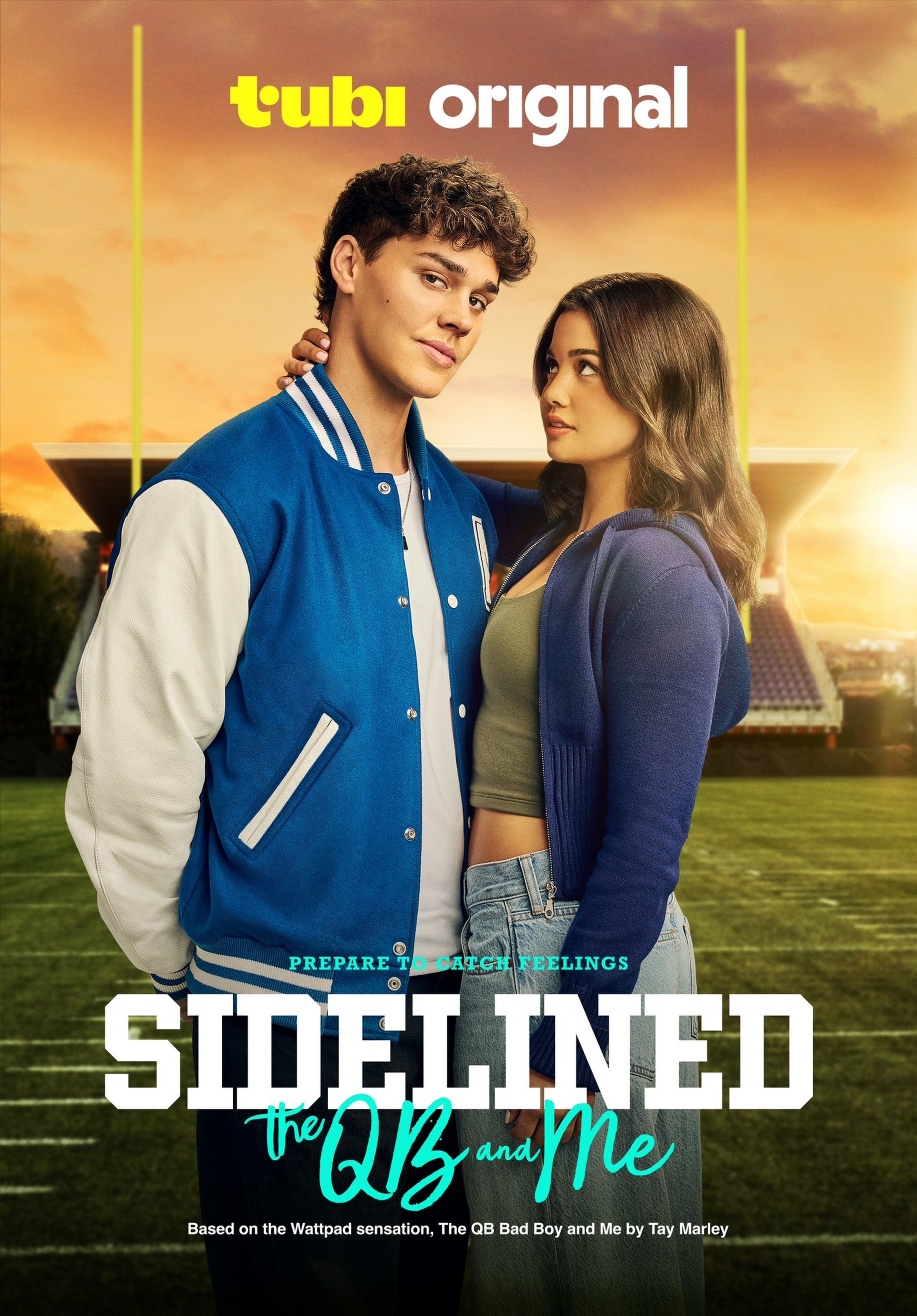 More than 20 million people have streamed this Tubi original movie. | Source: Courtesy Tubi
As Tubi’s viewership kept growing, so did its ad business. Four years after its launch, the company surpassed 1,000 advertisers. These days, the company boasts that a majority of Fortune 100 brands are advertising to its audience.
Just as the numbers kept going up, so did Tubi’s reputation for corny, offbeat content. In early 2023, the Onion ran a story (opens in new tab) titled “Tubi CEO combs through Goodwill used DVDs looking for movies to upload.”
“This one’s just someone’s high school graduation ceremony? Eh, fuck it. At least it’s not scratched,” said one satirical quote from the article.
Far from being offended, Massoudi was honored by the homage, not the least of which because it had a kernel of truth about Tubi’s business strategy.
“I loved that,” he said. “That was one of the greatest moments of my career.”
King of the trash heap
When Fox acquired Tubi in April 2020 for $440 million in cash, it unlocked scores more premium content, including primetime shows like “Lego Masters” and “MasterChef,” as well as movies like “Twilight,” “Trolls,” and “Mean Girls.” In 2025, Tubi even streamed the Super Bowl.
Still, the ethos that one person’s trash is another’s treasure lives on within the company. Since teaming up with Fox, Tubi has started to produce some original shows and made-for-streaming movies with a heavy focus on Black action thrillers, horror, and offbeat humor. Among the more notable projects: “Cinnamon,” a Blaxploitation homage starring Pam Grier that has a young stripper joining a gang of vampire hunters.
Sud, who was hired by Fox to run the streamer, freely admits that she had a bit of catching up to do to get ready for the job. “I didn’t know Tubi before,” she said. So she turned to Google — and the Onion piece was one of the first stories that came up.
One of the first things she said during an interview was: “Have you seen the Onion article?”
Sud quickly realized that Tubi’s penchant for long-tail content was worth embracing. “We let our fans be the arbiters of quality,” she said, adding that stepping outside of Hollywood’s beaten path also helps to raise new voices. “The Black filmmaker community in Detroit is thriving,” Sud said. “They have great stories, and they can’t find an audience.”
Tubi is helping such filmmakers find fans by betting heavily on personalization powered by machine learning. “The key part of it is: How do you match people to those [titles] and let them go down those rabbit holes? That’s core to our DNA,” said Tubi’s chief product officer, Mike Bidgoli, the very friend who wrote Massoudi that crucial seed-round check. After working as an ad executive for Pinterest and Meta, Bidgoli joined Tubi in May 2024. “He knows Tubi’s roots, and he’s been a believer,” Sud said.
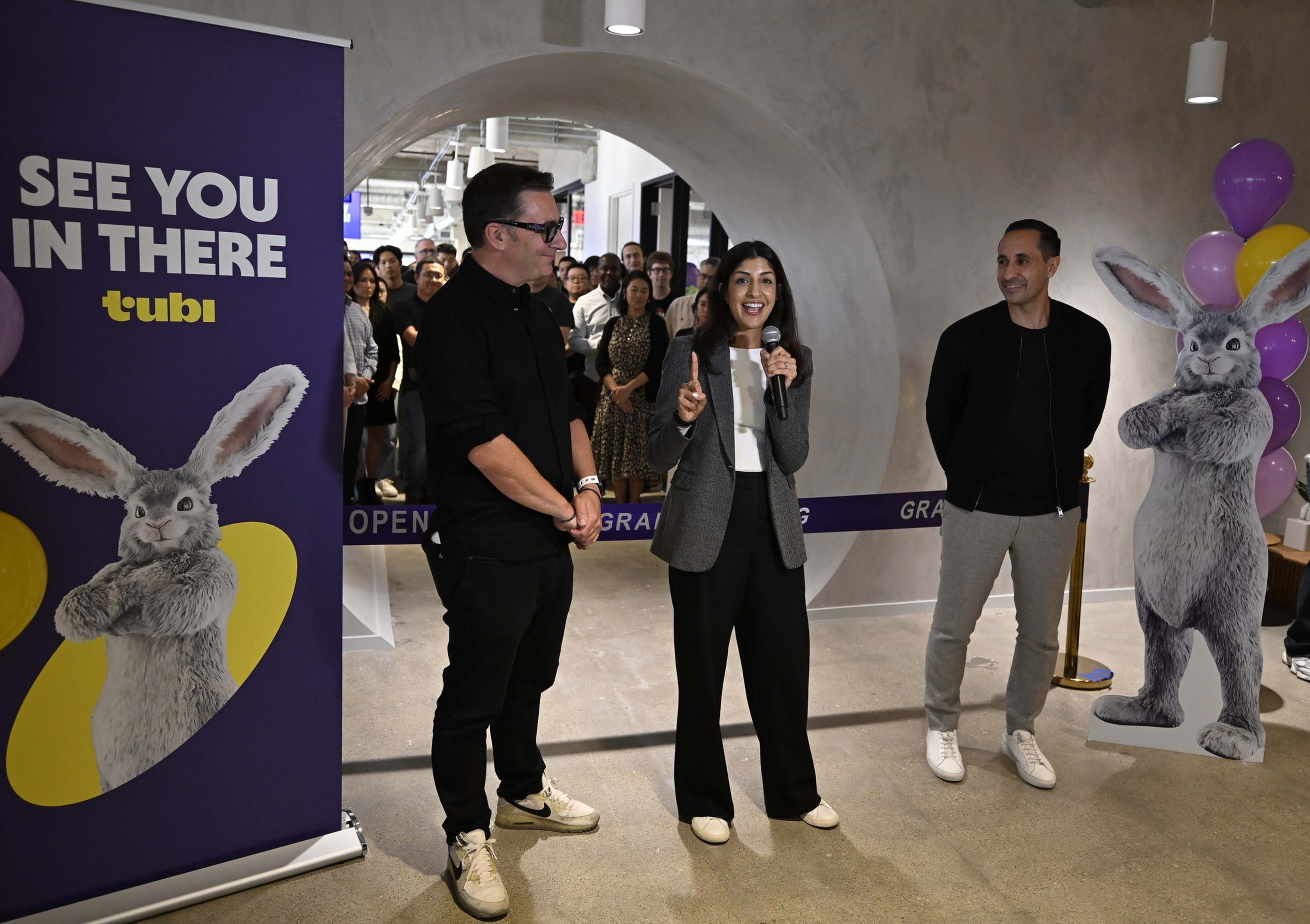 Sud speaks at the opening of the headquarters. | Source: Tayfun Coskun/Getty Images
More recently, Tubi started to embrace a type of modern B-content that defies the traditional entertainment industry: long-form videos by TikTok and YouTube influencers.
The company has struck deals with 400 influencers, including YouTube duo Rhett & Link and TikTok star Celina Myers, and added 25,000 of their videos to its catalog. “The idea of creators [vs.] Hollywood: These are just industry definitions,” Sud said. “Consumers don’t care. They just want great storytelling.”
One benefit of working with creators is that they have built-in audiences. When Tubi decided to turn the popular online novel “The QB Bad Boy and Me” into a full-length romance flick, it recruited Noah Beck for the main role. The TikTok star has more than 32 million followers.
The few critics who bothered to review the resulting Tubi-exclusive movie, “Sidelined: The QB and Me,” largely panned it as “streaming-age bubblegum (opens in new tab).”
Still, more than 20 million people have watched the film — and a sequel. What’s more, Beck’s popularity led to a 240% increase (opens in new tab) in app downloads for the streamer. “We think creators are exceptionally good at spreading your brand,” Bidgoli said. A third installment of the franchise is scheduled to debut on Tubi this fall.
Next spring, Tubi may face its biggest challenge. Fox’s acquisition of Roku could be a big boon for the platform, but the Roku Channel is one of Tubi’s closest competitors, and the two services could conceivably be consolidated.
Erickson believes that Fox will maintain Tubi as a standalone brand and that much of the consolidation will happen behind the scenes. “There will be substantial effort to merge the Fox and Roku Channel’s back ends and ad tech stacks sooner rather than later in order to realize scale-related cost savings,” he said. “I expect the Tubi brand to remain in place and for its fundamental proposition to also remain — it’s proven to be a reliable performer, and there aren’t many strategic reasons to tamper with that successful formula anytime soon.”
Sud and Bidgoli declined to speculate on Fox’s plans. However, Sud is quick to point out that Fox has given Tubi a lot of autonomy following the acquisition, which has arguably worked out well for both.
“There is a recognition that Tubi does things differently,” Sud said. “You don’t want to take the Tubi out of Tubi.”