
A sex comedy, or its polite equivalent, the “bedroom farce,” isn’t typical Chance Theater programming. But a play investigating relationship needs and choices, self-worth and other bewilderments among the young certainly is on the Anaheim theater’s bingo card.
And so Keiko Green’s “The Bed Trick” makes quite good sense on this stage.
The periodically engaging, and, at one point, riotously funny two-act comedy strains a tad at its seams with an overabundance of thematic energies.
But through H. Adam Harris’ polished direction, the ultimate takeaway is a showcase for the playwright’s probing intelligence.

Sophia Blake and Zoe Hertzberg appear in a scene from “The Bed Trick” at Chance Theater. (Photo by Eric Keitel Photography)


Zoe Hertzberg and Sophia Blake star in “The Bed Trick” at Chance Theater. (Photo by Eric Keitel Photography)

Mae Linh Young appears in a scene from “The Bed Trick” at Chance Theater. (Photo by Eric Keitel Photography)

Mae Linh Young and Khoi Le appear in a scene from “The Bed Trick” at Chance Theater. (Photo by Eric Keitel Photography)

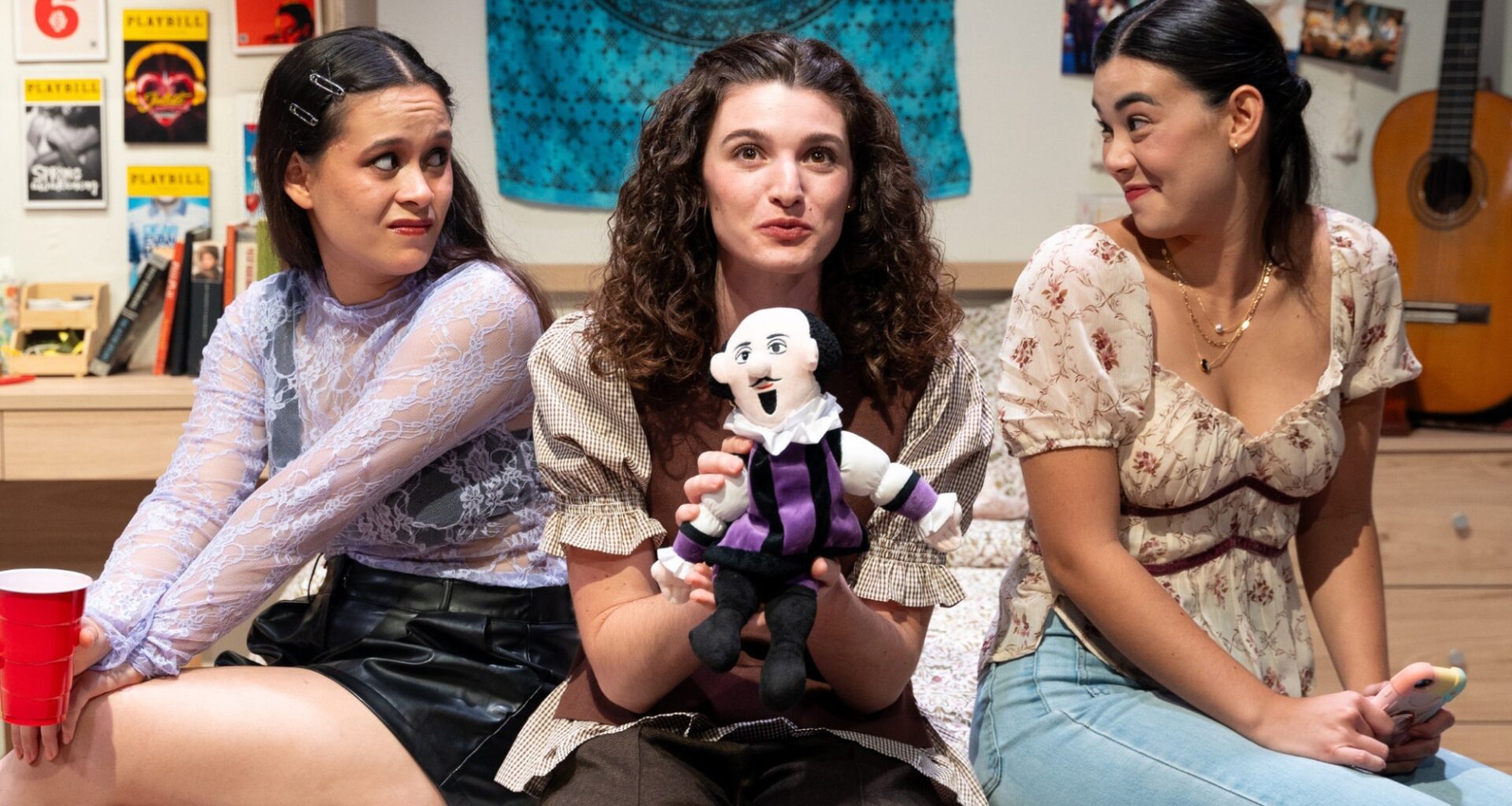
From left, Zoe Hertzberg, Sophia Blake, and Mae Linh Young star in “The Bed Trick” at Chance Theater. (Photo by Eric Keitel Photography)
Show Caption
1 of 6
Sophia Blake and Zoe Hertzberg appear in a scene from “The Bed Trick” at Chance Theater. (Photo by Eric Keitel Photography)
First, the title. As one of the play’s characters explains A “bed trick” is a plot twist device notably known from the early 1600s in two Shakespeare comedies, “All’s Well That Ends Well” and “Measure for Measure.”
A “bed trick” is a planned connivance involving mistaken identity, a substitute replacing an expected partner during an intimate encounter.
Shakespeare didn’t create it. Originating in early Greek tragedy, a bed trick unexpectedly appears in the start of the Bible, Genesis 29: 21-25 to be exact. (Google “bed, Jacob, Leah, Rachel”)
In olden times, this subterfuge occurred under the covers and in the cover of darkness.
But in Green’s play, it’s contemporary sources for emotional hoodwinking — online dating apps — plus plenty of old-fashioned lying, driving the deception.
The setting is a college dorm, and the focus is on the hyperactive interactions among three freshmen female roommates.
Two of them, Marianne and Lulu, are friends and the third, Harriet, overtly wants to be friendly.
But Marianne and Lulu find Harriet too different since the besotted theater nerd/actress is quite capable in the moment of using stuffed animals to stage a mounting in the dorm room of “All’s Well That Ends Well.”
And anyhow, the other two young women are preoccupied with scratching the distracting itch of their formative sex lives.
Marianne is turning 18 and wondering if she will gift herself with the loss of virginity, though with whom is a secondary concern.
Lulu is further along this path, now obsessed with exactly where she stands with an occasional hook-up named Willis, the friend she has discovered has opened a separate dating profile describing himself as “open” to other possibilities.
What ensues are frantic and fumbled online tactics between the two pals, clandestine texting and talking to Willis, with Harriet the unknowing participant in the fallout.
No further spoilers from here on.
Character conniptions aside, Green probes current boundaries of sexual consent and agency as well as using Harriet’s preoccupation with “All’s Well That Ends Well” as a sounding board to understand the dynamics of intimacy and power between things then and life now.
The three actresses channel the passions written into the roles effectively, with each taking them to a next step.
As Harriet, Sophia Blake’s earnest declarations come from within, and feel earned. In a note to directors, Green says an ideal Harriet has “chaotic energy that overwhelmed creative people have” and Blake fires those sparks well.
Mae Linh Young is recognizable as Marianne, a callow college freshman who is newly 18. Young’s performance peels back layers, both revealing capabilities for manipulating others, then also taking refuge in vulnerability when the situation blows up.
Zoe Hertzberg’s range through Lulu’s tough veneer and vulnerable interior, the dorm room’s chief schemer, is an interesting progression to watch. Her early take-no-prisoners confidence disintegrates when she realizes she is not controlling emotional events and the actress lets us see the insecurities which have been inside all along.
Though creatively engrossing as the work moves along, there are couple of challenges to sustain the audience’s attention.
Green introduces a distracting side plot involving Marianne’s divorced parents Benny and Anna who are struggling to find out how the mores of today’s intimacies fit them.
The revelation that their daughter’s conception took place in a similar bed trick situation feels convenient and forced.
Though well-acted by Karen O’Hanlon and Eric Dylan Matibag, these roles aren’t fully developed. The former couple’s value is for ultimately acting as referees in sorting out the main plot resolution among the younger people.
Additionally, Green saddles the work with slightly stodgy opening and closing monologues which Harriet, breaking the fourth wall, earnestly addresses to the audience.
An overly lengthy “warning: sexual content ahead” declaration opens the performance.
But a more interesting epilogue includes a very Shakespearean apologia: “…We’re sorry we’re presenting you more questions/But we hope that in all of this chaos/you found something worthwhile anyway.”
Quite worthwhile. And no apologies necessary.
‘The Bed Trick’
Rating: 3 stars (out of four possible)
When: Through Oct. 4. 8 p.m. Fridays and Saturdays, 3 p.m. Saturdays and Sundays.
Where: Chance Theater, Cripe Stage, 5522 E. La Palma Ave., Anaheim
Tickets: $48-$96
Information: 888-455-4212; chancetheater.com