
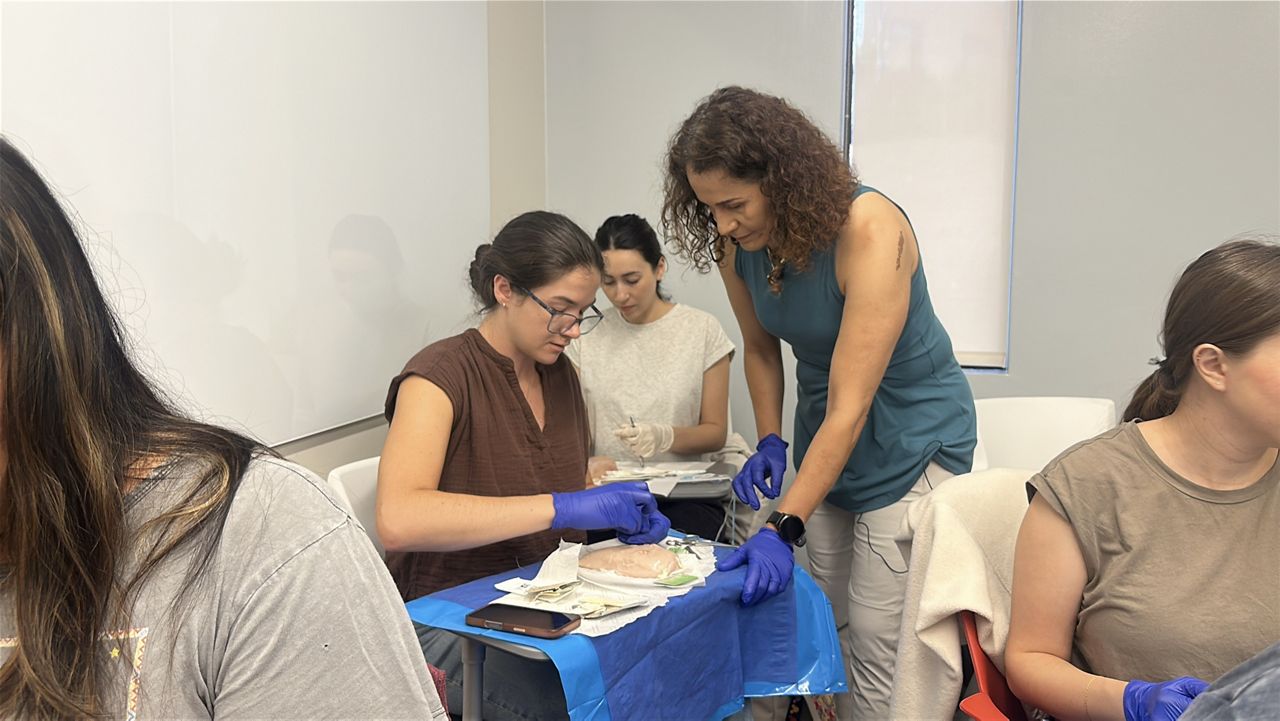
LOS ANGELES — The needle moves carefully through simulated tissue as Cal State Fullerton student Joie Harvey practices a skill she could one day use helping deliver babies as a certified nurse-midwife.
Suturing is just one part of the training for students in the university’s nurse-midwifery master’s program, where they practice responding to a range of situations they could encounter in the delivery room.
“As a midwife, we are able to suture first-degree and second-degree lacerations,” said Harvey.
The hands-on training comes as healthcare systems across the country face a growing shortage of maternity care providers. A 2026 March of Dimes report found that 34.6% of U.S. counties are maternity care deserts, meaning there are little to no obstetrics or birthing facilities.
A 2026 Health Resources and Services Administration or HRSA report projects that by 2035, all but 6 states will have an inadequate OB-GYN supply.
“Honestly, I’m a little nervous because our work is set out for us. But I’m excited because we have an opportunity to make a really huge impact,” said Harvey.
While mid-wives are not an alternative to OBG-YNs, they can help take pressure off the system, said certified midwife nurse and assistant professor at CSUF, Norma Bates.
“In women’s health, we can assist our physician partners by taking care of the low-risk pregnant woman, by taking care of those low-risk deliveries and still being able to help them as needed. Because I have been at the hospital swamped and I have taken care of that high-risk patient because both of my doctor’s colleagues have been in the in the in the operation room,” said Bates.
She says the need for more advanced practice providers has only grown since COVID-19, when so many maternity wards closed down.
“We have seen maternity deserts, if you will, where women are not able to get the service that they need or access is really, really bad. As advanced practice providers, certified nurse midwives and the women’s health nurse practitioners are able to go in and assist the physicians seeing patients in the office,” said Bates.
While Southern California is not considered a maternity care desert, Los Angeles County has seen at least five maternity wards close since 2023 and 16 since 2014, according to reporting from The Guardian. Just this year, a hospital in the Inland Empire announced they were closing its maternity ward, forcing expectant mothers to travel farther to access the care they need.
“The maternity base isn’t paying out as much. So some hospitals are actually closing down maternity floors and practices. As advanced practice providers, we can have our own business and we can be out in the public taking care of our patients,” said Bates.
Harvey is hoping to do that, caring for patients in her community while helping bridge the gap in access to maternity care.