
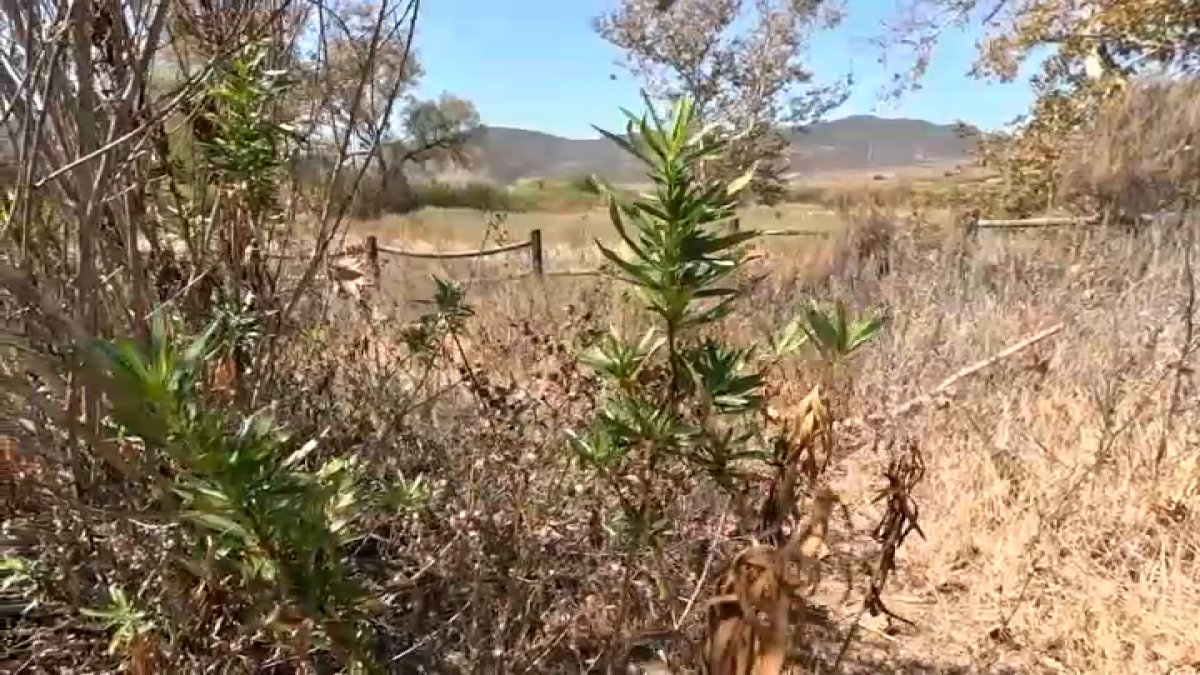
Crews have removed more than 60 tons of invasive vegetation from Mission Trails Regional Park in San Diego as part of an effort to reduce wildfire risk and restore native habitat.
The vegetation removal project, which began in 2024, has cleared invasive and fire-prone plants from the 8,000-acres of open space. The work is funded by the San Diego River Conservancy with oversight from the Mission Trails Regional Park Foundation.
Margaret Thompson, a restoration analyst with RECON Environmental, said some non-native plants can act as fuel for fires.
“This is Polypogon rabbit’s foot grass,” she said Wednesday as she was pointing out invasive plants. “It’s a non-native species that we see in the park that, again, like I was talking about, can create that kindling for fires.”
Over two years, crews have filled 60 large roll-off containers with vegetation removed from the park.
“We basically remove the biomass and put it into roll-off containers that are like 40 feet long huge roll-off containers,” Thompson said.
The work is intended to reduce the amount of vegetation that could contribute to a fast-moving wildfire in the park and surrounding communities.
San Diego City Councilmember Raul Campillo, who represents District 7, pointed to past wildfires as a reason for the ongoing prevention work.
“We do not want 2003 and 2007 when my parents had to evacuate East County. We lived through that and are doing everything we can do to prevent that,” said Campillo.
Jennifer Morrissey, executive director of the Mission Trails Regional Park Foundation, said removing invasive and fire-prone vegetation can also help protect nearby neighborhoods.
“We feel very strongly that we need to do our part to reduce the invasive plants and the fire-prone plants to make the parks safer, to make the neighborhoods and homes safer,” said Morrissey.
San Diego Fire-Rescue Deputy Fire Chief Dan Eddy said reducing vegetation can slow a fire’s spread and give firefighters more time to respond.
“So the more mitigation we can do working with our partners on this to get some of that area out, it slows that spread. I can get our air resources here. I can get fixed wing. I can get helicopters ahead of it to slow it and get our boots on the ground and knock it down,” said Eddy.
The restoration work also supports native vegetation at Mission Trails. Thompson pointed to California sagebrush and sycamore trees as examples of native plants that provide habitat and canopy for other species.
The vegetation work could also help during the rainy season. Restoring and stabilizing native habitat can lessen the risk of erosion during storms, while Eddy said vegetation management can reduce impacts associated with heavy rain.
“It slows down the impact of something holding it back.”
Non-native vegetation removal is expected to continue through 2027. After that, maintenance will continue with the goal of stabilizing the habitat and allowing more native vegetation to grow.
This story was originally reported for broadcast by NBC San Diego. AI tools helped convert the story to a digital article, and an NBC San Diego journalist edited the article for publication.