
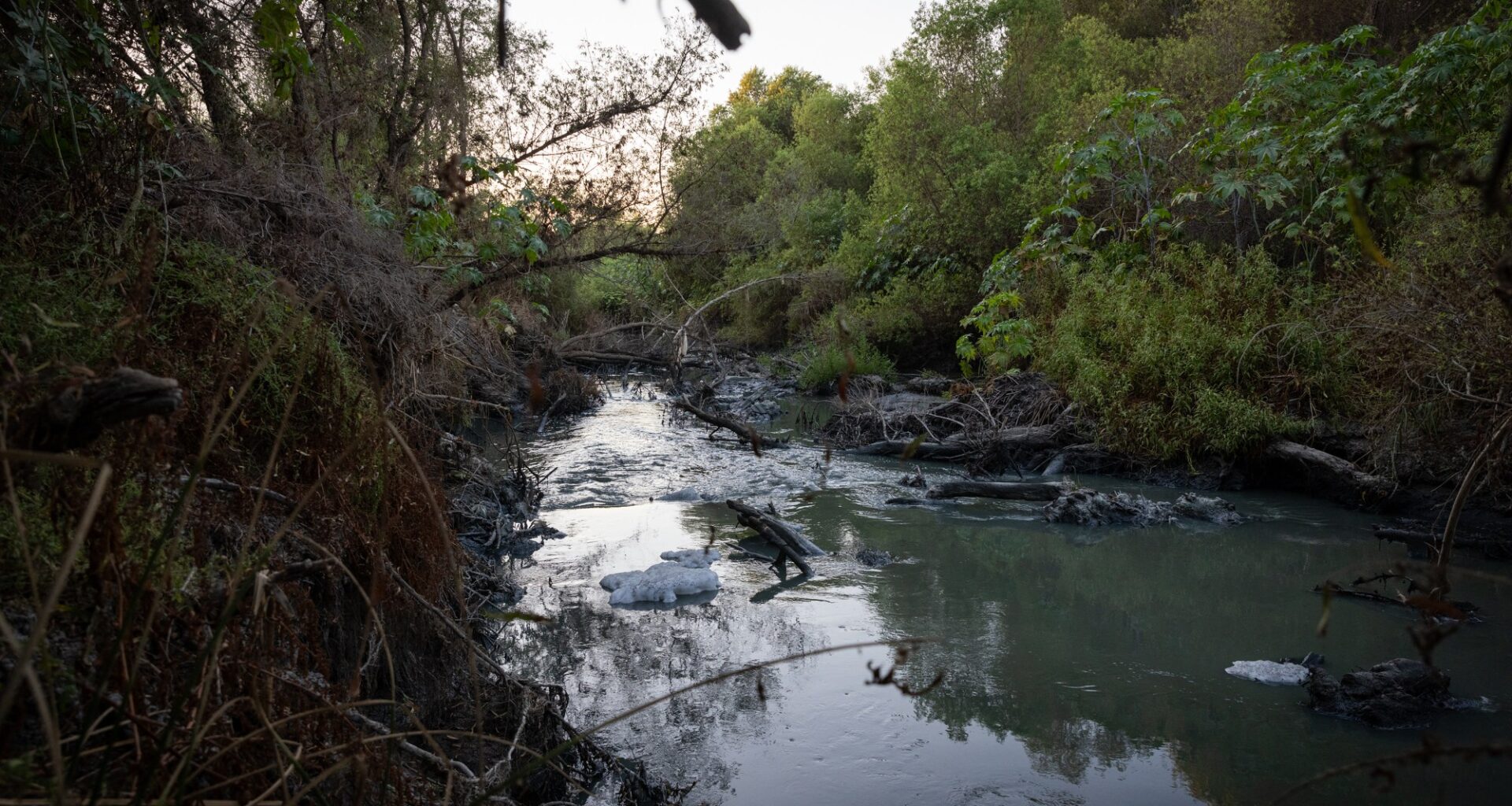
A federal public health agency has for the first time found hydrogen sulfide in outdoor air near the Tijuana River reached levels that could harm people’s health, concluding in a draft report released Wednesday that short-term exposure to the gas at those levels is a public health hazard.
The Agency for Toxic Substances and Disease Registry, which works alongside the Centers for Disease Control and Prevention, based its findings on air monitoring at four sites. The sites were a UC San Diego station on private property on Leon Avenue, Berry Elementary School about 600 feet away, San Diego Fire Station 29 in San Ysidro and the Imperial Beach Civic Center.
The agency found that brief spikes in the colorless, flammable gas, some lasting about 30 minutes, reached levels shown to cause headaches, nose and throat irritation and possible difficulty breathing in sensitive people. Average levels over weeks and months were not high enough to cause additional harm, according to the report, but the agency said it could not determine whether exposure before September 2024 harmed residents’ health, because too little data was collected before then.
Supervisor Paloma Aguirre, whose District 1 includes the most heavily affected communities, said the findings confirmed what residents had long reported.
“For two years, the answer was, ‘it’s just a smell.’ Today the answer is, ‘it’s a public health hazard.’ That’s the difference between being dismissed and being believed,” Aguirre said in a statement.
“This report is a floor, not a ceiling,” she said, adding that the county would press the federal government “to say plainly what the report covers and what it does not.”
The report comes after years of complaints from South Bay residents about a rotten-egg odor drifting from the river. For much of that time, the complaints had little data behind them. Air monitoring adequate for a public health assessment did not begin until September 2024, according to the report.
Much of the shift followed research by UC San Diego atmospheric chemist Kimberly Prather. Her team, drawing on residents’ knowledge, identified the Saturn Boulevard crossing as a primary source of the gas. There, sewage and industrial waste spill from culverts onto rocks below, creating turbulence that releases hydrogen sulfide into the air.
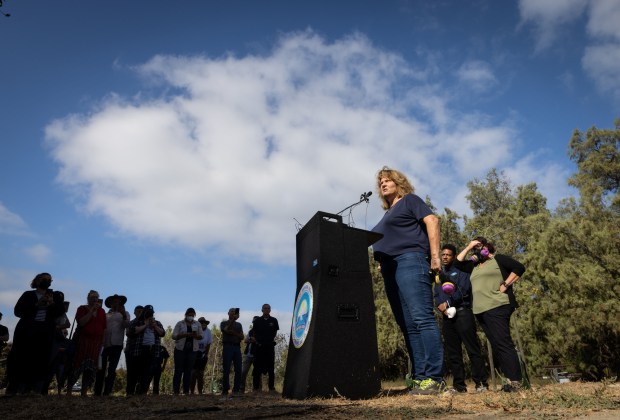 Kim Prather, UCSD researcher, speaks during a press conference to discuss the Tijuana River sewage crisis on Thursday, Sept. 12, 2024. (Ana Ramirez / The San Diego Union-Tribune)
Prather’s team measured hydrogen sulfide levels exceeding 4,000 parts per billion near the river and up to 20,000 parts per billion directly at the hot spot. When Mexican officials briefly diverted wastewater away from the site in September 2024, readings dropped sharply.
The team also compared years of resident odor complaints against its measurements and found a near-perfect correlation.
“The people were the sensors,” Prather said in July.
About 200 billion gallons of sewage-contaminated water have crossed the border through the river since 2018. Imperial Beach’s beaches were closed 296 days in 2024. The county’s southernmost beach had been closed 1,728 consecutive days as of this month, according to the Surfrider Foundation.
Local, county and congressional officials have pushed for years for health studies and emergency action. The county Board of Supervisors has declared the crisis an emergency 22 times, according to Aguirre. In January, supervisors approved $2.25 million for two health studies. The county has also contracted with Prather’s team for an exposure study that will measure pollutants beyond hydrogen sulfide.
Earlier surveys documented the toll on residents. A 2024 CDC survey found that 94% of South Bay households had noticed a sewage smell in the previous month and 45% reported at least one health symptom. Headaches were the most common.
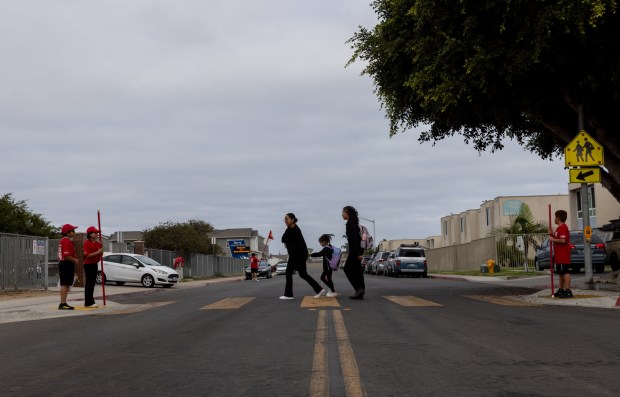 Parents walk their children to Berry Elementary School on Thursday, Sept. 12, 2024 in San Diego, California. (Ana Ramirez / The San Diego Union-Tribune)
The report’s data covers only September 2024 through May 2025. Since then, conditions at the Nestor monitor near Berry Elementary have worsened. Hourly readings there exceeded the county’s 30-parts-per-billion safety threshold more than 10% of the time so far in 2026, up from less than 2% in 2024. Levels hit 915 parts per billion June 2 after a Tijuana pipeline collapse.
The assessment stems from a May 2024 petition by members of California’s congressional delegation seeking an investigation into the health impacts of Tijuana wastewater contamination. The agency accepted the petition in January 2025. This report addresses only air. A second report will evaluate chemicals in surface water, sediment and soil.
The agency analyzed more than 800,000 air measurements collected between September 2024 and May 2025 at the four sites.
The highest reading came from Leon Avenue in September 2024, when a 30-minute rolling average reached 3,021.5 parts per billion, according to the report. That exceeds the 2,000 parts per billion level at which a human study observed health effects.
Concentrations topped that level 0.04% of the time, all between Sept. 8 and 10, 2024. Monitoring at Berry Elementary did not begin until Oct. 9, 2024, but the agency found readings at the two sites were significantly correlated. Both sit near where the river flows under Saturn Boulevard, a hot spot identified by UC San Diego researchers.
The report noted that the four monitors may not capture the highest exposures and that monitoring at the Saturn Boulevard drop would likely produce higher concentrations. A single county reading there reached 15,500 parts per billion in September 2024, though the device was not suitable for the agency’s formal analysis.
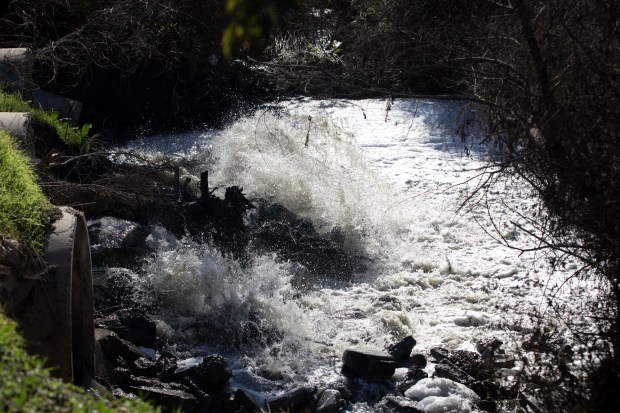 The Tijuana River flows on Thursday, Dec. 11, 2025 in San Diego, CA. (Ana Ramirez / The San Diego Union-Tribune)
Hydrogen sulfide exceeded the odor threshold of 0.5 parts per billion at all four sites up to 93% of the time, the report found. Exposure to the odor may bring on headaches, nausea, stress, eye, nose and throat irritation, and shortness of breath.
“This means that symptoms can occur in response to the odor itself, even at levels far below those used in toxicological studies,” the report states.
Aguirre pointed to county efforts, including funding a permanent redesign at Saturn Boulevard, expanding air monitoring and delivering free air purifiers to 14,500 homes. She also cited the Tijuana River Capture and Cleanup Initiative. Supervisors approved the initiative 4-1 on Sept. 1, beginning an 18-month, $1.8 million analysis of a county treatment system.
“The science is simple: fix the river and the air clears that night,” Aguirre said. “This community has waited decades for Mexico City and the Administration to stop the sewage, and it’s still flowing. If they won’t fix it, San Diego County will.”
The report recommends that federal and state agencies prevent transboundary sewage flows so hydrogen sulfide stays as low as possible, ideally below the odor threshold. It calls on local agencies to continue monitoring and community alerts, expand monitoring beyond fixed sites to include volatile organic compounds, and continue the district’s free air purifier program.
The draft is open for public comment through Nov. 21. The agency will hold a virtual public meeting Sept. 30, with an in-person community meeting planned for November at the Imperial Beach Library, according to Aguirre’s office.