
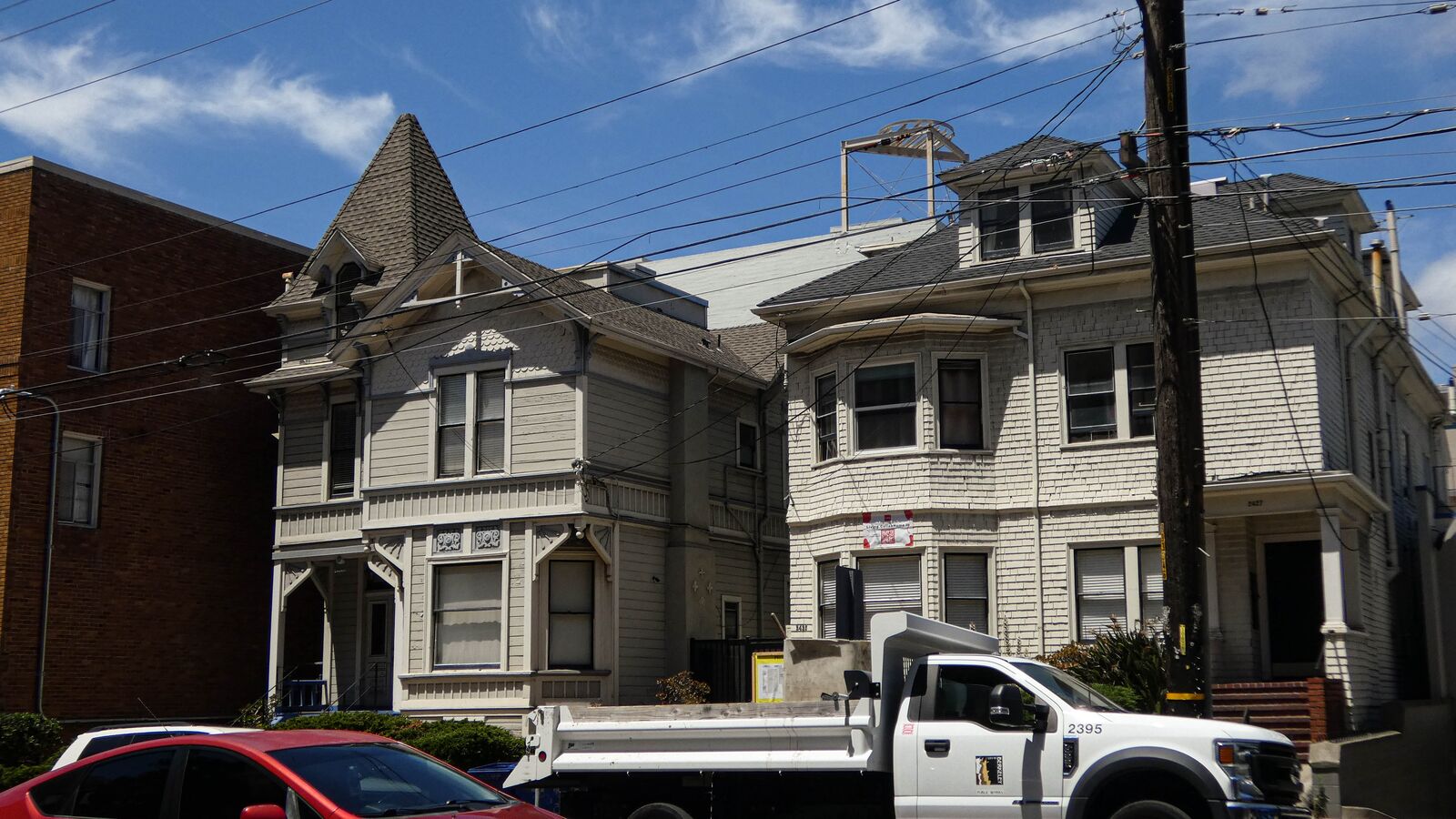
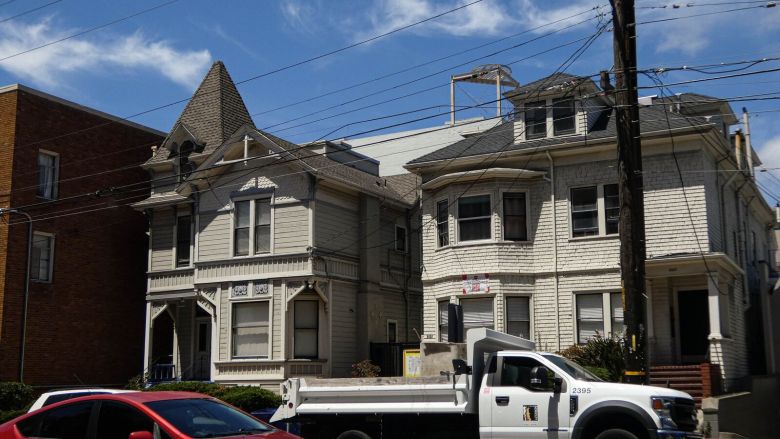
 The Berkeley City Council overturned a Landmarks Preservation Commission decision to declare 2421 Durant Ave., left, a landmark earlier this year. That failed effort led to new legislation to change the landmark process. Credit: Daniel Ekonde/Berkeleyside
The Berkeley City Council could raise the threshold for citizen petitions that seek to declare properties landmarks, in an attempt to crack down on what some members regard as dubious attempts to block the demolition of properties where developers want to build new housing.
The proposal to change Berkeley’s Landmarks Preservation Ordinance, which will go before the council Monday night, takes aim at what housing advocates say is a tactic development opponents have long used to try to block construction in Berkeley. Preservationists, meanwhile, say the item is an overreaction that will make it harder to preserve properties that embody local history.
Councilmember Rashi Kesarwani’s proposal calls for increasing the number of petition signatures from Berkeley residents required to start the landmarking process for a property from 50 to 200, if the property owner is one of the signers, or 400 if the owner isn’t on board.
“If we can raise the signature threshold, we might be able to avoid what we call the frivolous attempts to landmark that end up not being warranted,” Kesarwani said. Three other councilmembers — Brent Blackaby, Cecilia Lunaparra and Mark Humbert — have signed on as co-sponsors.
The item asks city staff to study and develop ordinance changes that would come back to the council for final approval in the future.
Councilmember Igor Tregub on Monday submitted proposed revisions to Kesawani’s item that call for using the 200-signature threshold on all petitions, regardless of whether the property owner agrees. Tregub’s item would also bar landmark attempts on structures where a housing project has been submitted within the past five years.
Does landmark process obstruct housing?
Kesarwani’s legislation argues the current landmark petition process has been “weaponized by opponents of neighborhood change.” She told Berkeleyside she has long taken issue with the process, but decided to write her proposal after the City Council earlier this year voted down two attempts to landmark buildings on sites where developers had proposed new housing.
The city’s Landmarks Preservation Commission had approved landmark applications brought by the Berkeley Architectural Heritage Association for a home on Durant Avenue in the Southside neighborhood, where a developer has submitted plans to build a 169-unit apartment building, and a building on Kittredge Street, where another firm plans to build a 66-unit complex. After the developers appealed the landmark designations, the City Council voted unanimously to overturn the commission’s decisions in both instances, with members saying the structures weren’t worthy of that status.
Even if the council had approved the landmark application, the distinction wouldn’t have protected the buildings from demolition because of a powerful 2019 law, SB 330, that bars cities from applying new restrictions to a property once someone has submitted a proposal to build housing on it. Landmark status makes it much more difficult, though not impossible, to demolish a structure.
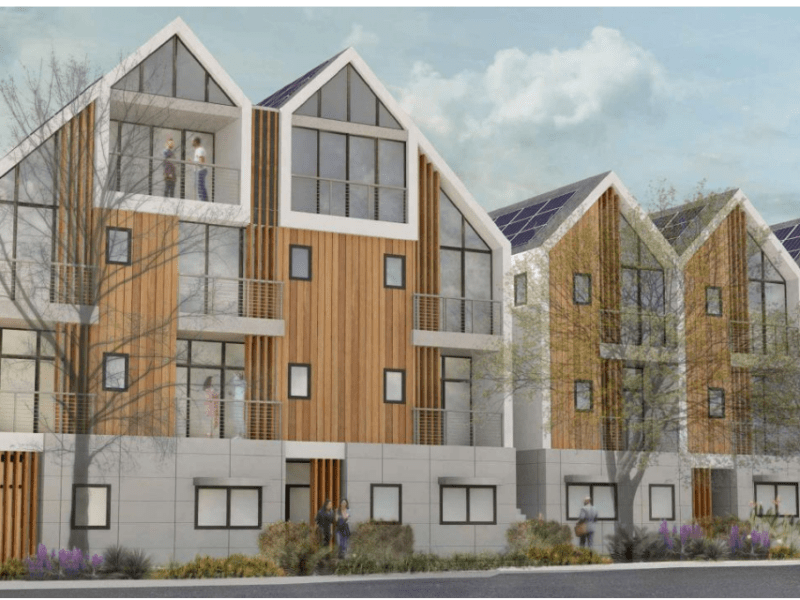
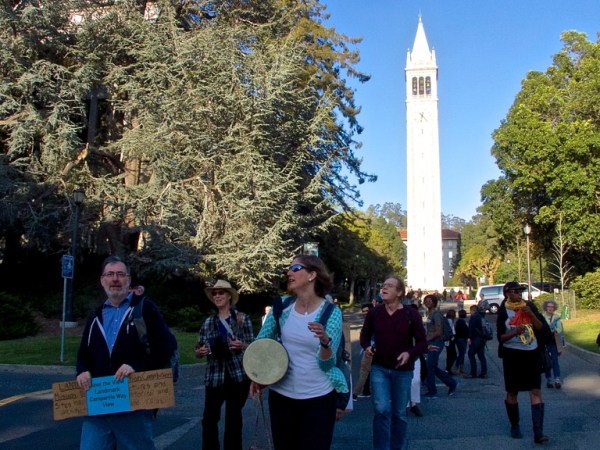
Housing advocates have also criticized unsuccessful attempts over the years to declare a home on Berryman Street a landmark after a developer sought to build townhouses on the site, and do the same with the view from UC Berkeley’s Campanile during the debate over a proposed housing project that would have partially blocked the vista.
BAHA board member Isaac Warshauer acknowledged there have been attempts to landmark properties that weren’t worthy of the distinction, but argued the landmark process already weeds out those dubious claims. Just gathering petition signatures isn’t enough to make the building a landmark — proponents of the designation must extensively research the property’s history and convince the Landmarks Preservation Commission, and perhaps the City Council, of its worthiness.
Warshauer contends Kesarwani’s proposal makes it far too difficult to launch a landmarking drive. Owners can already request to have their property considered a landmark without going through the petition process, so he contends the 200-signature threshold would “rarely, if ever” come into play. Preservationists would in most cases have to meet the 400-signature bar, Warshauer said, which can be challenging for a “niche” topic like landmark status.
“Yes, there has been abuse,” he said. “Where we disagree with the City Council is that we think changing the landmarks ordinance in this way is throwing the baby out with the bath water.”
“It’s pursuing de-facto repeal of an important part of the landmarks ordinance, to solve what is in truth … a really small problem,” he added.
Kesarwani noted that any landmark effort, successful or not, requires city staff to spend time reviewing applications and preparing reports for the Landmarks Preservation Commission and potentially the council.
“This is not intended to block all landmarking,” she said. “We just want to make sure that there’s a critical mass of people that think that it’s appropriate.”
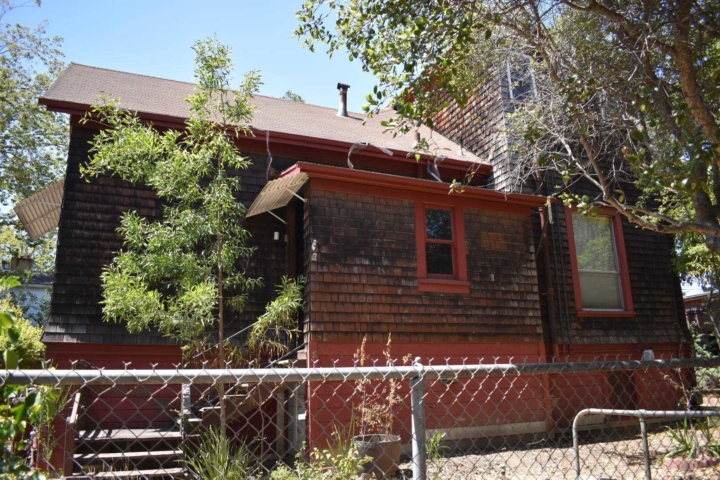 Neighbors sought to declare this 1899 home on Berryman Street a landmark after a developer proposed a project replacing it with townhomes. The effort failed and the project was approved, but has not been built. Credit: Supriya Yelimeli/Berkeleyside
Sparring over work of landmarks commission
Like Warshauer, Landmarks Preservation Commission Chair Denise Hall Montgomery contends the current process “is doing what it’s supposed to do” by turning down unworthy applications. Montgomery took issue with a section of Kesarwani’s council item that describes the landmarks commission’s decisions as being “based on commissioners’ and residents’ comfort with growth,” saying the body relies on federal historic preservation standards.
“That suggests that we’re weighing the historic merit of a property with growth — we’re not, we can’t do that,” Montgomery said in an interview.
But developers and housing advocates contend there is a problem with the process, because landmark applications can tie up attempts to redevelop a property for months at a time. And even if SB 330 means landmark status wouldn’t prevent the project from going forward, developers say just the symbolic restriction on the property can make it difficult to get funding from investors.
At the hearing last July where the council overturned the two landmark designations, developer Bill Schrader charged that the landmarks commission “seems to operate like an extension of BAHA,” another criticism Montgomery rejected.
“I know that there’s this stereotype that the Landmarks Preservation Commission is out to stop development, and that’s just not been my experience,” she said.
Related stories
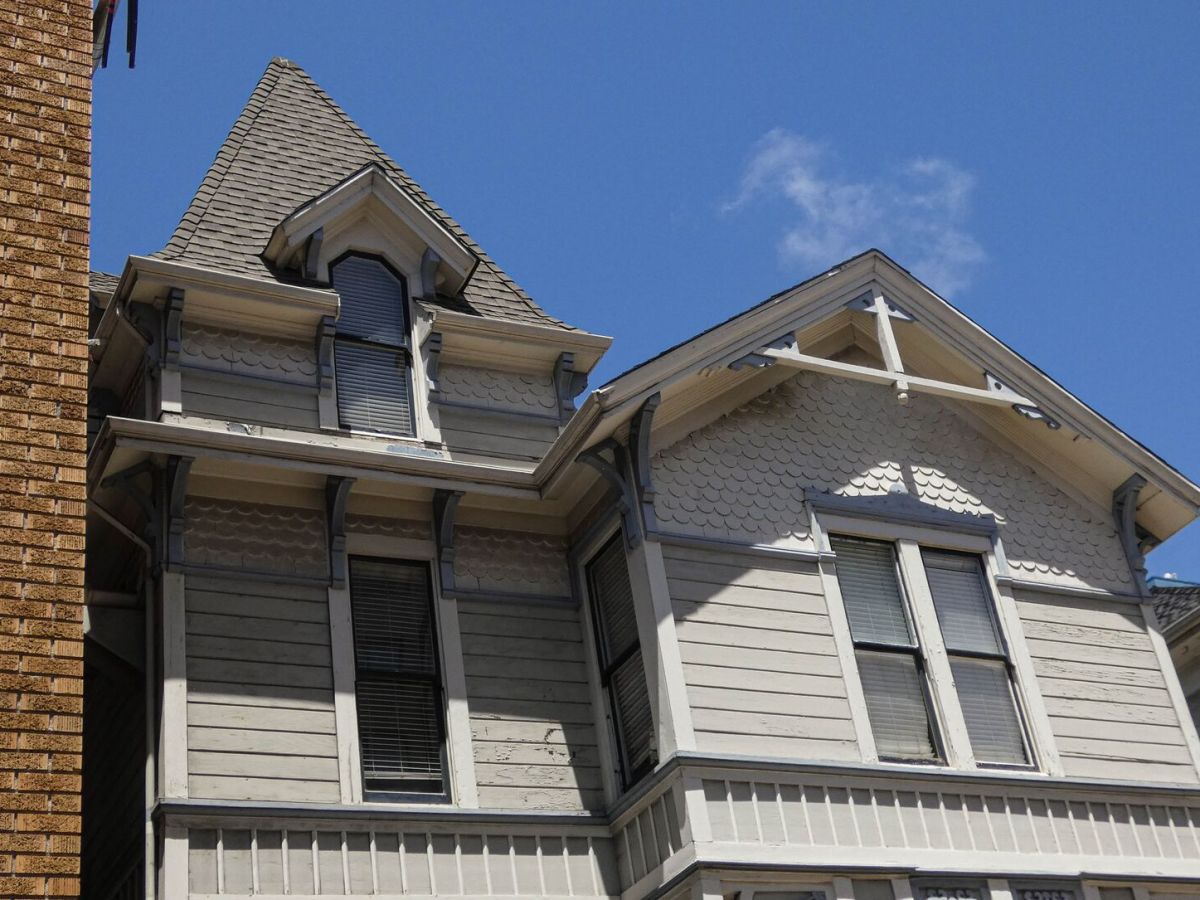
City Council shoots down attempts to landmark 2 buildings eyed for housing
July 24, 2025July 24, 2025, 4:51 p.m.
After failed landmarking, Berryman triplex to become 4-story townhouses
November 3, 2021Aug. 4, 2022, 10:45 a.m.
View from UC Berkeley Campanile will not be landmarked
April 6, 2015Aug. 4, 2022, 3:57 p.m.
“*” indicates required fields