
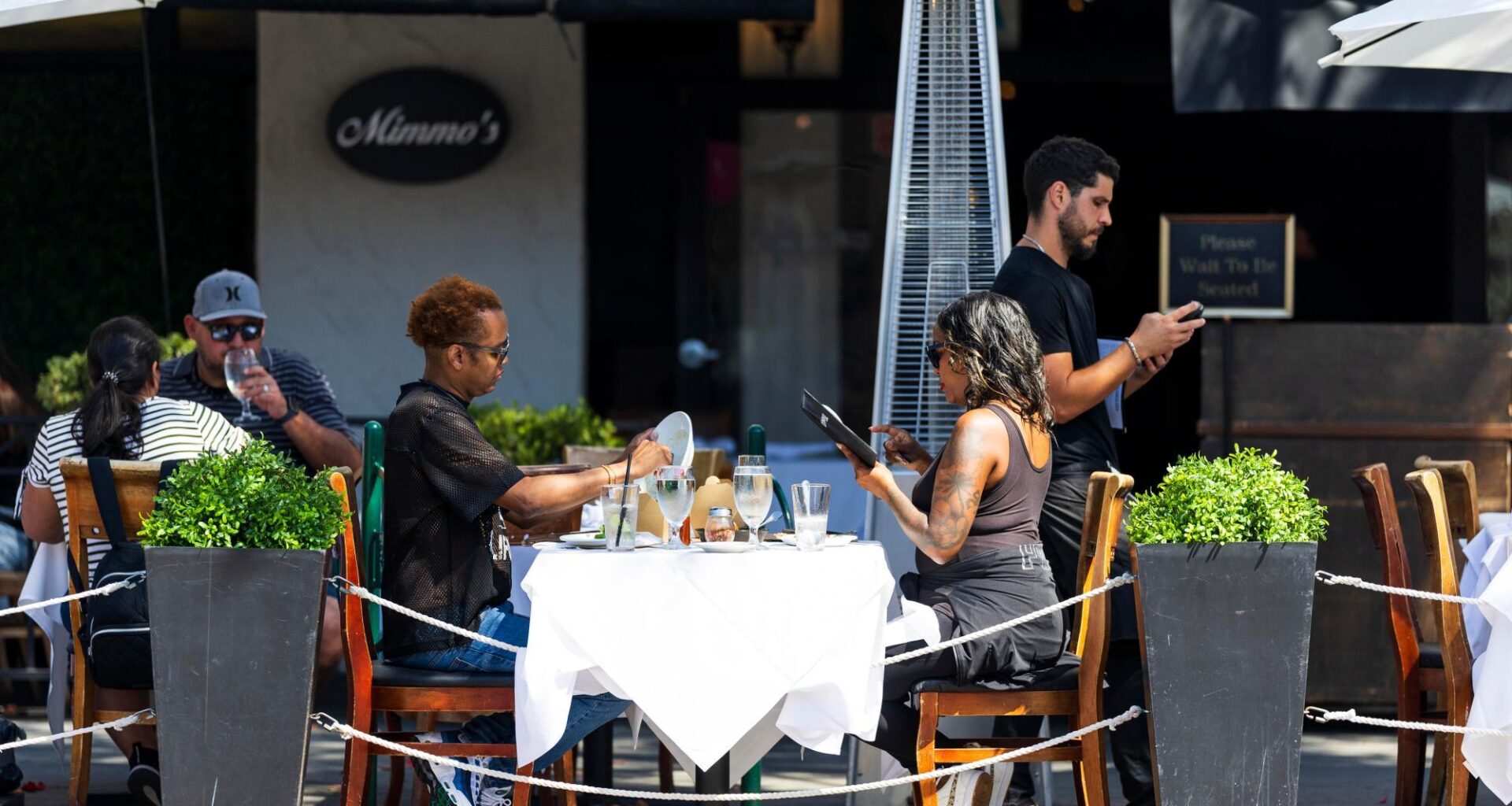
In a first for San Diego, elected leaders are advocating banning smoking and vaping at all outdoor dining areas.
At the urging of City Councilmember Jennifer Campbell — who is also a longtime medical professional — members of the council’s Community and Neighborhood Services Committee on Wednesday agreed to advance an ordinance that would create a citywide standard for smoke- and vape-free outdoor dining areas, something that’s already in place in 15 of the county’s 19 jurisdictions.
The proposed ban, which was universally supported by members of the public during the afternoon hearing, will now move forward to the full City Council for consideration.
The goal of what would be a change in San Diego’s municipal code is to shield the public from the harmful effects of secondhand smoke by “regulating smoking areas where residents, visitors, and restaurant patrons dine and gather,” said Campbell’s office.
If enacted, the prohibition would specifically exempt private outdoor events and adult-only bars and nightclubs.
“Protecting the health and well-being of the community remains my priority; after all, I am a physician,” said Campbell, who will be leaving office later this year after having termed out of her District 2 seat. “I believe that establishing a consistent citywide standard for smoking and vaping in outdoor settings is an important step.”
Her colleagues on the council committee heartily agreed.
“This is something that is so obviously common sense,” said Councilmember Raul Campillo. “Anybody in this room want more heart disease? Strokes? Cancer? My constituents neither.”
Campbell’s office noted that the move to bar smoking and vaping at outdoor dining venues was bolstered by the work of San Diego State University’s Policy Research Center for Tobacco and the Environment. In a 2024 study, the center’s researchers tested nicotine levels at restaurants where smoking was allowed outdoors and found that of 100% of those restaurants had detectable levels of nicotine on their patio tables, but those venues where outdoor smoking wasn’t permitted were less likely to have levels of concern.
“This is a health issue for those who work in these environments,” center co-director Thomas Novotny told the council members. “They are exposed to cigarette smoke involuntarily, and at the same time, for those who visit and are consumers, it’s a public nuisance. So what we hope is that this extension of existing legislation will kind of close a gap that I think we all can recognize.”
The center’s July 2025 report had pointed out that San Diego remains the largest city in the county without a comprehensive smoke-free outdoor dining policy.
To gauge support for such a ban, the center polled 1,793 California adults. The survey found that 73% of Californians surveyed would not eat in an outdoor dining area where people were smoking.
While no one representing the San Diego restaurant industry appeared at Wednesday’s hearing, the California Restaurant Association provided the Union-Tribune with a statement indicating its support of a smoking prohibition.
“The California Restaurant Association supports measures that protect the health and safety of restaurant employees and guests, while also considering the needs of businesses and private events,” said Jot Condie, president and CEO of the California Restaurant Association. “We appreciate that San Diego’s proposed outdoor smoking policy exempts private outdoor events, offering flexibility for such gatherings and supporting public health objectives. We believe this approach achieves a balanced outcome for restaurants, their employees, and the communities they serve.”
Several San Diegans who spoke in favor of the prohibition talked about how unpleasant it is when dining outside near someone who is smoking.
“I recently experienced this firsthand in Little Italy, and a man was smoking a very large cigar on a patio, which created an uncomfortable situation for several families and residents,” said Becky Rapp. “This situation becomes more important as the city moves towards more mixed-use and higher-density development, where we’re putting homes closer to restaurants, patios, businesses, sidewalks, courtyards and other shared outdoor spaces. An inclusive outdoor dining policy should allow families, older adults and people who are sensitive to smoke to enjoy these spaces.”
Just how soon an outdoor dining smoking ban could go into effect remains unclear. It’s likely that the full council will consider the proposal before the end of the year, said Guillermo Castillo, a policy adviser to Campbell. If approved, it’s possible that it may not take effect until early next year, he said.
As part of the move to create smoke-free areas, restaurateurs would be required to post signs notifying patrons of the prohibition.