
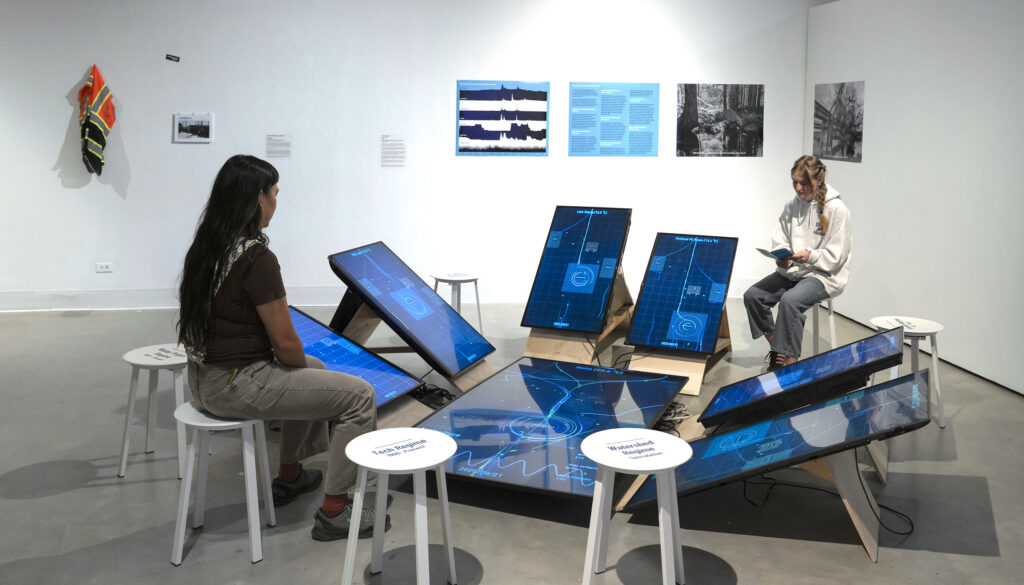
Blue-lit screens rise and tilt across the floor of UC Berkeley’s Worth Ryder Art Gallery. At their center, a digital river winds through an imagined watershed. Stools surround them, each representing a different water regime, or system for governing and allocating water — from Indigenous stewardship to colonial extraction and AI-driven optimization.
Sit on a stool marked “Kinship,” and the dams and large-scale irrigation infrastructure disappear. Sit on the “Water Projects” stool, where the state diverts as much water as it can, and the river shrinks as dams rise. Two stools offer competing visions of AI — one that maximizes economic output and another that prioritizes long-term ecological survival. When two or more people sit stools at the same time, the regimes interact. In some combinations, the system may prosper for a time; in others, it may reach “day zero,” when drought or depleted groundwater leave the watershed unable to meet competing demands.
“In the ‘Tech Regime,’ there’s going to be a whole bunch of data centers that pop up,” said Greg Niemeyer, a Berkeley professor of media innovation and creator of the installation, titled Water Council. “The salmon go away and the data centers pop up, and you’re like, ‘Well, maybe we didn’t want all that. Maybe we should just get off this chair now.’”
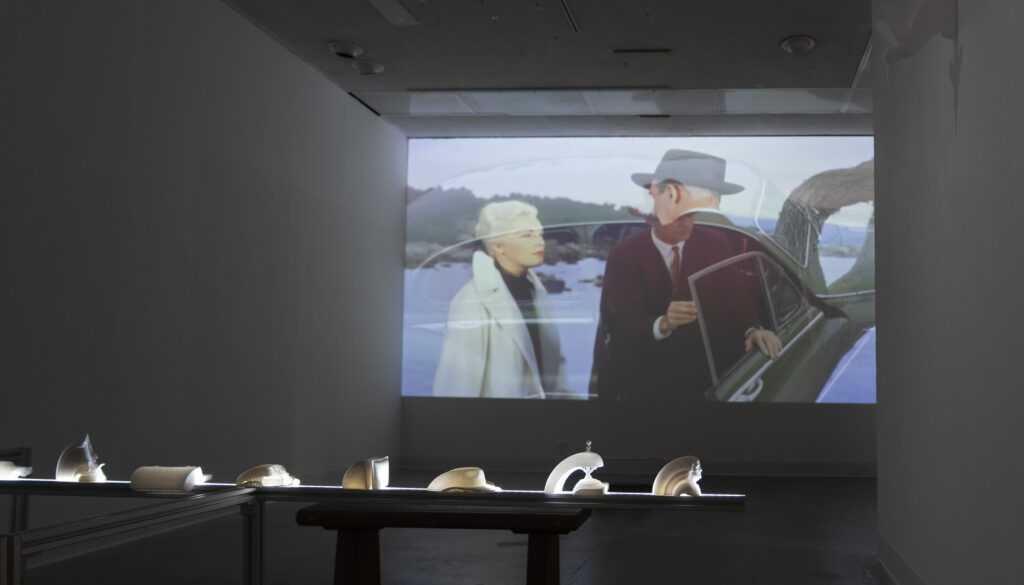 Grégory Chatonsky’s Readonlymemories VI (video) and Rear Objects (foreground) featured in the Hidden Layers exhibition, pair neural-network-processed cinematic imagery with 3D-printed “fossils” drawn from machine memory.
Minoosh Zomorodinia
Niemeyer’s installation is part of Hidden Layers: AI Infrastructures and Hallucinations, a group exhibition featuring work by international artists and researchers working at the intersection of contemporary art and machine learning. Its Berkeley contributors include professors Alex Saum-Pascual of Spanish and Portuguese, Gašper Beguš of linguistics, and Asma Kazmi and Jill Miller of art practice, as well as researcher Nina Beguš. Together, their works explore AI’s hidden costs and consequences — from the water, energy and labor that make it possible to the biases and fabrications, or “hallucinations,” its models can produce. The exhibition was curated by Antonio Somaini, a professor at Université Sorbonne Nouvelle in Paris, with Hannes Bajohr, an assistant professor in Berkeley’s Department of German; Sonja Thiel, a Ph.D. student in the department; and Elena Yu, manager of the Worth Ryder Art Gallery.
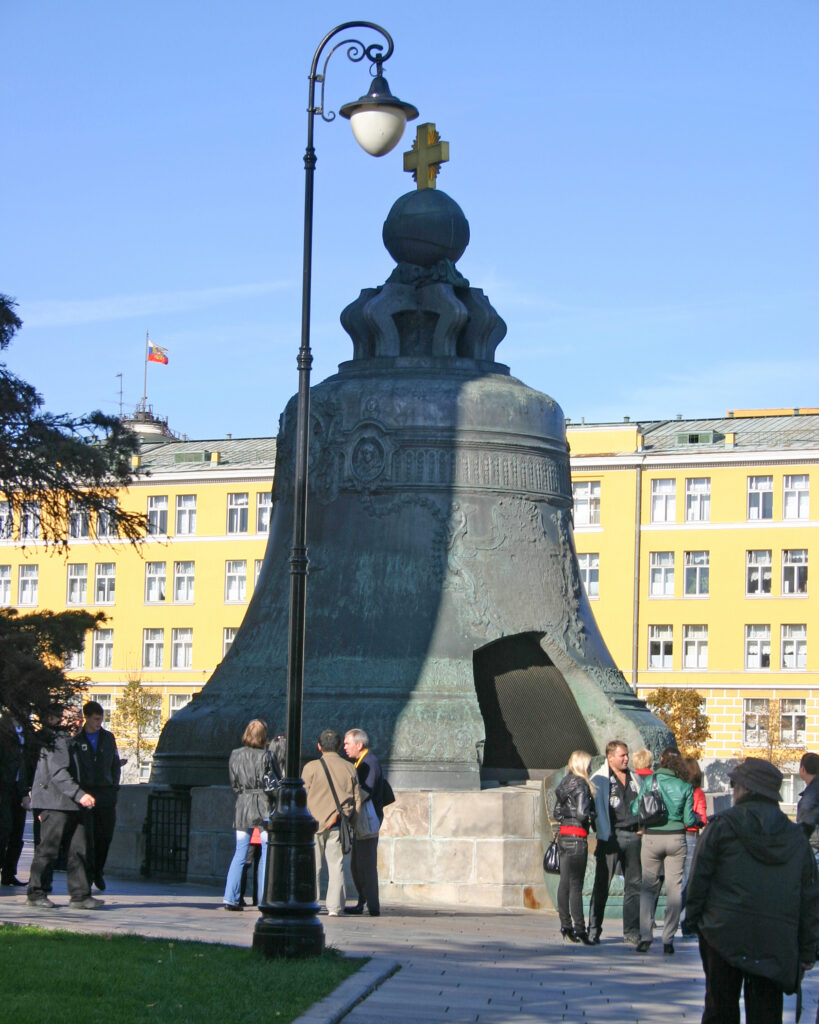 Though the massive Kremlin Tsar Bell cracked in 1737 without ever being rung, Niemeyer and his research collaborators used acoustic modeling to digitally simulate its sound in 2016.
Niemeyer has spent much of his career making invisible systems visible. After joining Berkeley’s Department of Art Practice in 2001 and then co-founding the Berkeley Center for New Media, he took on all sorts of projects that translated data into sensory experiences. He built air-quality sensors to create an alternate-reality game that helped Los Angeles high school students investigate pollution in their own neighborhood. And he turned tomato-ripening gases into live musical compositions, transforming plant metabolism into a playful, evolving sound environment. He also helped reconstruct the deep gongs of the world’s largest bell, the 200-ton Kremlin Tsar Bell, which cracked during a 1737 fire before it could ever ring.
Data on its own, says Niemeyer, can feel abstract and detached from reality; a spreadsheet of river flow rates or carbon dioxide levels may not immediately move us. But when those numbers are translated into art, that can help us feel what they mean.
“If you spend time with the data, you can make it really beautiful,” said Niemeyer. “You can look at data with a lot of compassion and say, ‘How many souls were affected by that data?’ We’re looking at how data represents the life of a creature, the life of a river. When we give it our attention, it becomes alive again.”
In 2023, data took on a whole new meaning for the artist. Instead of finding the lives and stories embedded in data, he suddenly became a set of numbers himself — one that charted an uncertain future.
‘You have six months to live. How do you want to spend it?’
It started with a cough he couldn’t kick. Walking across campus to his office in Dwinelle Annex Hall left him weak. He forgot what it felt like to take a deep breath.
At the hospital at UC San Francisco, Niemeyer stared at his X-ray in disbelief. Dark spots dotted his lungs. Idiopathic pulmonary fibrosis, the doctor called it. Or, in simpler terms: His lungs were progressively failing, and no one knew why. Once soft and spongy, they’d become mottled and scarred. In six months, they would stiffen to the point where breathing became impossible.
He remembers the sharp urgency of the news: “It was one of those moments where the doctor says, ‘You have six months to live. How do you want to spend it?’”
There was one option. It could save his life, but it was risky and required a lot of luck: a double-lung transplant. The procedure was rare, accounting for just 5% of all transplants in the U.S. And they were notoriously hard to come by — donor lungs would have to be viable, the right size and blood type, and compatible with Niemeyer’s antibodies. Even then, the threat of rejection would be greatest in the first months after surgery and would never entirely disappear.
I realized that water is not an object at all, but a circulation. And in my case, that circulation was healing. … It became a passage to a whole new way of life.
Not one to balk at the unknown, Niemeyer knew his decision.
“Of course, my wife and I were like, ‘Absolutely, we want to do this,’” he said.
At each hospital visit, doctors would tell Niemeyer how much lung capacity he had lost: 30%, then 40%, 50%, 60%, 70%. He felt like an unwitting actor trapped inside someone else’s tragedy. He began to lose hope.
“I figured I was probably going to die,” he said.
But then, in his fourth month of waiting — when his lung capacity had fallen to 30% — UCSF called. An organ donor had just died whose healthy lungs, remarkably, were a match. With mere hours to begin the transplant, Niemeyer and his wife raced to the hospital.
Twelve hours later, he woke up from surgery. The operation went well, the doctors told him. His new lungs were connecting to his body. Now he just had to recover, which would include about a year of intense, round-the-clock medical monitoring and physical therapy.
Lying in his hospital bed, Niemeyer looked down and “saw what recovery meant.” Tubes as thick as garden hoses protruded from his chest — four in all — draining pleural fluid from the space around his new lungs. The tubes emptied into two clear plastic canisters, each the size of a half-gallon milk jug. They would remain in place for a week, carrying several gallons of fluid out of his body.
Watching them fill, he began to see his body differently. It wasn’t a closed system like he’d thought of it, but a vessel — one sustained by and dependent on the movement of water.
“My relationship to water changed radically,” he said. “I realized that water is not an object at all, but a circulation. And in my case, that circulation was healing. … It became a passage to a whole new way of life.”
Water as life
In the three years since his lung transplant, Niemeyer has found a renewed sense of purpose in his artwork, with water and the forces that disrupt its circulation — pollution, extraction, drought and flooding — driving all that he creates.
“The flow of water is life’s enabling medium,” he said at an event for the Hidden Layers exhibition earlier this month. “It comes before infrastructure, before law, before markets. And not just we but every living thing we know depends on it.”
“We don’t lose water because it disappears,” he continued. “We lose water because we misunderstand what water really is.”
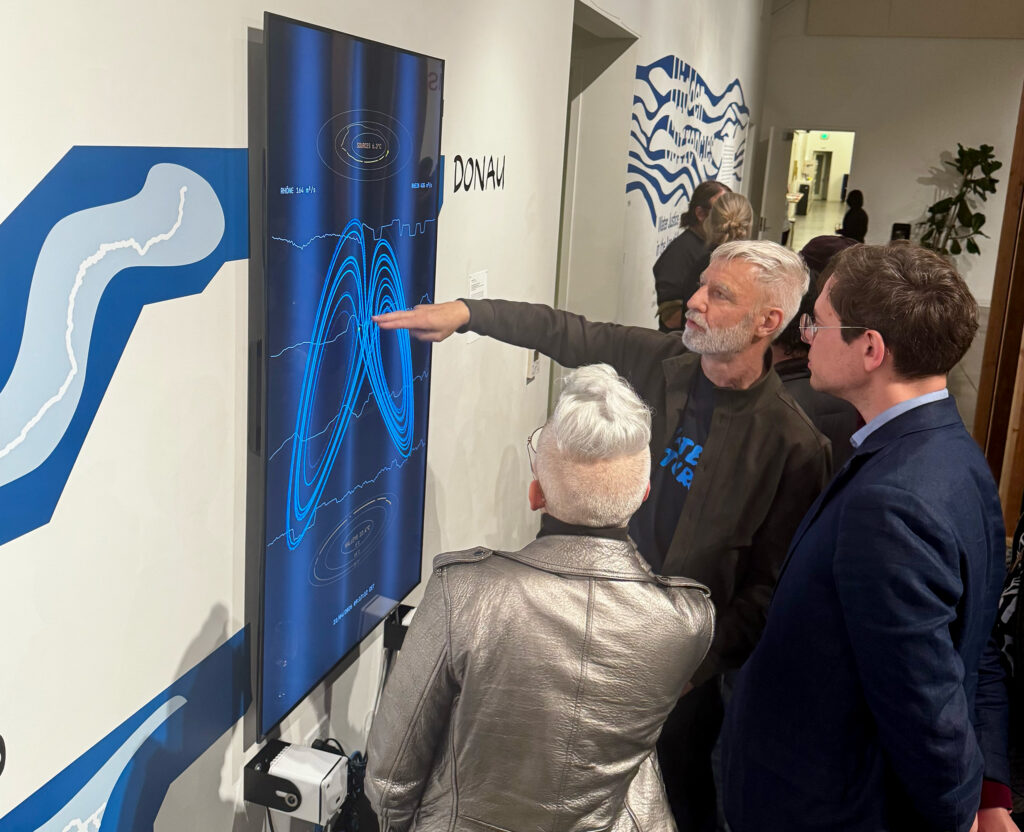 Niemeyer explains a data visualization mapping river dynamics to gallery visitors at the Hidden Currencies exhibition in 2026.
Courtesy of Greg Niemeyer
In addition to Water Council, Niemeyer has used art, public installations and community-based research to examine water as both a source of life and a resource shaped by power. In Hidden Currencies — first displayed at Swissnex in San Francisco, and its later Berkeley iteration, Liquid Memory, at the Worth Ryder Art Gallery — he made the vast water footprint of AI server farms tangible, drawing attention to a cost of digital life that often remains out of sight.
His other projects include Synchronicity, which in 2024 lit San Francisco’s Salesforce Tower with regional watershed and climate data; community-driven mapping and research on water insecurity in Detroit and displacement linked to Kenya’s Thwake Dam; and Water Futures, a 2026 San Francisco exhibition that brought together stories of water crisis and resistance from Kenya, Oaxaca, Michigan and California.
Niemeyer has also turned his attention to ocean systems. For visual artist and singer-songwriter Jewel, he and NASA scientist Chelle Gentemann helped to create Heart of the Ocean, an eight-foot kinetic sculpture for Jewel’s solo exhibition Matriclysm: An Archaeology of Connections Lost in Venice. Drawing on real-time data — including wave height, salinity, sea temperature and currents — the sculpture’s soundscape takes visitors on an immersive sonic dive to the deepest part of the Atlantic.
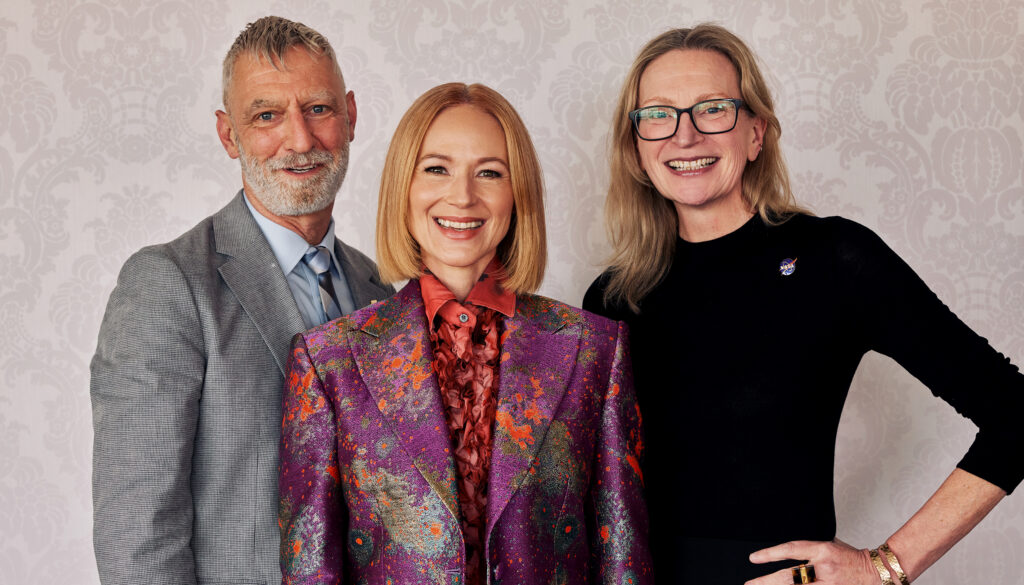 For visual artist and singer-songwriter Jewel (center), Niemeyer (left) and NASA scientist Chelle Gentemann (right) helped to create Heart of the Ocean. Drawing on real-time data — including wave height, salinity, sea temperature and currents — the sculpture’s soundscape takes visitors on an immersive dive to the deepest part of the Atlantic.
Aphrah Brokaw
At the start of the journey, viewers hear calm water and a light wind. The slow, nine-minute descent ends 27,493 feet below the surface at Milwaukee Deep, amid the sounds of the ocean’s low pulse and the rumble of shifting tectonic plates. The ascent is quicker, almost dizzying. Near the surface, sounds shaped by changes in temperature, salinity and pressure begin like angels singing, then turn ominous, evoking the mythological Sirens whose songs lured sailors toward danger.
“Everything turns to high unpredictability, to a kind of an alarm,” he said. “It’s the Sirens of the ocean crying out, saying things are not the way they used to be, things are changing.”
Choosing a water future
After his transplant, Niemeyer learned that he has a genetic disorder that can accelerate cellular aging and cause progressive scarring in the lungs. It is one more reminder, he says, that the future is not guaranteed. Uncertainty has become central to the questions he explores in his work. Like a body, a watershed depends on circulation. It can be strained by extraction, pollution and neglect; it can also be sustained by the choices people make together.
Back at the Worth Ryder Art Gallery, Water Council turns that premise into an invitation — and a warning. By choosing where to sit, visitors help determine whether the imagined watershed is pushed toward “day zero” or given a chance to endure.
“It’s entirely possible that AI could open the door to more equitable and sustainable ways of managing water,” Niemeyer said. “But our competitive instincts often pull us the other way — toward faster extraction. Water justice may be the most hopeful outcome, but it isn’t the most likely.”
Niemeyer will join the panel discussion, “Water and AI: What AI Can Learn From Water,” on Thursday, Oct. 1, from 6:30 to 8 p.m. at the Worth Ryder Art Gallery. The event, sponsored by the UC Berkeley Environmental Arts and Humanities Initiative, is free and open to the public.
Hidden Layers: AI Infrastructures and Hallucinations is on view at the gallery through Oct. 3, 2026.