
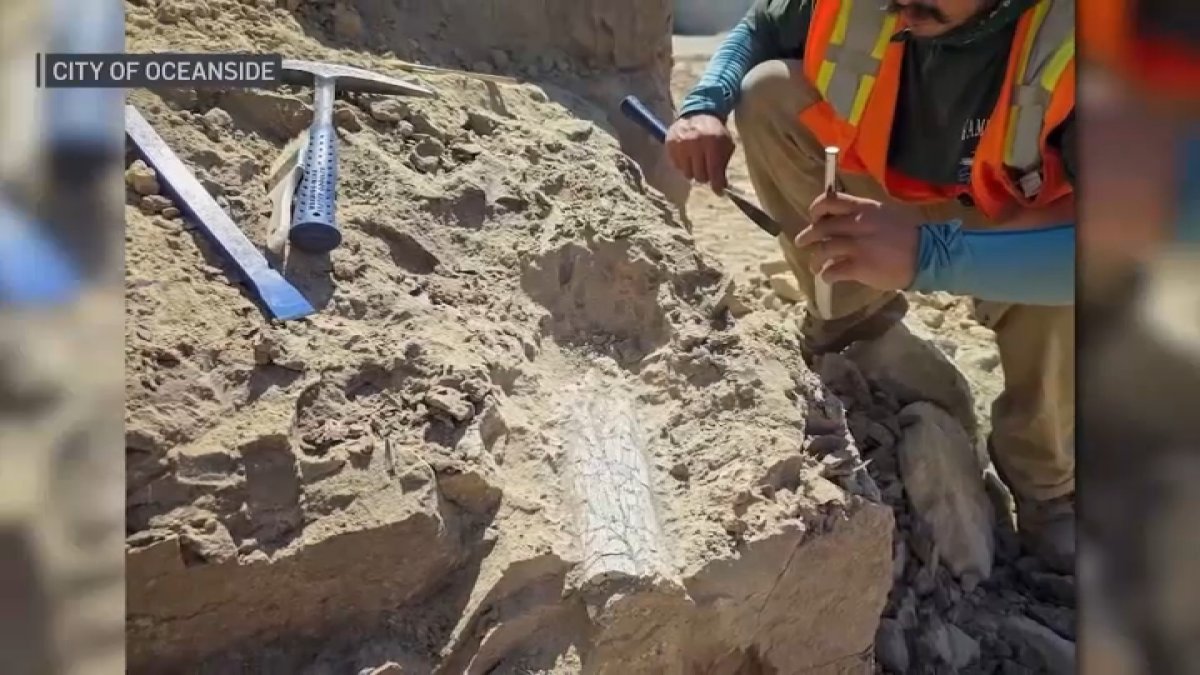
Pieces of around one dozen fossils were recently found at a construction site in Oceanside.
“Walked out and within eight minutes, within the sidewall, saw within minutes a piece of bone sticking out and immediately thought, oh god, we have something,” El Adli said.
Helix Environmental Planning Principal Paleontologist Dr. Joseph El Adli made the discovery a few weeks ago.
The city of Oceanside is not releasing the exact location of the construction site because they want to “protect public safety and the integrity of the site,” but El Adli shared that the bones were found in what’s known as the Santiago Formation, which is a rock unit 40-45 million years old.
Crews working on a City of Oceanside infrastructure project made a remarkable discovery this month: the fossilized remains of a large, hoofed mammal that walked the ancient floodplains of Oceanside, some 40 to 45 million years ago! Thunder Beast? More: https://t.co/aWqnNsRpXw pic.twitter.com/aWNLg6flbu
— City of Oceanside (@CityofOceanside) September 23, 2026
“We had about 6 feet of rock to dig down by hand to get to the bone itself from what we had found,” El Adli said.
The bones could belong to one of two animals from 40 to 45 million years ago during a time in San Diego history where it was tropical, more humid, and more of a forest environment during the Eocene Epoch. The San Diego Natural History Museum already preserves fossils from both those animals.
Dr. Tom Deméré, the San Diego Natural History Museum Curator of Paleontology, showed NBC 7 those remains, which were also found in the Santiago Formation.
“This is a, well, this is a partial lower jaw of a Brontotheriidae,” Deméré showed us.
It’s also called a Thunder Beast, which El Adli described looking like a rhino, massive in size with a Y-shaped bony horn on the nose.
“This is a lower jaw, again, broken off an Amynodontidae,” Deméré said. “It has different style teeth.”
This animal is known as a Swamp Rhino. Its body is more hippo-shaped, and a part of an extinct family of large-bodied herbivores.
Upon being discovered, the fossils were covered in plaster jackets and sent to a lab where they will be cleaned and eventually reveal what these bones belong to.
From the bones that El Adli did find, from ribs to limbs to other fragments ranging from 3 inches to a foot, he believes the animal probably lived in a flood plane.
”To me this indicates that this animal, 45 million years ago, died, and then was sitting on the surface for a very long time,” El Adli said.
While these bones date back more than 40 million years, Deméré says the oldest fossils in the coastal area in San Diego County are about 140 million years old. He calls it a blink of the eye when you think about the world as 4.6 billion years old.
“What’s beneath your feet is crazy,” Deméré said.
It’s what El Adli and Deméré say can tell us so much about the past.
“We’re protecting our past; we’re protecting our history. If we don’t know, we’re never gonna learn these things are here, we’re never gonna know what San Diego was like 40 million years ago,” El Adli said. “How we got to be who we are now – it’s all wrapped up in this history.”
Looking ahead to the winter, both El Adli and Deméré said the potential for heavy rain could mean more fossils uncovered across the area.