
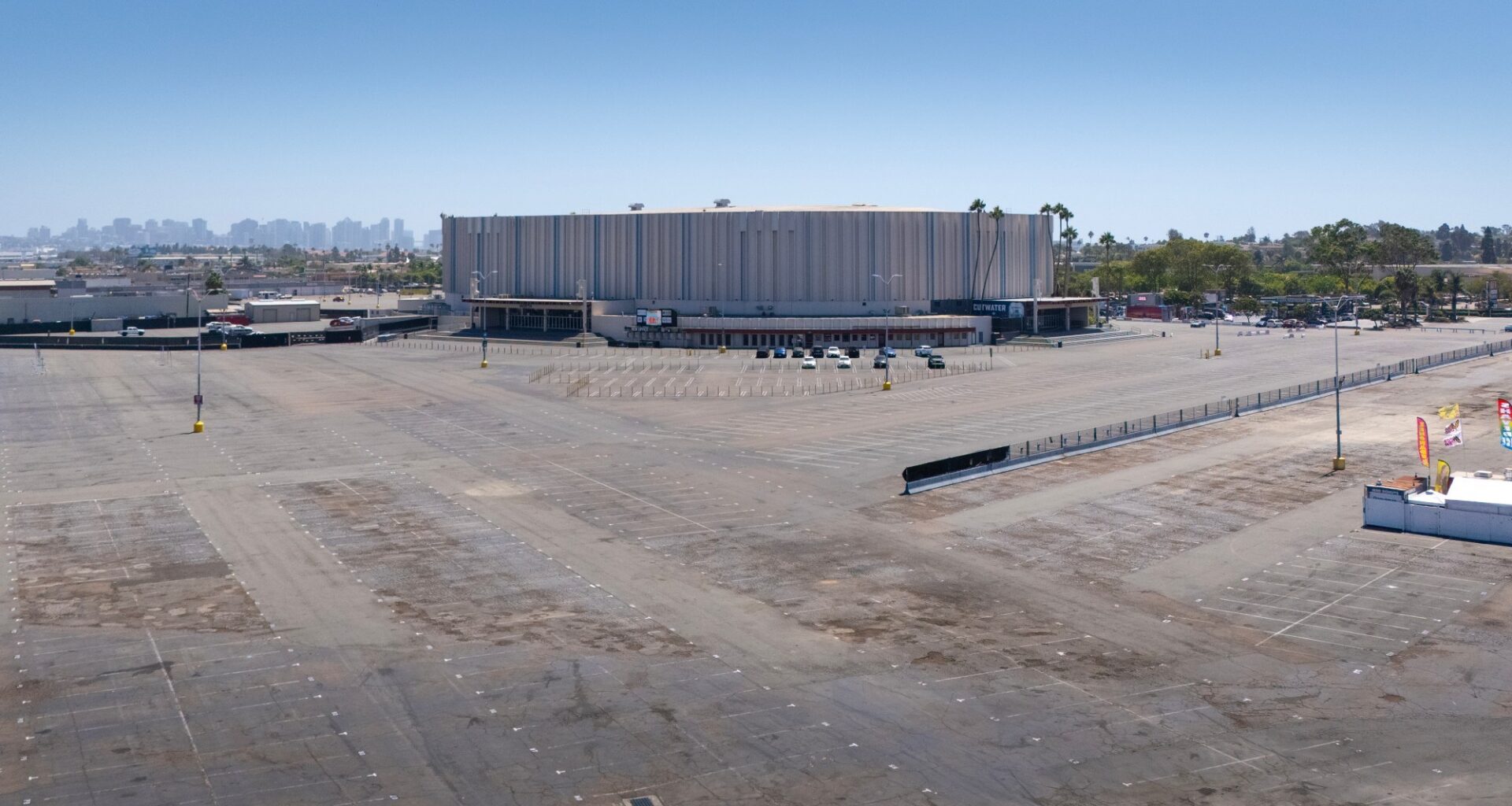
San Diego is preparing to extend the Midway Rising team’s lease for the existing sports arena through 2031 as the parties continue to negotiate a redevelopment deal for the broader, city-owned property.
On Tuesday, San Diego City Councilmembers will vote on a second amendment to the city’s sports arena lease with Midway Rising Venue Management LLC, a limited liability company owned by Midway Rising.
The proposed amendment extends the entity’s contract by five years — through Dec. 4, 2031 — and maintains the existing rent structure, meaning the leaseholder will continue to pay rent as a percentage of gross revenue.
The minimum monthly rent, which increases by 3% each year, starts at $70,648.07 for the extended period and grows to $79,515.03 in the final year. The amendment also requires Midway Rising to continue to pay $3 per ticket sold for concerts and events. San Diego pocketed more than $1.8 million from rent payments and ticket fees during the lease year that ended on Dec. 4, 2025, according to information provided by the city.
The updated contract is designed to maintain money-making arena operations until Midway Rising takes control of the city’s 49.2-acre property at 3220, 3240, 3250 and 3500 Sports Arena Blvd. in the Midway District.
The city and the developer have been negotiating a long-term ground lease and development deal for four years, and the transaction is expected to go before council members for a vote later this year.
“This (interim arena) lease is a standalone item for council consideration given the near-term termination date and the operator’s ability to sustain and plan arena operations,” said Christina Bibler, who heads San Diego’s Economic Development Department. “The five-year extension allows for a yes or no vote on the redevelopment of the site. This means the general fund revenue generated by the arena remains intact, as (the lessee) will be able to continue operations and book shows regardless of the decision on the greater redevelopment proposal, which will be heard at a later date.”
Opened in 1966, the San Diego International Sports Arena has been the longtime home of the San Diego Gulls and frequently hosts concerts, family shows and sports entertainment events. So far this year, there have been 64 shows and events, according to information provided by Midway Rising.
The historic venue, currently known as Pechanga Arena, is slated to be razed once a 16,000-seat replacement arena is constructed as part of the Midway Rising project.
Midway Rising is planning to build the replacement arena as part of a mega project that includes 4,254 total residential units, 130,000 square feet of commercial space, 8.1 acres of parks, and an additional 6.4 acres of plazas and public space. The developer has also committed to setting aside 2,000 residential units for households earning 80% or less of the area median income, or what’s considered affordable housing.
The development team is composed of market-rate housing developer Zephyr, affordable housing builder Chelsea Investment Corp., and sports-and-entertainment venue operator Legends. The Kroenke Group, a subsidiary of billionaire Stan Kroenke’s real estate firm, is the entity’s lead investor and limited partner.
Legends formally took over sports arena operations in August 2024, per the terms of an interim lease agreement between the city and Legends Venue Management. Around the same time, Legends also acquired the arena’s previous operator, ASM Global, meaning there was no change in day-to-day management. The lessee was later renamed Midway Rising Venue Management LLC.
The timing of the ASM takeover and the leasehold transition triggered a lawsuit from the Department of Justice, which alleged that Legends acted as the de facto owner of ASM before legally allowed to do so. Legends, which did not admit to wrongdoing, agreed to pay the federal government $3.5 million to settle the matter.
The interim sports arena lease is set to expire on Dec. 4. The proposed second amendment to the contract, in addition to extending the term for another five years, updates the minimum monthly rent to reflect the 3% increase for each additional year and allows the tenant to make improvements costing less than $200,000 to the venue without city authorization.
If approved, the interim agreement would terminate once the city and the developer enter into a disposition and development agreement and then close escrow on what the sports arena contract refers to as a “horizontal ground lease.” The horizontal ground lease language suggests that the redevelopment transaction being contemplated includes multiple leases, starting with a ground-level infrastructure lease and followed by separate building, or vertical, leases.