
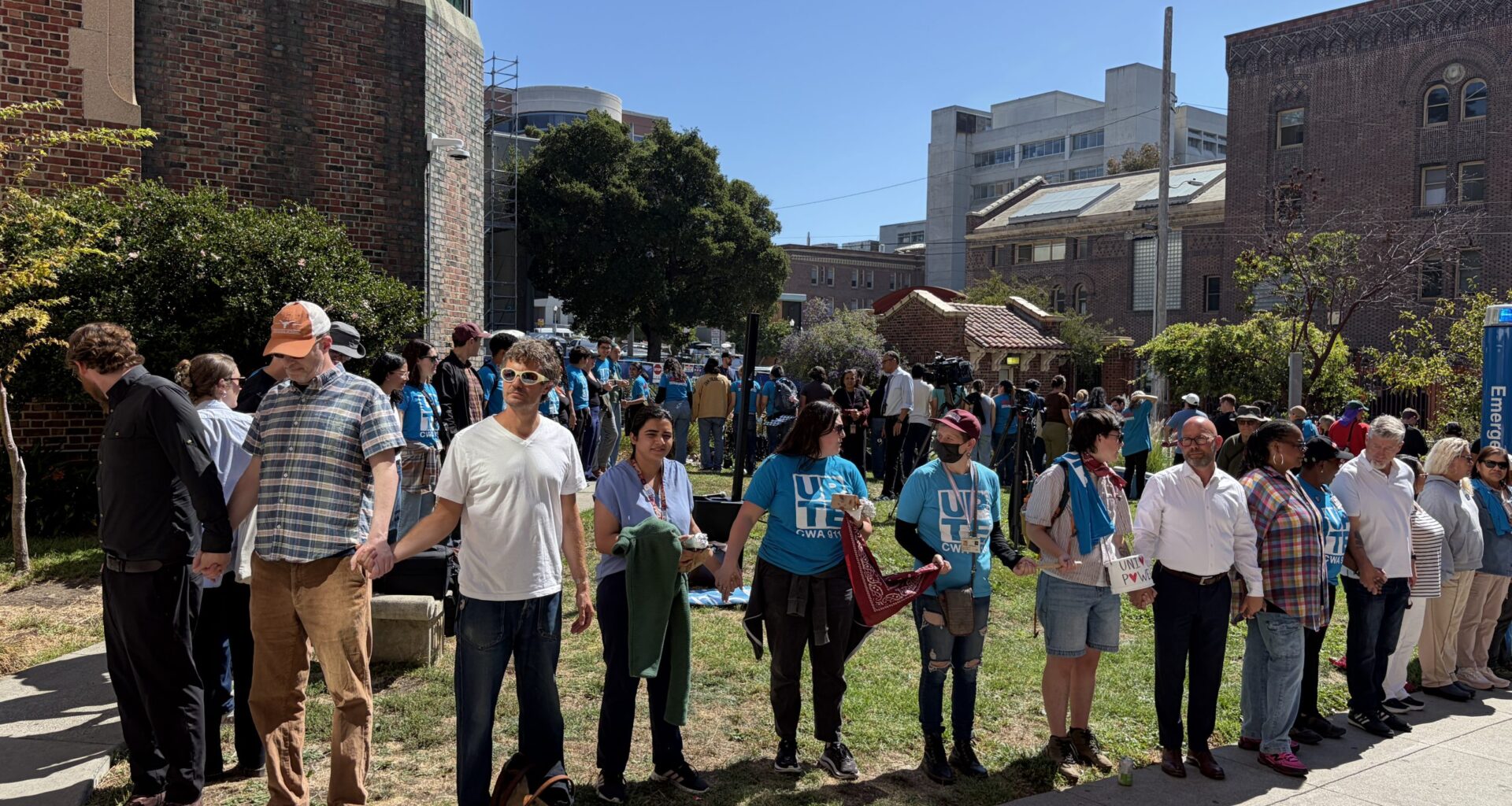
More than 100 social workers and their supporters gathered at Zuckerberg San Francisco General Hospital for a vigil and protest, nine months after social worker Alberto Rangel was fatally stabbed on Dec. 4, 2025.
Workers with UPTE, the union covering medical workers within the University of California system of medical centers, arrived at the vigil with a message: the University of California, San Francisco isn’t doing enough to protect its workers at clinics at San Francisco General and elsewhere in the city.
They brought with them a list of demands — co-signed by all 11 members of the Board of Supervisors, state assembly members Catherine Stefani and Matt Haney, and state Sen. Scott Wiener — addressed to UCSF’s chancellor, Sam Hawgood.
They called on Hawgood to “establish and fund safe staffing levels” in “high-risk behavioral health” units, improve “recruitment and retention” for UCSF social workers, and “guarantee frontline workers a meaningful role in safety decisions.”
“We should not have to improvise weapons out of our garbage cans to protect ourselves,” said Joi Jackson, a clinical social worker and colleague of Rangel’s, who said that she had done exactly that to protect herself from a patient attempting to harm her.
“We should not have to walk to our cars alone after being threatened. And we should not have to wonder whether help will actually arrive when we call for it, and we should not have to lose another colleague before the system changes,” said Jackson.
UCSF said in a statement it had made safety changes, and would continue to do so.
“UCSF has been continuously working and cooperating with the San Francisco Department of Public Health (SFDPH), our employees, and hospital, city, and union leaders to strengthen workplace violence prevention, security, patient protocols, and safety practices at ZSFG,” a UCSF spokesperson wrote.
“UCSF has strengthened workplace safety at Ward 86 by establishing rapid escalation and daily safety huddles, expanding emergency and security training, and redesigning workflows.”
Rangel was stabbed in Ward 86, the hospital’s pioneering outpatient HIV/AIDS clinic, where alleged killer Wilfredo Tortolero Arriechi walked in armed with a knife after having earlier made threats against a doctor in another clinic.
Arriechi, whose lawyers have argued was experiencing a mental health crisis, was seemingly searching for that doctor when he came to the ward.
Staff have raised safety concerns at the hospital for years, including in 2024, when the nurses’ union filed a complaint with the state after they requested security guards, cameras, and metal detectors at every hospital entrance, and were denied.
In a meeting with hospital staff in March, Department of Public Health director Daniel Tsai acknowledged security lapses, and said that the department had increased staffing to assess threats. The hospital tapped an outside firm to investigate, and hospital workers have for months demanded changes.
After Rangel’s death, the California Division of Occupational Safety and Health fined San Francisco General Hospital $130,500 after discovering seven workplace-violence-prevention violations, though another state department found “no deficiencies” in state and federal requirements.
In April, the Department of Public Health released a report, stating that immediately after the attack, it had installed a weapons detection system at Buildings 80-90 where the attack occurred, launching a 24/7 threat-management team to triage and respond to concerns and establishing a formal threat-escalation protocol that “balances safety measures with trauma-informed, patient-centered approaches.”
Since then, it continued, it had hired four additional staff members to its security team to ensure round-the-clock threat-management coverage, and committed an additional $15 million a year to “support a fundamentally strengthened and modernized approach to safety and security” across its facilities.
These measures are not enough, said some of the speakers at the vigil.
Robyn Miles, a UCSF clinical social worker, said there is no weapon-detection system at the clinic where she works.
“Our procedure is that our very hard-working and diligent safety staff ask clients if they have a weapon when they come in,” said Miles.
Juliette Suarez, a clinical social worker at San Francisco General’s trauma-recovery center, said the security changes made by the public health department do not extend to campus-side clinics that aren’t in department buildings.
These buildings, she explained, are UCSF outpatient mental health clinics serving Medi-Cal eligible clients, many of which are rented through private landlords.
Workers in these buildings are not given the same worker-involved safety committees, safety infrastructure upgrades or panic buttons, Suarez said.
After the speakers finished, those gathered for the vigil spread out across the lawn, joined hands, and concluded the event with a moment of silence in reverence for Rangel.
“Alberto’s death should not become another incident that is remembered, documented and eventually forgotten,” said Jackson. “It should be a turning point.”