
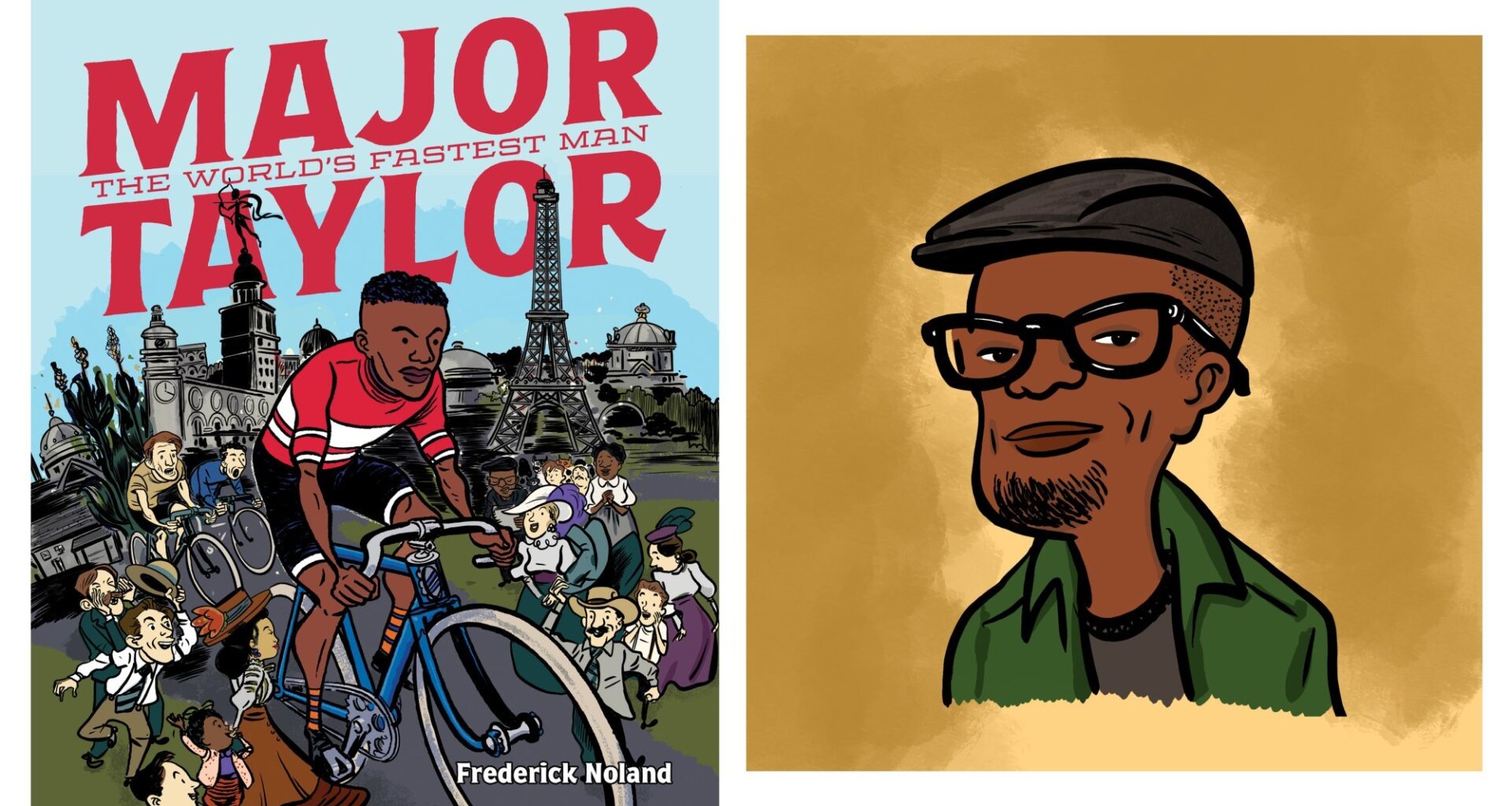
Earlier this month, Oakland-based comic artist Frederick Noland published his latest work, “Major Taylor: The World’s Fastest Man (Drawn & Quarterly, 2026).
Across 372 pages, this vibrant and dramatic tome tells the epic life story of a little-known American cycling legend. Taylor, who was Black, was born and raised in Indianapolis at a time when Jim Crow laws were prevalent and enshrined severe racism throughout the United States.
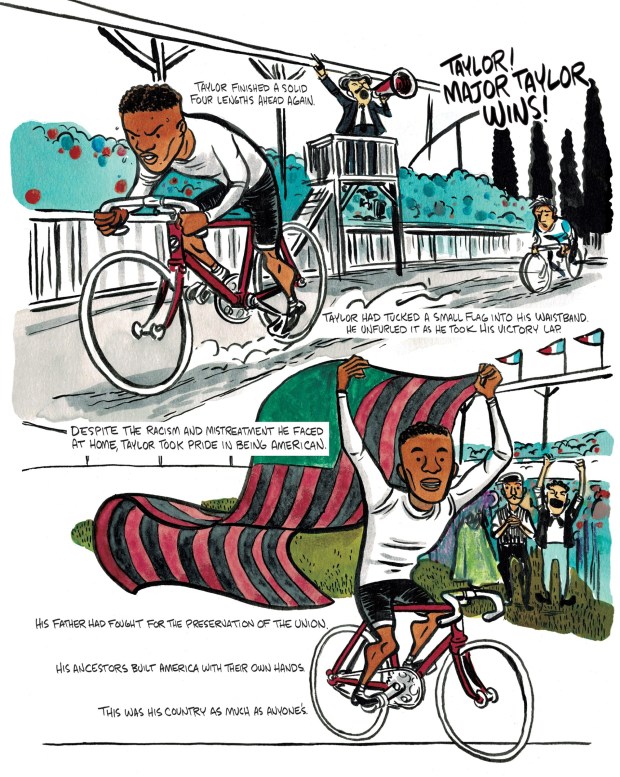 A page from Major Taylor, a non-fiction graphic novel by Frederick Noland, and released in September 2026. (Courtesy: Drawn & Quarterly)
Despite this, Taylor quickly rose through the ranks of the local cycling community before moving with his mentor, Louis “Birdie” Munger, to the late-19th-century cycling hub of Worcester, Mass. But Taylor faced considerable adversity, and some white cyclists even refused to compete against him, or worse, assaulted him.
Yet, in one year alone, 1898-1899, Taylor set seven world records in cycling, including in the 1- and 2-mile distances. Later, he toured and competed in both Europe and Australia, where he won even more races.
Noland, who himself is an amateur cyclist, first wrote a mini comic about Taylor in 2016. He also created “San Francisco Black History”, a public art series, for the San Francisco Arts Commission, in 2022.
The author is scheduled to appear at 3 p.m. Saturday, Sept. 26, in San Francisco for a short bike ride starting in Ferry Plaza and ending in time for a 5 p.m. signing at Mission Comics, at 2250 Mission St.
The author talked to us about his new graphic novel. This interview has been edited for length and clarity.
Q: So, first of all, I want to ask you a little bit about something that you wrote in the very end of the book (the Afterword). You wrote about how your mission with Major Taylor was to tell the story of his life on wheels.
You said clearly this was a job for comic books. Why does this story specifically lend itself to being told in the form of a comic?
A: I mean, generally speaking, like I’m hugely evangelical about comics. I personally think it is the ultimate form of communication but, you know, I might be a little biased. In a comic, you can basically make it as long, as short, as inclusive, as brief as whatever as you wish.
And so when I got the opportunity to do the graphic novel, that was an opportunity to really tell the story and get deep into it and tell the emotions of the story and a bit of the background, too. And like that’s something that I know hasn’t really been done with (Taylor) yet.
Q: One of the things that I think really came alive in some of these sections, which don’t come across as well in the form of a fully text-based book, are the emotions as you depict them.
I think you’re making sort of educated guesses as to what his emotions would have been at certain moments in his life based on the various trials and tribulations that he was going through.
A: Yes.
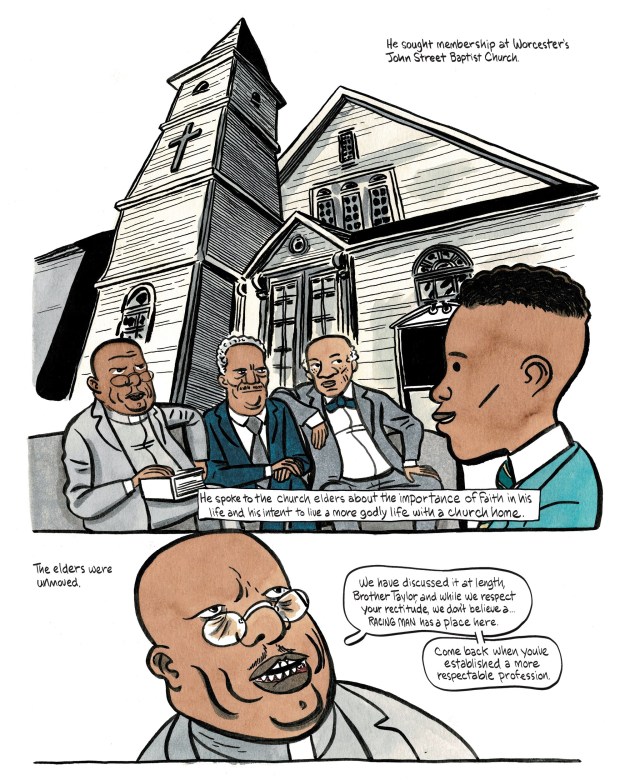 A page from Major Taylor, a non-fiction graphic novel by Frederick Noland, and released in September 2026. (Courtesy: Drawn & Quarterly)
Q: There’s a couple of pages that don’t have words. I’d love to hear from you a little bit about your choices when to use words and when not to use words and just have the images tell the story.
In Chapter 2, I guess Memorial Day 1892, there’s a picture of Major in the crowd. He’s not racing, but he’s in the crowd.
Mr. Hay (Major Taylor’s boss) is standing there clapping next to a tuba and he sees Major who you’ve drawn in color, whereas almost all the other characters are drawn in black and white. And Major is in the center frame and he stands out.
He’s looking towards the action. But as I saw that I was like — he probably really stood out in 19th-century Indiana.
A: Well, I mean, I can tell you being like the Black guy at a thing, you know, because there’s not a ton of black cyclists, and I also grew up being this like black punk rocker and in the lily-white suburbs. So, you feel like this beacon, you know, you really do stand out.
Q: What do you think this story says to somebody who’s not on their bike every day?
A: There’s a couple of things going on. And one of the things I hadn’t thought about is Taylor is a really very American story in a lot of ways because he’s this … they always talk about the self-made man, right? He’s this literal up-by-the bootstraps-guy, you know, he was gifted a bike and he continued to trade up in his life.
I think what the book is for anyone generally is that it’s difficult to persevere in life and it’s very difficult to persevere while being yourself. And I think that is one of the main themes of the book is that you know you can.
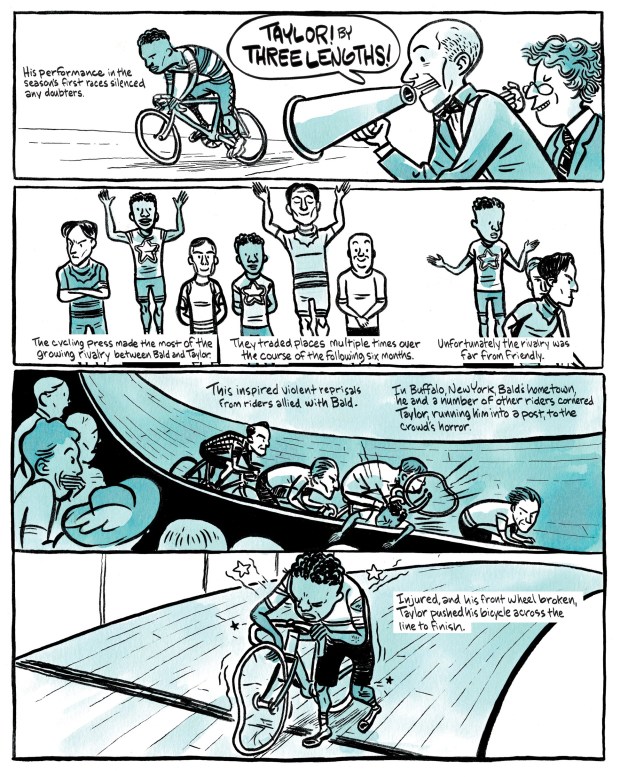 A page from Major Taylor, a non-fiction graphic novel by Frederick Noland, and released in September 2026. (Courtesy: Drawn & Quarterly)
Q: Was there anything that emerged for you, now that you have gone through this decade-long process of sitting with this person?
A: Nobody does this alone, you know. He’s out on the track by himself, I’m at a drafting table by myself. I spend a tremendous amount of time alone, which is good — fortunately, I’m an introvert — so it doesn’t drive me nuts. Makes me a little weird, but you know, you don’t do this alone. I had people helping me in ways that I would not have thought were so crucial.
We really support each other. We really carry each other and that I think is the thing that I really pulled from this. It’s like how important mentorship was to him.
He would have just been like some black kid with a bicycle in Indianapolis if people hadn’t seen him. That’s the other thing, you have to be seen and you have to see, you know, we have to see each other, right?
And I don’t think we do that very well. I try to be better about it, but it’s important, you know, that we actually recognize and see each other.
Q: Why do you think his story isn’t in the pantheon of great black athletes — Jesse Owens, Jackie Robinson, among others. Why do you think he hasn’t been as rarified in that way, historically?
A: I think it’s because it’s largely an accident of the time because there’s no film of him, you know, there’s no recorded voice of him.
You know Jesse Owens was running, you know he was a celebrity runner, and he was running in the age of film. You know you could see him in these news reels around the world. (Taylor is) not going to leap out of that the way you know, a Jackie Robinson is going to leap out of a film at you.
The other thing is cycling was so huge in this era. But, you know, cycling really fell off in this country. Like there used to be velodromes, you know, everywhere. And cycling remained popular, but it really was so displaced by the automobile here — it’s just not thought (of in the same way as) elegantly racing a bicycle around an oval, which I’m all about.