
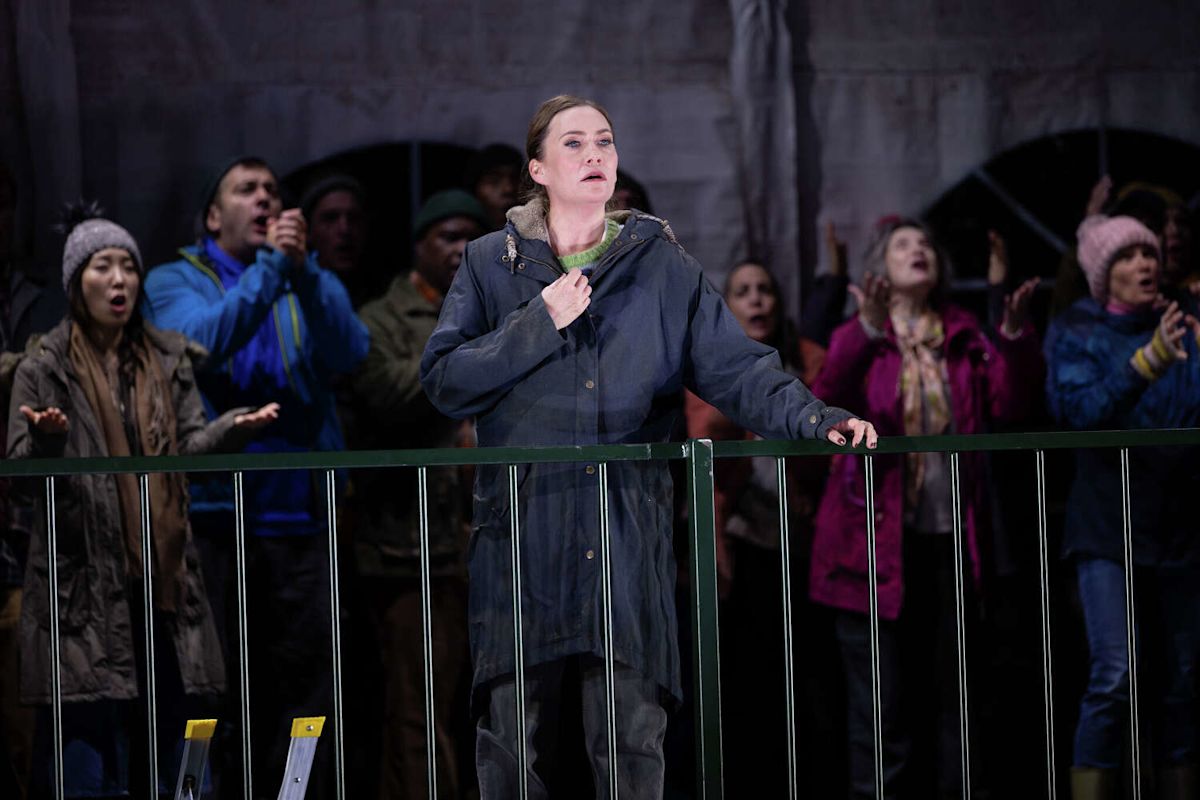
Queens rarely get happy endings in opera. Few, however, are portrayed with the humanity, dignity and emotional force that Heidi Stober brings to Thea Musgrave’s “Mary, Queen of Scots.”
Her extraordinary performance anchors a San Francisco Opera production, which opened at the War Memorial Opera House on Thursday, Sept. 24, and is such a triumph that it deserves to become a company landmark.
More Information
“Mary, Queen of Scots”: San Francisco Opera. Through Oct. 4. $37-$456. War Memorial Opera House, 301 Van Ness Ave., S.F. 415-864-3330. • Livestream available 10 a.m. Sunday-Tuesday, Sept. 27-29. $25. www.sfopera.com/operas/mary-queen-of-scots/livestream
Musgrave’s landmark 1977 opera about the young queen was last seen in San Francisco in 1979, when Opera affiliate Spring Opera Theater mounted the West Coast premiere at the Curran Theatre with Musgrave herself conducting.
For the current iteration, much of the production’s success is owed to the Opera’s brilliant cast, led by Stober in the taxing title role. An Opera veteran and always an outstanding performer, the soprano has entered a period of even greater vocal splendor and keen dramatic insight. Both an imperious queen and a tender, frightened mother, her Mary is a fully realized, complex human trapped in impossible circumstances.
Upon her return to Scotland after a childhood in France, the newly-widowed Mary must choose her allies. Her options include her illegitimate half-brother James (the suavely handsome baritone Thomas Mole in an impressive company debut), Scotland’s military leader the Earl of Bothwell (sung with dominating intensity by the budding heldentenor Thomas Kinch) and the weak-willed drunkard Lord Henry Darnley (the excellent, bright-voice tenor Christopher Sokolowski, also in his company debut).

Heidi Stober as Mary and Christopher Sokolwski as Lord Darnley in Thea Musgrave’s “Mary, Queen of Scots.” (Matthew Washburn/San Francisco Opera)
James and Darnley aspire to be king, while Bothwell yearns for Mary and fantasizes that the attraction is mutual. The fictional Lord Gordon (veteran bass-baritone Philip Skinner, a genuine supporter of Mary who has her best interests and those of Scotland at heart, and Mary’s Italian secretary, David Riccio (baritone Hadleigh Adams), are also in the mix.
It’s Mary’s rash marriage to Darnley that sets in motion her disastrous fall and exile from Scotland.
By the opera’s close, Mary has no supporters and no choices. She flees Scotland for England, abdicating the throne and leaving behind her son, the future James VI of Scotland and James I of England. Decades later, Elizabeth I has Mary executed.
Musgrave’s virtuoso compositional technique convincingly drives all of this drama, contrasting Renaissance melodies in the voices and band onstage with modern and dissonant music in the pit. The harp swirls, paired with English horns, slither around the vocal lines, and the orchestra trills ominously in tense moments. The percussion section, which occasionally improvises, echoes the dramatic action.

Philip Skinner as Lord Gordon with members of the San Francisco Opera Chorus in Thea Musgrave’s “Mary, Queen of Scots.” (Matthew Washburn/San Francisco Opera)
Musgrave’s vocal lines – sometimes spiky, sometimes breathtakingly lyrical – set the libretto idiomatically. Though Musgrave’s libretto is occasionally awkward (characters don’t need to restate what you can see), the plot hurtles forward and each of the three acts is well-structured.
Neapolitan conductor Clelia Cafiero, in her Opera debut, leads the colorful score magnificently, allowing every instrument and voice to be heard with perfect clarity. She’s utterly in command of the music’s many rhythmic complexities.
“Mary, Queen of Scots” is a co-production with the English National Opera, which has described the work as having been originally conceived for semi-staged concert performance. Perhaps that accounts for its unusually stripped-down vision by director and production designer Stewart Laing.
The unit set is a large, tentlike structure with a fence across the stage. The soloists and chorus wear contemporary clothes, though the action extends from 1561 to 1568. The modern approach makes it difficult to discern within the chorus whether you’re looking at the people of Scotland, an army, or a group of lords. (The supertitles could help by providing the year and location for each scene.) A particularly significant misfire in the costuming adds confusion to a character’s standing: Bothwell, a soldier, could easily have been in uniform to distinguish his character from the civilians, but instead he wears a sweater and winter jacket.

Thomas Kinch as the Earl of Bothwell, Heidi Stober as Mary, and Thomas Mole as James Stewart in Thea Musgrave’s “Mary, Queen of Scots.” (Matthew Washburn/San Francisco Opera)
Still, Laing’s direction largely succeeds in clarifying the story of a short, intense opera that’s packed with complicated relationships.
James’ smooth, oily movements contrast with Darnley’s flailing inebriation and Bothwell’s looming brawn. Over the course of the opera, Mary seems to shrink physically as her political stature collapses.
These are the first complete U.S. performances of “Mary, Queen of Scots” since the work was produced in 1981 by New York City Opera. The opera is so thrilling, with such vividly drawn characters, that it clearly deserves to be seen more widely.
If only Musgrave, who still composes at age 98, could have been present to see “Mary” conquer the War Memorial stage.
Lisa Hirsch is a freelance writer. This review has been provided in partnership with San Francisco Classical Voice.
Subscribe
There’s more to San Francisco with the Chronicle. Subscribe today for just 25¢.
This article originally published at Review: San Francisco Opera makes a thrilling case for ‘Mary, Queen of Scots’.