
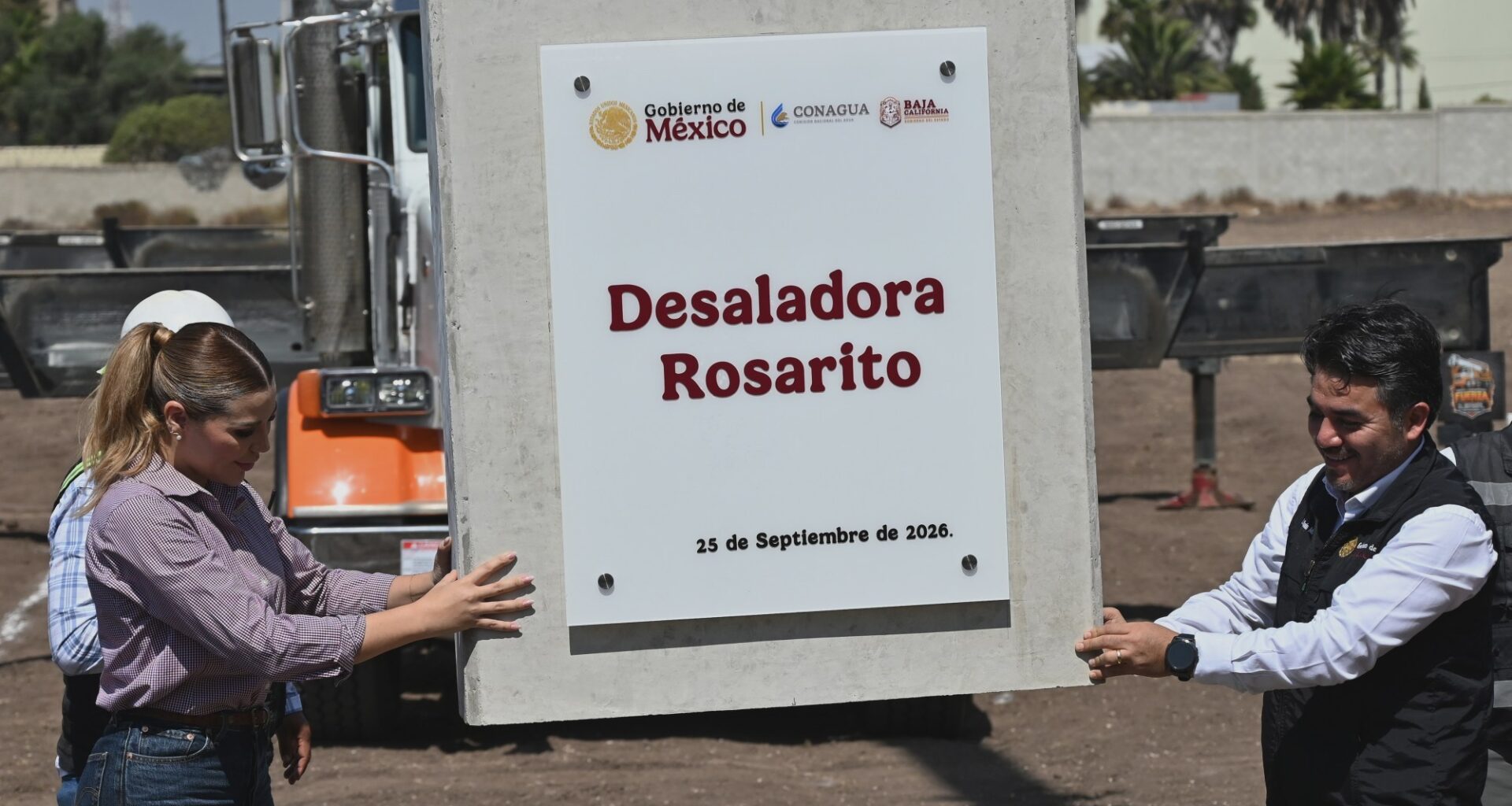
Mexico kicked off construction Friday on what officials are touting as the largest desalination plant in Latin America, a $850 million project that aims to bolster the water supply for the cities of Tijuana, Rosarito and Ensenada.
The desalination plant, being built in Rosarito and financed with public funds, will help reduce dependence on the Colorado River, the region’s main water source. Construction is expected to take about three years.
“Baja California couldn’t rely solely on water from the Colorado River anymore,” Baja California Gov. Marina del Pilar Ávila said Friday during the groundbreaking ceremony in Rosarito. “We needed to open a new door.”
The plant is one of 17 infrastructure projects included in Mexico’s National Water Plan. President Claudia Sheinbaum announced the beginning of construction during her visit to Tijuana last week.
The federal government will cover the cost of the desalination plant, while the state will pay for the pipeline network needed to transport and store desalinated water along the coastal area, Andrés Pulido, Baja California’s secretary of finance, said on Wednesday.
Baja California has grappled with water-related challenges ranging from shortages to aging infrastructure, which have occasionally resulted in service interruptions — some that have lasted for days in certain neighborhoods.
“The great thing about the desalination plant is that it will generally relieve the strain on our water system,” said Mónica Vega, director of the Tijuana State Public Services Commission.
Last month, the construction of the plant was awarded to the Spanish multinational company Cox — which, according to its website, has developed desalination plants in 16 countries.
“The plant will use reverse osmosis technology, an advanced treatment system that employs semi-permeable membranes to remove salts, minerals and impurities from seawater and convert it into drinking water,” the company said last month in a news release. “This technology is recognized for its high operational efficiency, the quality of the water produced and its lower energy intensity compared with other desalination solutions.”
Officials said the plant will initially have the capacity to treat 2,200 liters of desalinated water per second. The company said in its news release that the final production capacity of the plant would be 4,400 liters per second, “equivalent to more than 380,000 m³ of drinking water per day, making it the largest facility of its kind in Latin America.”
Marisela Martínez, professor and researcher at CETYS University School of Engineering in Tijuana, said the plant will help significantly, but it should be seen as an additional source and not an ultimate solution. “The water issue we’re facing in Tijuana and along the coast is critical, as we all know,” she said.
She said that authorities should also consider additional water treatment and reuse projects, update the aging infrastructure and raise awareness about water conservation among the public and industrial sector.
Previous Baja California state administrations had also planned to build a desalination plant in Rosarito, but through a public-private partnership. In 2020, then-Baja California Gov. Jaime Bonilla canceled those contracts, arguing that it was not financially feasible, as reported by Mexican news site Proceso, leading to a dispute that was settled four years later.
Years ago, the Otay Water District explored building a cross-border pipeline to purchase some of the water from the proposed Rosarito plant — and was granted a presidential permit by the U.S. Department of State — when the project was being developed in Mexico as a public-private partnership.
Víctor Daniel Amador, Baja California’s secretary of water management, sanitation and protection, said on Wednesday that the plan to export water to the U.S. is not being contemplated as part of the new project.
“We have not planned for a desalination plant to export water, nor do we have the infrastructure for it,” he said. “A special aqueduct would have to be built, and we are not currently planning anything like that.”