
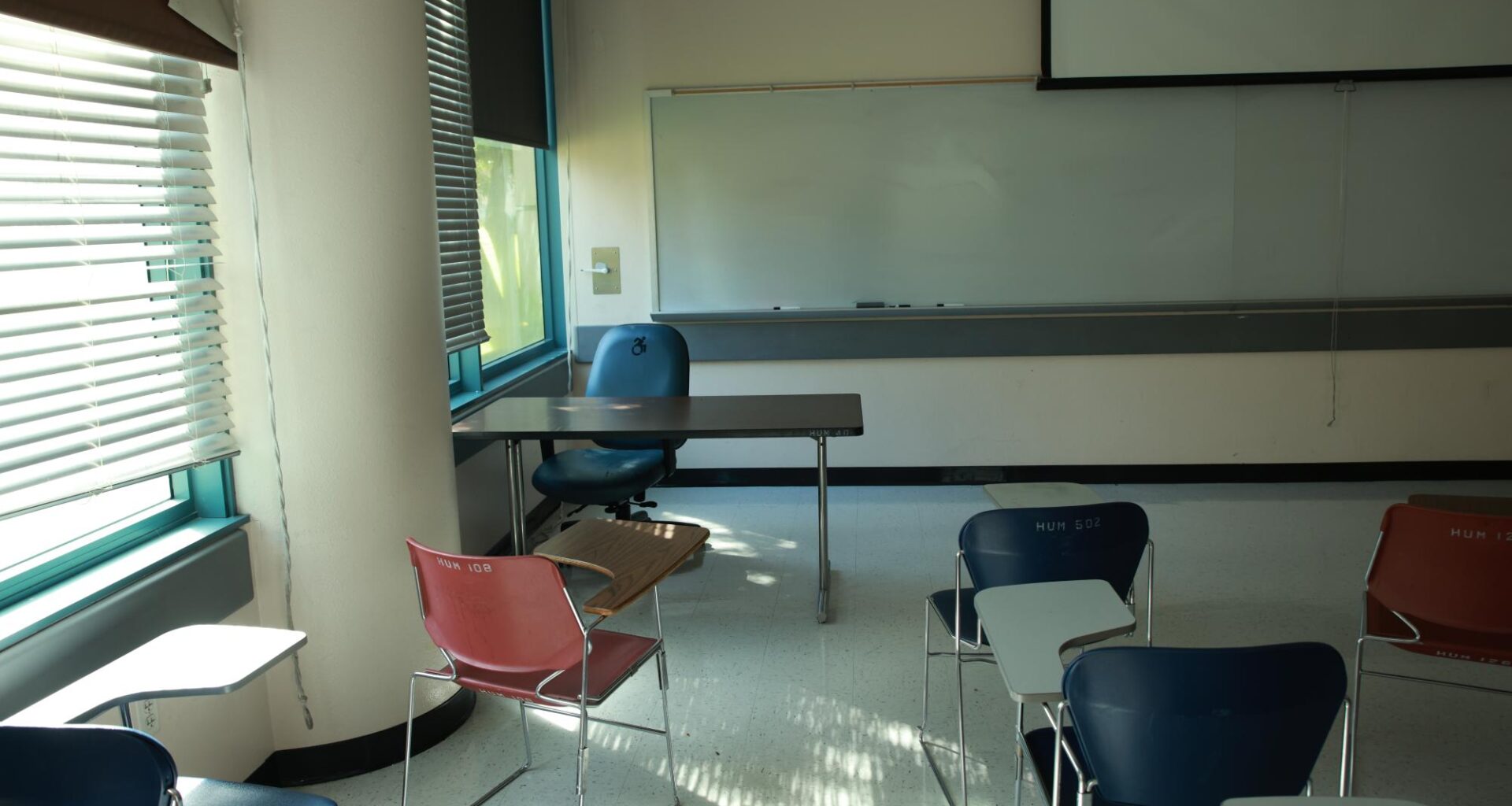
San Francisco State University’s commitment to creating a culture of access for an inclusive learning and working environment has fallen short for some students.
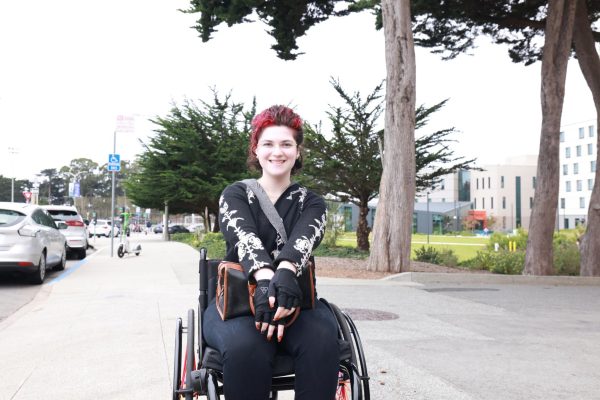 Elijah Mac Adoha, senior, San Francisco State University Student outside humanities building. San Francisco CA. (Peter W.Ngugi / Golden Gate Express)
Elijah Mac Aodha, a fourth-year philosophy major, is rendered ambulatory and requires a wheelchair for navigation. When Aodha transferred to SFSU in August 2025, she requested on-campus shuttle service because her motorized wheelchair was delayed. She was met with a frustrating back-and-forth.
“I remember waiting for minutes on end while I came closer and closer to running late, but no one showed up, so I ended up walking all the way from Manzanita to Humanities,” Aodha said. “I always arrived late, short of breath and on the verge of passing out… Sometimes I even had to sit out of class so I could regather myself.”
Mac Aodha also described complications with specialized desks that were promised to her during classes, stating that multiple rooms in humanities were using accommodation desks as normal tables rather than for their intended purpose.
Mac Aodha made calls to the Disability Programs and Resource Center regarding the lack of consistent transit arrivals and reported only receiving a ride when she went to the office to request it in person. Representatives claimed that she never filed any paperwork. According to Aodha, she witnessed the papers she filed in Aug. being processed in person.
The mobility transportation page on the SFSU website states that while the school tries to accommodate as many as possible, rides are not guaranteed solely because a form is filed.
Mac Aodha also voiced frustrations toward the lack of working handicap accessible door buttons around campus, specifically in Manzanita Square. These buttons are designed to give students with impaired movement an easier time getting into buildings with heavy doors. Resident advisors often had to open the door for residents because it took over five months to fix the door’s button.
When repairs go unresolved, it forces disabled students to make pain and discomfort an inseparable part of their schedule. These long roundabout detours also waste time and can make tardies stack up into real academic penalties.
“I know there’s a master’s program for philosophy here, but I won’t be taking it,” Aodha said. “I’d honestly be better off doing what I was doing back east cause this just isn’t worth it.”
Mac Aodha referred to her Manzanita Square accommodation as a “stone closet with barely any room to breathe” for a wheelchair user.
“Sure you could move if the entire space was absolutely empty, but that’s just not the case,” Aodha said.
Seventh-year music major, Masha Aleskovski, also described similar frustrations with inoperable door buttons in the Creative Arts building.
“The front door has a button, but sometimes it doesn’t work, I guess because it’s old, but for students who have to rely on it 24/7 that’s unacceptable,” Aleskovski said. “Because if a campus is going to say it’s ADA accessible, it should commit to that whole 9 yards.”
Mac Aodha’s friend, Alyss Davis, a fourth-year psychology major, described the experiences their cane-using friends have with living arrangements on the higher floors of Village at Centennial Square B.
“In Village B there’s only one elevator that can get you to the sixth floor. Next to that elevator, there is a door to the outside in which you can only exit, not enter…,” Davis said. “To get to the elevator you either have to go down to the main lobby then walk back an extra 300 feet, or you have to go to the other external door just across the way, go into the first floor, go up one flight of stairs, cross back over the sky bridge to the elevator and then take the elevator up to the sixth floor.”
Terrilyn Woodfin, an africana studies lecturer, has lived with chronic asthma since childhood and suffers from arthritis of the knees due to a bus accident as a teenager. Only after her battle with COVID-19 did her walker become a necessary part of her daily life.
Since 2023, Woodfin has used the on-campus shuttle service with few issues. However, Woodfin described one recent incident where she had to wait around 40 minutes for the shuttle to arrive and take her to the HSS building. By the time she reached her destination, there were so few students left that all she could do was count attendance and dismiss the remaining class early.
“It sometimes feels like campus security wants to rush you; they don’t wanna listen,” Woodfin said. “They just want to rush you along, and that tends to be a problem.”
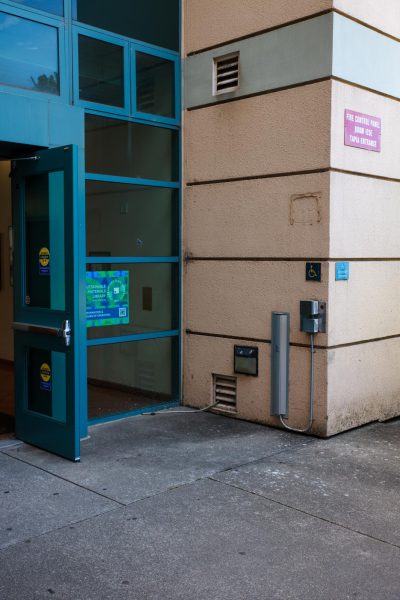 Entrance to Humanities Building, San Francisco State University. (Peter W. Ngugi / Golden Gate Xpress)
According to SFSU’s mobility transportation policy, passengers are allowed a maximum three-minute leeway period to arrive and board their shuttle before the driver is obligated to move to their next request.
Woodfin explained that new drivers are no longer allowed to touch her mobility aid, something that was not an issue with previous driving volunteers in the past.
“My driver said, ‘We’re not allowed to touch your belongings,’ and I thought that was strange since every other driver was more than willing to help me load the walker into the cart,” Woodfin said. “He eventually did help me after I asked, but explained that his hesitation was because of some new policy they had introduced.
When Aleskovski isn’t studying music, she’s participating in the Disability Rights, Education Activism, and Mentoring organization as event coordinator.
Aleskovski mentioned that when she first enrolled, the shuttle service was run by the DPRC and provided five years of reliable service. While she hasn’t experienced any outrageous wait times or tardiness with the new shuttle, she hopes to see it return to the DPRC.
According to DPRC representative Dai To, as of January 2026, all requests for shuttle services must be filed with Parking & Transportation. Police are used as substitute drivers after DPRC’s closure at 4:30 pm and if no other community service specialist is on hand at the time.
Aleskovski hopes that one day the school can afford the volunteer training necessary for the shuttle to be a DPRC-run service again.
The reality shared by students and faculty about accessibility on campus shows how the inclusivity the school prides itself on is eroded by negligence. Issues like shoddy door buttons, poorly-designed dorms, and an inconsistent cart service remain, while money is continuously spent on newer, shinier buildings while ones that have stood for decades receive little to no maintenance.
“We’re somewhat wasting our budget,” Aleskovski said. “Not on bad things necessarily; it just isn’t getting to what we need as students with disabilities”
The promise of inclusivity does not merely happen on words. It is performed through consistent action that shows a sustained commitment to helping, not through making small concessions that hardly get fixed.