
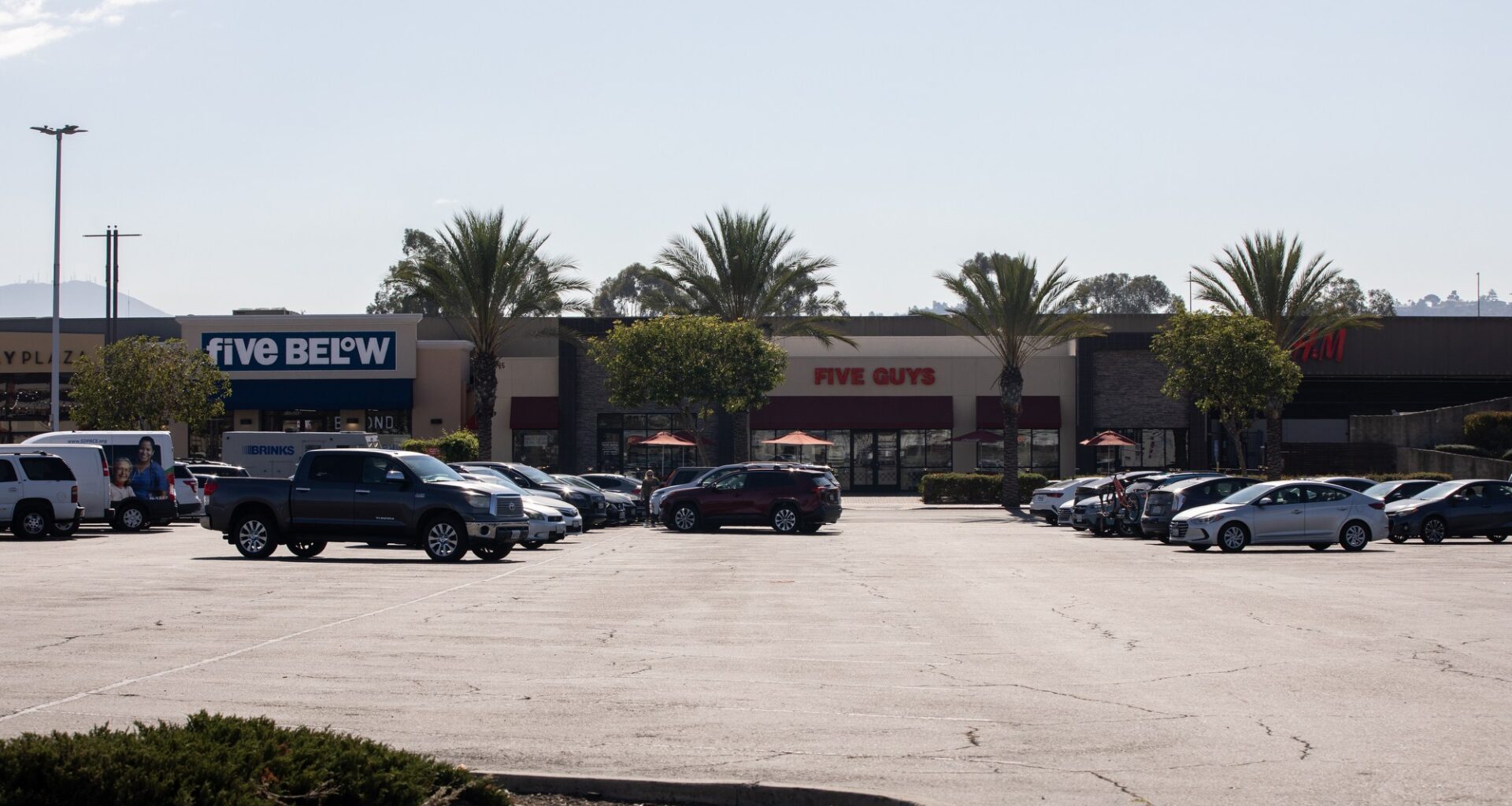
City leaders in El Cajon are weighing options — including eminent domain and partial ownership — to prevent Parkway Plaza from becoming a dead mall.
The City Council last week was presented with an analysis of options to potentially acquire, control or influence the owners of Parkway Plaza, an 80-acre site at the interchange of Interstate 8 and Highway 67. The city has not announced a formal appraisal of the site, but a 2021 market analysis estimated the shopping center’s value at about $150 million.
A once-thriving commercial and social hub, the mall was one of the city’s top tax revenue sources during its heyday.
Officials recently revived a stalled plan to potentially redevelop the mall, citing concerns for its long-term viability and the revenue hit the city could face if it fails. Revitalization of the mall could increase the city’s annual revenues by at least $10 million, according to an earlier report by Hunden Partners.
“It’s hard to have these conversations with the development community because we have no control,” City Manager Graham Mitchell said.
Central to the issue is Parkway Plaza’s complicated ownership structure.
For decades, the shopping center was separated into different parcels, each with different owners. For instance, Sears and Macy’s each owned plots at opposite ends of the mall, while — for many years — Westfield Group owned the mall’s central parcel and commercial strip center until selling the properties to Starwood Capital Group in 2013.
The group subsequently lost control and ownership of the property in 2020, following a series of tumultuous financial transactions, resulting in “significant” unsecured debt on the property, according to deed records and a staff report.
Golden East Investors and Pacific Retail Capital Partners were selected by court-appointed trustees to restructure ownership of the properties, but what’s left is a complex debt arrangement with repayment requirements that continue to “challenge the property,” Mitchell said.
The city’s efforts to revitalize the mall kicked into gear about two years ago when Walmart, a Parkway Plaza anchor tenant, announced it would not renew its lease, further amplifying concerns surrounding the outstanding debt.
“Most property owners have a vested interest to see the long-term growth of their property,” Mitchell said. “A trustee does not have that motive; their motive is either to fill it with as many tenants as it possibly can, to become profitable to sell it for as much as it can, or just to pay off its debt.”
As it stands, the mall’s ownership is split into four parcels, each owned by a different trustee. The left portion of the mall, which includes a large chunk of parking spaces and a recently added Kid’s Empire indoor playground, is owned by Citivest.
The central portion of Parkway Plaza is owned by Starwood Capital Group, which includes tenants such as JCPenney, Dick’s Sporting Goods and the shuttered Walmart storefront.
Tourmaline Capital owns the mall’s rightmost portion, which includes Macy’s.
Most recently, the adjacent “power center” portion of the mall sold for $31.5 million to the Tabani Group, a Texas-based real estate firm.
Officials were presented with the city’s options for potential acquisition or control of the property, ranging from a development agreement, a long-term ground lease agreement, partial ownership to acquisition of the entire mall space.
Their options were ranked by monetary risk and the resulting levels of control each would provide.
The highest-risk choice is eminent domain, where the city seizes the property. But that route comes with significant challenges, Mitchell said, noting it would cost more than a voluntary acquisition and could involve a yearslong court battle.
“There are reasons why municipal governments are not the best suited to own and manage real estate,” a staff report reads. “Typically, the private sector is more effective, efficient, and unhampered by governmental regulations.”
The most prominent example of the use of eminent domain in the region is the city of San Diego’s use of condemnation powers to build Horton Plaza. In 2022, the San Diego City Council used eminent domain against Fashion Valley Mall to acquire private retail land for a water pipeline extension project.
Councilmember Phil Ortiz described El Cajon’s situation as “extraordinarily complex,” noting the city’s role is to bring together developers, stakeholders and the community to find the solution.
“We have to show the development community that it’s one of our highest priorities to see Parkway Plaza at its highest and best use, and that we as a city council are willing and ready to engage, make investments and make concessions.”
Councilmember Michelle Metschel said she wants the city to continue engaging with the mall’s ownership, but said she preferred a partnership that is “low risk to the city.”
Noting other city-owned assets that have become “somewhat troublesome,” Metschel said she preferred avoiding going down the acquisition route. “We shouldn’t be in the mall business,” she continued.
Advancing the overhaul plan could also motivate the current owners to further their own revitalization efforts, Mayor Bill Wells said in an interview.
The city is hosting a town hall meeting at the Ronald Reagan Community Center on Oct. 1 to share preliminary site concepts and gather input from the community.
Officials continue to develop their land-use plan and hold closed-door negotiations with the mall’s ownership, leaving the fate of the once-thriving commercial hub up in the air.
“I’m mostly interested in strategies to be successful, which I think might be better as a closed session discussion, so I’ll leave it at that,” Wells said.