
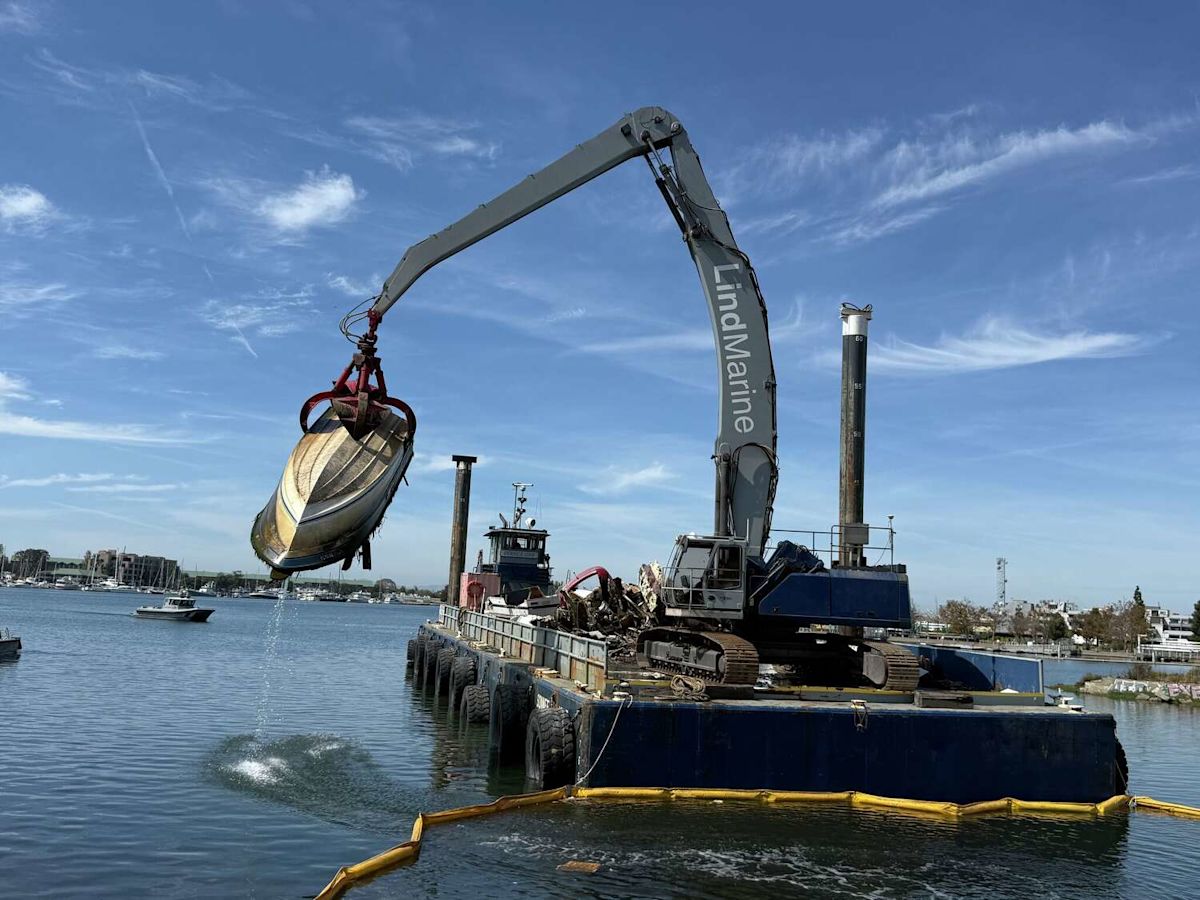
For years, derelict boats littered the Oakland Estuary, at times serving as sites of drug activity, or obstacles kayakers would evade before the decaying vessels sank, spewing diesel, sewage or other pollutants into the water.
Then, last week, floating cranes arrived at the waterfront, extracting waterlogged boats in the latest effort to clear the estuary that runs along the shoreline connecting Oakland and Alameda. The channel carries commercial ships to and from the Port of Oakland, while families use its waters for canoeing and stand-up paddleboarding. But abandoned and sunken vessels have long cluttered the estuary. So far this year, Oakland has removed more than 50 boats and local officials intend to remove more sunken vessels over the coming weeks.
“These boats are causing lots of problems. They’re modern-day pirates, committing crimes from the boats and onto the shore. That’s not going to continue to happen,” Oakland Police Captain James Beere said at a press conference Thursday. “We’re reclaiming the waterfront for the public.”
Six months ago, about 40 vessels had either sunk in the waterway or were moored there illegally, Beere said. Sunken boats can leak toxic fluids into the water. Last year, the Coast Guard responded to 60 pollution cases in the estuary and spent $50,000 from the Oil Spill Liability Trust Fund, Lt. Cmdr. Carey Lewis said.
“This has been a herculean effort to get to this point,” Lewis said. “It’s a significant milestone for the estuary.”

Oakland Police Chief James Beere said the derelict boats in the Oakland Estuary have, at times, become hubs for criminal activity. (Brock de Lappe)
Beyond the environmental concerns, the illegally anchored boats sometimes became hubs for criminal activity. Beere said some boats served as “mobile meth labs” and others had weapons on them, including assault rifles and pistols.
“It’s not just an eyesore,” Beere said. “It wasn’t uncommon for officers to board boats and come into contact with people with assault rifles, pistols. They were mooring the boats out here and then entering private properties and committing burglaries. This is nothing new.”
Mary Spicer, who founded the I Heart Oakland-Alameda Estuary, an organization that arranges volunteer clean ups of the waterway, said she has seen a massive difference in the number of derelict boats in recent months. Recently, several illegally anchored boats were cleared from a cove near Jack London Aquatic Center.
“It’s honestly like a breath of fresh air,” she said, referring to the clean up. “Our community has had to really fight to raise awareness around this issue.”
Before official enforcement intensified, Spicer’s organization created a sunken boat map, where she identified roughly forty boats in the waterways.
“We are used to being able to go and paddle or kayak or boat without the concern of an unmanned vessel moving in front of you, or a sunk boat hitting your boat,” she said. “To actually have that stability and safety for our community, it just means a great deal.”
Subscribe
There’s more to San Francisco with the Chronicle. Subscribe today for just 25¢.
This article originally published at Police say abandoned boats fueled crime on Oakland’s waterfront. Now comes the cleanup.