
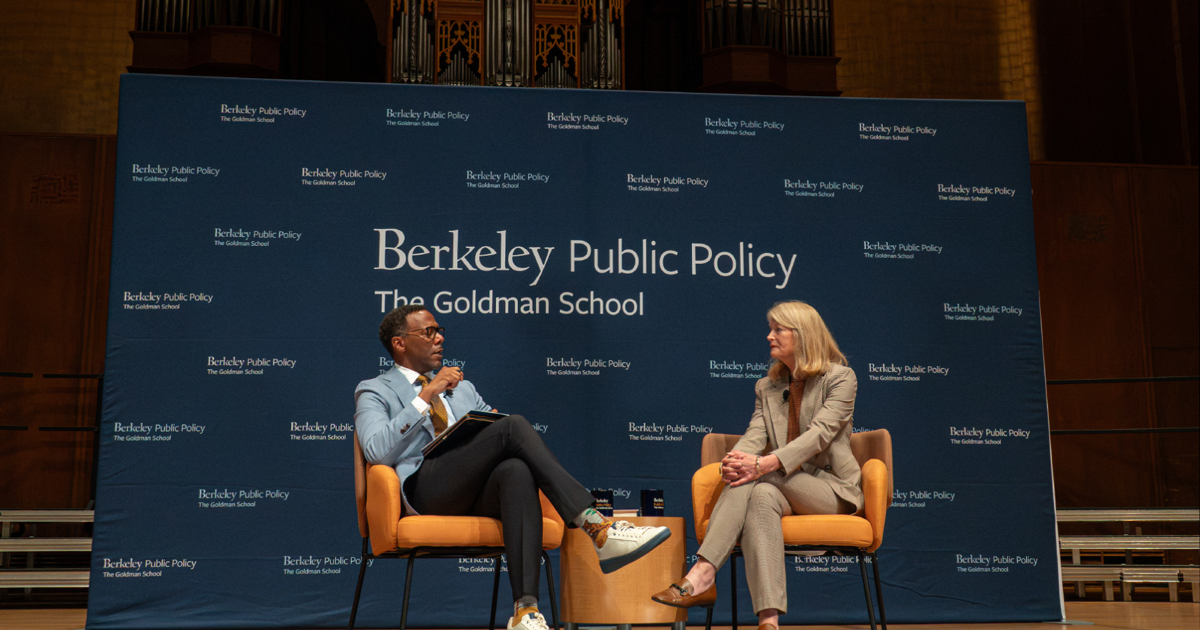
U.S. Senator Lisa Murkowski reflected on her political career and the role of party politics in governance during her visit to UC Berkeley Friday, Sept. 25.
Murkowski, who represents Alaska, joined the Goldman School of Public Policy Dean David Wilson at Hertz Hall for a talk on public service and bipartisanship. The event was part of the Goldman School’s “Democracy Book Club” series, following the publication of Murkowski’s 2025 memoir.
“The audience was over-the-top fabulous,” Murkowski told The Daily Californian. “It’s beautiful in Berkeley. First visit, and so this is pretty special.”
Before an audience of students and visitors, she detailed her path into public service, beginning with the parent-teacher association at her sons’ school in Anchorage and later detailing how she joined the Alaska Legislature when the state was suffering from budget deficits.
Murkowski recounted her support for reinstating income tax to address the shortfall. For her, losing office was a risk she was willing to take.
“It seems like everyone is afraid of a political shadow — that if I do something, if I say something, I’m not going to be elected,” Murkowski said. “We’re so focused on staying in power, staying elected, we forget why we wanted to use this position … Why are the people in Alaska sending me here in the first place?”
Although a registered Republican, Murkowski is commonly known as a centrist working to bridge the Senate’s gap in bipartisanship.
During the talk, she described party control over congressional issues as “one of the most damaging things that (is) happening.”
“We are unable to work constructively, to work on a bipartisan basis, in a way that I think most people assume is happening,” Murkowski said.
“I think definitely there’s some disagreements most Berkeley students could have with Senator Lisa Murkowski … especially when it comes to economic policies, tax policies, labor policies,” said UC Berkeley student Brandon Maskey.
Maskey praised Murkowski’s ability to “hold out as one of the many swing votes” in Congress and “stake out different priorities,” referencing her deciding vote to pass President Donald Trump’s One Big Beautiful Bill Act in 2025 after winning concessions for Alaska.
Wilson said the Goldman school welcomes perspectives from across the political spectrum, despite Berkeley’s left-leaning reputation.
“You may see Berkeley as historically progressive, liberal or Democratic, but we are not exclusively progressive, liberal or Democrat,” Wilson said. “We are focused on solutions to public problems, no matter where they come from.”
Campus student Zebi Juraeva, an international student from Uzbekistan, connected Murkowski’s remarks to her own reasons for studying politics in the United States.
“She said that it’s very important to realize why you’re there in the first place. You’re there to represent your people,” Jeruva said. “I think that was the biggest takeaway for me because it really resonates with me and why I’m here at Berkeley … to learn more and bring it back to my people, to my country.”