
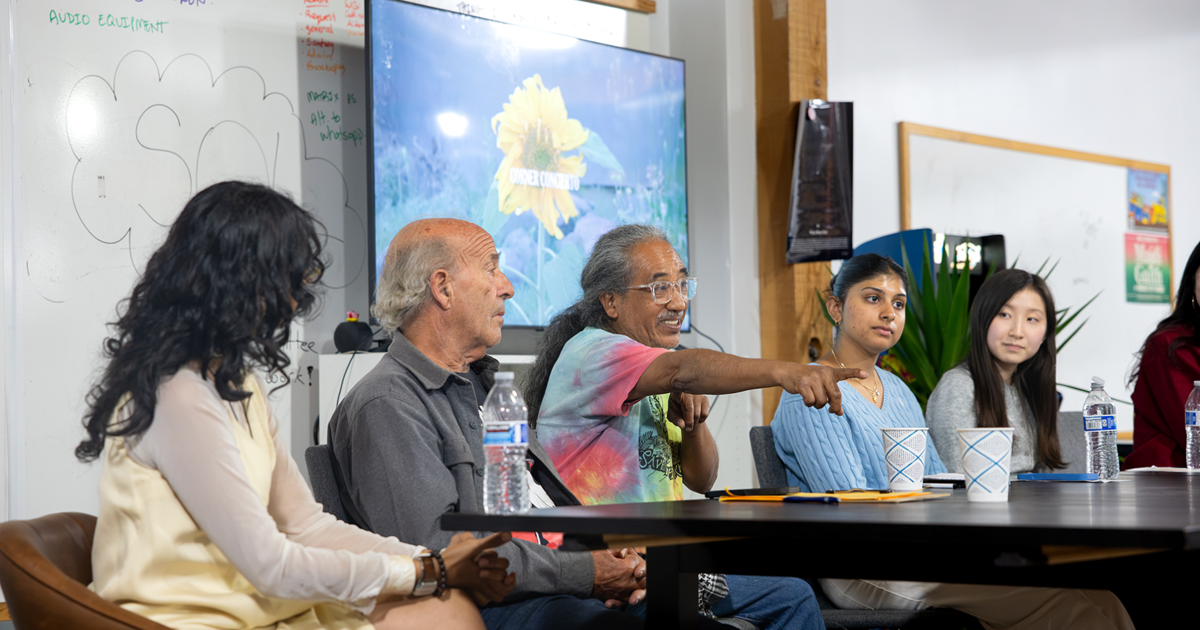
People’s Park activist and Berkeley City Council candidate Aidan Hill moderated a community forum Thursday to examine the persistence of the People’s Park community since the park was walled off for student housing developments in 2024.
The panel discussion featured former People’s Park residents and mutual aid groups that worked closely with the park community.
“We’re so desperate to fight for this place because it’s the only one that we have in the neighborhood that we call home,” Hill said.
People’s Park has been known as a notable site of political activism since the 1960s, though it later became primarily known for tent encampments, with the last one enduring until UC Berkeley closed the site in 2024.
Hill says the People’s Park community is still gathering for weekly meetings and open mic events in other locations around Berkeley. Free food is provided by East Bay Food Not Bombs, an activist organization that’s been serving People’s Park since the 1990s.
Additionally, the Suitcase Clinic, a UC Berkeley student organization offering free health services to underserved Berkeley populations, spoke at the event. Executive Director Michelle Choi, who was a panelist at the forum, said the organization used to regularly offer its services at People’s Park.
“We would love if there were to be a physical space where we could go and meet (people) where they are,” Choi said. “But now that space is kind of gone, and we’ve been struggling a lot to go to different encampments. So we just really wanted to connect to more community members through that panel too, to talk to people and figure out what’s the best way we can support them.”
According to UC Berkeley’s People’s Park Housing website, the housing project will include permanent supportive housing for more than 100 low-income and unhoused individuals, as well as providing open green space. But Hill is worried the complex won’t stay open to the community once it’s built, wanting the area to continue being a gathering space for the community, envisioning a basketball court, sign language training, artist programs and other supportive services.
Prior to campus’s closure of People’s Park, unhoused residents were offered temporary housing. But Erick Morales, a 10-year resident of People’s Park and current resident of University Homes, a supportive housing project, described feeling “not human” at the housing project and instead being treated like “a number,” a stark contrast to the community he had at People’s Park.
“We were a community. We did everything for our people,” Morales said at the forum. “Food Not Bombs, water, mental health, clean the bathrooms — all those things we did as a community. So I enjoyed that … it’s the best, ‘cause I lived it with love, I lived with my friends.”