
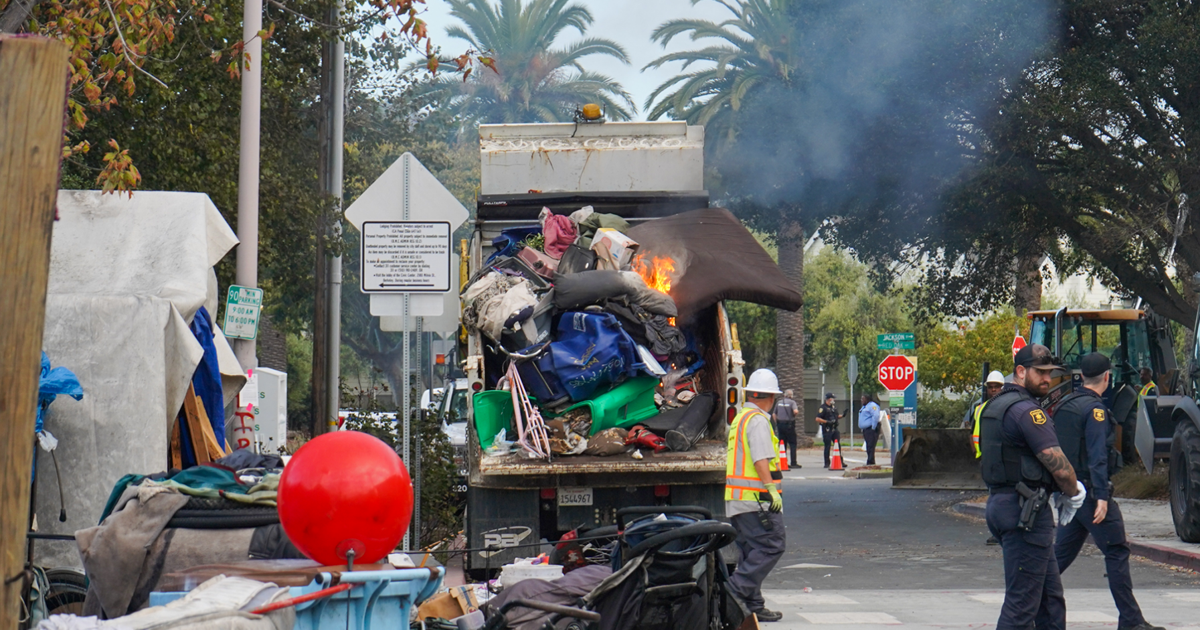
To no one’s surprise, the city of Berkeley swept the Eighth and Harrison streets encampment last week, evicting roughly 40 residents.
If the city’s goal is to dilute the visibility of homelessness by scattering a tight-knit community, built over years of interdependency, it has succeeded.
But history will inevitably repeat itself: Encampments will continue to pop up, and the city will have to pay, again and again, the financial and human toll of displacement.
So we on the Editorial Board can only ask: Now what?
Former residents of the Harrison encampment have relocated to spots at Ninth and Camelia streets, Fourth and Camelia streets and on Second Street. Residents who were exempted from the sweep based on continuing negotiations over Americans with Disabilities Act accommodations remain at the encampment site, along with residents who returned post-sweep, their belongings trashed, with nowhere else to go.
The prevalent arguments for encampment sweeps are self-contradictory. In execution, sweeps do little more than a disposable bandage does for an oozing wound, creating new burdens that disproportionately fall upon disabled residents.
To start, Bay Area sweeps have proved ineffective historically. An encampment at Oakland’s Union Point Park was swept 11 times before it was effectively cleared. In San Francisco’s Tenderloin, tents reappeared on sidewalks just days after the city’s Homeless Outreach Teams cleared the site. Even with the city padlocking porta-potties at night, homeless residents returned.
This pattern points to a self-evident truth: Sweeps only relocate homeless residents, leading either to more encampments elsewhere — often in more isolated areas that compromise the safety of these already vulnerable people — or to the immediate reinhabitation of the former encampment sites.
Following trends of anti-homeless rhetoric, the city of Berkeley has continuously wielded public health concerns as justification for the sweep, citing allegations of leptospirosis in its legal battle against the Berkeley Homeless Union. However, the city’s justification operates on a sensationalized and inflated portrayal of public health risk.
In late 2025, leptospirosis was found in dogs and rats associated with the Eighth and Harrison streets encampment, however, no human cases were linked to the encampment. Elsewhere in Berkeley, two individuals contracted the disease after breeding rats a mile away from the Harrison encampment in a private RV, causing one to die. Yet city documents repeatedly cited concerns about rodents, debris and unsanitary conditions to portray the encampment itself as a persistent threat. As a result, in mainstream media coverage, the encampment became publicly synonymous with the “rat-borne disease.”
If the city is truly motivated by public health risks, the Editorial Board urges the city to confront its own complicity in the site’s conditions. In framing the encampments as a source of danger, Berkeley can overlook how municipal neglect may have endangered its own residents, resting comfortably in its claim to innocence. Even more insidious, the city of Berkeley has not just been a spectator of the encampment conditions, but an active perpetrator of the public health crisis they blame on homelessness. In anticipation of a sweep, the city removed the site’s dumpster. Since the removal in 2025, the city has failed to restore it, leaving residents with no choice but to pile trash up in the streets, manufacturing the very sanitation conditions that were later cited as justification for the sweep.
Evidently, the sweep takes no steps forward in the issue of homelessness, instead amplifying the topic’s present, harmful discourse. This past August, Lyanne Melendez, ABC7 News reporter and mother of a UC Berkeley student, posted a video of the encampment on X, shaming the city of Berkeley and UC Berkeley alike. The video went viral and the comments below agreed with her en masse. But such sentiment is not new. Two years ago, a coalition of northwest Berkeley business owners sued the city for not doing enough to clear the tents, calling residents and their tents “public and private nuisances.”
Now, with the encampments cleared, Mayor Adena Ishii can stand behind a camera and tout the sweep as a sign of good faith to Berkeley residents, proof of the city’s “concern” for safety, sanitation and aesthetics. But Berkeley residents should ask themselves: What, if anything, has been made better by pushing our unhoused neighbors out of sight? The villainization of our most vulnerable communities does nothing to remedy the issue itself.
The dominant rhetoric has normalized sweeps, establishing them as evidence that the government is actively dealing with homelessness. However, pushing an issue out of sight is nothing but an ostrich solution. Encampment sweeps are an act of negligence, a harmful rhetorical amplification, the ultimate refusal to confront the most visible consequences of poverty and social exclusion.
The city’s fight with the Berkeley Homeless Union brings up another uncomfortable question, namely what the city has spent to litigate and appeal against the BHU. The city, instead of directly attempting to solve the issue of homelessness, chose to divert its budget toward opposing the people organizing on behalf of the unhoused.
In the meantime, the bandage is infected — slapping it on the wound does nothing but worsen the rot. When encampments reappear, when people’s possessions are replaced, when the city must again and again defend its actions in court, then it becomes clear that Berkeley has not solved homelessness. It has simply paid to scatter the problem.
The city, with its agenda-setting and rhetorical authority, has both the opportunity and obligation to leverage equitable legislation to educate the public on humane and effective responses to homelessness, at least until its budget can effectively suture the wound. When the court of public opinion amplifies a solution with no feasibility, the city must rise. Public opinion and rhetoric surrounding homelessness have a long way to go. The loudest voices surrounding homelessness argue that the encampments are dangerous, unaesthetic and unsanitary. But the loudest voices are not always the most correct. Our elected officials are beholden to the history, resources and awareness of city stakes, stakes that the public is not required to consider.
Thus, the Editorial Board posits that the city has an obligation to advocate for its residents — all their residents, including the unhoused ones.
The Editorial Board demands that the city stand behind its action: If it continues to clear the encampments, Berkeley must publicly publish its report detailing the health, economic and displacement benefits and consequences of the sweep. Residents deserve access to these outcomes to make informed decisions.
We call on Berkeley residents to look out for one another. We urge you to bear in mind that members of Berkeley’s unhoused population are also residents. Reject the sweeps, change the conversation.
Preserve space for unhoused residents to organize, advocate and remain a part of the civic community. It is through the collective project of compassion and solidarity that we move toward housing and justice.