
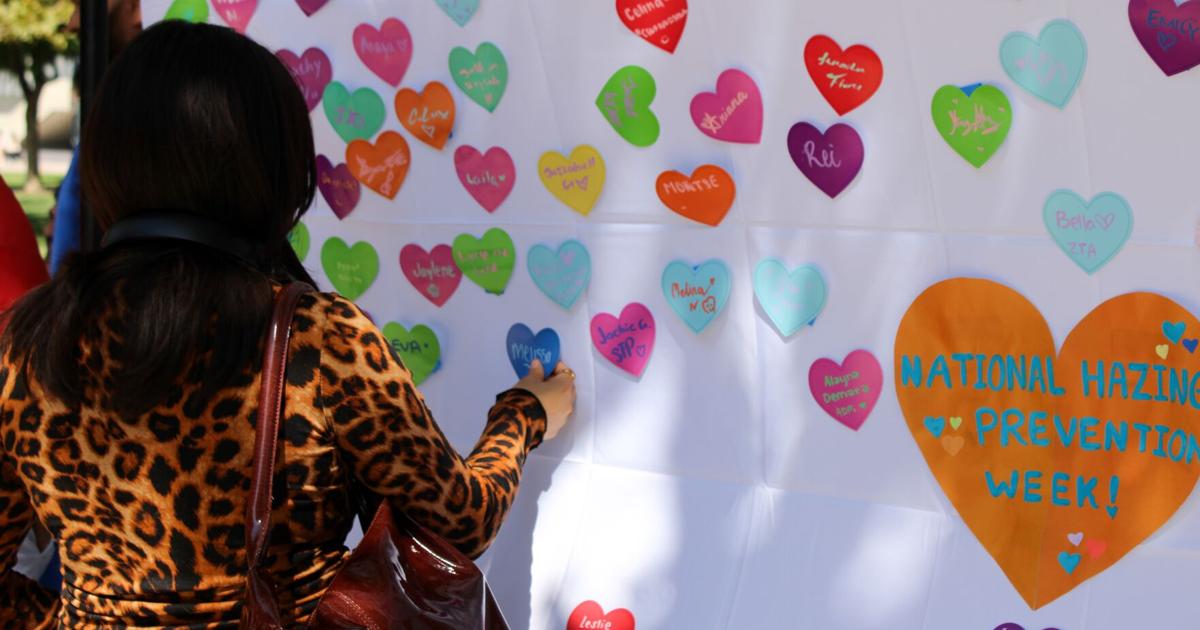
Cal State Fullerton recognized National Hazing Prevention Week last week with events focused on raising awareness of hazing and promoting respect and belonging on campus.
National Hazing Prevention Week is an annual campaign that is held in the last full week of September, focused on educating students and campus communities about hazing and encouraging them to create safer environments.
CSUF Student Life and Leadership (SLL) hosted the tabling event “These Hands Don’t Haze” on Wednesday at the Titan Walk, which encouraged students to pledge against hazing and to teach more about how to prevent it within campus organizations.
Leslie Quintana, a first-year master’s student in higher education and graduate assistant for SLL’s club sports program, said the activity reflects the university’s stance against hazing and encourages students not to feel pressured to participate.
“We want to prevent that (hazing) from happening,” Quintana said. “Just for the safety of all our students, but also for the communities and for everyone to feel safe and welcomed in an environment like Cal State Fullerton.”
CSUF defines hazing as the intentional, knowing or reckless conduct connected to joining, affiliating with or maintaining membership in a student organization that poses a risk of physical or psychological injury. The university lists activities such as forced consumption, sleep deprivation, confinement, dangerous physical activity and humiliation as forms of hazing.
The university also states that a person’s willingness or consent to participate does not excuse hazing. Students who participate may face disciplinary action, including possible expulsion from campus.
Hayden Fielding, a third-year American studies student, participated in the “These Hands Don’t Haze” event after passing by Titan Walk and said that hazing deserves more attention.
“The more outreach we get, the more names we can get out there, the more people talking about it,” Fielding said.
Fielding said that for events like this, tabling activities can help encourage more students to discuss hazing and potentially lead to stronger rules.
SLL also hosted a panel on Thursday featuring guest speaker Sara Lowery, the associate director of fraternity and sorority leadership and learning at the University of Delaware.
The panel, titled “Not Us, Not This Time: A New Approach to Hazing Prevention through a Culture of Care,” was held at the Laurel Multipurpose Room and advocated for organizations to move beyond simply complying with hazing policies and instead develop a systemic “culture of care.”
Isabel Mendez, a third-year psychology major, said students should not feel pressured to participate in harmful activities to fit into an organization or community.
“I feel like we all should be feeling like we deserve to fit in, no matter what, no matter if we want to participate in things or not,” Mendez said.
CSUF’s Campus Hazing Transparency Report lists no substantial hazing incidents during the Jan. 1 through June 30, 2026, reporting period. The university requires hazing prevention training for all student organization presidents, treasurers, student-athletes and members of social fraternities and sororities.
The 2026 Annual Security Report, which includes public safety data and procedures, was the first to include hazing statistics pursuant to the Stop Campus Hazing Act. The report stated that there were two reports of hazing in 2025.
Students who witness or experience hazing can submit an anonymous report through CSUF’s incident reporting system. Students can also contact the Dean of Students Office or SLL for guidance and support.