
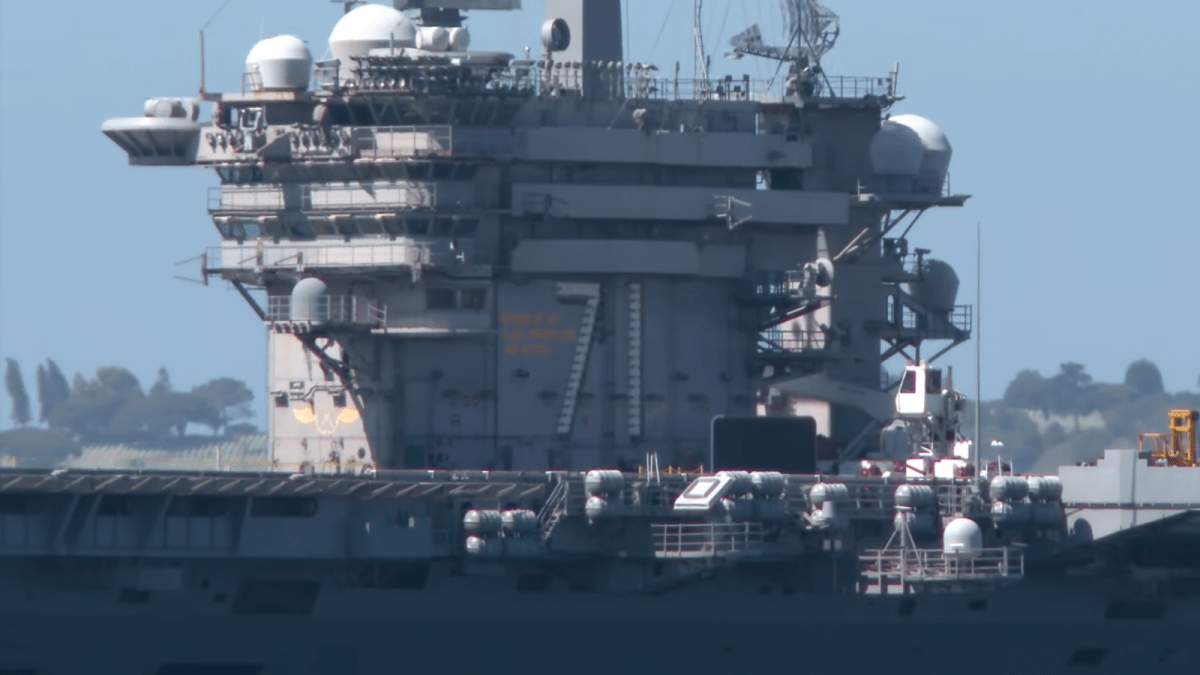
USS Theodore Roosevelt deployed from San Diego on Sunday as the nuclear-powered aircraft carrier prepares to head toward the Middle East amid the ongoing war against Iran.
The San Diego-based carrier is expected to relieve Yokosuka-based USS George Washington in the Middle East. Its departure comes as another San Diego-based carrier, USS Abraham Lincoln, continues its journey home following a historic deployment lasting more than 300 days.
A spokesperson for the U.S. Third Fleet shared a statement with NBC 7 about USS Theodore Roosevelt’s deployment.
The Theodore Roosevelt Carrier Strike Group is underway conducting routine operations in the U.S. 3rd Fleet area of operations. An integral part of the U.S. Pacific Fleet, U.S. 3rd Fleet leads naval forces in the region and provides the realistic, relevant training necessary to execute our Navy’s role across the full spectrum of military operations – from combat operations to humanitarian assistance and disaster response. U.S. 3rd Fleet works together with allies and partners to advance freedom of navigation and overflight, the rule of law, and other principles that underpin security for the region.
Navy leadership said it was preparing USS Theodore Roosevelt for what could become an extended deployment. Three weeks before the carrier’s departure, the chief of naval operations acknowledged challenges aboard USS Abraham Lincoln in a video posted to social media and said lessons learned were being applied to USS Theodore Roosevelt in anticipation of a potentially extended deployment.
USS Theodore Roosevelt and USS Abraham Lincoln are similar nuclear-powered aircraft carriers and serve as flagships of carrier strike groups, which include other ships such as guided-missile destroyers.
USS Abraham Lincoln has been deployed for more than 300 days, with the vast majority of that time setting new records for the longest consecutive time spent at sea.
Concerns aboard USS Abraham Lincoln have included food, rest and mental health. A letter from acting Secretary of the Navy Hung Cao confirmed eight suicide attempts among the roughly 7,500 sailors and Marines in the Lincoln Carrier Strike Group.
USS Abraham Lincoln is now getting closer to home. A bipartisan congressional oversight visit was held aboard the carrier for the first time since it deployed in November following repeated requests from lawmakers.
San Diego Rep. Sara Jacobs said she was aboard the ship Sunday and spoke with sailors, Marines and leadership about logistics, supply issues and what will change moving forward. Jacobs continued to call for accountability and an end to the war.
Yesterday, I joined a bipartisan Congressional delegation to conduct in-person oversight of the USS Abraham Lincoln, which is currently en route to its home port of San Diego. I spoke directly with sailors, Marines, and leadership aboard the ship. Here’s what I learned. 🧵 pic.twitter.com/iL8lnc7M2L
— Congresswoman Sara Jacobs (@RepSaraJacobs) September 28, 2026
Sen. Alex Padilla, who visited Naval Base Coronado within the last few days, also criticized the administration’s response to congressional oversight efforts.
“This administration has been anything but forthcoming let alone honest when members of congress are asking questions and trying to do our job of conducting oversight, which is why I think coming to meet folks here in the field to get a little more of a picture of what the challenges and needs are,” said Padilla.
The Navy has 11 aircraft carriers, three of which are currently homeported in San Diego. USS Abraham Lincoln is expected to relocate to Bremerton, Washington, after its homecoming.
This story was originally reported for broadcast by NBC San Diego. AI tools helped convert the story to a digital article, and an NBC San Diego journalist edited the article for publication.