
Join us for the fourth CicLAvia Sunday of the 2026 season—and our 68th CicLAvia Sunday since 2010! CicLAvia—Heart of LA is happening on Sunday, October 11th, from 9am to 4pm.
This marks the 18th Heart of LA route, which has taken place almost every October since CicLAvia’s launch in 2010! This year’s 6.5 mile route links the civic heart of our city to the vibrant communities of Echo Park, Chinatown, Little Tokyo, and Boyle Heights for a fun-filled car-free day!
Check out our Interactive Digital Map to plan out your day, and keep in mind that CicLAvia is not a race. Enjoy the event at your own pace, snap some photos, and learn some history with us at CicLAvia—Heart of LA.
Civic Center
The intersection of 1st and Broadway marks the point where the three different legs branch out on the route. Within a block are two Metro Rail stations, Historic Broadway and Civic Center/Grand Park, giving easy transit access from much of the city. This section of Downtown is characterized by civic buildings, which serve as the seat of government for both the City and County of Los Angeles.
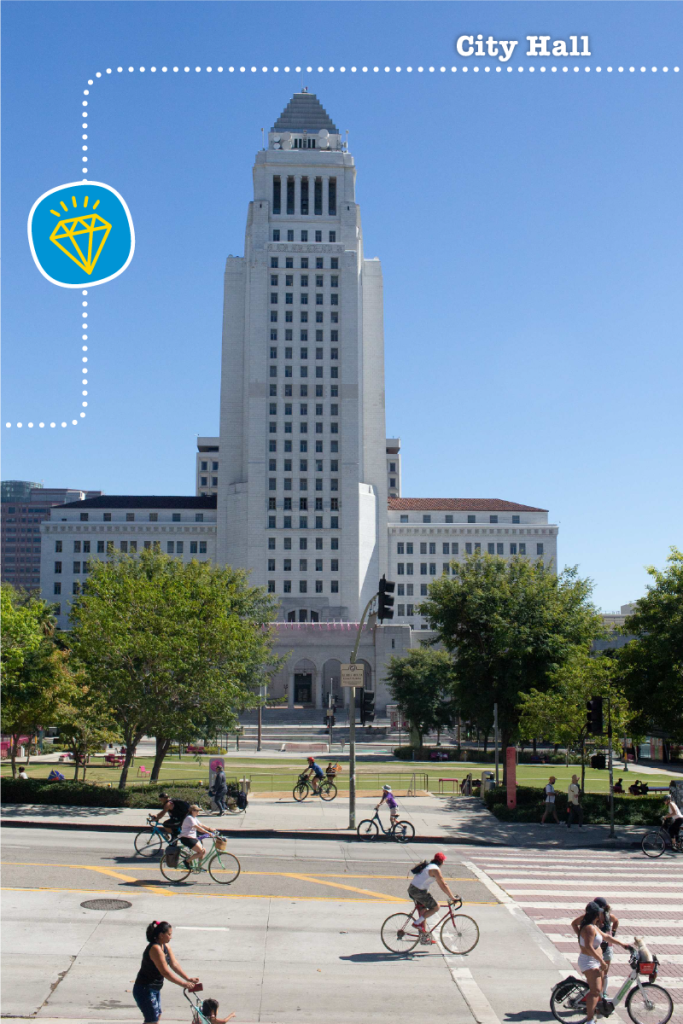
200 N Spring St, Los Angeles, CA 90012
Completed in 1928, this Art Deco landmark was the city’s tallest building for many years and still serves as the center of government for the City of Los Angeles. Inside are the mayor’s office and city council chambers. During office hours, you can ascend to the 27th floor to enjoy the open-air observation deck, which offers marvelous views of Downtown. Entry is free and open Mondays through Fridays.
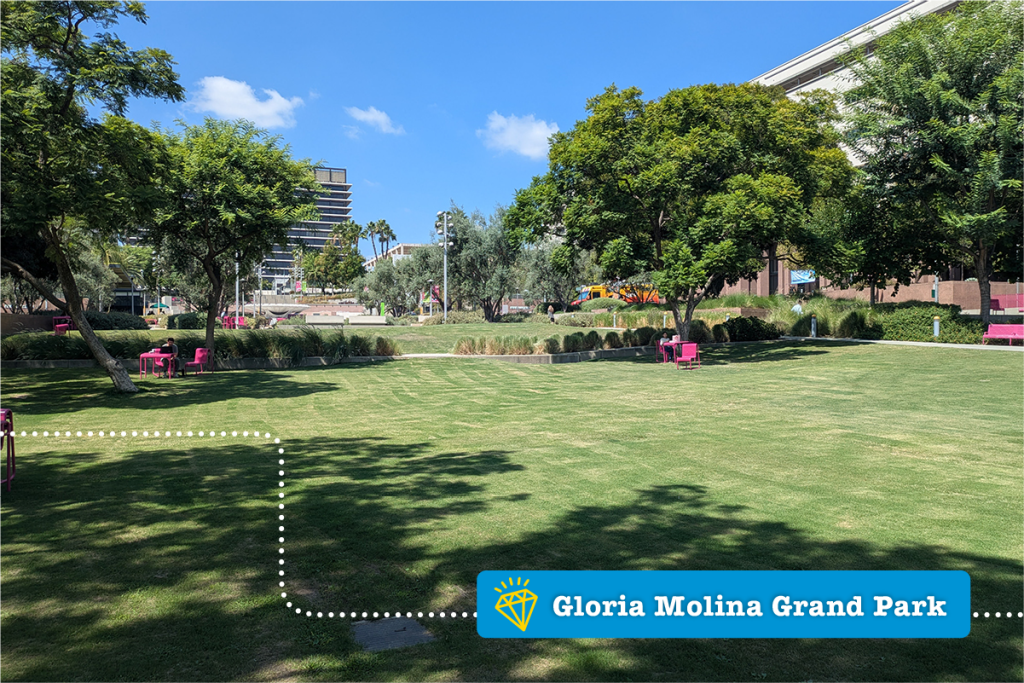
200 N Grand Ave, Los Angeles, CA 90012
Rising across several blocks from City Hall at the bottom to the Music Center on Grand Avenue, Grand Park is the focal point for the Civic Center and serves as an important gathering space for the city. The park hosts events throughout the year, from cultural festivals to concerts to an annual New Year’s Eve celebration, as well as political demonstrations. Near the top of the park is a fountain and splash pad, and throughout are plenty of lawns and seating that make it a good place to take a break and soak in the sun.
Los Angeles Sister Cities Monument
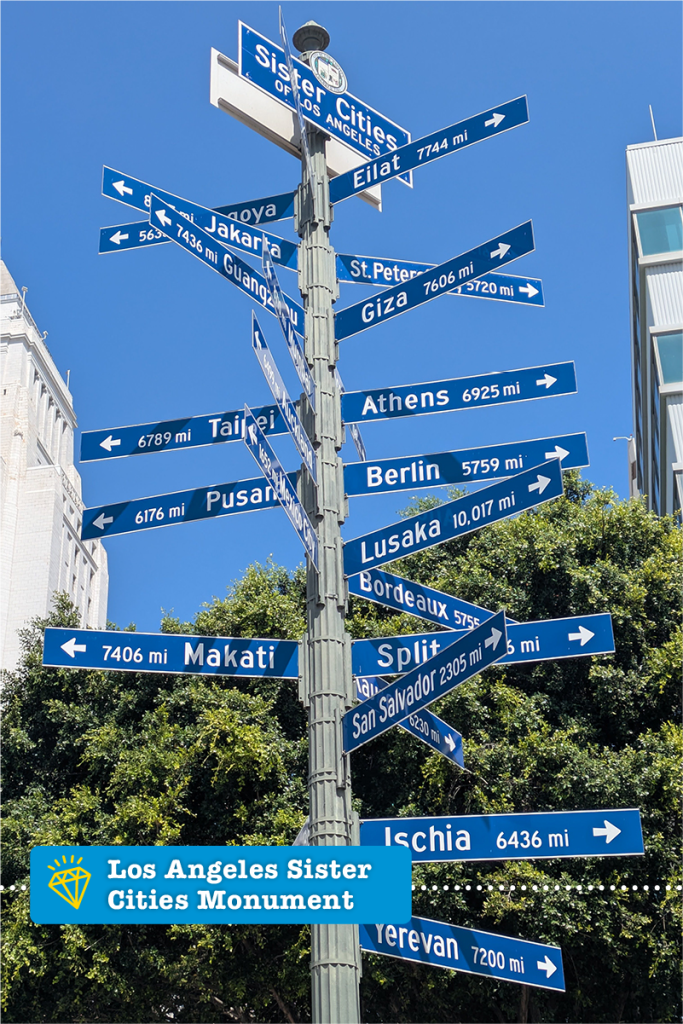
110 N Main St, Los Angeles, CA 90012
The Los Angeles Sister Cities Monument landmark sits on the corner of 1st and Main, just outside of City Hall South. It’s a public artwork commemorating the 25 Sister Cities of Los Angeles. The monument was designed to resemble a signpost, with signs pointing in the direction of each sister city. Adjacent to the monument is a clock tower gifted by the people of Nagoya, Japan, Los Angeles’ first sister city.
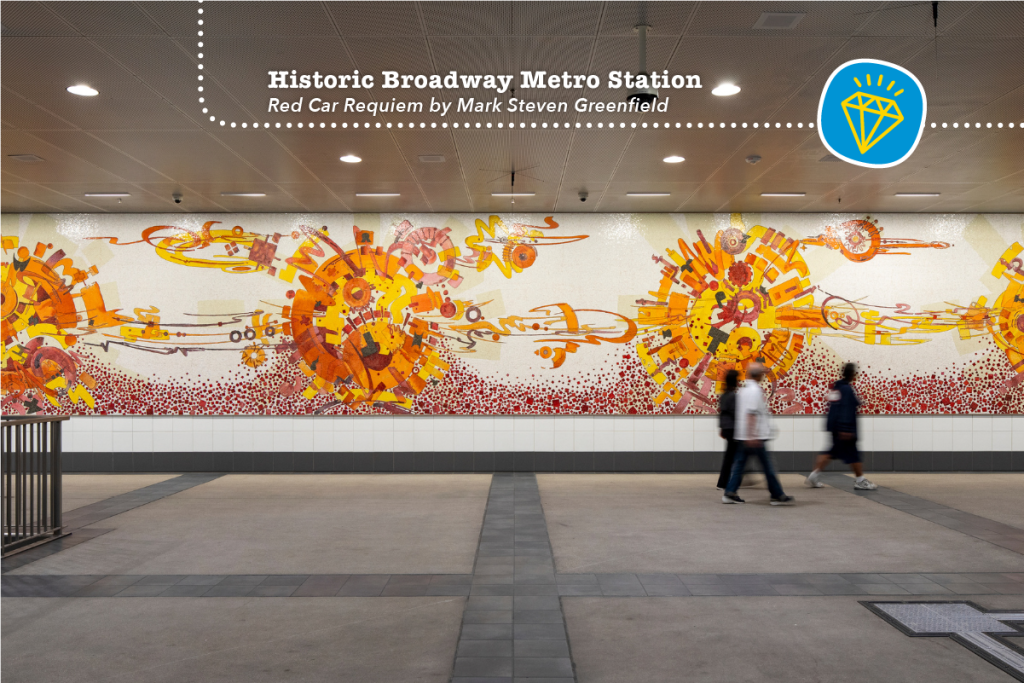
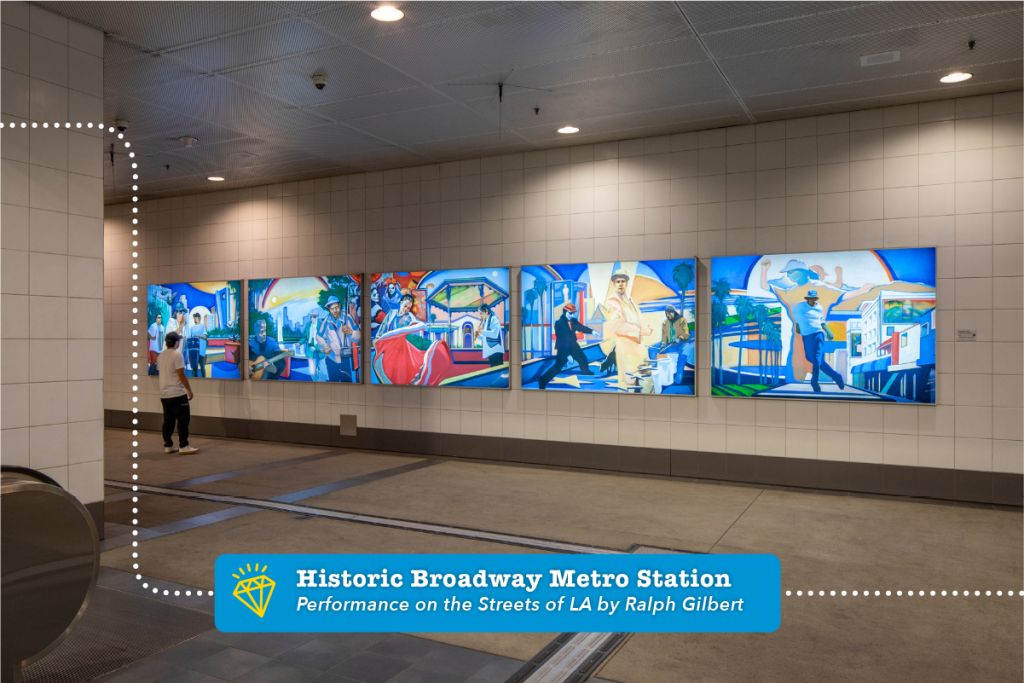
Details of Red Car Requiem by Mark Steven Greenfield and Performance on the Streets of LA by Ralph Gilbert. Photos courtesy of Metro Art.
202 S Broadway, Los Angeles, CA 90012
Directly on the route at the corner of 2nd and Broadway, this station provides access to the Metro Rail A and E Lines. Throughout the station are several compelling artworks that reflect the culture and history of the area. Inside is the whimsical Red Car Requiem by Mark Steven Greenfield, an abstract glass mosaic that pays tribute to the Pacific Electric streetcars of yesteryear, and Ralph Gilbert’s colorful Performance on the Streets of LA, which depicts street performers at many iconic LA locations.
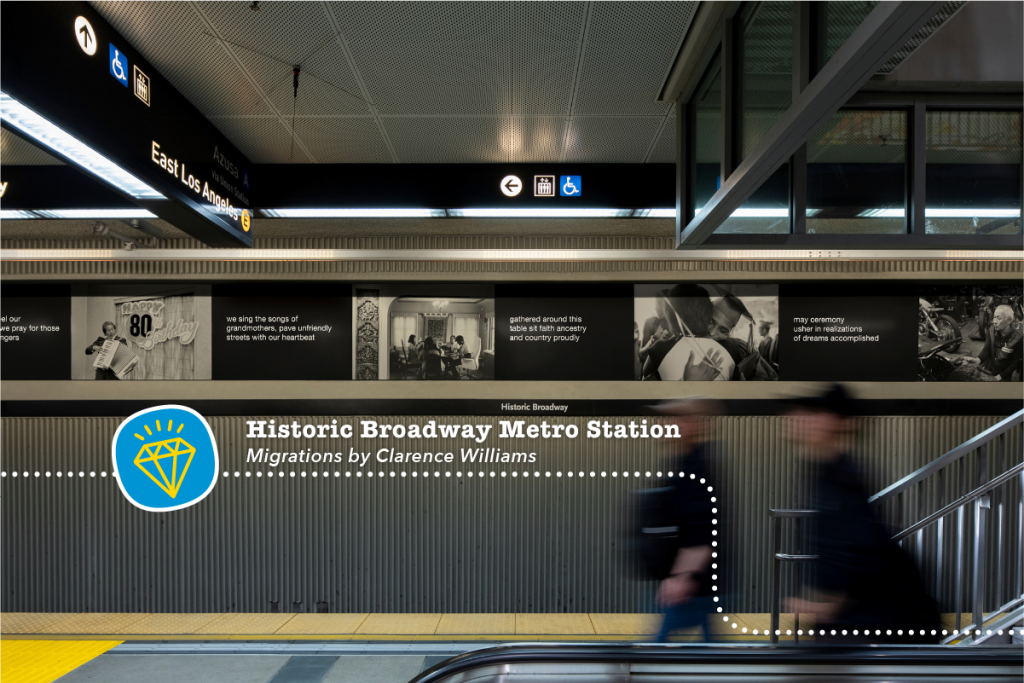
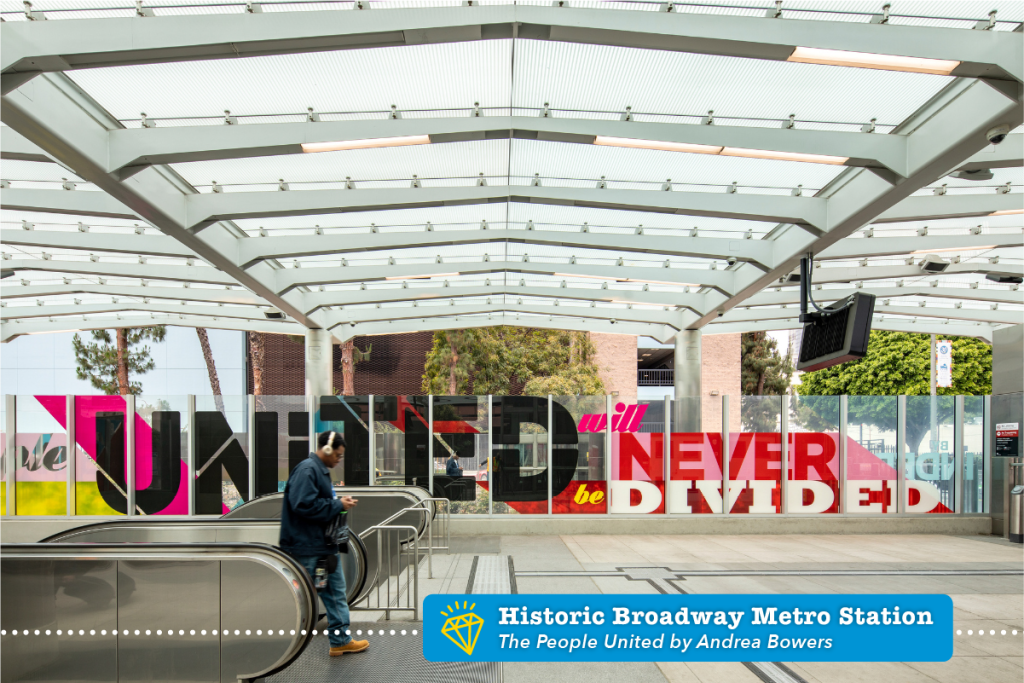
Details of Migrations by Clarence Williams and The People United (“El pueblo unido jamás será vencido,” Sergio Ortega and Quilapayun; “Brown Beret 13 Point Political Program,” La Causa) by Andrea Bowers. Photos courtesy of Metro Art.
Along the platform, Clarence Williams’ Migrations is a moving set of black-and-white photographs that honor Downtown’s legacy as an entry point for many migrants to Los Angeles. Glass walls of the station’s entrance pavilion are adorned by protest slogans in a work by Andrea Bowers, a nod to the many people who come here to exercise their political voice.
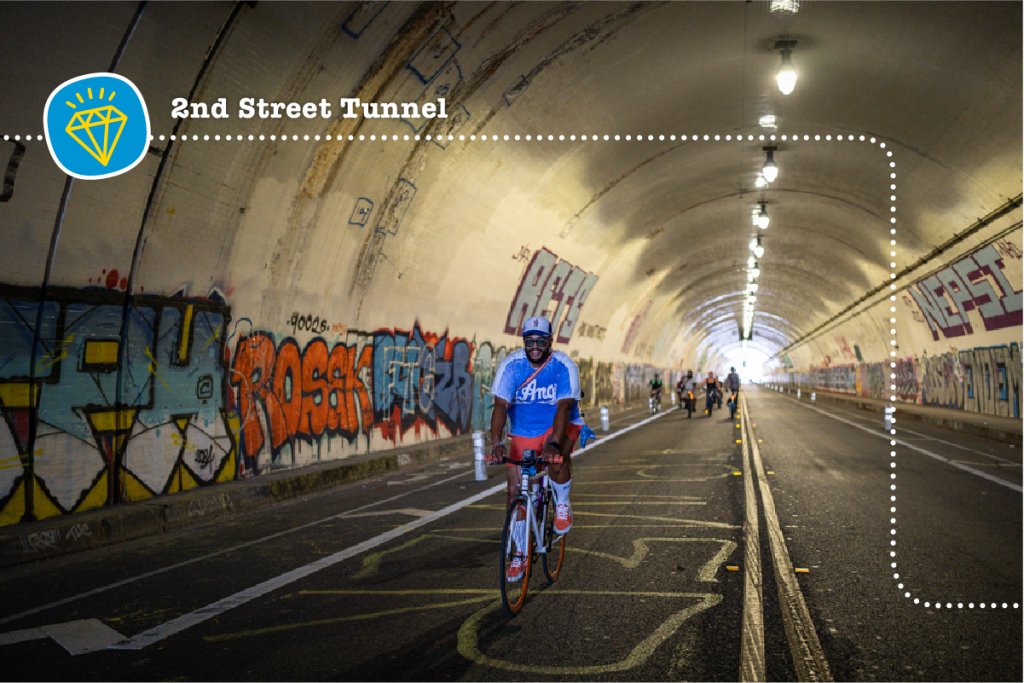
2nd St, between Hill St and Figueroa St
Spanning 1,500 feet under Bunker Hill, the 2nd Street Tunnel opened in 1924 and is often a highlight of the Heart of LA route for CicLAvia participants. It is common for people to cheer and ring their bike bells as they pass through, taking advantage of the tunnel’s acoustics. The tunnel is an extremely popular filming location, having appeared in countless car commercials and many famous movies and music videos, owing to the tunnel’s reflective white tiles.
Echo Park
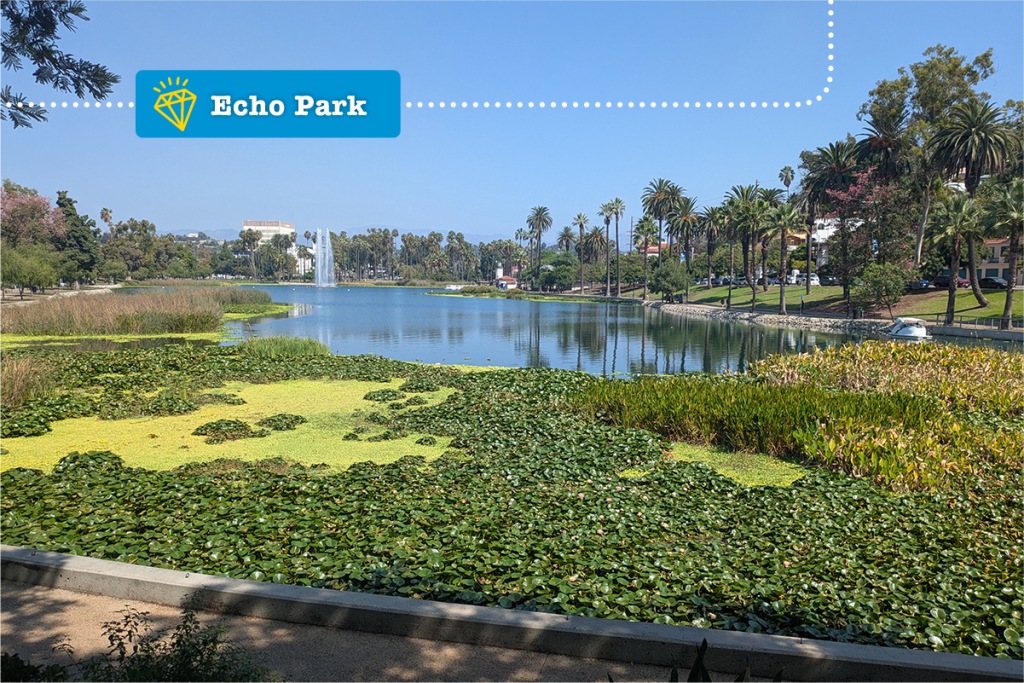
Northwest of Downtown, Echo Park is a vibrant and diverse neighborhood surrounding its namesake, Echo Park Lake. The lake was built in the 1860s as a reservoir for drinking water and makes up one of the oldest parks in the city. A towering spray fountain erupts from the center of the lake, framing one of the most iconic views of the Downtown skyline anywhere in Los Angeles. Around the lake, you’ll find restored wetlands, swan paddle boats, and plenty of ducks and geese that have made the park their home.
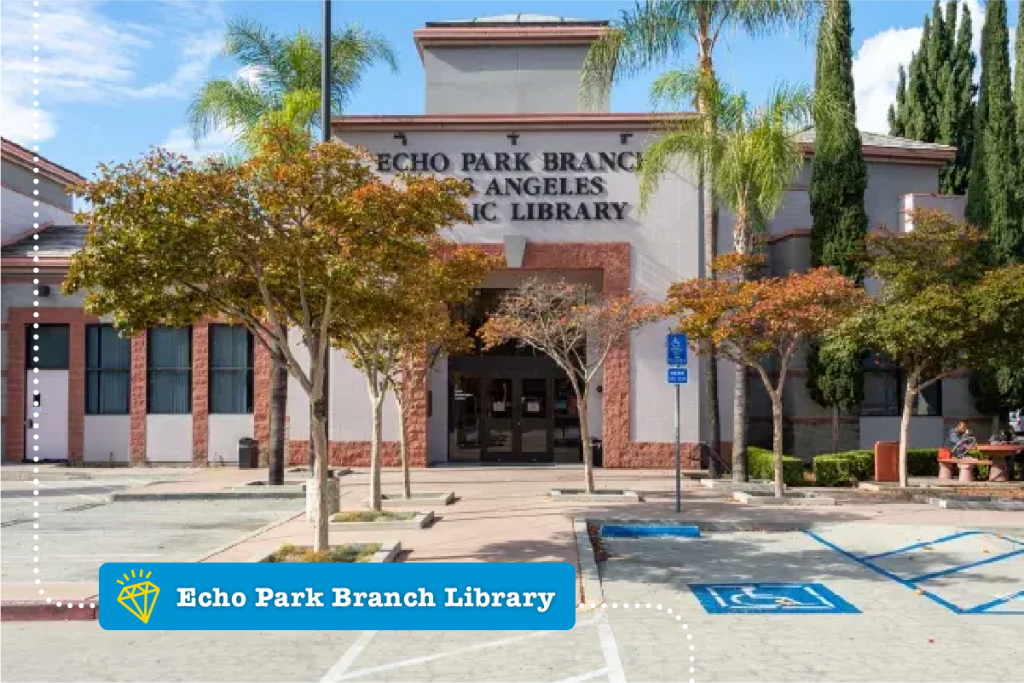
1410 W Temple St, Los Angeles, CA 90026
Located a few blocks east of the route on Temple Street, this branch of the Los Angeles Public Library has served the community for over a century. The branch started in the early 1900s as a depository for discarded books in an old Echo Park clubhouse and grew to have its own building in the 1920s. The current location was built in the mid-1990s and features a gallery wall of local artists’ works. A unique feature of the Echo Park Branch is the Philippine Heritage Collection, which includes over 1,000 books on Filipino American life and culture, reflecting the branch’s location on the edge of Historic Filipinotown.
A button featuring the Echo Park Branch Library will be available to purchase at the Echo Park Hub on CicLAvia Sunday!
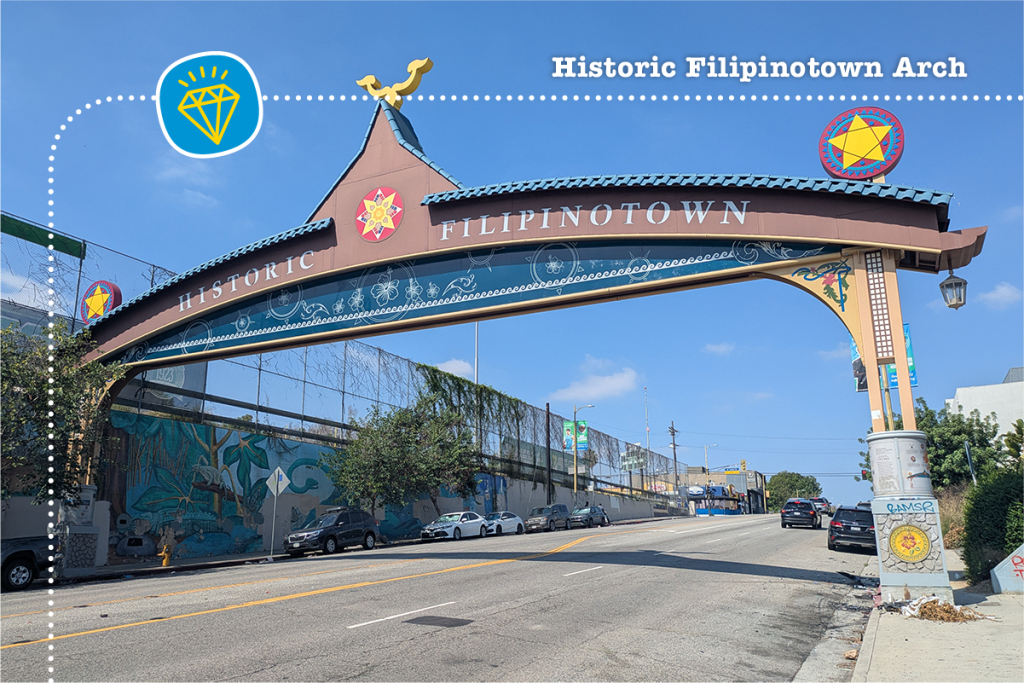
1539 Beverly Blvd, Los Angeles, CA 90026
A block west of the route, where 1st Street becomes Beverly Blvd, is this gateway marking the eastern entrance to Historic Filipinotown. This 30-foot-tall archway, officially called “Talang Gabay: Our Guiding Star,” serves as a monument to the local Filipino American community. The design of the arch is inspired by traditional Filipino architecture and features symbols of Filipino culture, such as a parol lantern and hibiscus flowers.

100 N Toluca St, Los Angeles, CA 90026
Just a short way off the route, a block east from where 1st Street crosses overhead, this 10.5-acre park provides natural serenity and vital green space for the neighborhood. Throughout the park you’ll find walking trails, grassy meadows, native plants, a naturalistic grotto with a running stream, and a nature-themed playground with sculptures of animals for kids to play on. You’ll also find picnic areas and a popular bench with a famed view of the Downtown skyline.
Chinatown
North of Downtown, Broadway passes through the heart of Chinatown, one of Los Angeles’ oldest ethnic enclaves. Along Broadway, you’ll find many vendors and shops with displays spilling out onto the sidewalk, from produce stands to small stores selling tchotchkes, clothing, umbrellas, lanterns, and houseplants. Among the local businesses lining Broadway are restaurants, boba tea shops, bakeries, and pharmacies, all catering to the local Chinese and Southeast Asian community.
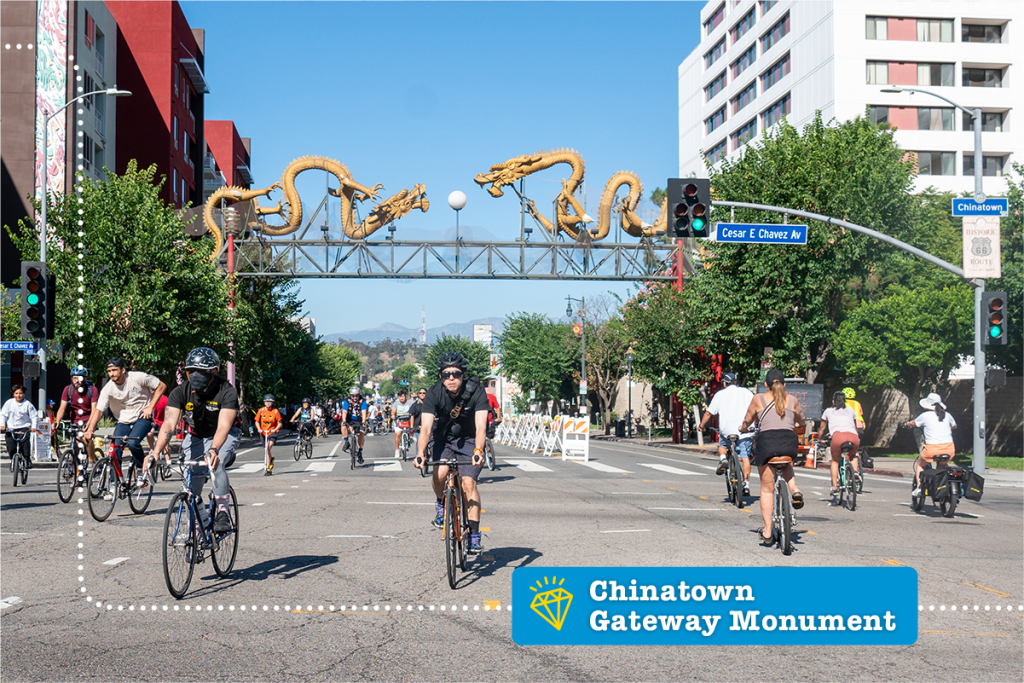
600 N Broadway, Los Angeles, CA 90012
At the southern entrance to Chinatown is this eye-catching gateway welcoming visitors. Spanning over Broadway are twin golden dragons fighting over a pearl, a recurring motif in Chinese art. At night, the pearl and the dragons’ eyes are illuminated, transforming its appearance.
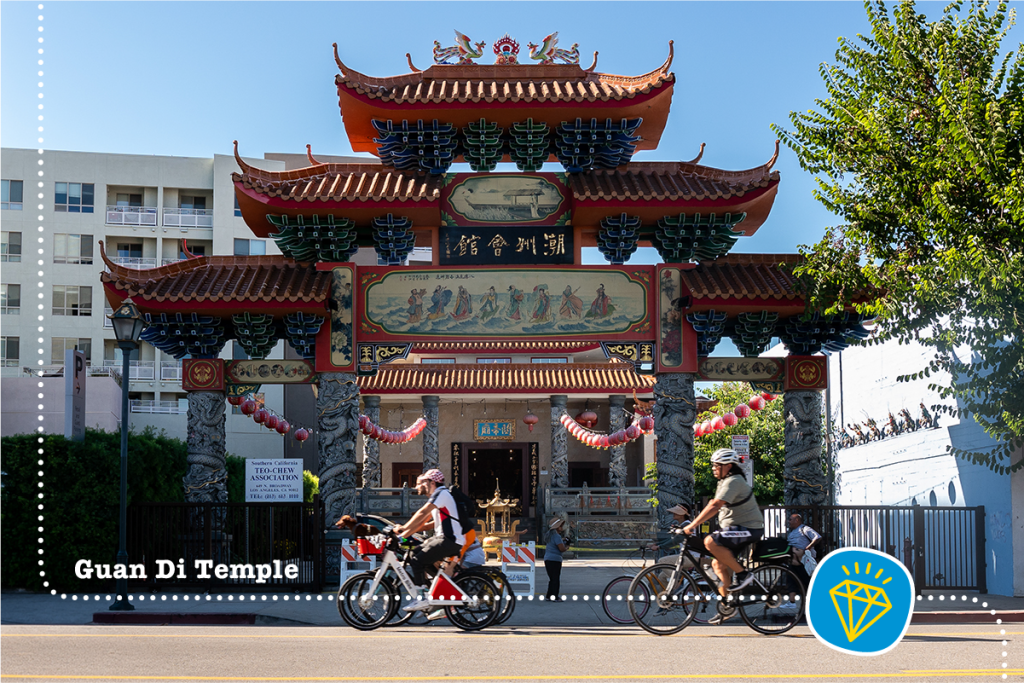
649 N Broadway, Los Angeles, CA 90012
The Guan Di Temple is an ornate Buddhist temple run by the Teo-Chew Association of Southern California. The Teo-Chew are an ethnic group native to the Guangdong region of South China, although many of the Teo-Chew who came to Southern California immigrated from Vietnam, Cambodia, and Thailand. The temple’s elaborate gate is marked by stone lions and columns adorned with intricately carved dragons, offering a glimpse of the craftsmanship found throughout the temple.
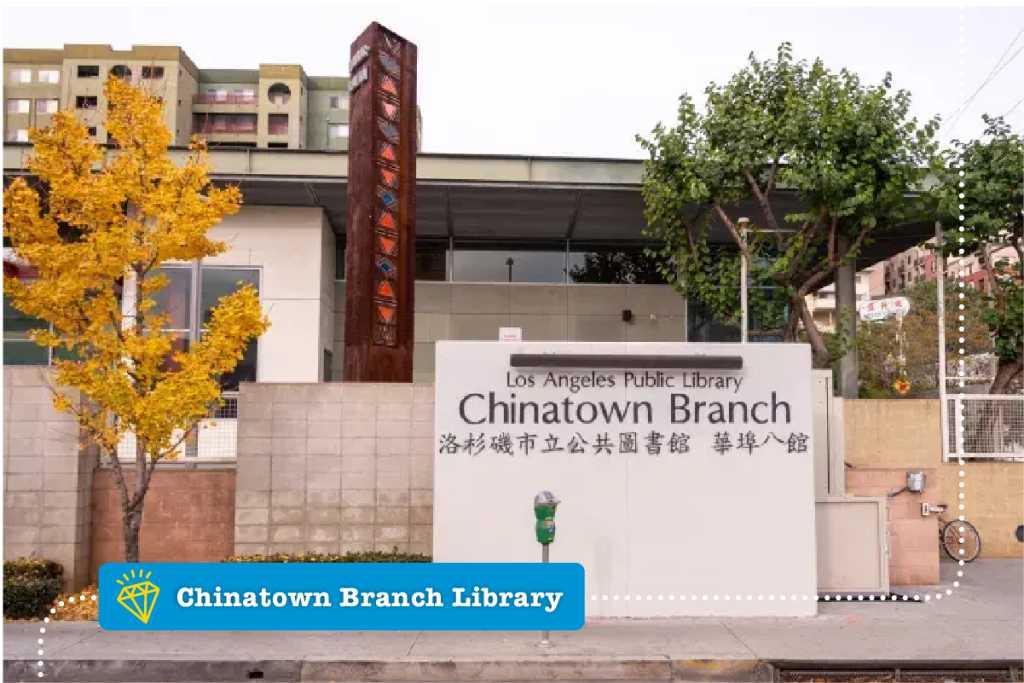
639 N Hill St, Los Angeles, CA 90012
A block west of the route, at the corner of Ord and Hill St, is this branch of the Los Angeles Public Library. The branch opened as a result of community activism in the 1970s and was initially located in the auditorium of nearby Castelar Elementary School. The current location opened in 2003 and holds the largest collection of Chinese language materials in the LAPL system. Directly behind the library is Ord and Yale Street Park, a pocket park that hugs the hillside with a playground, terraced gardens, and a stairway overlooking Chinatown.
A button featuring the Chinatown Branch Library will be available to purchase at the Chinatown Hub on CicLAvia Sunday!
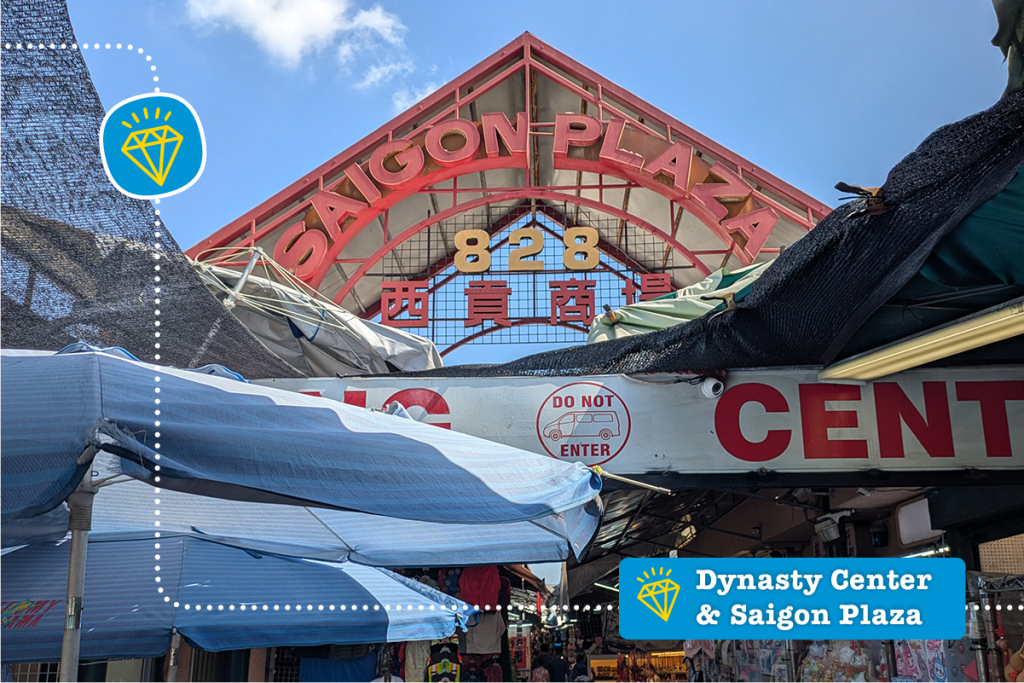
812 N Broadway, Los Angeles, CA 90012
Along Broadway between Alpine and College Streets, these two interconnected shopping centers make up one of the last active shopping malls in Chinatown. Along the open-air aisles beneath colorful umbrellas and tarp roofs, you’ll find dozens of local vendors selling clothing, accessories, toys, luggage, and household goods.
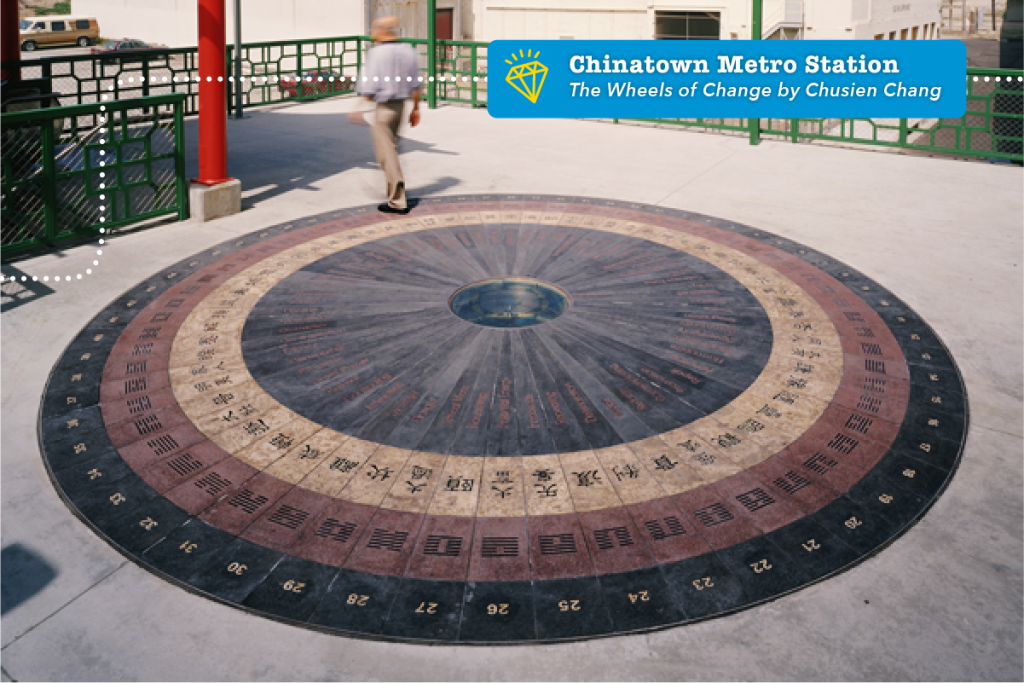
Details of The Wheels of Change by Chusien Chang. Photo courtesy of Metro Art.
901 N Spring St, Los Angeles, CA 90012
The elevated platform of Chinatown Station offers views of Downtown and the surrounding area. Throughout the station you’ll find Chusien Chang’s The Wheels of Change, an artwork consisting of multiple parts including a granite I Ching dial inlaid into the station’s concourse. A walkway connects the station to Broadway through the adjacent Blossom Plaza development; along the way, you’ll pass a small fountain surrounding a set of boulders that emit steam.
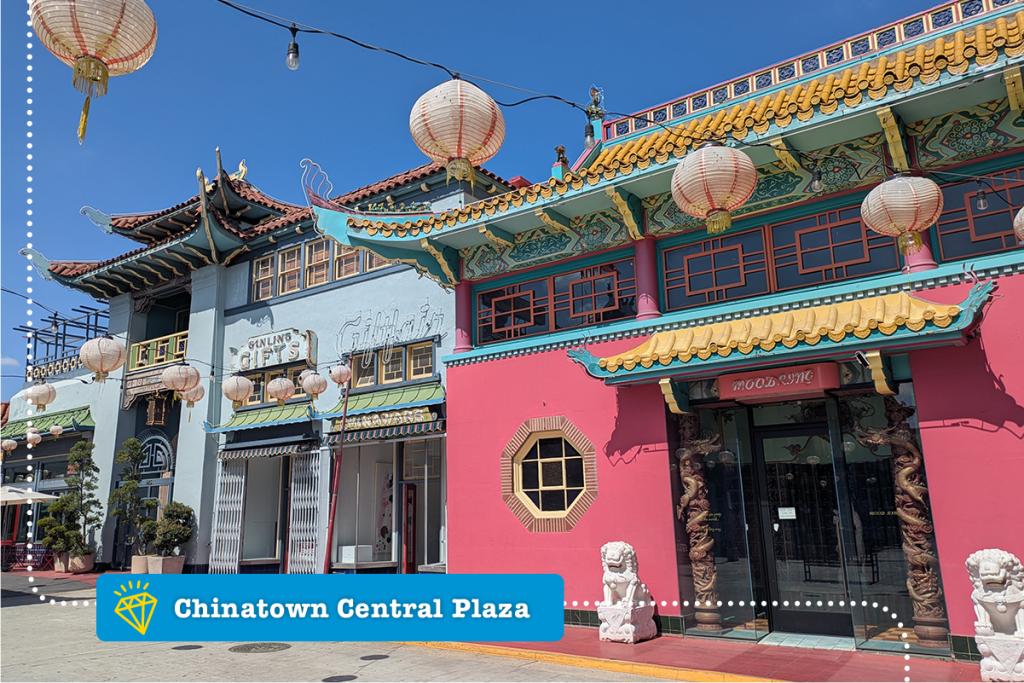
943 N Broadway, Los Angeles, CA 90012
This pedestrian mall dates back to 1938, after the city’s original Chinatown was displaced to make way for the construction of Union Station, and has served as a hub of the community since. Chinatown Central Plaza was the first planned Chinatown in the nation to be owned and planned by Chinese Americans, and its opening marked the birth of the “New Chinatown” in its current location. The buildings were designed with a mixture of traditional Chinese and modern stylings, with pagodas, hanging lanterns, and colorful neon. Around the plaza, you’ll find a statue of Bruce Lee as well as lots of galleries, gift shops, and boutiques to browse through.
Chinese Historical Society of Southern California
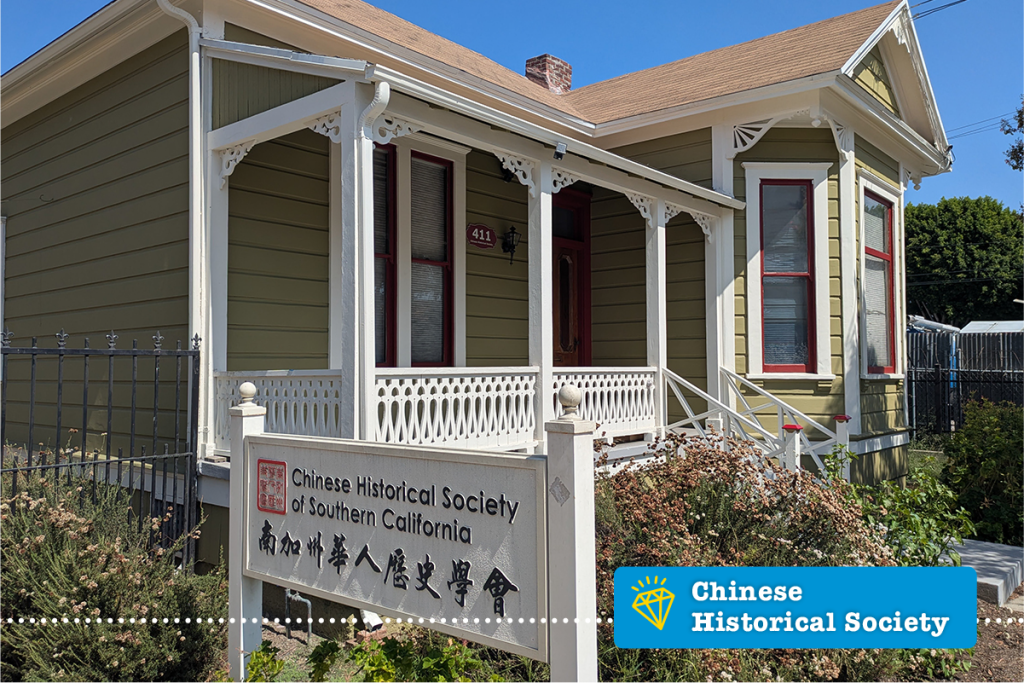
411 Bernard St, Los Angeles, CA 90012
Just around the corner from the northern end of the route, this historical society occupies two Victorian houses dating back to the 1880s, making them some of the oldest buildings still standing in Chinatown. Inside you’ll find displays of artifacts from the original Chinatown, excavated during construction at Union Station, as well as displays on the history of Chinatown, a research library with books pertaining to Chinese American and Asian history, and a small bookstore. The society is open to the public on Sundays from 2-5pm.
Little Tokyo
To the east of Civic Center, Little Tokyo is a vibrant and bustling neighborhood that is one of Downtown’s biggest draws and a cultural center for Japanese Americans in Southern California. Along the route you’ll find numerous Japanese eateries and stores, from ramen shops to taiyaki stands to anime pop-ups. The north side of 1st Street between San Pedro Street and Central Avenue is lined with historic storefronts that date back to before WWII, with some businesses having served generations of tourists and residents of Little Tokyo.
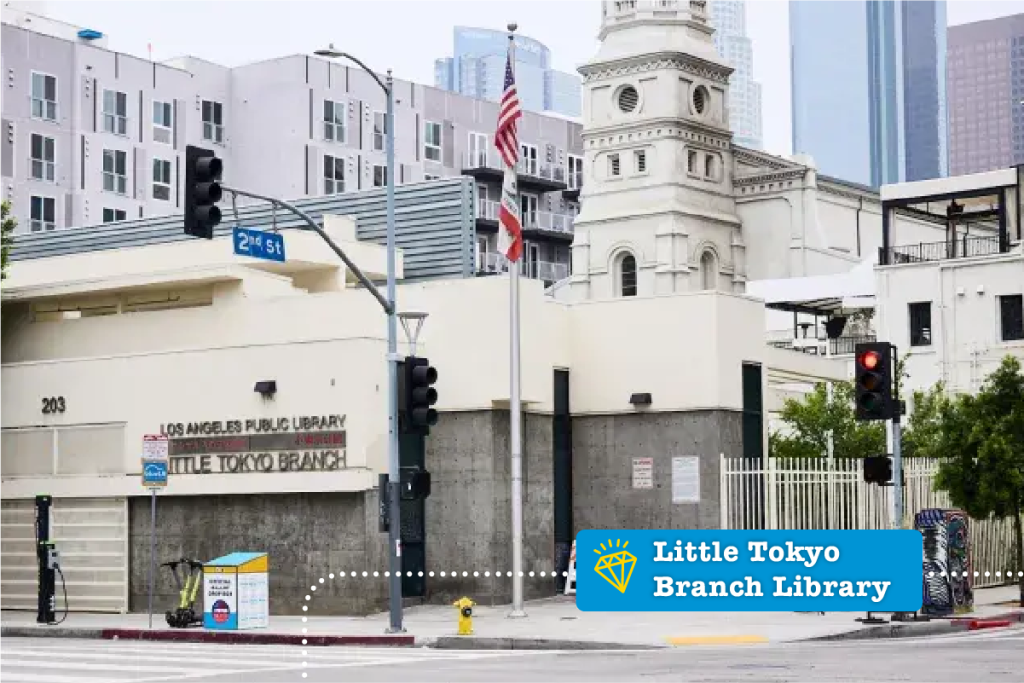
203 S Los Angeles St, Los Angeles, CA 90012
Located a block south of the route, at the corner of Los Angeles and 2nd St., this branch of the Los Angeles Public Library serves the Little Tokyo community. The branch started in 1977 as a weekly bookmobile stop in Little Tokyo, opening as an experimental branch in 1989. After occupying a couple of temporary locations, the current facility opened in 2005 and was designed to reflect traditional Japanese architecture and building materials, with exposed wood ceilings and a set of serene interior gardens. The library is home to the Japanese Heritage Collection, an expansive collection of books and magazines on Japanese and Japanese American culture.
A button featuring the Little Tokyo Branch Library will be available to purchase at the Little Tokyo Hub on CicLAvia Sunday!
Space Shuttle Challenger Memorial
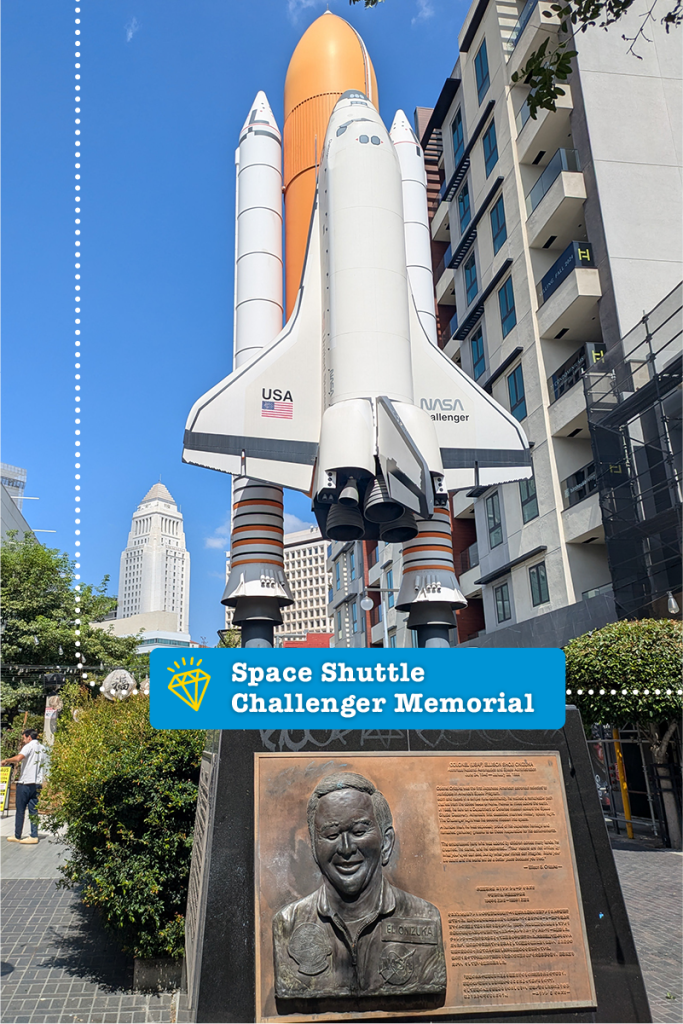
Astronaut Ellison S Onizuka St, Los Angeles, CA 90012
Slightly south of the route, cutting through the block between Los Angeles and San Pedro Streets, is this short street named for Colonel Ellison Shoji Onizuka, the first Japanese American astronaut and a member of the crew that was tragically killed in the Space Shuttle Challenger explosion. In the middle of the street, you’ll find a memorial to Onizuka topped by a scale model of the Challenger. Nearby, a tall residential building is adorned with colorful murals paying tribute to Onizuka.
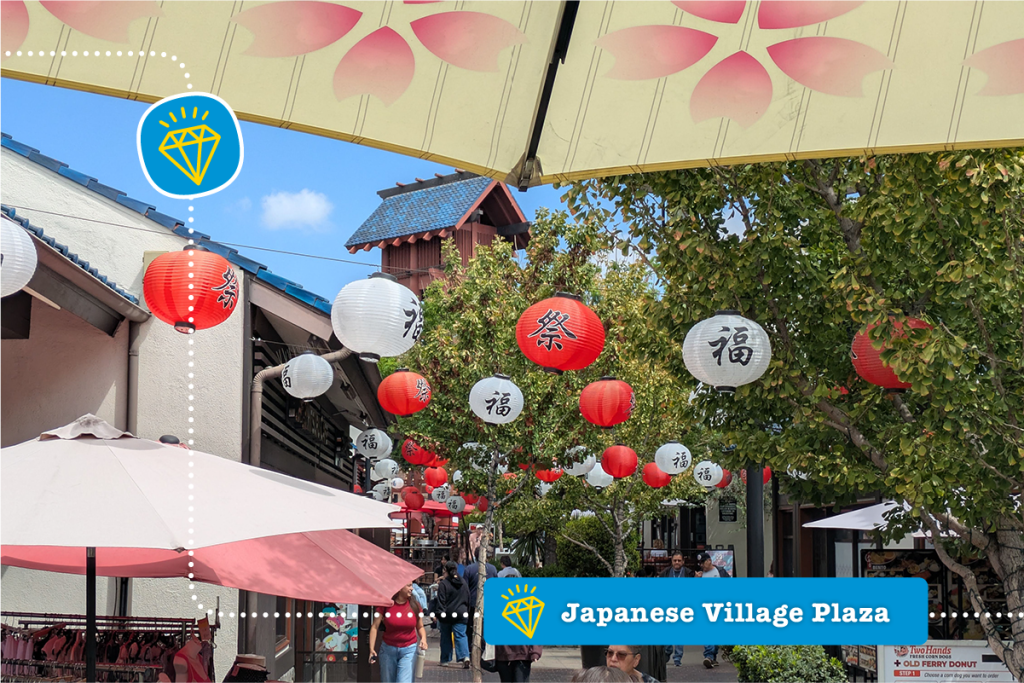
335 E 2nd St, Los Angeles, CA 90012
Off the corner of 1st and Central, this bustling mall offers dozens of Japanese-themed shops and eateries. The architecture of the mall is a romanticization of traditional Japanese style, with shingled roofs and strings of hanging lanterns over a winding pedestrian alley. At the entrance to the mall on 1st Street is a replica of an old-fashioned Japanese watchtower, which has become an icon for the neighborhood.
Japanese American National Museum Campus
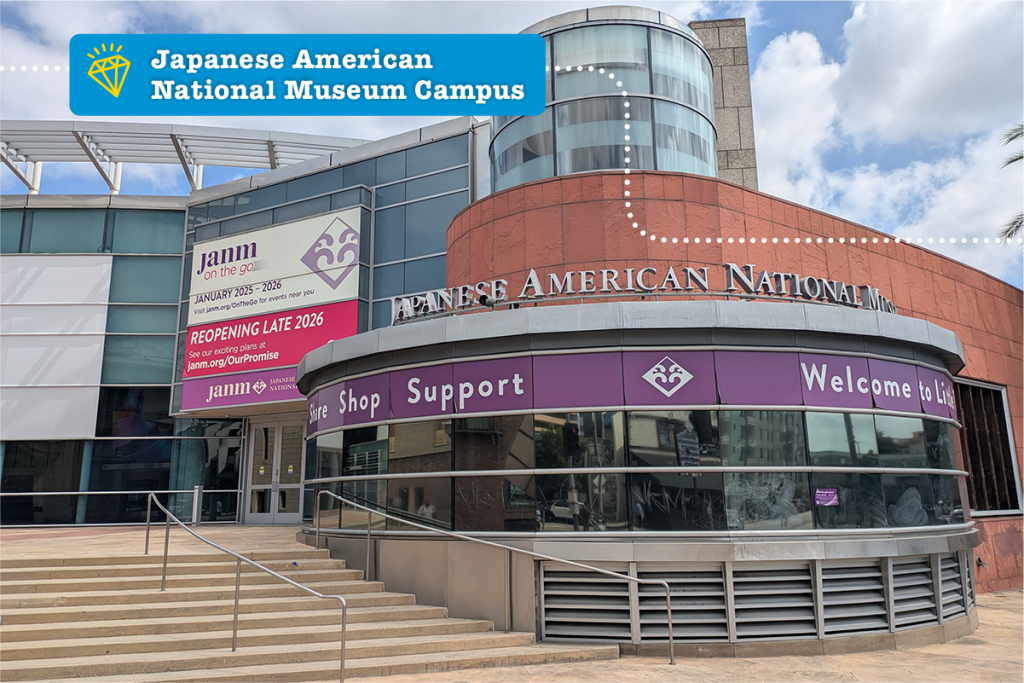
100 N Central Ave, Los Angeles, CA 90012
The Japanese American National Museum (JANM) is currently undergoing an extensive renovation and is scheduled to reopen to the public on January 23, 2027, with reimagined exhibitions and redesigned spaces dedicated to the story of Japanese American culture. Across from JANM, the Go For Broke National Education Center occupies the historic 1925 Hompa Hongwanji Buddhist Temple building. Visitors can access the Defining Courage exhibition, an interactive exhibit that teaches the story of the Japanese American experience during World War II and its relevance to our lives today.
Facing Central is the public artwork OOMO (Out Of Many, One), a giant cube with mix-and-match photographs of faces on the sides that you can rotate. Further back from the street, you’ll find the Aoyama Tree, a massive Moreton Bay Fig planted over a hundred years ago, which stood at the entrance of a Buddhist temple that once occupied this site. And in the very back is the Go For Broke Monument, a tribute to the Japanese American soldiers who fought in WWII to secure the rights and freedoms of future generations.
Little Tokyo/Arts District Station
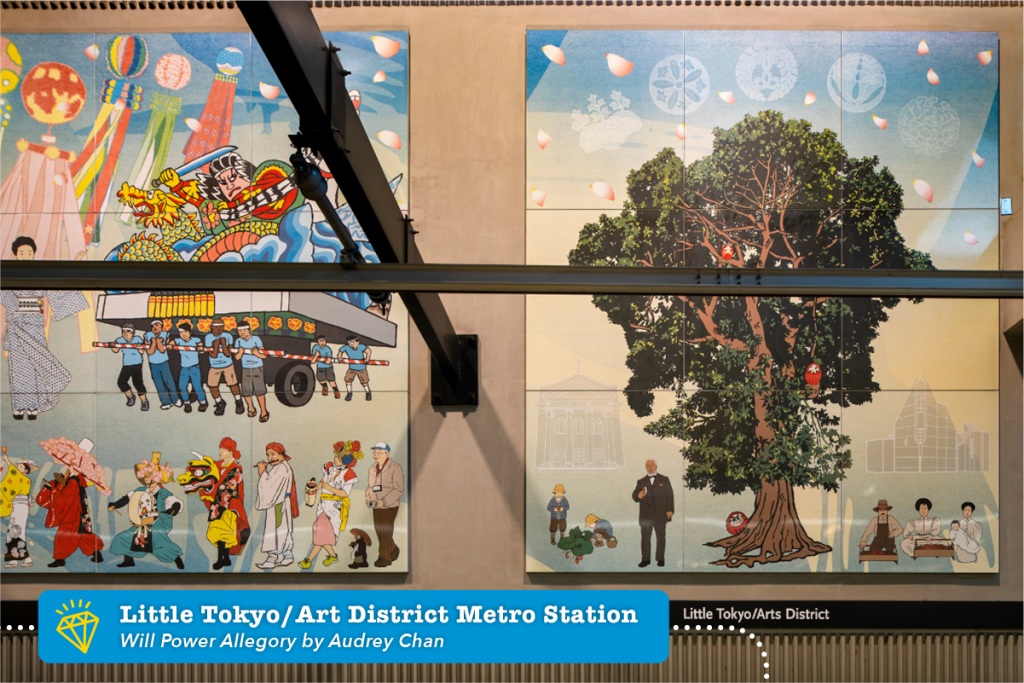
Details of Will Power Allegory by Audrey Chan. Photo courtesy of Metro Art.
402 E 1st St, Los Angeles, CA 90012
Along the station platform is Audrey Chan’s Will Power Allegory, a set of 14 colorful panels that depict vignettes of people, places, and symbols from Little Tokyo, the Arts District, Skid Row, the historic neighborhood of Bronzeville, and the Gabrielino/Tongva Tribe. The work serves to remind viewers of the history of this place and as an allegory of Los Angeles as a site of remembrance and political resistance.
Higashi Honganji Buddhist Temple
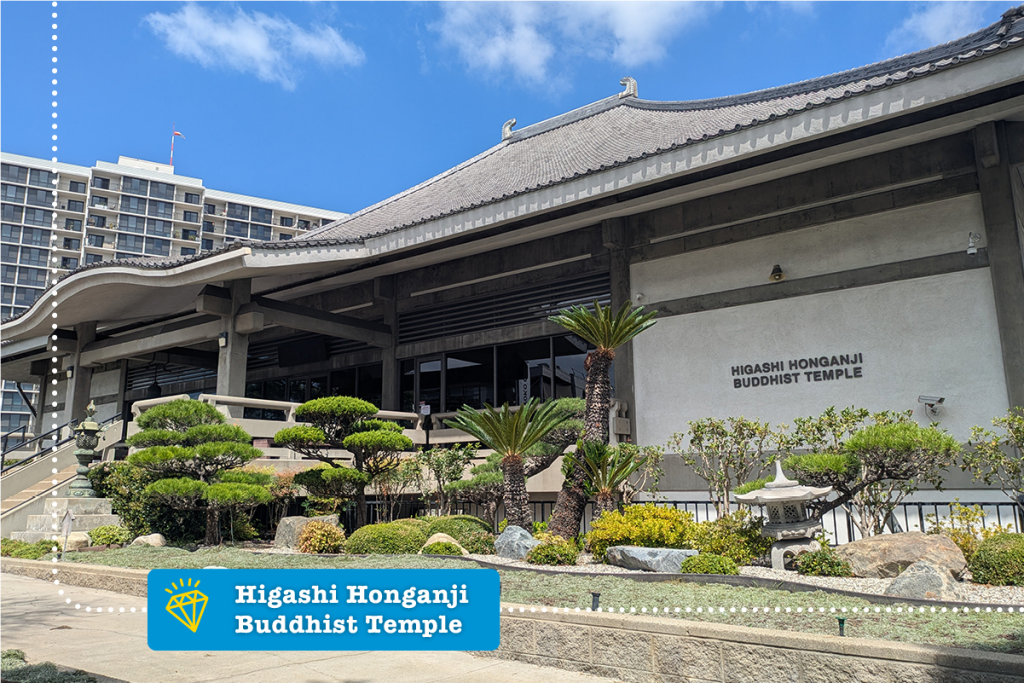
505 E 3rd St, Los Angeles, CA 90013
Located directly on the route at the corner of Central and 3rd, this temple is one of several Buddhist temples in the Little Tokyo area. The Higashi Honganji Temple is an affiliate of the Shinshu Otani-ha, one of the oldest and largest Buddhist denominations in Japan. The temple was founded in 1904, relocating several times throughout Little Tokyo and Boyle Heights before the present temple opened in 1976. The building features a traditional roof with over 30,000 tiles imported from Japan and Japanese-style landscaping outside that is maintained by temple members.
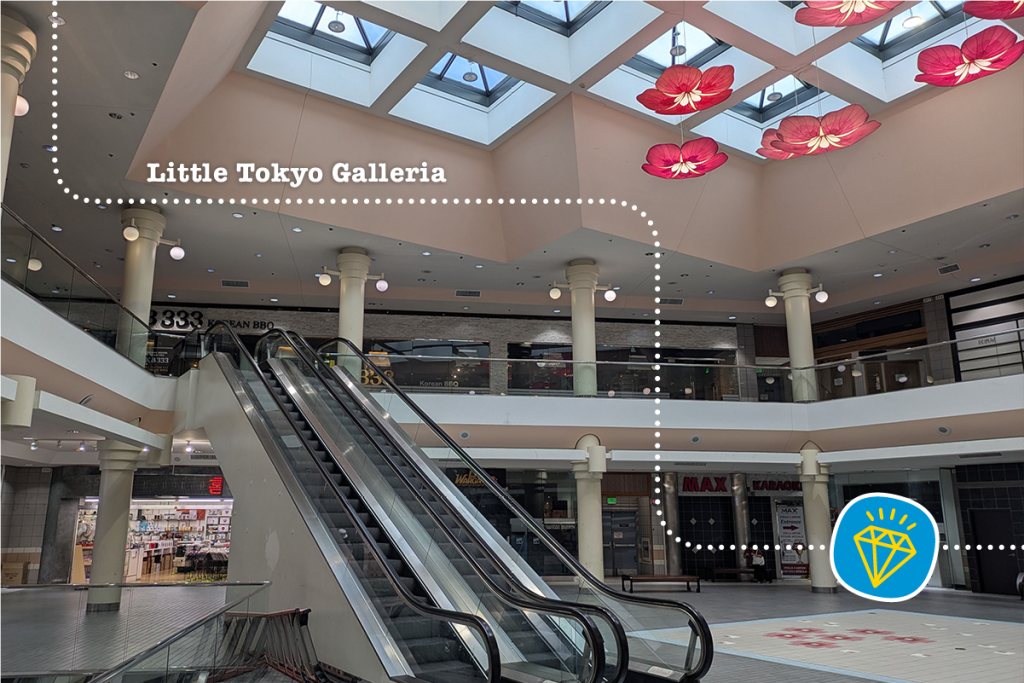
333 S Alameda St, Los Angeles, CA 90013
A short ways off the route on 3rd Street is this large, three-story indoor shopping center. Inside you’ll find a variety of shops and restaurants catering to the local community, including an Asian supermarket on the first floor, a bowling alley, and a karaoke studio.
Boyle Heights
Situated on a hill overlooking Downtown, Boyle Heights is one of the oldest neighborhoods in Los Angeles and thrives as one of the most important centers of Chicano and Latin American culture locally. Throughout the neighborhood you’ll find delicious restaurants, charming local businesses, and colorful murals that celebrate the vibrant history and culture of the Eastside.
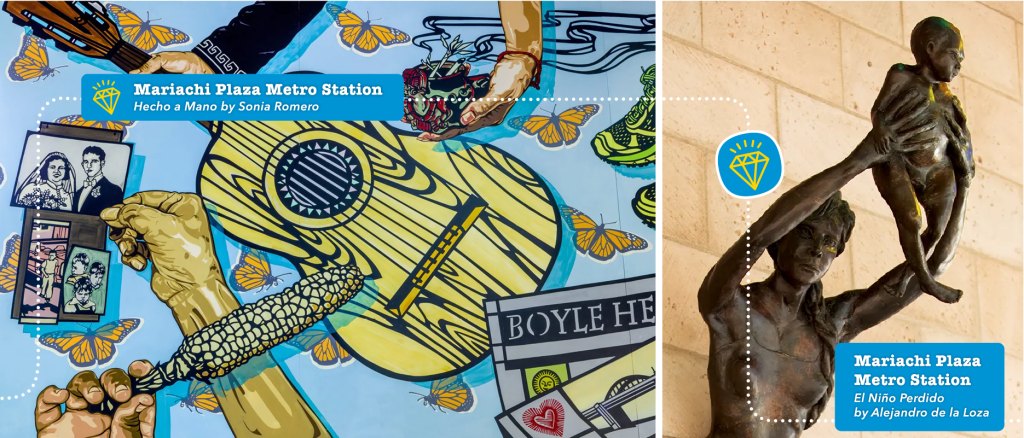
Details of Hecho a Mano by Sonia Romero and El Niño Perdido by Alejandro de la Loza. Photos courtesy of Metro Art.
1831 E 1st St, Los Angeles, CA 90033
At Mariachi Plaza, this station features two notable artworks. On the walls of the station’s concourse is Sonia Romero’s Hecho a Mano, a beautiful mural depicting objects of personal significance from local residents—a guitar, family photographs, marigolds, and a protest sign—being held aloft amidst a backdrop of monarch butterflies. At the station’s entrance, beneath a colorful shell-shaped awning, is El Niño Perdido by Alejandro de la Loza, a bronze statue of a mother holding up her child that takes its inspiration from a traditional Mexican song.
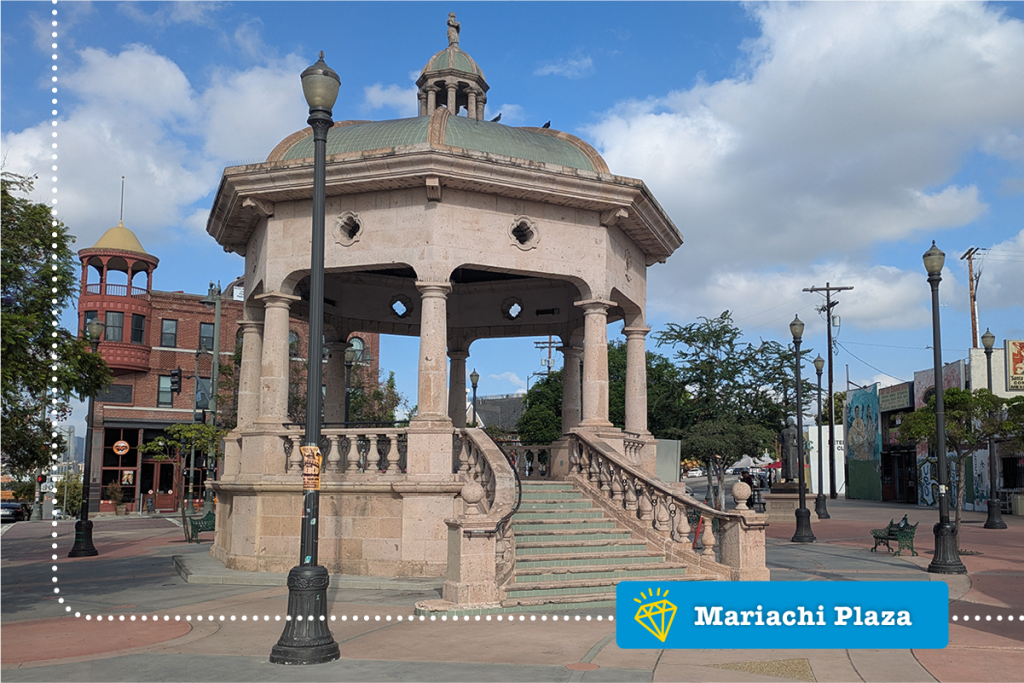
1831 E 1st St, Los Angeles, CA 90033
For many decades, the corner of 1st and Boyle served as an informal gathering spot for local mariachis looking for work. In the 1990s, the spot was developed as a formal public square and now serves as a space for community events and celebrations. Around the plaza you’ll find many tributes to musicians and mariachi-inspired murals, as well as a stone kiosk gifted from the state of Jalisco, Mexico, widely regarded as the birthplace of mariachi music.
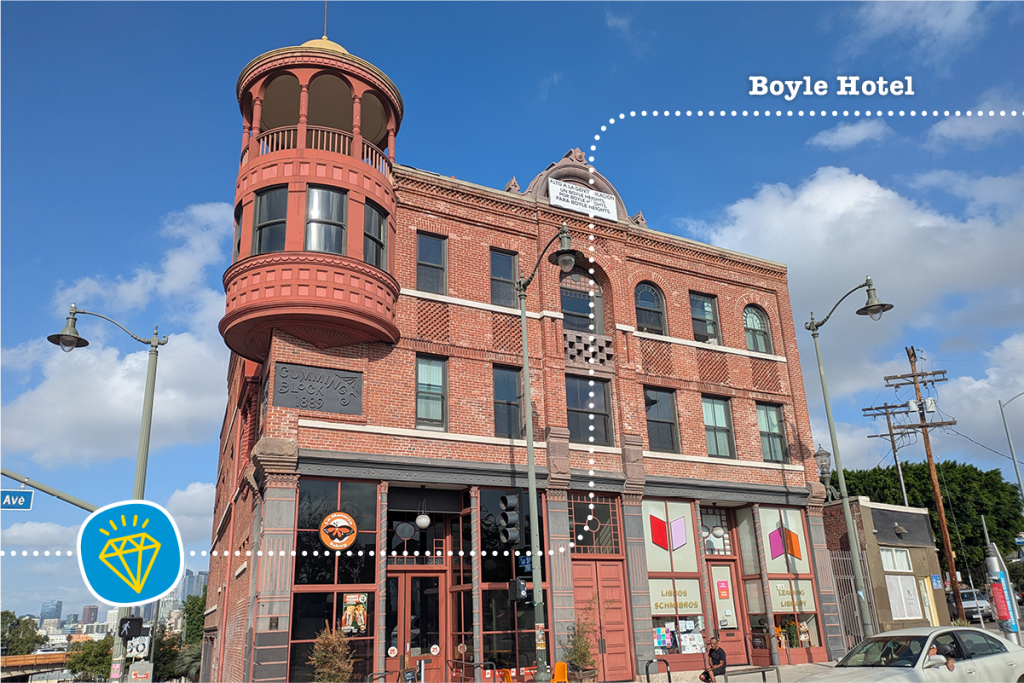
101 N Boyle Ave, Los Angeles, CA 90033
Dating back to the 1880s, this stately red-brick building was originally built as a fashionable hotel. Built in the Queen Anne architectural style, it sports a corner turret framing what has become an iconic view down 1st Street of the Downtown skyline. The building has since been converted to affordable housing, with a pair of storefronts facing Boyle Avenue.
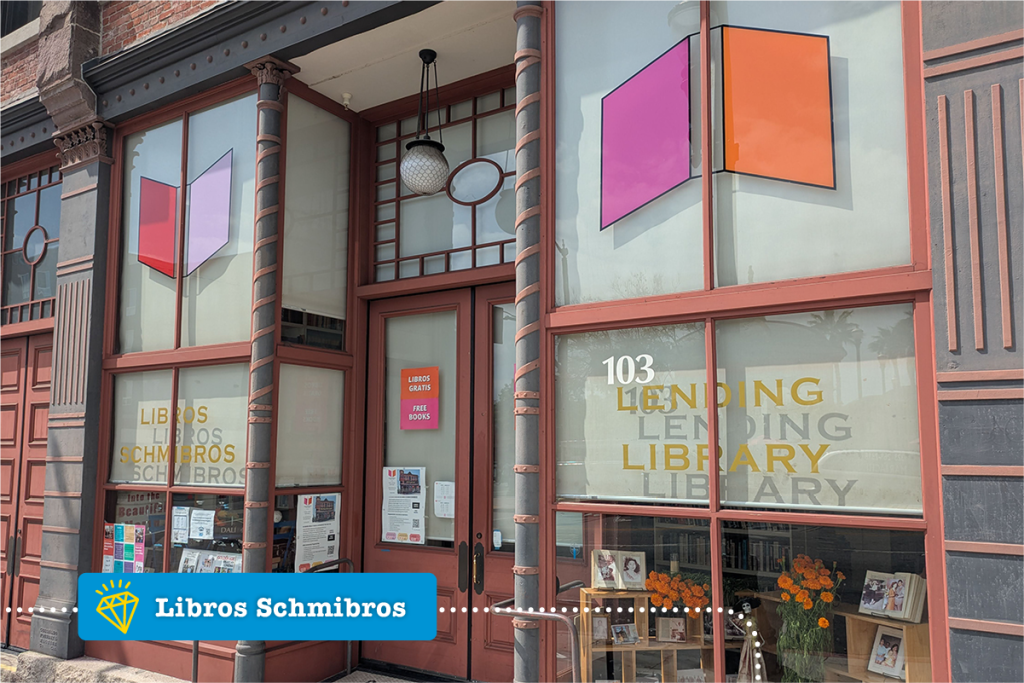
103 N Boyle Ave, Los Angeles, CA 90033
Within the former Boyle Hotel is this nonprofit lending library that provides free and low-cost books to the community, with materials in both English and Spanish. Libros Schmibros also regularly hosts events and community programming, including workshops, film screenings, poetry readings, and a children’s story time.
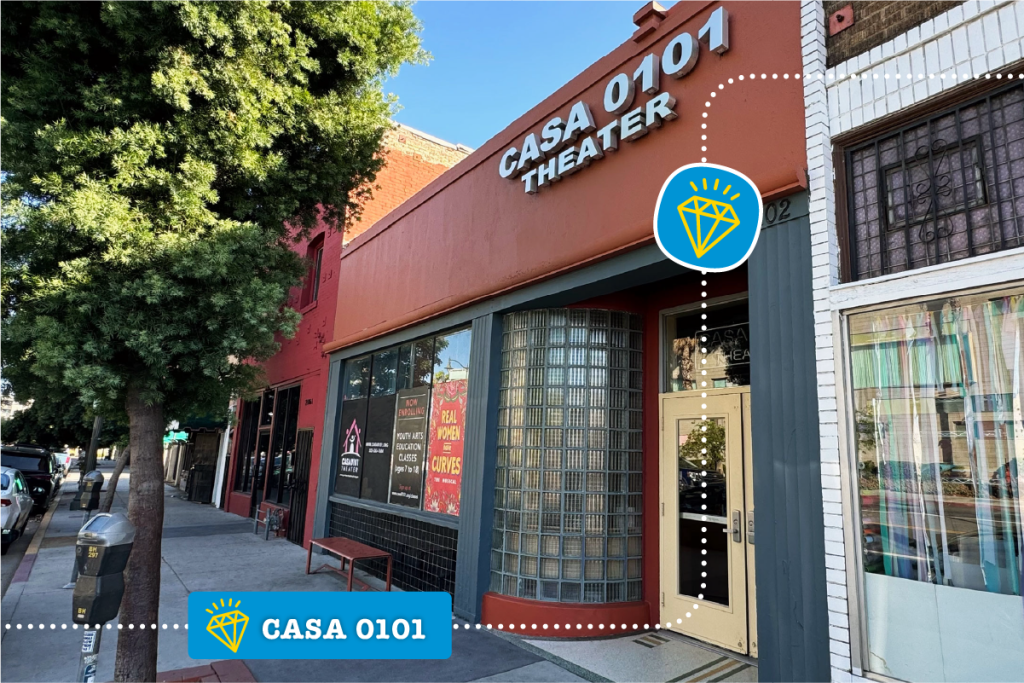
2102 E 1st St, Los Angeles, CA 90033
Just off the corner of 1st and St Louis St, this performing arts theater is dedicated to providing theater performances, art exhibits, and educational programming to the Boyle Heights community, with the aim of nurturing future storytellers. CASA 0101 was founded in 2000 by Josefina Lopez, author of Real Women Have Curves. The theater presents both original and established stage productions, with an art gallery that hosts original exhibits primarily featuring local area artists.
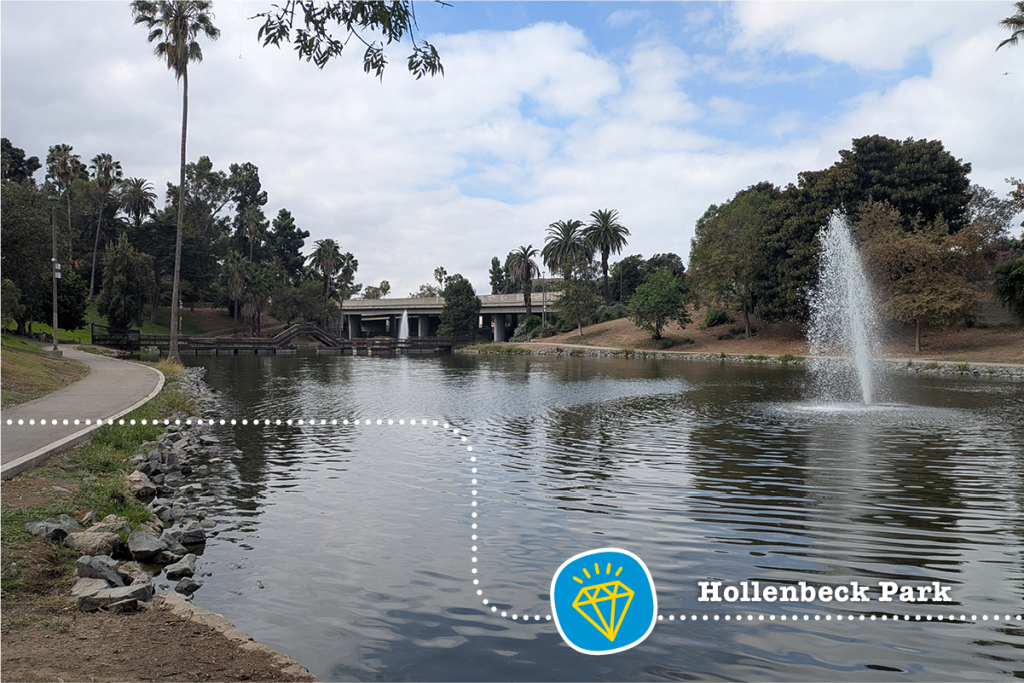
415 S St Louis St, Los Angeles, CA 90033
Stretching across 21 acres between 4th Street and Hollenbeck Drive, this spacious park dates back to 1892, making it one of the oldest in the city. Along St Louis Street you’ll find grassy knolls overlooking the Downtown skyline and the park’s man-made lake, which features large spray fountains and an old wooden pedestrian bridge. Elsewhere in the park you can find a playground, a rec center, a skate park, and plenty of picnic tables.
Sixth Street Bridge (Sixth Street Viaduct)
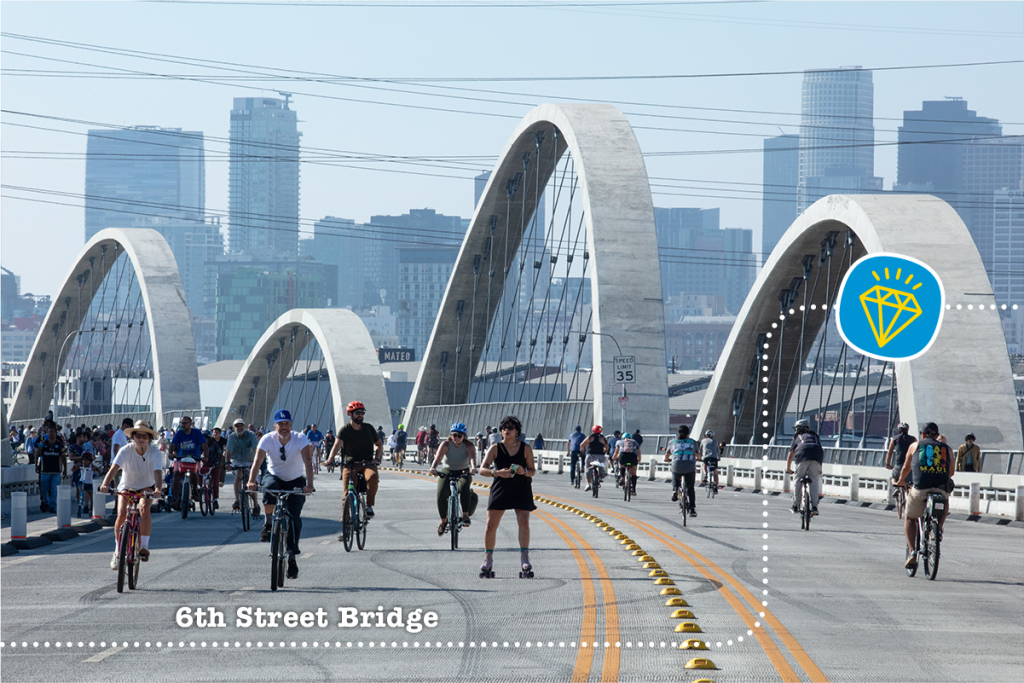
6th St / Whittier Blvd, between Mateo St and Boyle Ave
Linking Boyle Heights to the Arts District in Downtown, this viaduct was completed in 2022 and replaced an earlier span built in 1932. The new span has become a notable landmark, with massive concrete arches that tower over the surrounding area, and has already become a common filming location. A public park is taking shape beneath the bridge, with sports fields, play areas, landscaping and trees, and a performing stage, among other features.
Robert Louis Stevenson Branch Library
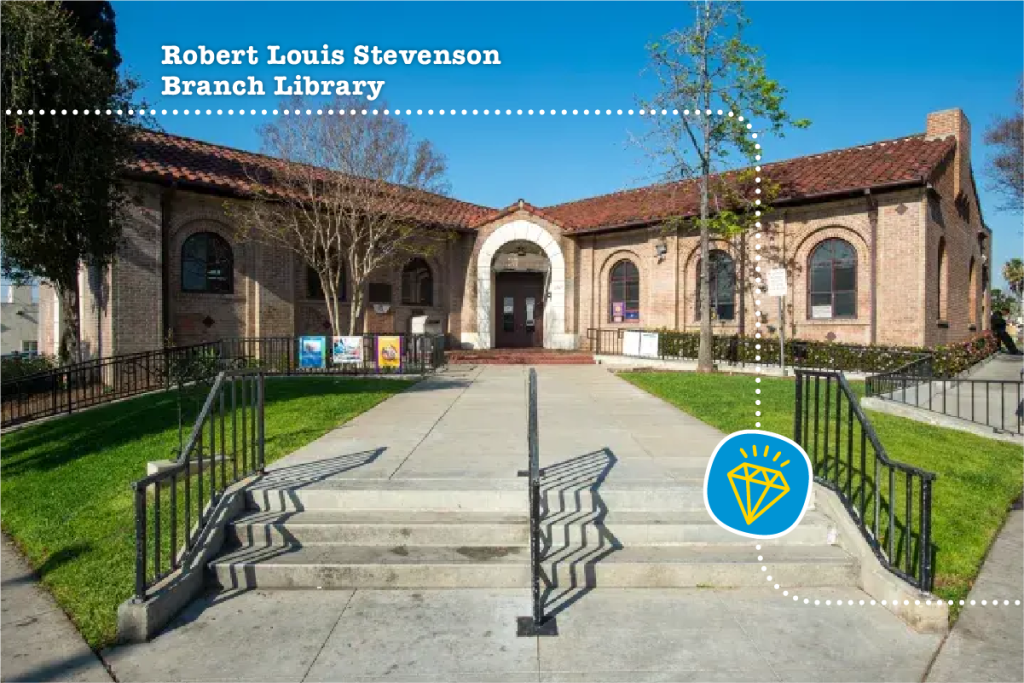
803 Spence St, Los Angeles, CA 90023
Located just off Whittier Blvd about 1.4 miles east of the route, this branch of the Los Angeles Public Library is one of three branches that serve the Boyle Heights community. Opened in 1914, this branch was originally called the Stephenson Branch, owing to its location on Stephenson Avenue, the original name of Whittier Blvd. After the street was renamed in 1925, the library renamed itself after Robert Louis Stevenson, the famed Scottish author of Treasure Island and the Strange Case of Dr Jekyll and Mr Hyde. The present building dates back to 1927 and underwent a renovation after suffering damage from the 1987 Whittier Narrows Earthquake.
A button featuring the Robert Louis Stevenson Branch Library will be available to purchase at the Mariachi Plaza Hub on CicLAvia Sunday!
This Local Gems post was compiled by guest writer John Perry, a local transportation advocate. You can see more of his work at his website, Transiting Los Angeles, where you’ll find local guides and videos about LA transit.
Photos courtesy of John Perry, CASA 0101, Los Angeles Public Library, Metro Art, Laura Rudich, Jon Endow, and Farah Sosa.
We can’t wait to see you all at CicLAvia—Heart of LA on October 11! Don’t forget to sign up for our mailing list so you don’t miss out on updates and information about future programs.
CicLAvia exists because of people like you. To support more open streets, make a tax-deductible donation today.