
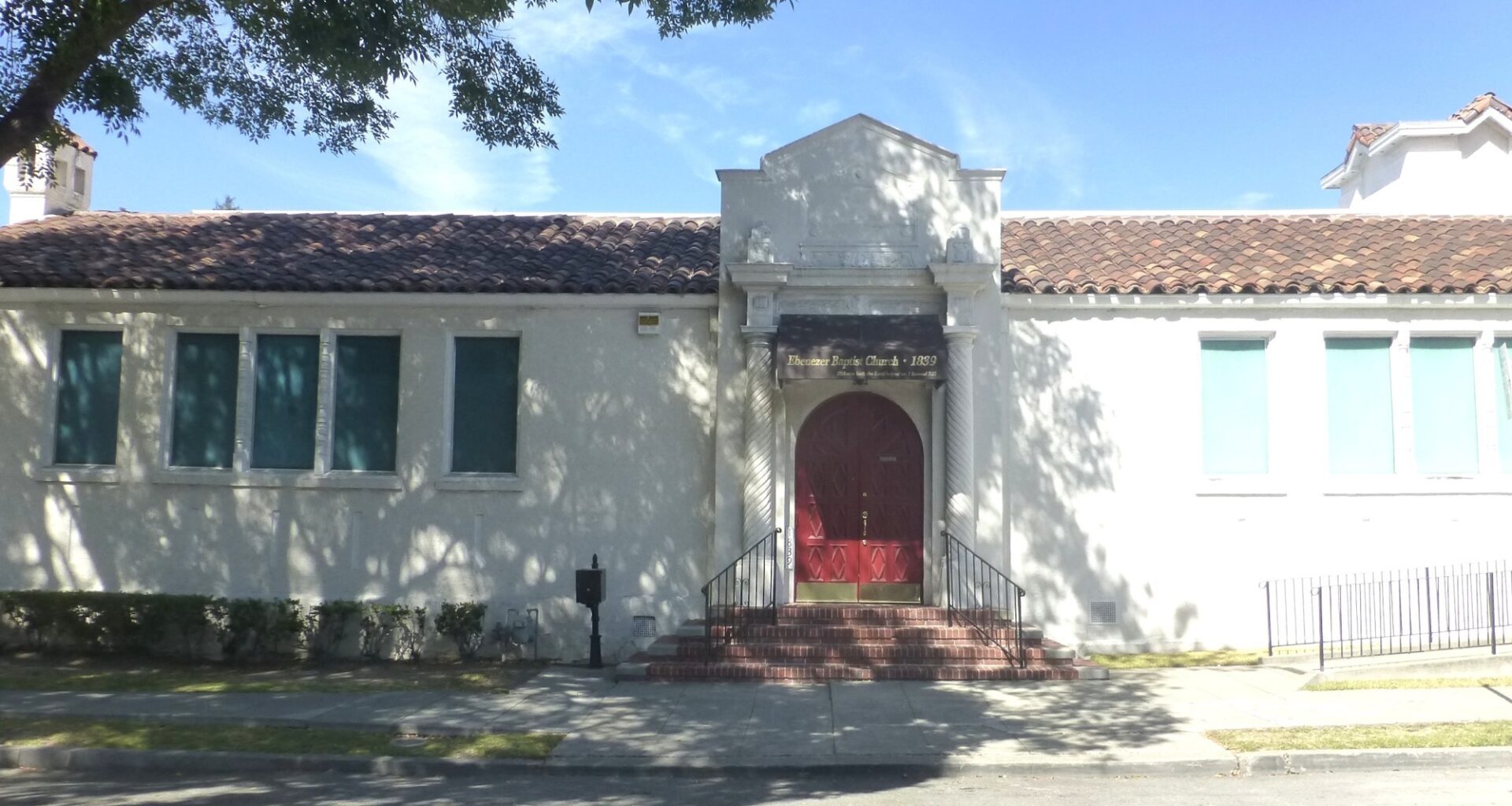
A century ago, on Oct. 1, 1926, “despite rain, ground was broken today as scheduled on the site of the new branch of the Berkeley Public Library to be built in South Berkeley on the corner of Grove and Woolsey streets. All contracts have been let and construction will begin immediately,” the Berkeley Daily Gazette reported.
“The building, which promises to be one of the most attractive in the city, will be modeled after the Spanish type of architecture.” Originally the South Berkeley Library, the building still stands at the northwest corner of Martin Luther King Jr. Way (the former Grove Street) and Woolsey Street but is now the home of the Ebenezer Baptist Church.
Library trustee: Edward Ament, a “well known South Berkeley merchant and president of the Ashby Furniture Company,” was recommended for a seat on the Berkeley library board on Oct. 6, 1926. Ament would indeed be appointed and would later serve on the City Council and as mayor.
Hopkins development: On Oct. 1, 1926, the Berkeley city Planning Commission conducted a contentious public hearing about a development proposal near the corner of what is now The Alameda and Grove Street (again, today’s Martin Luther King Jr. Way) in North Berkeley. Three sites, with two commercial buildings and one medical office building costing a total of $200,000, were proposed.
The developers said “all three buildings would conform to one architectural scheme, the California Spanish type” and noted that “the location in question is the busiest corner in North Berkeley and originally was intended and sold by the promoters as business property. The Standard Oil station already at that location is the third largest in Alameda County.”
Opponents of the commercial rezoning “crowded the City Council chamber” and argued to the commission that “traffic on the streets is through traffic and is actually a liability to first-class business properties,” questioned “the business sagacity of the move” and argued against locating businesses in the rapidly developing residential neighborhood.
The commission punted, deciding to further study the issue and put off a decision for two weeks. I haven’t discovered yet what the final decision was, but given the current use of the three proposed sites — single-family homes and an expanded gas station — it’s possible the rezoning didn’t happen, at least as originally proposed.
Anti-dog vaxxers: On Oct. 4, 1926, the Berkeley City Council voted down a proposal from “city health officers” for “the annual vaccination of dogs against rabies and distemper.”
“Scores of dog owners crowded the chamber in demonstration against the ordinance.” One argued that “it is not yet proven that there is such a disease as rabies. Dogs may act as they do when they are said to have rabies when they are suffering from pain, fear or excitement. Vaccination in such an event is both dangerous and useless.”
Another speaker told the council that “cold mud baths will cure a case of alleged rabies in three-quarters of an hour.” “Laughter and hisses greeted the statement of Miss Alice M. Barrs that vaccination had limited smallpox in communities where it is adopted.”
Oakland wildfire: “A brush and grass fire swept over several hundred acres between Pinehaven and Thorn Road near the Rockridge district of Oakland, throwing a huge pall of smoke over the hills” on Oct. 5, 1926. Oakland firefighters fought the blaze, which threatened “a score of homes.”
Claremont Canyon: On Oct. 8, 1926, Berkeley’s city manager advocated for developing a roadway connection between Berkeley and what is now Fish Ranch Road, starting with immediate paving “from the end of Tanglewood Road near the Hotel Claremont to the entrance of Garber Park.” This would eventually grow into today’s Fish Ranch Road through Claremont Canyon.
Bay Area native and Berkeley community historian Steven Finacom holds this column’s copyright.