
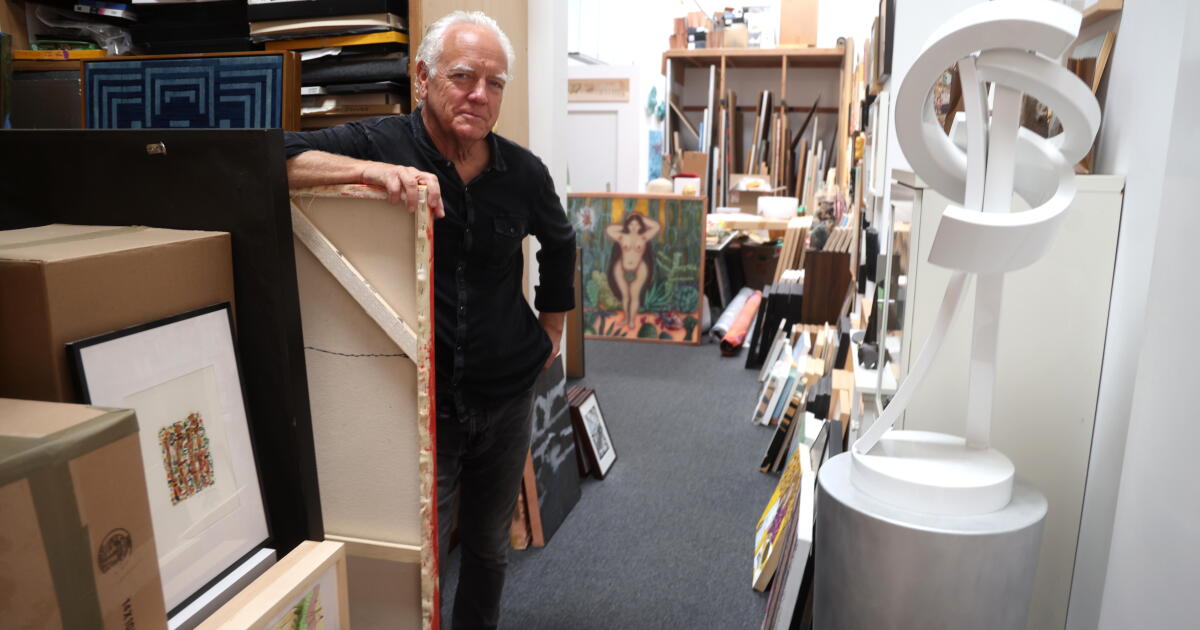
Bergamot Station was a neglected, decaying railroad station and industrial zone when Craig Krull first saw it back in 1994.
He and others envisioned it being something so much more. And within a few years, it was one of the world’s most exciting artist hubs. At its zenith, the collection of buildings housed world-famous galleries and artist exhibitions that made the gritty section of Santa Monica an unlikely contemporary art capital.
“You squint your eyes, and you have a vision,” Krull said in an interview. “It’s been emulated around the world.”
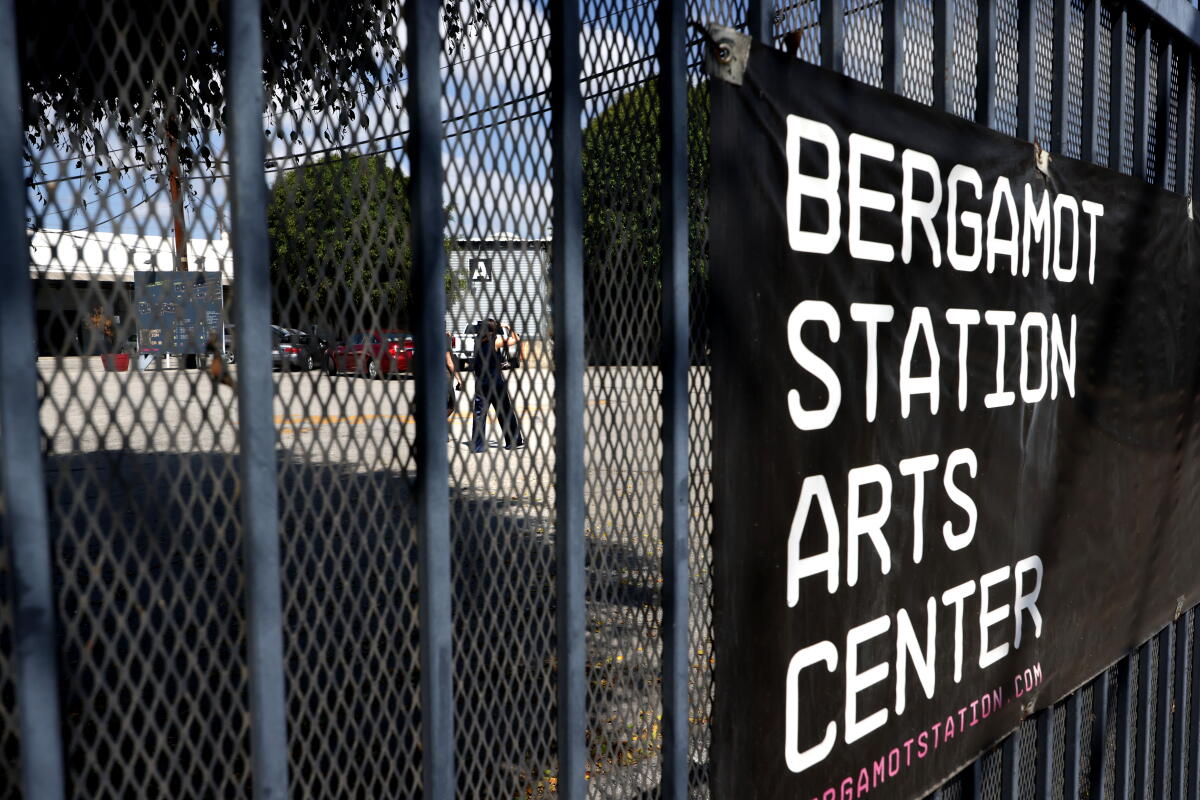
A woman walks past the main gate at Bergamot Station Arts Center.
(Genaro Molina / Los Angeles Times)
But now, Bergamot Station is facing an uncertain future.
The city is considering a plan to turn the 32-year-old center into new homes, part of its effort to meet state requirements in providing affordable housing in the beach city. During its Sept. 8 meeting, the Santa Monica City Council met behind closed doors with developers to turn the 5.6-acre property into more than 700 affordable homes.
The possibility of its being torn down has placed artists and gallery owners in limbo, as they await the fate of the art center.
In its heyday, more than 30 galleries filled their spaces with the work of established, renowned artists and young, upcoming artists, many of whom would go on to international acclaim.
Artists such as Retna, Man Ray, John Valadez, Frank Romero and Carlos Almaraz have had work featured in the center’s galleries. Young artists from Germany, Japan and other countries have taken their work to be shown there, said Robert Berman, owner of the Robert Berman Gallery at Bergamot Station.
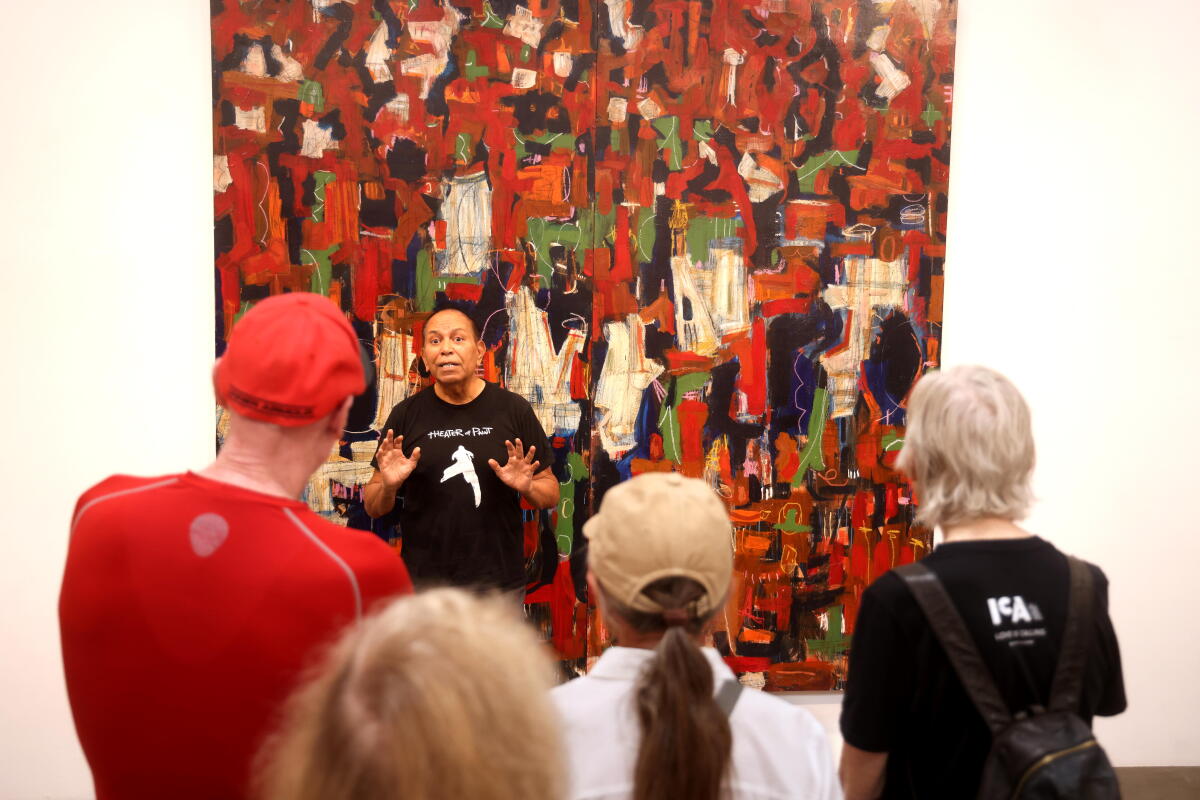
Famed Chicano painter Gronk discusses his work with Santa Monica College students visiting Bergamot Station Arts Center.
(Genaro Molina / Los Angeles Times)
The buzz at Bergamot Station has cooled considerably in recent years.
Today, about 15 galleries remain in the center, with several spaces now sitting empty.
But artists are fighting to preserve what is left.
The future of the Bergamot Station Arts Center has for years remained uncertain as city officials decide what to do with the city-owned property. That uncertainty has put a strain on gallery owners, who said rumors have made it difficult to operate, to bring in collectors and to attract new artists and galleries.
“They keep giving us mixed signals — you’re going to be there for five more years, you’re going to be there 10 more minutes, you’re going to be thrown out in 30 days,” said Berman, whose gallery has been at the center since it opened in 1994.
Douglas Marshall, whose Marshall Gallery opened in Bergamot 14 years ago, said the incertitude has hurt business.
On Sept. 12, the center hosted its fall opening, drawing in hundreds of visitors, collectors and art enthusiasts, but gallery owners found themselves addressing rumors and viral misinformation that spread on social media about the center’s future. Was it closing? Being shut down? Was it turning into a homeless shelter?
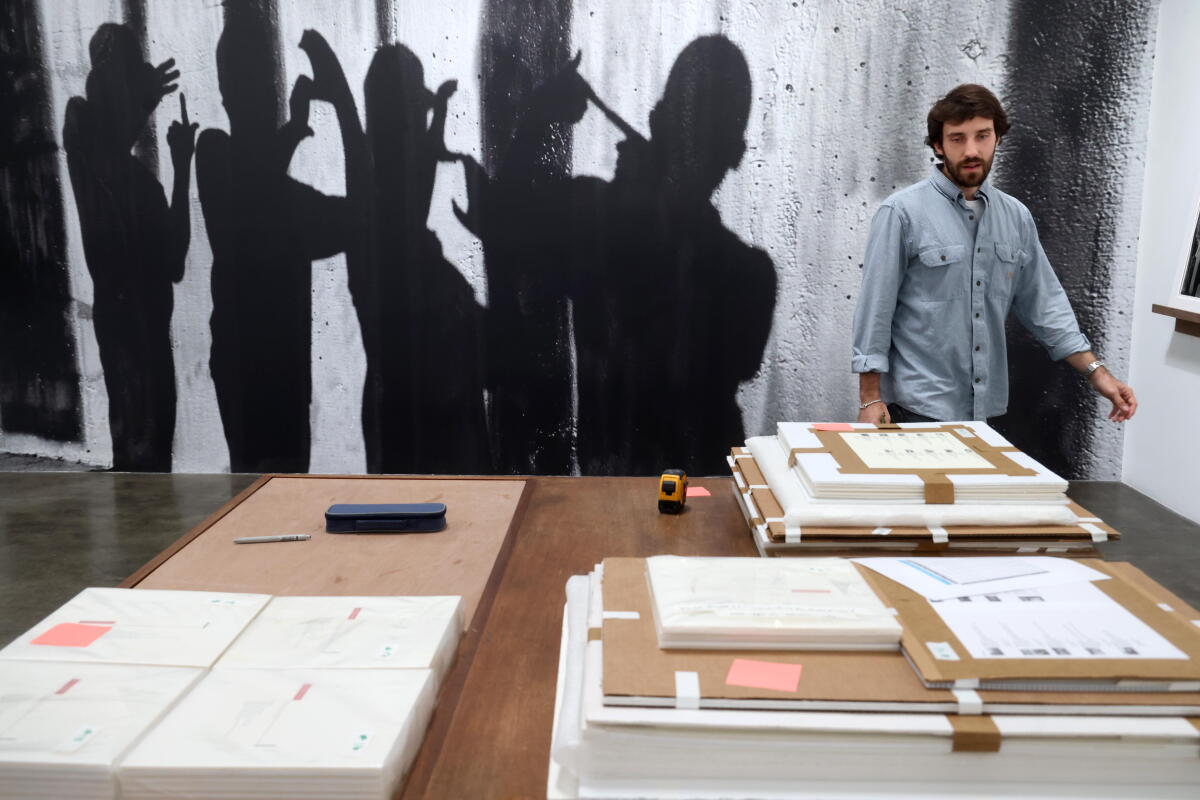
James Mach, a gallery associate with the Rose Gallery at Bergamot Station, packages work to be returned to an artist against a backdrop of a photograph by Mexican photographer Graciela Iturbide.
(Genaro Molina / Los Angeles Times)
“Every week we have to answer questions about what’s happening to this place,” Marshall said. “It’s a constant and it’s not good for business. It creates confusion. Art investing and buying is something that is based on trust.”
The plan is for housing on-site, but city officials stress the land is not being sold and is instead being negotiated as a long-term lease. Details are scarce, although the city has asked developers to ensure any new project includes a new space for art galleries and offers gallery owners the right to return to the new space.
“Speaking just for myself, I am fully committed to ensuring that the Bergamot Arts Center remains a thriving cultural and artistic center on a long-term basis,” Santa Monica Councilmember Ellis Raskin said in a statement. “I plan to work alongside my fellow Councilmembers to ensure that any future uses at the Bergamot property include exisiting tenants and other art and performance spaces.”
Mayor Caroline Torosis agreed, and said that although the city plans to move forward in redevelopment and housing, it’s also intent on preserving what she said was a “cultural anchor” of Santa Monica.
“This is a super special part of the community,” Torosis said. “These are cultural spaces for our community, and it’s absolutely an area worth preserving. It gives us character.”
City officials declined to offer details on proposals they have received, citing closed-door negotiations with developers. But Torosis said the city has been looking to prioritize artists and galleries that are still at the Bergamot and to finding ways that galleries can return with the same rental rates after temporarily relocating. Torosis said she was committed to making sure the temporary relocation would be at no cost to the current galleries.
“I understand that development is scary, and can be disruptive,” Torosis said. “We do not want to see a single tenant leave.”
But gallery owners told The Times they’ve felt neglected by the city for years. As more galleries sit empty, many of the remaining tenants believe any plan to build housing on the land means they’ll be permanently displaced, and that would mean the end for Bergamot Station.
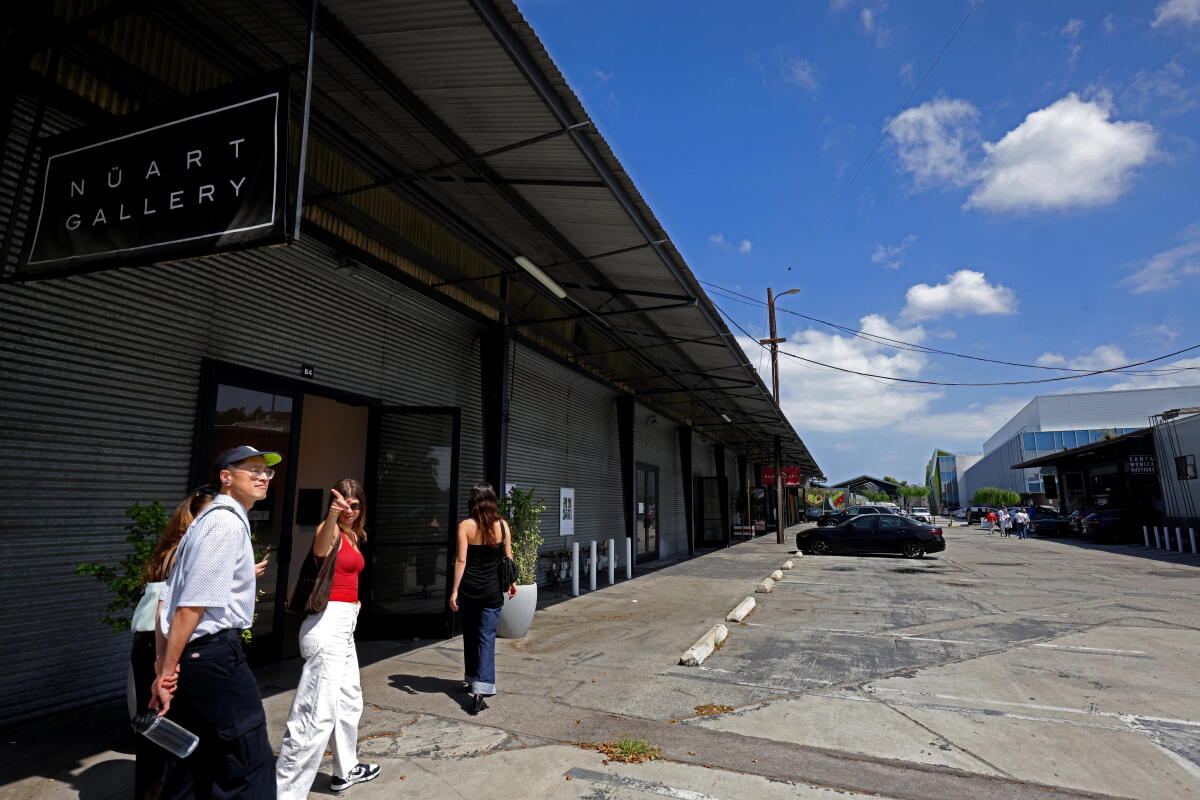
Art patrons walk past a row of galleries at Bergamot Station.
(Genaro Molina / Los Angeles Times)
Founder Wayne Blank sold his portion of the center in 2017 and, since then, the city has hired different firms to manage the property. Different plans over the years fell through, and then in February 2025, the city declared the site surplus land. On June 30, 2025, Santa Monica put out a notice to developers, making the land available for affordable housing. In the request, the city announced it was looking to turn the 5.6 acres along Michigan Avenue into housing, with at least 707 affordable residences.
The units, according to the notice, would be occupied by residents who make up to 80% of the area median income, which is $91,000 a year for the city of Santa Monica.
The city is also instructing developers to design 15% of the units for artist affordable housing. The proposal has a carve-out for the 700 affordable housing unit requirement if the developer “includes an explanation as to why that number cannot be met.”
After the Sept. 8 meeting, the city attorney released a statement saying the property is being considered for long-term lease, not for sale, as part of the city’s housing element program.
Councilmember Dan Hall said the city is in a difficult position of trying to support the arts, and to fulfill its commitment to use public land for affordable housing.
“To backtrack on that commitment puts us at risk of running afoul of state housing law,” Hall said. “So how do we find the balance between doing two ‘right’ things? How do we protect and promote the arts while also expanding opportunities for workers, artists and lower-income families to live here? That’s what we’re working through.”
Rose Shoshana, owner of the Rose Gallery, which has also stood at the center since its opening, said gallery owners have struggled to get clear answers from the city about the center’s fate.
Curators and artists are still drawn to it, but not knowing whether the center will be standing next month or next year makes it difficult to book artists or bring in new galleries.
“We’re hamstrung,” Shoshana said.
The idea that galleries would be able to return after the land is developed is unrealistic, she said. High rents and uncertainty are already making it difficult to bring in new galleries. Construction would keep away collectors and buyers even as galleries are already struggling, and those that would step away during any kind of construction would probably not return after setting roots elsewhere, she said.
“For Santa Monica, to lose the only art center in the city doesn’t seem to be an issue for them, which is what we’re so distressed about,” Shoshana said.
It’s a stark contrast to the role that the Bergamot Station Arts Center once played in the city’s cultural and political life.
Back when the center had fewer empty gallery spaces and the city was on a different economic footing, the Bergamot felt like the place to be. In 2004, the center hosted then-New York Sen. Hillary Clinton, former presidential candidate Howard Dean and the Red Hot Chili Peppers during a Democratic fundraiser. A young, rising political star — then-Senate candidate Barack Obama — was also in attendance.
Krull remembers Clinton using his office for an interview that day.
But circumstances have changed for the once-booming Southern California beach town, both from global events and self-inflicted wounds. The city’s economic engine was slowed, as it was for so many others, by the Great Recession and then the COVID-19 pandemic. But its budget has also been sapped by hundreds of millions of dollars in sex abuse case settlements.
Now the city is betting its financial turnaround on special events, hoping they and a new “entertainment zone” ordinance that allows visitors to buy and walk with open alcoholic drinks can draw in visitors to its promenade.
For gallery owners, it’s unclear what role the Bergamot plays in the city’s turnaround strategy.
Marshall said Santa Monica is missing an opportunity.
“They know [Bergamot] is good for the city, but there’s no vision to do something great with it,” Marshall said.
Torosis said redeveloping the area could be a win for the galleries there, with new renovated spaces that would be available to them. The city has faced economic troubles and needs to meet affordable housing requirements, but she said Santa Monica is also facing a renewal, and an opportunity.
“This is a renaissance that our city is undergoing,” Torosis said. “This could be a renaissance for Bergamot Station.”
Shoshana said those at the center are not opposed to more affordable housing but question why a location that has been instrumental in feeding the arts in Santa Monica is targeted for the build.
“I don’t think destroying Bergamot Station is the solution to the city’s problems,” Shoshana said.
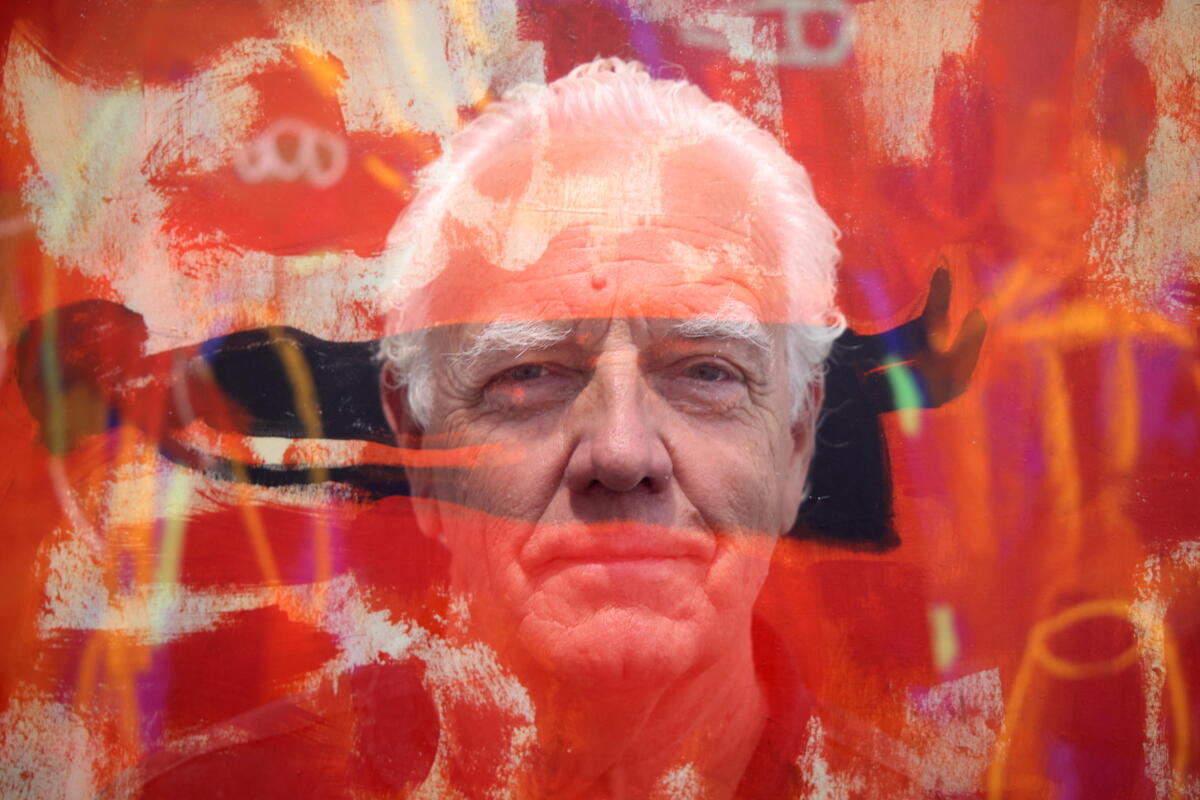
Craig Krull is captured in a double exposure with an untitled painting by artist Gronk at the Craig Krull Gallery at Bergamot Station.
(Genaro Molina / Los Angeles Times)
For Krull, after one divorce, two daughters, and showcasing more than a hundred artists at his Craig Krull Gallery since the center’s founding, Bergamot Station has been the one constant in his life. He’s moved so often, the Bergamot address is on his driver’s license.
“I love L.A., and L.A. art, culture and everything about it,” Krull said. “For some reason, Santa Monica is not loving us.”
“I’m not going anywhere,” he added. “I’m not leaving until they kick me out.”