
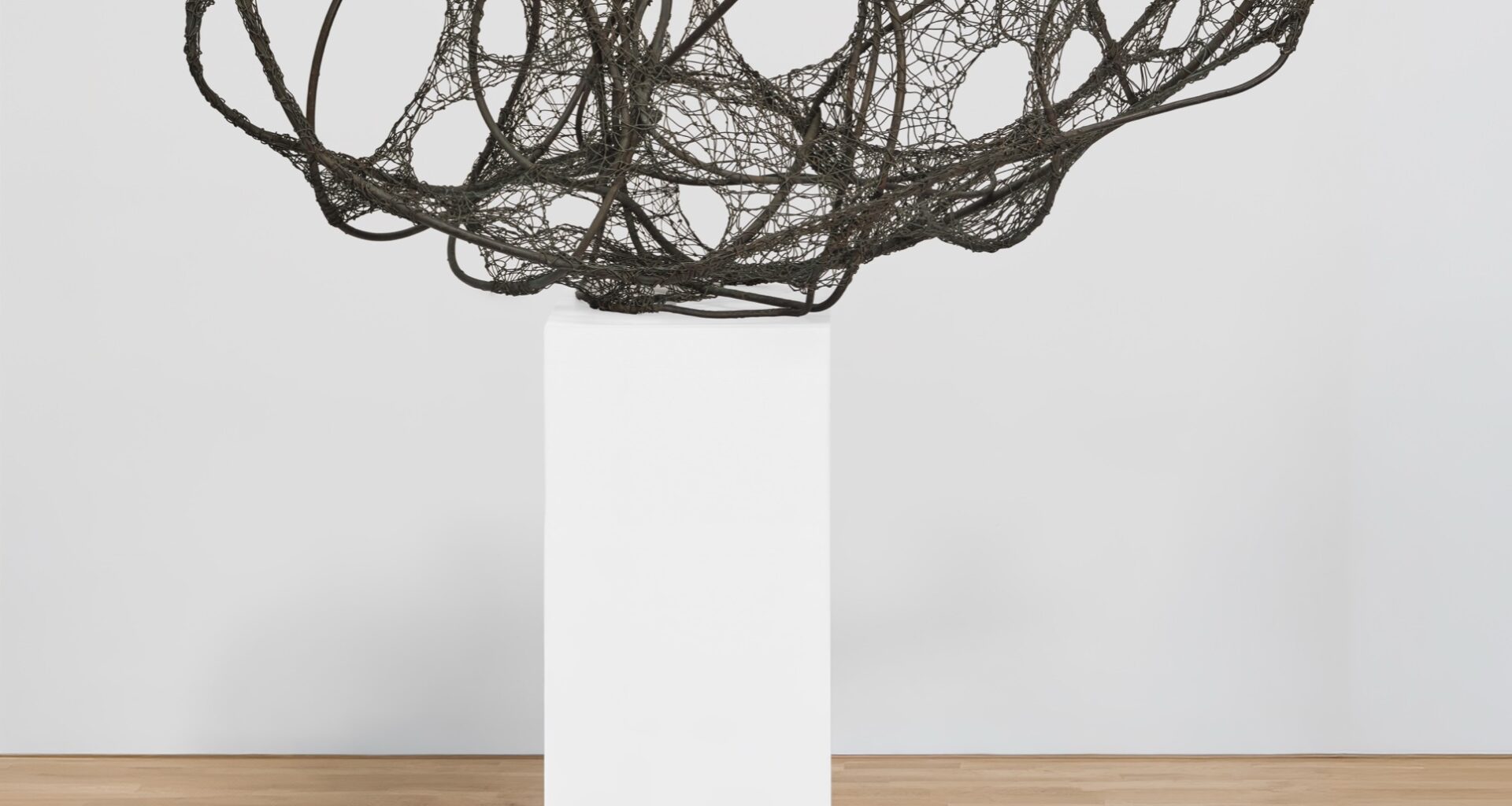
San Francisco, Paris, Rome
Ortuzar
September 10–October 31, 2026
New York
Known for her milled iron and Murano glass gates at Peggy Guggenheim’s Venetian palazzo, Claire Falkenstein’s oeuvre is primed for a serious reappraisal. At Ortuzar, we encounter a well-curated exhibition of early historical gems created in San Francisco, Paris, and Rome. Largely pegged as a modernist known for her architectural commissions in 1960s California, Falkenstein (b. 1908; d. 1997) was slowly erased from an LA art scene dominated by the all-male Ferus Gallery stable. Before the early 1970s, the marginalization of women was largely the rule in the city of the angels. Hauser Wirth & Schimmel’s Revolution in the Making: Abstract Sculpture by Women 1947–2016 began to set the record straight. Falkenstein’s stellar brazed iron, bronze, and copper wire “Suns,” seen alongside the likes of Louise Bourgeois, Magdalena Abakanowicz, and Lee Bontecou, placed her firmly in this exalted firmament. Today, seeing wire sculptures by Christopher Wool and Alan Saret, we realize Falkenstein made similar works that look surprisingly contemporary decades earlier. She was one of the first women to use experimental industrial materials and led the way for artists like Eva Hesse. It is wonderful to see Falkenstein finally getting her due, along with her fellow Californian Ruth Asawa!
Importantly, this exhibition’s point de départ is the artist’s early period in San Francisco, where her comrades in art were Alexander Archipenko (b. 1887; d. 1964), László Moholy-Nagy (b. 1895; d. 1946), György Kepes (b. 1906; d. 2001), and later Clyfford Still (b. 1904; d. 1980). Falkenstein studied sculpture with Archipenko at Mills College in 1933. San Francisco, Paris, Rome begins with Inside Out (1939), a pivotal clay sculpture whose exterior form folds into the interior like a Möbius strip or Klein bottle. For Falkenstein, interior and the exterior space would become interchangeable in importance. Archipenko’s influence can also be seen at Ortuzar in Falkenstein’s Four Piece Bronze Horizontal (Sculpture horizontale) (1951), which is reminiscent of his Walking Woman (1912). It is one of the few bronzes Falkenstein made, since casting was so costly. That expense may have worked to her advantage and freed her from more academic approaches, while pushing her to experiment with industrial materials and metal wire.
Moholy-Nagy and Kepes—whom she met at Mills College—feel more like kindred spirits than influences. Falkenstein knew both Moholy-Nagy and his wife Sibyl and was familiar with his work. László Moholy-Nagy’s experimental photograms, like Marseille, filets de pêche (1929) and Light-Space Modulator (1930), mirror Falkenstein’s interests in movement, space, and unfettered experimentation. Kepes’s photographic works, like Hand and Geometry (1939), may have helped Falkenstein unleash her explorations into see-through and uncanny forms. As she said, “I’m working with motion all the time. If you’re unwilling to … go into the unknown and fail, you’ll never do anything.”
In 1950 at forty-two, Falkenstein decamped to Paris, which fueled an important chapter of her artistic development. In a leap of faith, a short trip turned into a thirteen-year stay. The expat group “Les Américains à Paris” included Sam Francis, Joan Mitchell, Zuka, Alice Baber, and others. In Paris, they met up with the École de Paris, whose members included Jean Arp, Karl Appel, Alberto Giacometti, Antoni Tàpies, and Georges Mathieu. In a small flat on the rue de Savoie, Falkenstein began working with industrial stovepipe wire, lead, melted solder, and metal rods. She was never part of the herd. Often working in isolation, her independent approach stood out. The French critic Michel Tapié identified her as one of the select, maverick practitioners of what he termed art autre—art that resembled no others and was free from both geometric and figurative inherited form. Several American expats were also working with wire and rods but in very different ways: Alexander Calder with his whimsical circus, Harold Cousins’s iron rods welded into more predictable abstractions, and Shinkichi Tajiri’s semi-figurative sculptures. Falkenstein’s Parisian sculptures were never predictable or figurative. Her densely layered sculptures like Sun #4 (1954) and Untitled (Sun) (ca. 1955), which could include melted glass, sheet copper, and dripped enamel, have a weighty psychological impact and palpable presence. They were radical, and there was nothing like them. Her larger and more open-spaced works, such as Sun #13 (ca. 1958) and Sun #14 (1958), take flight in another way, becoming almost topographical structures mapping an imaginary cosmology.