
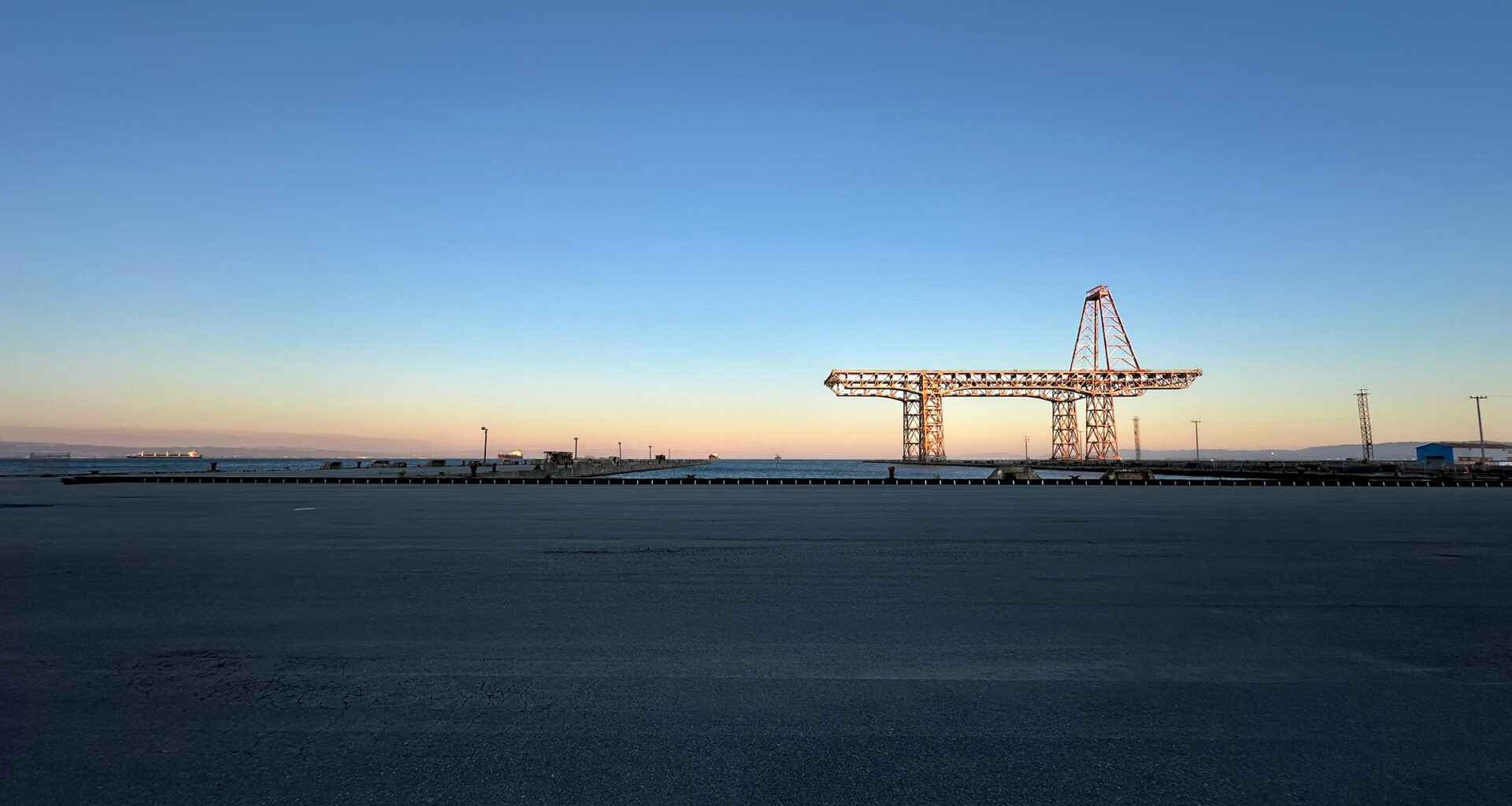
The gantry crane at the Hunters Point naval shipyard is the most famous San Francisco landmark you never think about.
Visible from five counties and standing nearly 500 feet tall, the immense steel structure — which at one point loaded million-pound gun turrets onto U.S. Navy battleships — was eclipsed in stature only by the Golden Gate Bridge at the time of its construction.
On Oct. 9, the crane will become the centerpiece of a 40-minute, multi-sensory light show, one that took several years and multiple grants to realize. “It’s a real production,” said Barbara Ockel, the president of the Shipyard Trust for Artists.
The crane was first lit up in 2024 in honor of the 40th anniversary of the shipyard artists, one of the largest art communes in the country, which has its own gallery and open studios events. And, while the experience was awe-inspiring, Ockel sees room for improvement.
“It was not nearly bright enough,” she said.
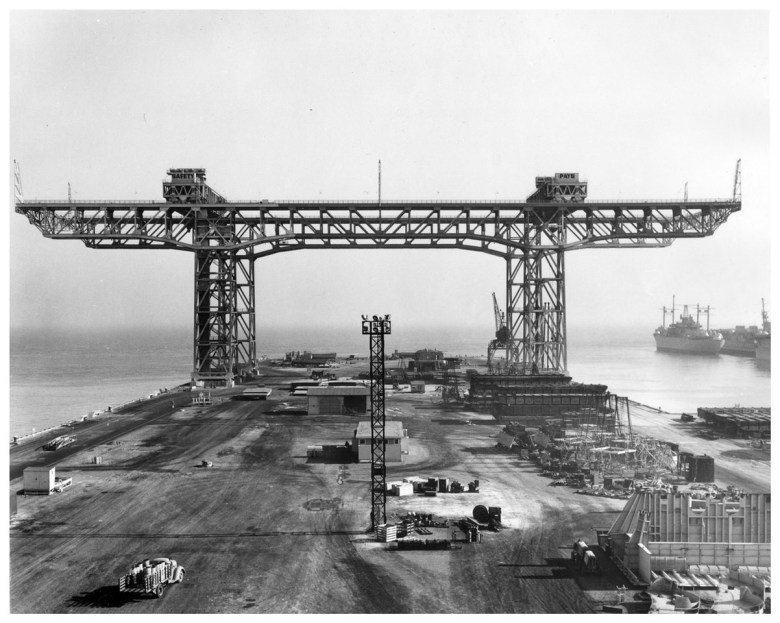 Giant crane at Hunters Point Shipyard in 1947. The original structure before the A-frame was added had two twin trolley cranes that moved along the top railway. The twin cranes could either service one ship each on either end, or could lift in tandem for singular heavy loads. Courtesy of the National Archives at San Francisco, Record Group 181.
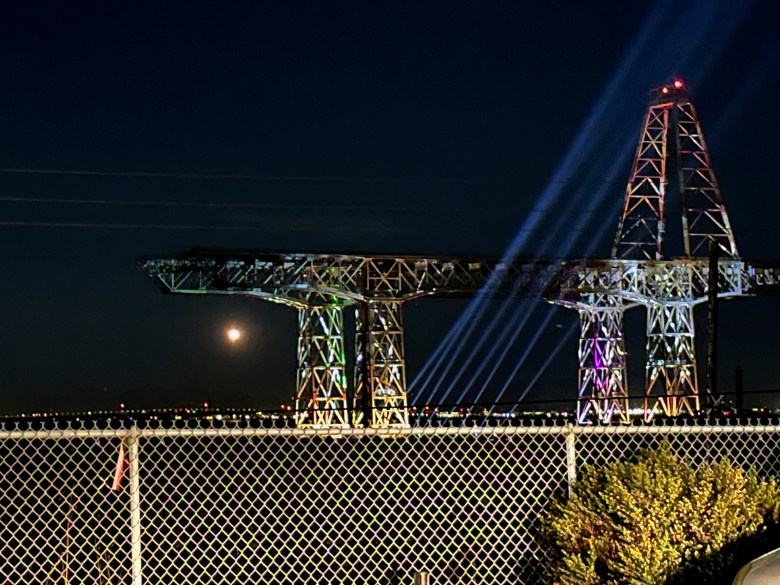 Courtesy of the Shipyard Trust for Artists. 2024.
The crane stands often unremarked-on today, a silent witness to the furious effort and top-secret projects the shipyard once contained.
At the peak of its operation in 1941, the Hunters Point naval shipyard employed 18,000 people. The crane, the largest in the world at the time of its construction, became an inevitable symbol of war and might with its capacity to lift 630 tons in its work re-gunning battleships.
The shipyard became the site of top-secret nuclear experiments at the Naval Radiological Defense Laboratory after having received highly irradiated battleships from the world’s first nuclear disaster, the “Baker” test conducted by the U.S. military at the Bikini Atoll.
The A-frame was added to the top of the crane in 1967 specifically to help it withstand the pressure of testing nuclear weapons like the Poseidon Missiles.
Officially declared a Superfund site in 1989, the shipyard’s radioactive contamination required a lengthy cleanup process — one made even more extensive when falsified soil samples set the remediation back by more than a decade.
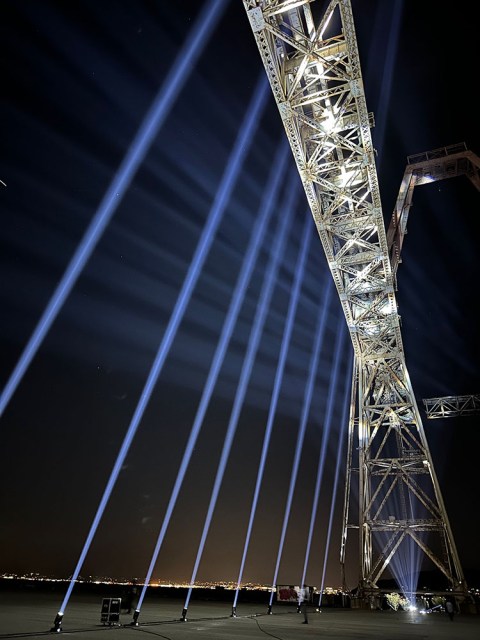 Courtesy of the Shipyard Trust for Artists.from 2024.
Given its deep connections with the U.S. military and nuclear testing, employees of the shipyard often wouldn’t, or couldn’t, share details about their work, leading to a sense of secrecy and awe.
CRANE intends to shine a light, both literal and metaphorical, on the impressive-yet-fraught work the shipyard often did. And, with support from the Rainin Foundation, The National Endowment for the Arts and the San Francisco Arts Commission, this round of illumination will be much more sophisticated than the last.
Opening night, Oct. 9, will feature a live choral performance and watch party at Zaccho Dance Theater (the chorus will also perform on closing night, Oct. 17). On Oct. 16 and 17, during the shipyard’s open studios, there will be a livestream at Building 101 on the grounds of the shipyard.
“It’s a magical moment when it gets dark enough [for the crane] to start emerging,” Ockel said.
The vision
CRANE is billed as a temporary monument in five movements — crane, voice, light, sound and projection — created to honor the history and memories of a shipyard steeped in history, mystery and controversy.
Composer and sound artist Evelyn Ficcara, part of the five-member creative team behind the art installation, accepts all sounds as part of her music: found sounds, instrumentals, spoken word and voice.
In composing the program for the crane’s illumination, she began wondering what kinds of sounds the crane itself was making. She attached contact microphones to the structure — piezoelectric microphones can capture sounds from objects rather than through the air — and pressed record.
“It made a humming sound, a lovely C minor-major 9th,” Ficcara said. “It’s hard to exaggerate the sound of that crane.”
Ficcara then had members of the chorus at the Dr. George W. Davis Senior Center sing the sounds of the structure.
“Symbolically, it’s humans who made the crane, and humans sing the voice of the crane.” She likened the result to a cinematic soundtrack.
Augestene Phillips, who sings in the Davis Center choir, said that participating in CRANE allowed her to finally appreciate the structure she had walked by so many times in Candlestick Park but never really noticed. Now she is fascinated by its complex history.
Like the sounds of the crane, snippets of the seniors’ recollections also animate the soundtrack. “It’s a site that has many, many stories and a range of voices inside it,” Ficcara said.
The composer worked closely with consulting historian Stacey Carter, who provided Ficcara with historic recordings of the shipyard. Carter, who also worked on the 2024 illumination, said this project has been much more involved.
She has shared many of her discoveries with the team, like the existence of Paul Draper’s all-Black painting crew that was in charge of maintaining the crane for decades. Tied onto the crane’s massive frame with little more than a rope, his crew would get to one end and turn around and paint and seal again from the other direction.
“Just like the Golden Gate Bridge, this thing had to be maintained 24-7,” she said. “It was a constant job.”
She met Paul Draper’s son, also named Paul Draper, when he came to one of the shipyard’s Open Studios events having no idea about the work his father had done.
Nearly everyone on the artistic team talked about the struggles in realizing the performance, one that, just like the crane itself, is epic in scale and meaning. Yet the community and the importance of collective memory helped guide CRANE through the roadblocks.
“One thing that keeps me going and really working on it is, it’s an iconic thing to bring something back,” said Ian Winters, the video artist on the team. “The lights went out on the base almost 40 years ago, but we’re getting to help bring the lights back on for a few days.”
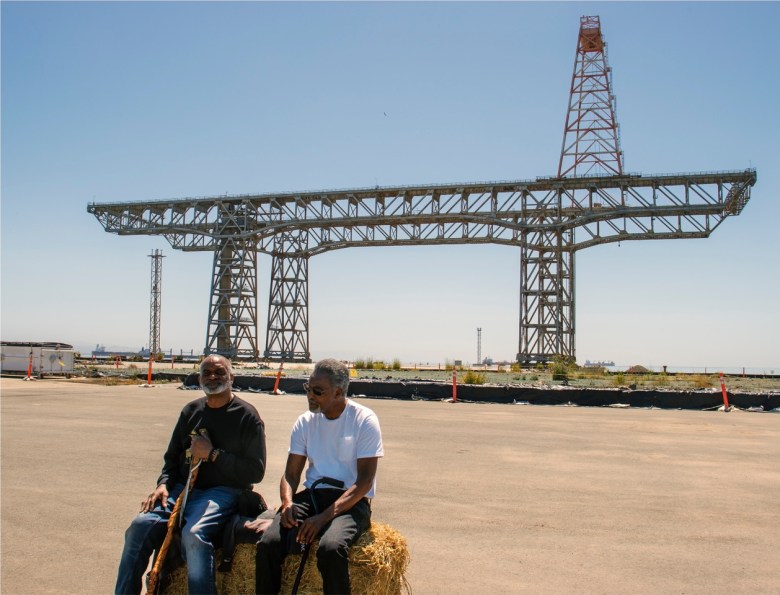 Allen Jordan and Claude Carpenter during their oral history interviews done on-site at the crane. Photo by Stacey Carter, 2025.
The struggle
William Rhodes, an artist and the intergenerational program director at the Davis Senior Center, also sits on the creative team behind CRANE. He believes the kind of preservation work intrinsic to the project is essential.
“We’re losing people and, pretty soon, this history could disappear,” he said. “The fear many of the seniors have is, with development and everything else, all of a sudden, you just start erasing things.”
This felt particularly relevant when a key component of the CRANE performance went missing: A live audience.
Despite allowing an audience at the illumination of building 411 on the shipyard grounds earlier this year, the Office of Community Investment and Infrastructure (OCII), the agency with jurisdiction over the area, refused to admit people to the foot of the crane for safety reasons.
“At first, I had proposed that the audience walk out there, and we were going to illuminate a bunch of buildings along the path,” Ockel said. “OCII said, ‘No, you can’t do that. But if you can bring them there with a bus, we’ll be okay with it.’ And all of a sudden, between March and now, the bus is not okay.”
The organizers regrouped and planned to have only the vocal performers come out to the crane. Again, OCII vetoed that idea.
OCII is the successor agency to the San Francisco Redevelopment Agency, infamous for its controversial leveling of the Fillmore District as part of urban renewal.
“A redevelopment agency in San Francisco, in the Hunters Point shipyard, deciding to not allow the seniors to come close to the crane really feels like an alarm bell for us,” Rhodes said.
“It’s a safety concern,” said an OCII representative when asked for comment. “That’s an active construction site.”
Ockel said she submitted a detailed safety plan, which she said was rejected without any clear grounds. She never anticipated an issue with CRANE, given an audience was allowed on site for the illumination of Building 411 before its slated demolition.
“They have more hazards on the streets of San Francisco than the areas that we were talking about designating for a public audience,” said Carter.
The future
Despite the change in audience plans, Carter and the rest of the team remain confident about the quality of the show they will be able to put on.
Their hope is that the illumination will draw more attention to the shipyard and its many-layered history. Carter believes the crane should become an officially designated historic landmark to protect it from being torn down.
“Nobody has a crane like this anywhere in the world,” she said.
Woody LaBounty, the president of SF Heritage, said there are three main factors in designating a city landmark: That it be on city property, that it be more than 50 years old and that its character-defining features — that is, what makes it historic or significant in the first place — are still identifiable.
“I think it’d be great to be a landmark,” LaBounty said. Yet there are two caveats.
One is that landmarking the crane doesn’t mean it will be protected forever, nor does it provide any funds for its maintenance. It only adds in the step of historic review before any changes can be made to the crane — including demolition.
Yet the bigger obstacle is that the crane doesn’t sit on city property. The shipyard is owned by the U.S. Navy and is, for now, on federal property. If the property were to switch hands in the future, a designation could become possible.
In the meantime, the crane — and its illumination — can serve as a beacon for San Francisco, both a symbol of our wartime past and also of how far we’ve come.
“Now all of that is behind us and we’re making art from it,” Ockel said. “That’s the direction we want to go in.”
Opening night watch party, Fri., Oct. 9, Zaccho Dance Theater
Watch Party at Building 101, Fri., Oct. 16, Hunters Point Shipyard
Watch Party at Building 101, Sat., Oct.17, with live choir
To watch the livestream from anywhere, visit this link.
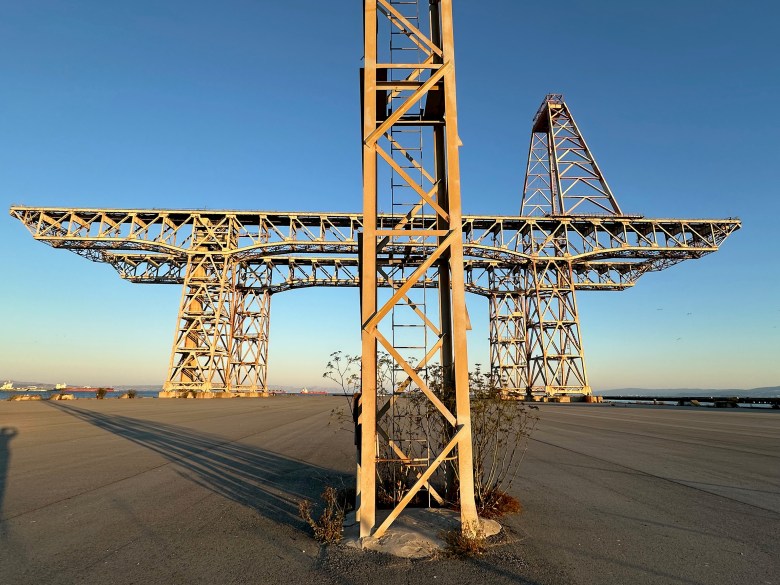 Courtesy of the Shipyard Trust for Artists.
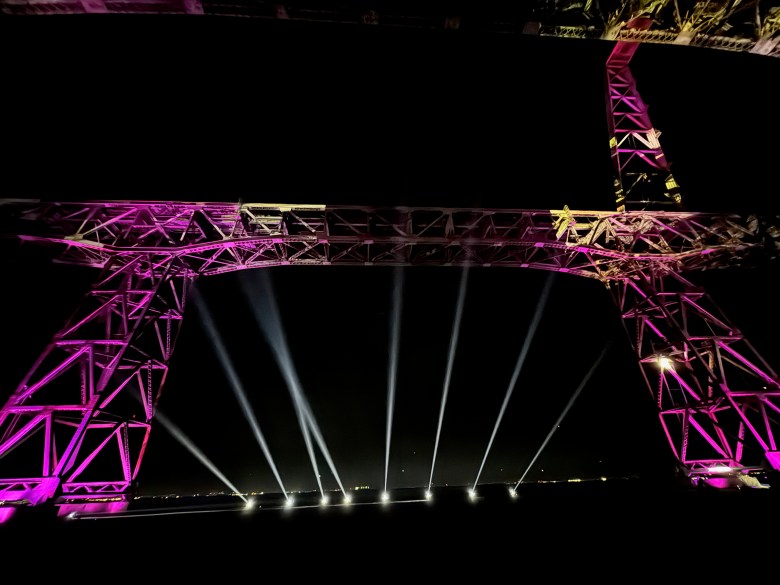 Courtesy of the Shipyard Trust for Artists.