
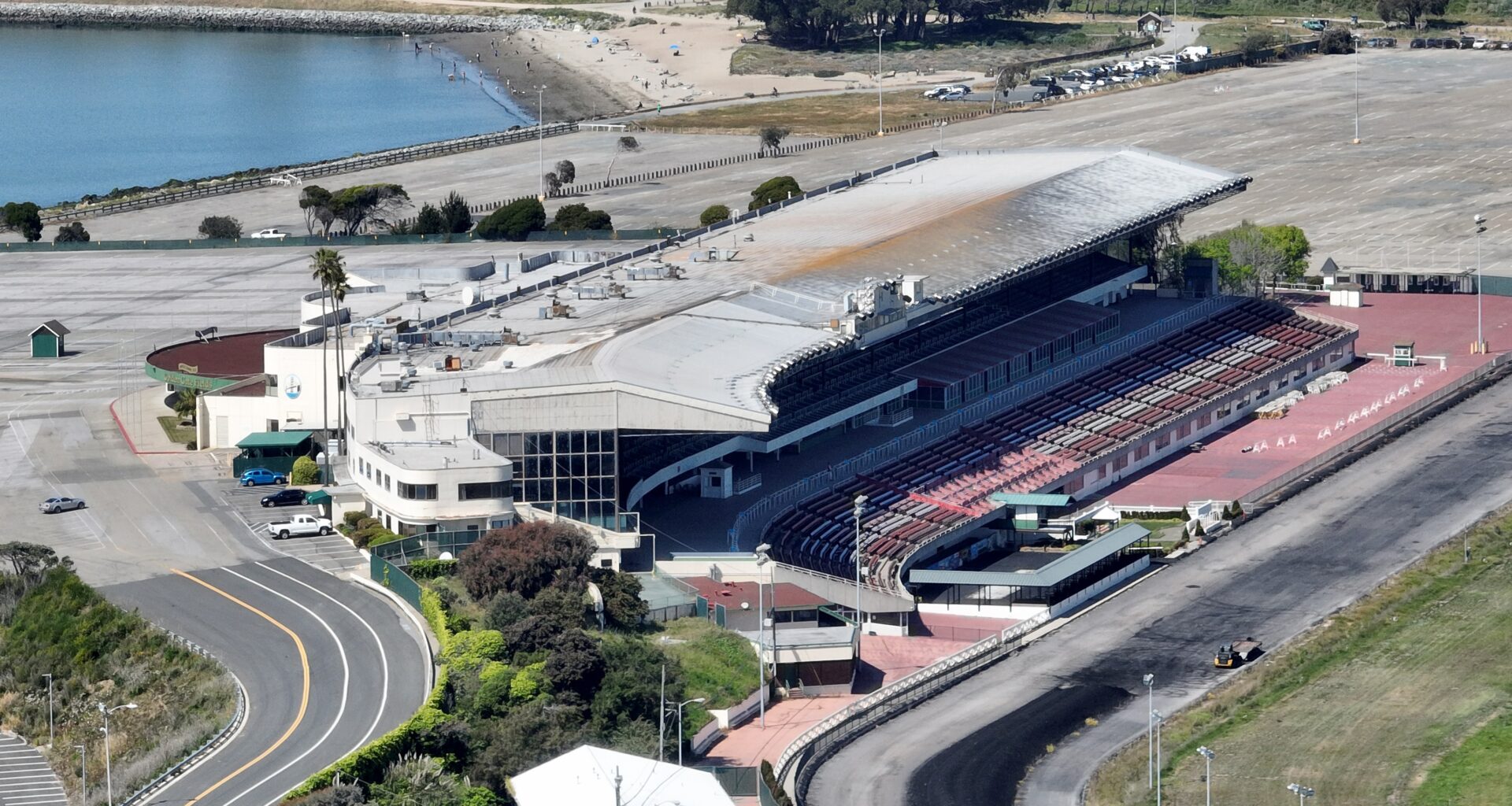
The city held a special meeting Monday night in Albany to discuss the anticipated acquisition and redevelopment of Golden Gate Fields into a 162-acre public shoreline park.
While the transition would make the effort one of the largest open space projects in the state, turning the former horse racing track into a park along the bay will come at a cost to the city, school district and municipal services via tax revenue.
“The biggest challenge ahead for Golden Gate Fields is if the property becomes tax exempt, the city stands to lose roughly $1.3 million a year at the same time our costs continue to rise,” Councilmember Jon Destin said. “We know this is coming, which means we should be planning for it now.”
Golden Gate Fields operated as a thoroughbred racetrack from 1941 until its closure in 2024 amid a decline in the horse racing industry and pressure from animal welfare groups. But the 162-acre property, straddled between Berkeley and Albany along the San Francisco Bay, is a prime location for reuse.
In March, the Trust for Public Land secured a $175 million deal with the Stronach Group, the site’s corporate Canadian owner since 1999, to acquire the property in early 2027. The funding includes $125 million in redirected climate dollars from the state legislature, $20 million committed by the East Bay Regional Parks District from Measure MM, and $30 million raised from private and philanthropic sources, according to the city.
When escrow closes next year, Albany expects to lose $2.2 million in tax revenue. The property generates approximately $1.1 million annually in special tax revenue for city infrastructure and about $700,000 for the Albany Unified School District.
“The most significant impact for the City would be from the loss of parcel tax revenue associated with Measure K (emergency medical services); this source currently provides about $400,000 in funding annually for EMS services, representing nearly 20% of the total from that tax,” according to the city’s website.
For a city of 20,000 people, Golden Gate Fields was a tax boon.
“It is lovely to think of all the new open space. It is also onerous to consider the lost revenue to city services and the $700,000 per year lost revenue to AUSD,” said Albany resident Judy Kerr. “It is a huge loss that will require focused and creative alternatives.”
Many of those alternatives were offered by Albany residents Monday night.
Some proposed building electric vehicle charging stations, a restaurant or event venue, or for part of the site to be turned into an emergency evacuation center. One resident requested to put in a horse racing museum to honor accomplished jockeys such as Russell Blaze and thoroughbreds like Silky Sullivan.
Plans call for the demolition of the racetrack’s structures as part of the redevelopment, but for Albany residents like Peg Healy, she wondered if those structures could be reused and adapted for different purposes.
“Even if the grandstand area, which stands on solid ground, required remodeling and repair, is it not more cost effective to do so and use it for community use? The first thing that occurs to me is whether it can be used as an emergency evacuation center?” Healy said. “I’m mostly concerned that if you tear the grandstand and clubhouse building down now, you won’t have $50 million to rebuild it.”
Under the terms of the dispossession agreement, the Stronach Group will remove all buildings from the site, including the stables and grandstand. What environmental cleanup will look like at the site is still to be determined.
Next month, the East Bay Regional Park District Board of Directors will approve the acquisition agreement and its long-term stewardship. This will lead into the formal closure of the escrow agreement and transfer of the property to the East Bay Regional Parks District and the cities of Albany and Berkeley to create a specific plan for the site.
“Partnership with the cities will be important both in a future planning process and in our long-term stewardship and management of the site. If we are successful acquiring the site, we would look forward to an open, transparent planning process to determine a vision for the property,” the East Bay Regional Parks District said in a statement. “If there are opportunities for revenue generating, park compatible uses at the site that could be managed in partnership with the city, we would look forward to exploring those ideas during the upcoming planning process.”
A multi-year community planning process will then begin, led by the property owners to determine amenities, restoration priorities and public access. Construction is likely to begin in 2029 as part of a phased plan to expand public availability.
Whatever will occur at Golden Gate Fields is a tantalizing prospect for public redevelopment for all involved, said Albany Councilmember John Miki.
“Recognizing the limitations we as a community placed on the property, and recognizing the funding limitations that you all have, I am super excited for the future of Golden Gate Fields,” Miki said.