
Emma Rice’s new theatrical version of “North by Northwest” is not just a failure as an adaptation — it is a debasement of the art it purports to honor.
Built from the 1959 Alfred Hitchcock film of the same name, the American Conservatory Theater’s current production manages to turn the master of suspense into a multihour endurance test for boredom. Distinguished by an omnipresent narrator, tasteless musical numbers and an abominable series of left turns in place of an ending, the production is an insult both to Hitchcock and to the unfortunate souls that constitute its audience.
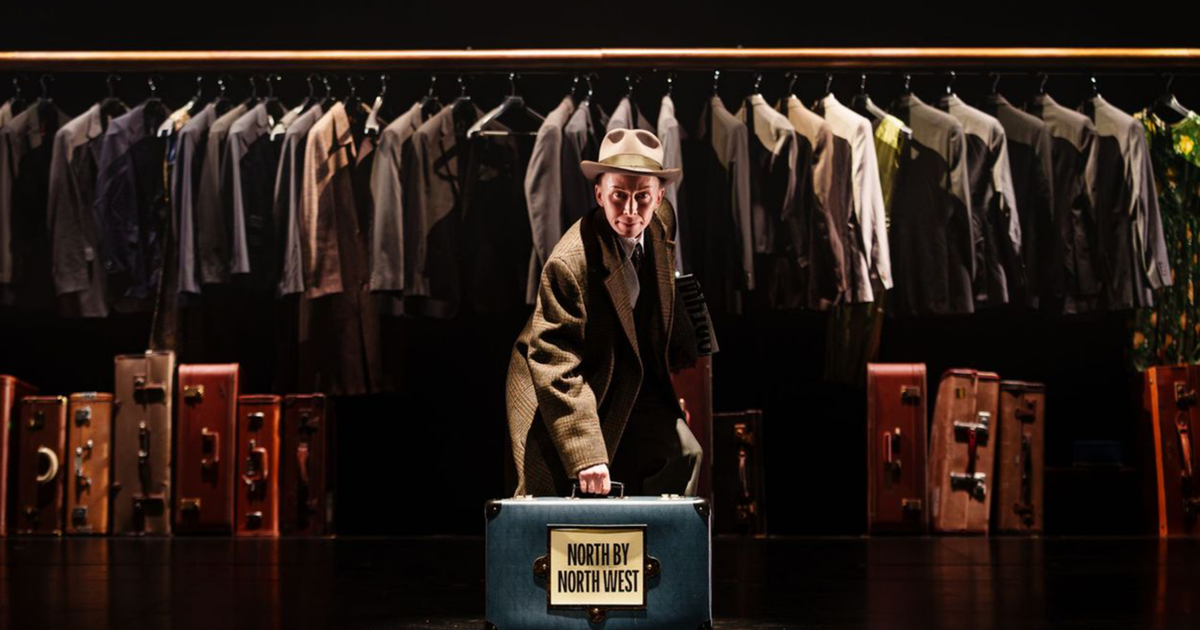
It is a given that a stage adaptation of any movie will need to make adjustments for the different medium, and that is especially true of “North by Northwest.” Hitchcock’s classic is not only a thriller but a travel flick, changing its setting with almost comical frequency as the action bounces around the United States. Rice knew that recreating this on a stage would be difficult, but she and set designer Rob Howell were up to the challenge. The stage’s key feature is a set of four revolving-door structures styled with wood and assortments of fake liquor that at different times serve as a bar, the walls of a train car and, well, revolving doors. A proper creative solution to an obvious problem, the set design was the best thing about the production.
But one technical victory does not make a good adaptation. Arguably, the most important narrative element is its intricate plot, which demands that the viewer know enough, but not too much. The play’s solution? Constant, condescending exposition dumps that don’t even accomplish their goal of clarifying the story. This not only insults the audience’s intelligence, but severely disrupts the pace of a narrative whose momentum is a crucial element.
The chief medium for the exposition is the professor, a glorified narrator whose inclusion is the most egregious of the play’s myriad of creative missteps. Katy Owen does a good job with the character she was given, but to no avail. Their dialogue incorporates text from the scene descriptions of the original movie’s script, as well as plenty of ham-fisted lines written by Rice herself.
The former choice is an interesting idea that does not work in practice; scene descriptions are descriptions for a reason, and often sound strange when read aloud. But the even greater offense is what’s added in. Beyond mere narration, the professor addresses the audience, alludes to what has yet to happen and provides subjective commentary about the events of the play. The final result is a character who overshadows the story, and even the main characters, with their refusal to just shut up.
Even without the abundance of exposition, the play would be too rife with interruptions to earn the movie’s “thriller” designation. This is because, as an Emma Rice production, it includes her signature song-and-dance numbers slotted in every few scenes, complete with period-accurate tunes and lip syncing by the actors. The problem is the numbers’ lack of any discernable narrative purpose to justify their intrusion; their function seems to begin and end with attempting to be cute. Employing ’50s pop songs and jazz standards that have, at best, a tenuous connection to the plot, the musical numbers ultimately come across as tacky and fishing for nostalgia.
Despite its many creative liberties, the play generally remains true to the events of the film — that is, until the end. Without revealing what is said, the final act of the play departs from Hitchcock’s ending to make room for a series of speeches that can only be described as disasters. It is meta, it is tone deaf and it is hard to watch. While that description applies to the play’s final 15 minutes, it would also serve as a fine assessment of the whole show. “North by Northwest” consistently misses everything that makes its source material great, turning what could have been an exciting reimagining into a massive disappointment.