
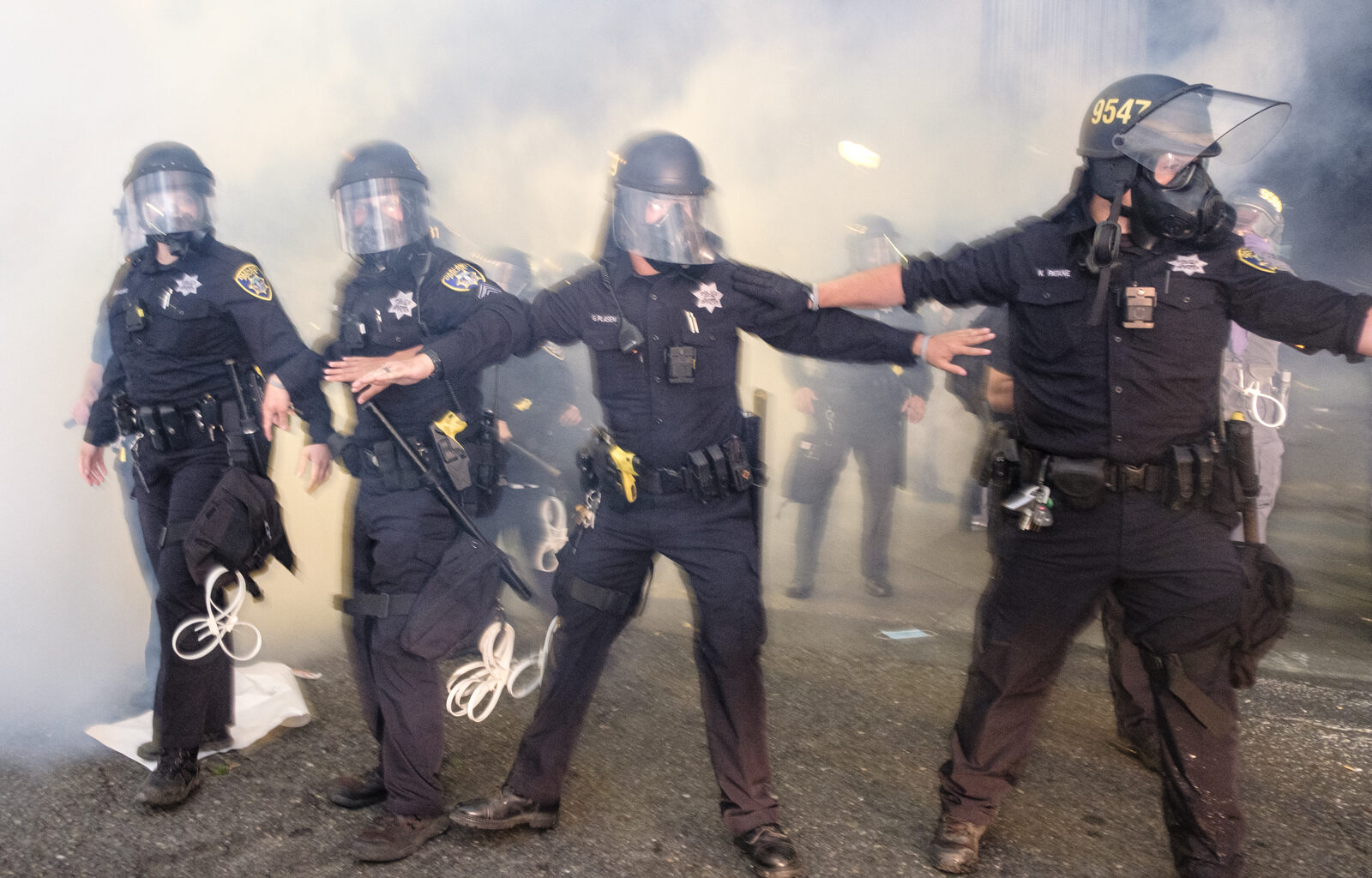
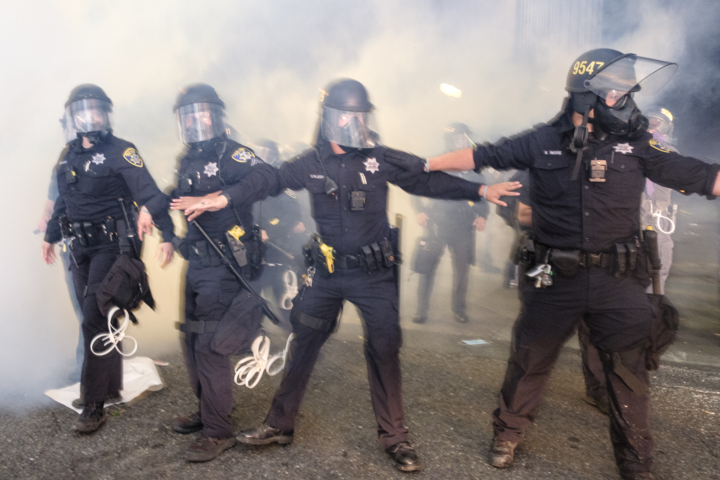
 Oakland police officers trying to maintain order after firing tear gas into a crowd of protesters on Seventh Street on May 29, 2020. Berkeley police provided mutual aid at the time. Credit: Pete Rosos
Berkeley is keeping its outright ban on tear gas in place after a narrow vote by the City Council Tuesday night. The vote also maintained policies banning police from using smoke or pepper spray for crowd control.
The tear gas ban was adopted in 2020 as anti-police demonstrations sprang up nationwide following the murder of George Floyd — and as the pandemic was at its height, prompting new health concerns around the use of chemical agents.
A proposal from Councilmember Rashi Kesarwani would have allowed BPD officers a few tightly controlled uses for tear gas but was voted down 5-4 by councilmembers Ben Bartlett, Cecilia Lunaparra, Terry Taplin, Igor Tregub and Mayor Adena Ishii.
Over several hours of public comment Sept. 15 and again Tuesday, dozens of Berkeleyans and others expressed fear and outrage at the notion of giving back to BPD officers the authority to use tear gas, or broadening their latitude to use pepper spray and smoke.
“‘Tear gas’ is an incorrect term. It makes CS seem trivial,” George Lippman, a member of the Peace and Justice Commission, said Sept. 15. “It’s actually not even a gas, but an aerosol made up of ultrafine particles,” which are hazardous to lung health and especially so to vulnerable populations.
Tear gas works by making “people unable to function,” according to the Centers for Disease Control and Prevention. It does this by irritating the eyes, mouth, throat, lungs and skin. Long-lasting exposure can lead to glaucoma, eye scarring, cataracts, asthma and other breathing problems, particularly if someone is exposed indoors.
Police supervisors answered council members’ questions on potential uses under the proposal, and officers asked the council during public comment to reverse the 2020 ban.
“Tear gas is an industry standard deescalation tool that allows us time, distance and a higher level of control,” police Sgt. Derek Radey, who serves on the Special Response Team, said Tuesday. “BPD is the only department in the nation whose tactical team is prohibited from using this potentially life-saving tool.”
Kesarwani’s proposal would have introduced safeguards designed by Councilmember Brent Blackaby narrowing acceptable uses of tear gas to three specific circumstances — barricaded subjects, hostage situations and serving high-risk warrants against suspects actively threatening officers or others — and only by Special Response Team officers with approval by incident commanders. The proposal would also have added explicit prohibitions against using tear gas for crowd control or during sweeps of homeless encampments. It would still have permitted BPD to use smoke and pepper spray in some crowd control situations.
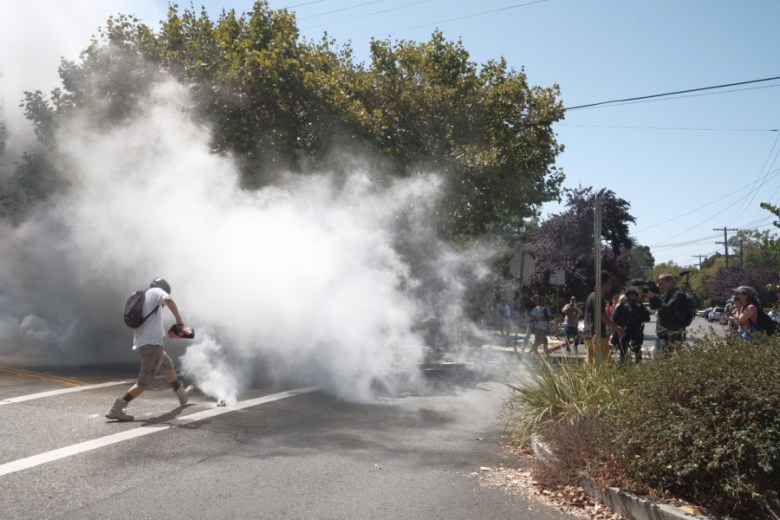 Smoke used during a demonstration in August 2017. BPD said they used only smoke, not tear gas, to break up a fight. Credit: Pete Rosos
Critics predicted BPD would not honor those safeguards.
“When police have tools, whatever their intended use is, they use them on peaceful protesters,” Soli Alpert, who chairs the Rent Stabilization Board, said Sept. 15. “When our protesters in Berkeley are protesting Trump and his agents make it violent, I don’t want our protesters to be tear-gassed by our department.”
Critics have also pointed to BPD’s infrequent use of tear gas as evidence the agency does not need it. Police say, however, that their track record shows they have the restraint and awareness to keep the weapon stockpiled and only use it as a last resort. “We shouldn’t have to meet a frequency threshold to save someone’s life,” Kesarwani said Tuesday.
“No other California city, except Berkeley, maintains an outright ban on tear gas in all cases,” Blackaby said Tuesday. “I don’t celebrate its use, I don’t celebrate the fact that we have to consider using it, but in order to protect the public, protect our officers … to reduce the likelihood of violent confrontations in these three very narrow circumstances, I do support the proposal today.”
Lunaparra said she was unconvinced tear gas could ever be safe enough for innocent bystanders. “As resistance to the Trump administration continues to grow, adopting these changes would send a clear and disturbing message about our City Council’s priorities,” she said. Even with Blackaby’s proposed safeguards, “passing this item tonight would still deter people from speaking out, from going to protests and defending their rights.”
Taplin agreed with Lunaparra.
“In order for us to land this policy, it needs to be crystal-clear to every stakeholder why this is a tactical necessity and why there is nothing else,” Taplin said. “I think tonight is not the night that we take this action.”
Taplin told Berkeleyside on Wednesday that he may be amenable to a different proposal in the future, but that the overlapping criteria for different chemical weapons made this one too convoluted.
“I don’t understand why it has to be tear gas and why there are no other options,” Taplin said. I want to at least as a community look at that and think it through together.”
Berkeley has tear gas but can’t use it; other agencies have disposed of it
BPD had 232 chemical canisters in its stockpile as of May, according to its most recent military equipment report. It was unclear from the report how many were tear gas and how many were pepper spray. A department spokesperson said BPD had no plans at present to dispose of its supply.
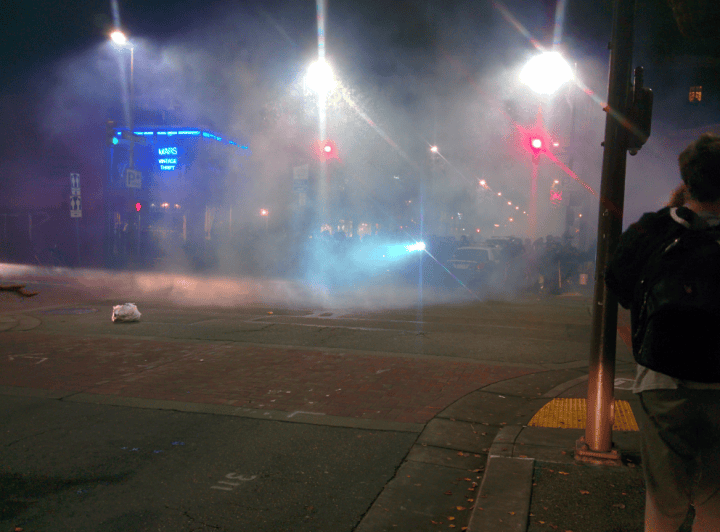 Berkeley police deployed tear gas to disperse protesters at around 10:15 p.m. in the area of Durant and Bowditch in Berkeley on Dec. 6, 2014. Photo: Citizen reporter
While other cities may not have banned tear gas use by policy, resolution or ordinance, some police departments have simply emptied their stores.
Former San Francisco Mayor London Breed ordered in 2020 that SFPD get rid of its tear gas by the end of the following year. Police there still have pepper spray and “pepper ball” ammunition, which is chemically similar, but no tear gas, according to their annual equipment reports. (SFPD has an internal policy expressly prohibiting the use of chemical agents of any kind for crowd control.)
The San Francisco Sheriff’s Office still had a supply of tear gas at least as recently as 2024, according to reports from that agency.
During a training exercise at a county jail in San Bruno that May, in which deputies used canisters previously belonging to UC Berkeley police, chemical agents sickened several students at a nearby elementary school, according to reports at the time from the San Francisco Chronicle.
UCPD’s most recent equipment report for its Berkeley officers also listed pepper balls and OC canisters, but no tear gas.
“*” indicates required fields