
For the first time in nearly a quarter century, the Oakland Police Department is no longer operating under the watchful eye of a federal judge.
U.S. District Court Judge William Orrick on Tuesday dismissed the consent decree that had governed Oakland’s police force since the Riders policing scandal of the early 2000s, when several of its officers were found beating and planting drugs on West Oakland residents. In doing so, he ended the longest such policing oversight model in the nation — a rigorous and contentious form of supervision that dragged on as a series of new scandals emerged over the last two-plus decades.
“While it was important for this court to have played the role it has over the last 23 years to reach today, now it’s important for the court to get out of the way and let the people of Oakland and their leadership build a future,” Orrick said. “I think everyone here agrees that substantial compliance has been achieved.”
A written order finalizing the ruling is expected in the coming months.
Moments after the judge announced his decision, Robert Warshaw, the longtime federal monitor who served as Orrick’s eyes and ears on the department’s reform progress, commended the city for its work. He called the move “a chance for a new beginning.”
“I concur with the court — the Oakland Police Department can continue its forward path no longer tethered to the court,” Warshaw said.
Still, he issued a warning to the police force that it needed to maintain its reforms, adding “who is guarding the guardians?”.
“Joy should be tempered with humility, because many of the things you’ve accomplished, you should have been doing all along,” Warshaw said.
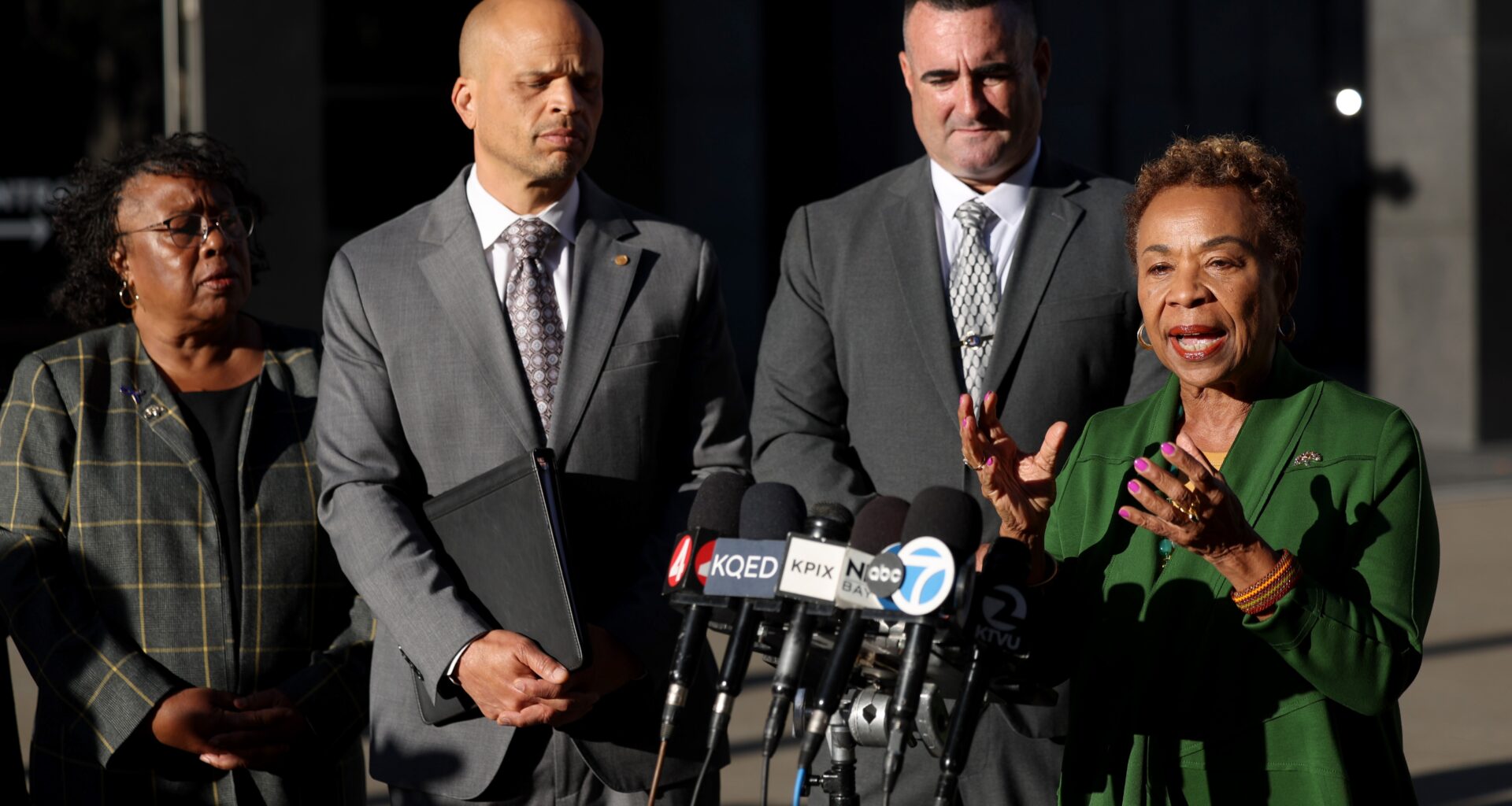
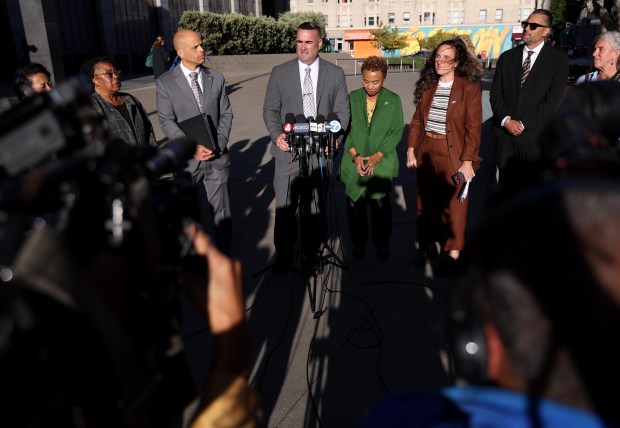 Oakland police Chief James Beere speaks during a press conference outside of the Phillip Burton Federal Building and U.S. Courthouse in San Francisco, Calif., on Tuesday, Sept. 29, 2026. To the right is Oakland Mayor Barbara Lee and to the left is City Attorney Ryan Richardson. U.S. District Court Judge William Orrick made a decision to relinquish federal oversight of the Oakland police department to Oakland city leaders for the first time since 2003. (Jane Tyska/Bay Area News Group)
The decision drew ecstatic reactions by a cadre of Oakland leaders in the courtroom Tuesday, with Mayor Barbara Lee and police Chief James Beere hugging moments after the judge ended the hearing. Later, standing outside the courthouse, the mayor recalled how she had seen first-hand how poorly the police department operated a quarter-century ago — and how far it had come to understand “police accountability and public safety go hand in hand.”
“I know very clearly this is not the police department of the days I experienced as a community activist,” Lee said.
The move appeared increasingly unlikely in recent weeks after a controversial police shooting in East Oakland, a spike in criminal prosecutions targeting Oakland officers and a surprise report finding the department had once again fallen out of compliance with the landmark accord governing it since 2003, known as the Negotiated Settlement Agreement.
In mid-September, the department’s federal monitor said the agency was operating below a key benchmark for investigating the most serious complaints against its officers.
During the first three months of 2026, the most recent term available, the department completed 83% of its most serious internal affairs investigations within the required six-month timeframe, according to Warshaw. The mark — signifying 77 completed cases out of 93 tracked by the monitor — was a couple percentage points shy of the 85% rate mandated by the landmark Riders consent decree.
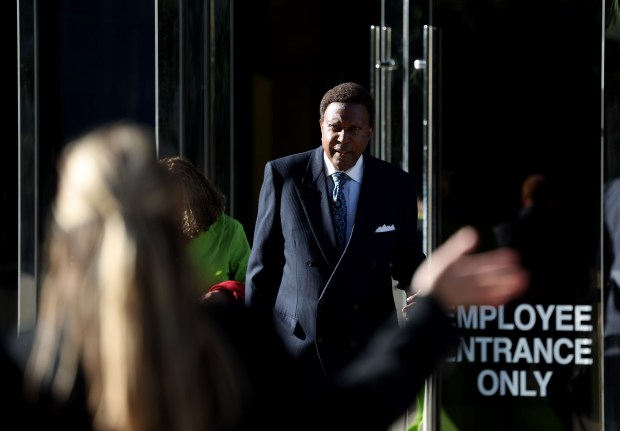 Civil rights attorney John Burris leaves the Phillip Burton Federal Building and U.S. Courthouse in San Francisco, Calif., on Tuesday, Sept. 29, 2026. U.S. District Court Judge William Orrick made a decision to relinquish federal oversight of the Oakland police department to Oakland city leaders for the first time since 2003. (Jane Tyska/Bay Area News Group)
Warshaw’s findings prompted the two civil rights attorneys who first pursued the Riders case — John Burris and Jim Chanin — to recommend another year of court oversight, calling the department’s missed target “incomprehensible and bitterly disappointing.” Their request came with a twist that drew immediate pushback from city leaders: The two attorneys would have “no future role in the case,” and instead leave that oversight to the court’s whims in a new, still-to-be-determined model.
On Tuesday, Orrick showed little appetite for that alternative.
With the decision in hand, Oakland’s leaders struck a celebratory tone. City Council President Kevin Jenkins called it “a great day for Oakland — it’s been too long,” while Councilman Ken Houston said “this is not the end, it’s a new beginning.” The Oakland Police Officers Association interim president, Cesar Leyva, issued a statement saying the city’s officers were “ready for the next chapter,” adding the ruling “reflects years of hard work by generations of officers.”
Standing by Lee’s side outside the courthouse, Beere hailed “a historic day” for the city, adding that the community was “getting their police department back.”
“This is just the ground floor — it’s not the ceiling,” Beere said. He vowed that “instead of reporting to the federal court, we’re going to be reporting to the city, to the community we serve.”
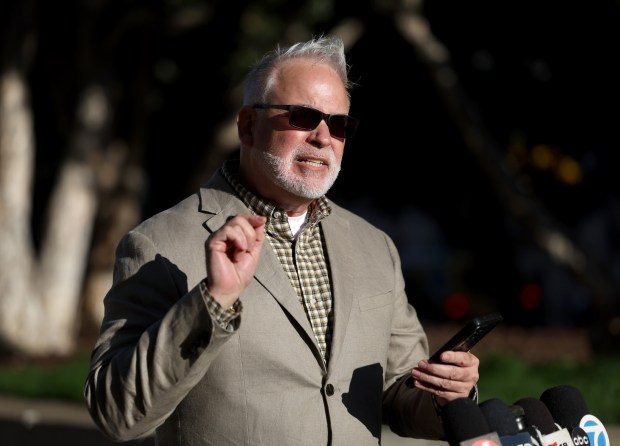 Edward Escobar, founder of the Coalition for Community Engagement, speaks during a press conference outside of the Phillip Burton Federal Building and U.S. Courthouse in San Francisco, Calif., on Tuesday, Sept. 29, 2026. U.S. District Court Judge William Orrick made a decision to relinquish federal oversight of the Oakland police department to Oakland city leaders for the first time since 2003. (Jane Tyska/Bay Area News Group)
With the federal judicial apparatus gone, oversight of the department now falls to the Oakland Police Commission, a volunteer civilian body that has struggled to establish stable footing or avoid clashes with elected city leaders since it was formed in 2016. Of late, police accountability advocates have increasingly raised alarms about lagging funding levels for the commission and its investigative arm, the Community Police Review Agency.
Adding to that challenge is the fact that Oakland has yet to announce a permanent hire in the role of the constitutional policing administrator – a $264,000-a-year job that could prove pivotal to OPD’s ability to sustain progress when oversight ends. An assistant city administrator, Michelle Phillips, was appointed to the post last year by Lee in a bid to ensure reforms within the department remain on track.
Concerns about the police commission’s funding levels — coupled with headline-grabbing turbulence over the last year — suggest that Oakland could be “wading into dangerous waters” following the judge’s ruling, said Cat Brooks, co-founder of the advocacy group Anti Police-Terror Project.
“We are moving very quickly to a time where there is no oversight, or no incentive for them (police) to even pretend to try to color inside the lines,” Brooks said. “I am very concerned about what this means.”
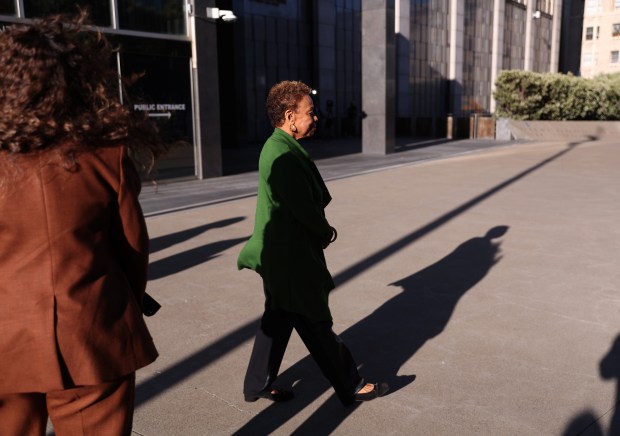 Oakland Mayor Barbara Lee heads to a press conference outside of the Phillip Burton Federal Building and U.S. Courthouse in San Francisco, Calif., on Tuesday, Sept. 29, 2026. U.S. District Court Judge William Orrick made a decision to relinquish federal oversight of the Oakland police department to Oakland city leaders for the first time since 2003. (Jane Tyska/Bay Area News Group)
On Tuesday, the police commission’s chair, Ricardo Garcia Acosta, said the commissioners were “incredibly excited to get to work.”
“I think we have the structure in place to do so,” he added, suggesting the police department had evolved and was “not like it was even three years ago.”
The court’s now-finished oversight structure dated to the notorious Riders scandal more than 20 years ago, when four officers were accused of beating West Oakland residents and planting drugs on them, all while filing falsified police reports. A 2003 class-action lawsuit resulted in a $10.9 million payout to scores of people who claimed abuse at the hands of those Oakland cops and the implementation of the oversight plan.
The police department nearly escaped that scrutiny in 2016, right before allegations emerged that numerous officers sexually exploited a teenage girl in a scandal that spread to multiple other agencies across the East Bay. The court’s role also almost ended in 2022, before allegations emerged that veteran homicide detective Phong Tran had bribed a witness in a murder case and then lied about it. The ensuing fallout— which came just as the department cleared all but one benchmark — led multiple members of OPD’s top command staff to be disciplined, while numerous criminal cases were dismissed or overturned, including at least three murder convictions.
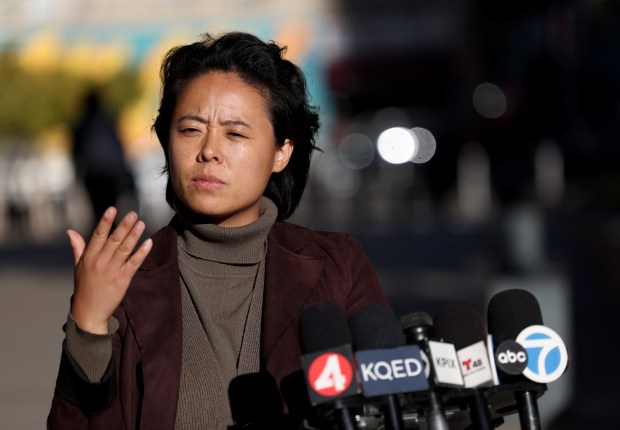 District 2 councilmember Charlene Wang speaks during a press conference outside of the Phillip Burton Federal Building and U.S. Courthouse in San Francisco, Calif., on Tuesday, Sept. 29, 2026. U.S. District Court Judge William Orrick made a decision to relinquish federal oversight of the Oakland police department to Oakland city leaders for the first time since 2003. (Jane Tyska/Bay Area News Group)
Yet Orrick voiced increasingly rosy predictions in recent months that he would soon end his oversight role, often crediting Lee for his confidence that the department’s reforms would stick.
With the ruling final, Antonio Lawson, who heads the city’s Community Police Review Agency, agreed with the federal judge that the consent decree needed to end. Yet he also suggested that the city’s work to maintain trust with the community was only just beginning, adding “tomorrow is the day that matters most.”
“There wasn’t going to be a better time,” Lawson said. “But the key is what do we do now?”
Jakob Rodgers is a senior breaking news reporter. Call, text or send him an encrypted message via Signal at 510-390-2351, or email him at jrodgers@bayareanewsgroup.com.