
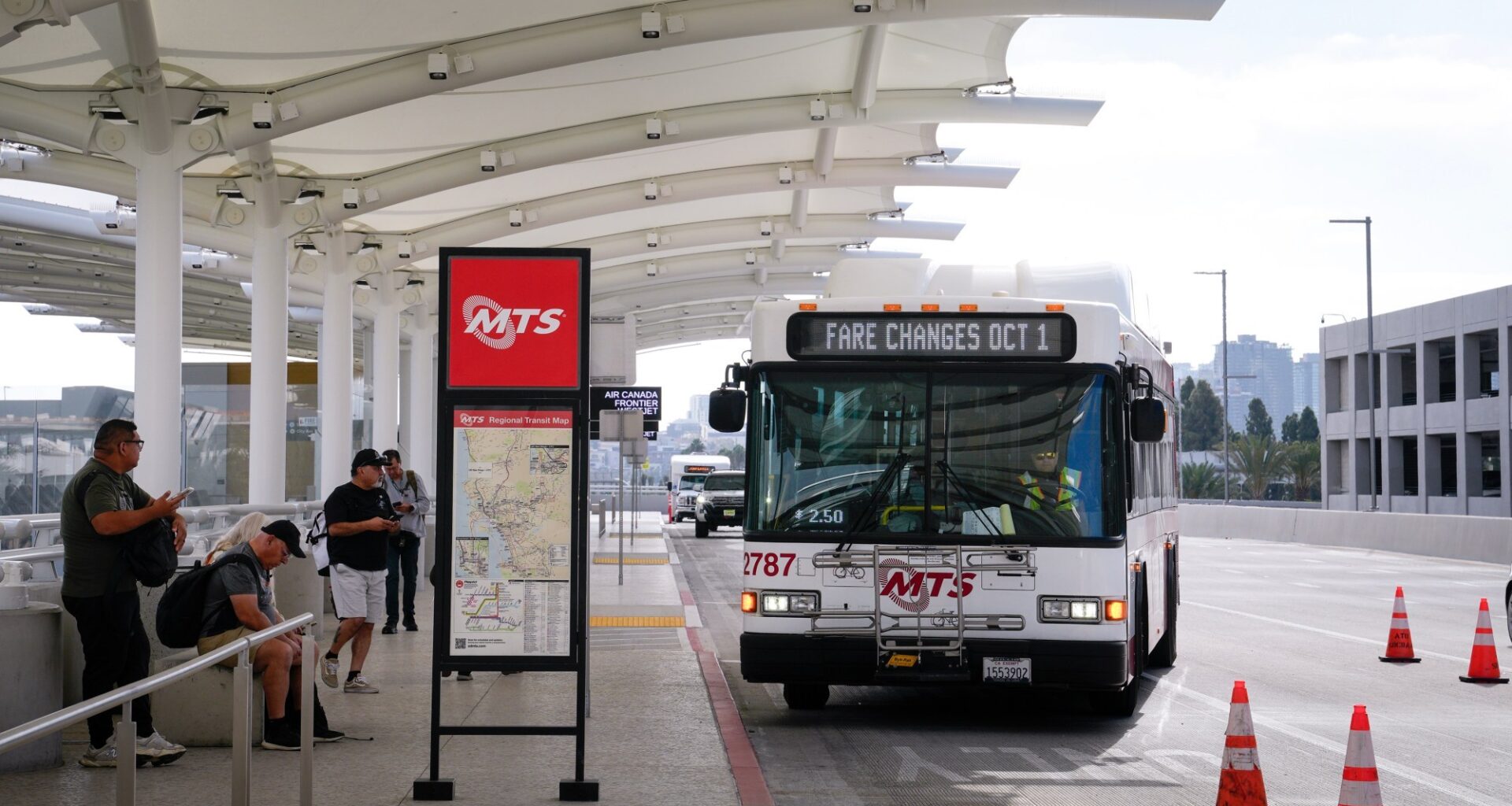
San Diego transportation officials did two notable things last month, one sensible, the other less so.
As promised, they launched expanded Metropolitan Transit System bus service to San Diego International Airport.
Then leaders of the San Diego Association of Governments, the regional planning agency, directed staff again to fulfill a four-decade, multibillion-dollar dream of finding a way to build a rail line or automated people mover to the airport.
Sandwiched between the two actions — an interesting juxtaposition if there ever was one — was an MTS statement that its budget shortfall is so severe that it could be forced to eliminate one-third of the bus routes and reduce the frequency of trolley runs in a few years.
Meanwhile, there was a real-world, cautionary tale unfolding up the road in Los Angeles. A people mover to Los Angeles International Airport called Skylink appears to be near completion, but its opening, which was once envisioned for 2023, is again being delayed. The latest price tag of $3.3 billion is about $1.4 billion over the original estimate.
That public-private partnership project — something some SANDAG board and staff members have suggested locally — has resulted in disputes between the contractor and public agency that hired it, a grand jury investigation and a bond downgrading that could make the project vulnerable to default.
Trying to move forward, SANDAG staff deserves credit for what initially was called “interim” expanded bus service that, in theory, was considered a stopgap measure until a rail/people mover project could be realized.
Meanwhile, SANDAG CEO Mario Orso’s response to the board’s request to get moving on that faster, sexier, massive project seemed to border on exasperation.
“Looking at basic math, let’s call it $2 billion (for a transit connection). The soft costs to get to a $2 billion project (are) a billion dollars. Who’s going to cover that?” he told the board last month, according to Lori Weisberg of The San Diego Union-Tribune. “MTS, do you have a check or city of San Diego? Or maybe North County wants to bail us out? We have to figure out all those finances.”
Remember, Orso was hired in part to bring SANDAG down to earth after controversies and a pie-in-the-sky $160 billion, decades-long regional transportation plan that hastened the exit of his predecessor, Hasan Ikhrata, in 2023.
Immediate fiscal hardships affecting several local government agencies shouldn’t stop planning for years and decades ahead. But regardless of good or bad financial times, the trolley/people mover idea hasn’t come close to becoming a reality.
Weisberg noted the considered options for such a project have narrowed from 21 to five. Progress of sorts, perhaps, but it’s approaching a half-century of discussion and planning.
San Diego City Councilmember Sean Elo-Rivera, who sits on the SANDAG board, expressed the widely held notion that people want a better connection to the airport.
Such a project was part of Ikhrata’s plan, and it was something that could have been partially funded by a countywide transportation sales tax initiative on the ballot in 2024.
An airport rail line or people mover was a big selling point for Measure G, but the tax was narrowly rejected by voters.
MTS officials are now discussing a sales tax proposal for 2028, but given deficits of up to $150 million in a handful of years for existing operations, it’s hard to see much, if any, of that being syphoned off for a new airport route if voters approve.
A fare increase that took effect Thursday won’t change the grim scenario facing MTS, according to David Garrick of the Union-Tribune.
We’ve been down this path before many times. SANDAG and MTS moved in the right direction by expanding service on the Route 922 bus loop from downtown to the airport.
The San Diego County Regional Airport Authority took a big step toward improving the situation several years ago by starting the free shuttle service from the Old Town Transit Center.
Public transportation to the airport has demonstrably improved, though it still falls short of adequate.
San Diego decision-makers should build on what’s here and what works. That future should be on wheels.
Yes, many other cities have people movers or rail lines to their airport that would be great to have in San Diego, if practical and affordable. But the never-ending yearning for something similar here has felt like chasing a unicorn.
Elected officials and the planners who answer to them should take a lesson from the relatively recent history of the airport itself. For decades, there were efforts to relocate what used to be called Lindbergh Field to someplace that would allow for the addition of a second runway, among other expansions.
As advocates repeatedly banged their heads against the wall, the airport on San Diego Bay was stuck in limbo with outdated, cramped facilities and few major improvements. It was not a pleasant place to be, particularly the old Terminal 1.
Finally, officials decided to make the best of what we have, where it is. The result is now two highly-regarded redeveloped terminals, more gates and more space for jets to park, although no additional runway.
Yes, getting in and out of the airport can be frustrating, but that’s the case with many major metropolitan airports. Yet it’s something that has been, and can be, further improved upon in San Diego.
For a modest portion of the cost of a people mover — that $2 billion total may be wishful thinking years down the line — San Diego could vastly improve airport bus and shuttle service. Perhaps creating bus lanes and/or doing something more creative could improve access.
The MTS annual operating budget is just shy of $500 million. MTS is already shifting money from some capital projects to operations. There’s a larger discussion about whether the expensive hoped-for airport line would take resources away from everyday transit across the region.
Further, bus routes are more flexible than rail lines in adapting to shifting development and ridership trends.
The pursuit of a zippier transportation connection to the airport has been ongoing, though the intensity has ebbed and flowed. It’s time to end this charade.
Stop wasting money, staff time and public attention on something that’s likely never going to exist and go all in on what already does.