
There’s a reason why The New York Times recently named Suzan-Lori Parks’ 2001 tragicomedy “Topdog/Underdog” the nation’s best play since Tony Kushner’s two-part “Angels in America.”
Both of these Pulitzer Prize-winners evocatively explore the history and mythology of the American Experience/American Dream, and how this country has failed in serving its most marginalized people.
“Angels” was about a once-religious gay man, and a reluctant U.S. government, losing their battles with the AIDS epidemic. In “Topdog/Underdog,” it’s two Black brothers struggling to overcome the crush of childhood trauma, racism, poverty, violence and profound loneliness.
A gripping and superb new production of “Topdog/Underdog” opened Thursday at The Old Globe, under the taut and intricately detailed direction of Steve H. Broadnax III, and starring the talented and charismatic actors Alano Miller and Elijah Jones.
Produced in the round in the Globe’s Sheryl & Harvey White Theatre, the two-character play takes on the anxious atmosphere of a sibling “boxing” match. The spellbound audience surrounds the “ring” as these rivals verbally spar, weave, dance, taunt and slug it out in their quests for sibling supremacy.
This marks the play’s third professional production in San Diego, following a 2009 staging at UC San Diego and a 2012 staging at ion theatre. Now 25 years old, the play feels just as timely, potent and heartbreaking.
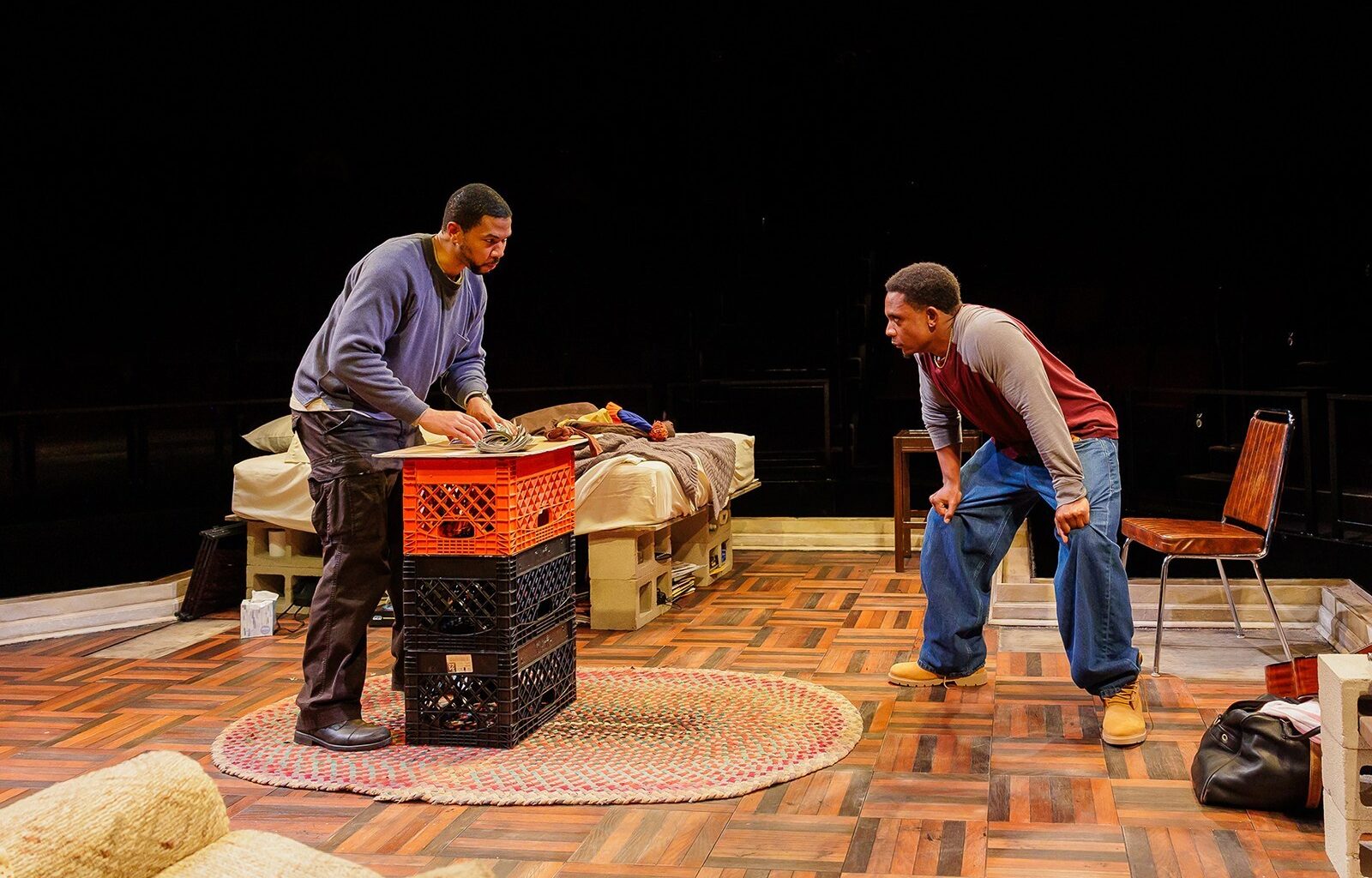
 Alano Miller as Lincoln, foreground, and Elijah Jones as Booth, back right, in The Old Globe production of Suzan-Lori Parks’ “Topdog/Underdog.” (Rich Soublet II)
“Topdog” is the story of siblings Lincoln and Booth, who got their historically linked names from their father as a joke. Abandoned by their parents in their teens, the now-adult siblings are uneasily sharing Booth’s tiny apartment after Lincoln’s wife kicked him out.
Booth, whose sole occupation is shoplifting, has always looked up to his brother, but in the current situation, he’s topdog in their relationship. He oversees the monthly budget, sleeps on the apartment’s only bed and bullies and demeans his elder sibling.
The circumspect Lincoln long ago gave up his lucrative but dangerous job as a street-hustling, three-card monte dealer for what he calls a “sit-down job with benefits.” He now earns a living playing president Abraham Lincoln (in whiteface makeup, false beard and stovepipe hat) in a sordid carnival arcade where mostly white ticket-buyers pay to “assassinate” Honest Abe with a cap gun in a mock Ford’s Theater.
Booth wants Lincoln to teach him three-card monte so they can work as a team, but Lincoln refuses, in part because he doubts his brother’s card skills and intelligence. But when Lincoln loses his arcade job, he secretly picks up the cards again, and his rise to power and resurgent self-esteem overturns the sibling power dynamic.
The play demands of its actors both dramatic and comedy chops, as well as a mastery of fast-paced, sleight-of-hand card skills and the accompanying rhythmic vocal patter. Miller and Jones are more than up to the task and they occasionally turn to the audience to search for the “marks” they’ll target for a card scam.
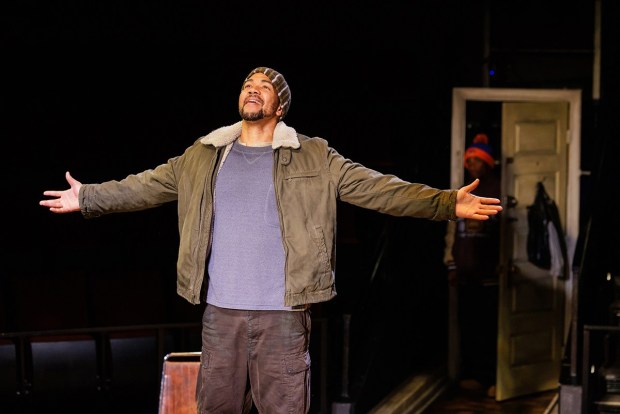
As Lincoln, Miller has a quiet, wise and world-weary presence. He shrinks inwardly at his brother’s withering insults and avoids eye contact. But after a day of confidence-building card-hustling, Miller dramatically transforms — shoulders back, head up, arms wide open, a lyrical chant in his voice, a smile on his face and a strut in his step.
As Booth, Jones has the showiest role and he makes the most of it. The muscle-bound actor is like a bantam boxer — fierce, cocky, boastful, aggressive and intense. But he’s even more dangerous, vicious and unpredictable when he loses topdog status to Lincoln. His final scene is mesmerizing and devastating to watch.
Arnel Sancianco’s scenic design depicts a grimy apartment sitting atop a trash-littered ring of carousel-style lights. Richard St. Clair designed the show’s timeless costumes, Jason Lynch designed lighting and Curtis Craig designed sound. The adult-themed production runs just under 2-1/2 hours with intermission.
Many plays ends with a message, a moral or a redemptive arc. “Topdog/Underdog” does not. Instead, it’s a rough and raw look at two troubled men trying their best to play the hand of cards they’ve been dealt. But as in most games of chance, the odds are stacked against them.
‘Topdog/Underdog’
When: 7 p.m. Tuesdays-Fridays; 2 and 8 p.m. Saturdays; 2 and 7 p.m. Sundays. Through Oct. 18.
Where: Sheryl and Harvey White Theatre, The Old Globe, 1363 Old Globe Way, Balboa Park, San Diego
Tickets: $44 andup
Phone: 619-234-5623
Online: theoldglobe.org