
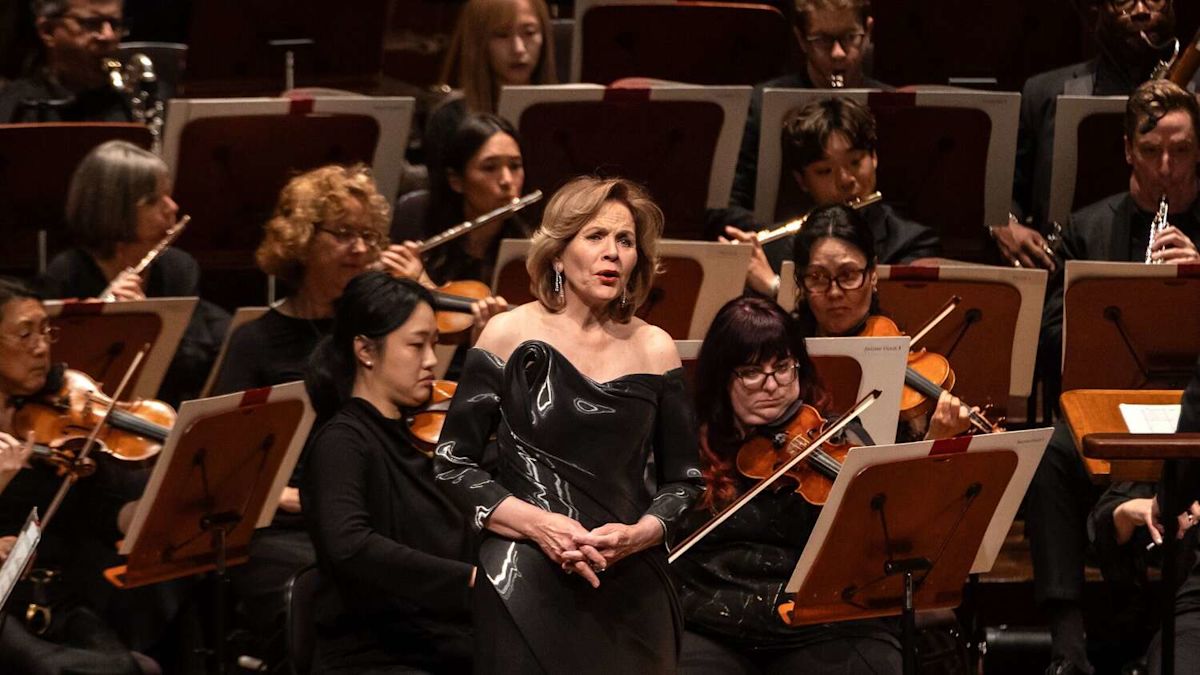
Renée Fleming has spent decades making Richard Strauss’ music her own. With the San Francisco Symphony, the celebrated soprano returned to one of his crowning achievements, “Four Last Songs.”
But as the Marschallin says in Strauss’ “Der Rosenkavalier,” “Time… is a strange thing” – and it’s catching up with Fleming.
More Information
Renée Fleming Sings Strauss: San Francisco Symphony. 7:30 p.m. Saturday, Oct. 3; 2 p.m. Sunday, Oct. 4. $55-$215. Davies Symphony Hall, 201 Van Ness Ave., S.F. 415-864-6000. https://www.sfsymphony.org
On Thursday, Oct. 1, at Davies Symphony Hall, Fleming brought her long experience with Strauss to the composer’s autumnal song cycle, led by Finnish conductor Santtu-Matias Rouvali in his Symphony debut.
Strauss composed the songs in 1948, just a year before his death at age 85. He set poems by Hermann Hesse and Joseph von Eichendorff to ravishingly beautiful music. Seeing his own life winding down, Strauss chose poems replete with images of twilight, mourning, nature, sleep, dreams and encroaching darkness.
Like so many of Strauss’s soprano roles, these songs call for a silvery, expansive voice that floats with ease. On Thursday, the audience could admire Fleming’s breath control and ability to sustain a long musical phrase. Her high notes sometimes pierced the hall. Still, at 65, while she can readily vary the color of her voice, there’s not much silver left.
The soprano’s voice no longer has the presence it once did, and at times it struggled to project. Fleming never had much of what Italians call squillo, the bright edge to a voice that lets it cut through an orchestra and fly into a concert hall, and now that’s diminished too. She sang carefully rather than spontaneously.

Santu Mattias Rouvali conducting the San Francisco Symphony at Davies Symphony Hall on Thursday, Oct. 1, 2026. (Brittany Hosea-Small/San Francisco Symphony)
Fleming’s encore, the lightly scored 1894 Strauss song “Morgen!” (Tomorrow!), worked best of all for her.
Rouvali led the orchestra with the utmost sensitivity and never let it overpower the soprano during the five songs.
Strauss’s 1899 tone poem “Ein Heldenleben” (A Hero’s Life) was composed as he was about to turn almost entirely to opera. Like his operas, it’s richly scored: dense with strings, packed wind instruments – there were nine horns onstage – and two harps.
Here Rouvali conducted with wit and flexibility, maintaining good balances in the orchestra even at high dynamic levels. Under his direction, the strings shone, the brass blended superbly, and Strauss’ built-in pauses sustained the drama.
The life Strauss chose to depict in “Ein Heldenleben” was his own, though he was just 35 and perhaps not the embodiment of heroism outside his own imagination. Regardless, listeners can only wonder at his extraordinary compositional skills and how he deploys them over the course of the work’s roughly 45 minutes.
Strauss opens with a broad, vaulting theme in the strings and horns. This is the hero’s theme, and it returns near the end of “Ein Heldenleben.” Next, he brings on his critics, making the woodwinds a veritable chattering class, representing or mocking every music critic who didn’t care for what he wrote.

Santu Mattias Rouvali at Davies Symphony Hall on Thursday, Oct. 1, 2026. (Brittany Hosea-Small/San Francisco Symphony)
The third section puts a solo violin, played with light-handed grace by concertmaster Alexander Barantschik, in the spotlight, representing the hero’s romantic partner, modeled on Strauss’s own wife, the soprano Pauline de Ahna. (The two had a long, sometimes volatile, ultimately happy union.)
Then the harps (principal harp Katherine Siochi and guest harpist Jieyin Wu, both marvelous) join in, lusciously and romantically. Principal oboe Eugene Izotov contributed tender, plaintive solos, as did principal clarinet Carey Bell.
The sardonic winds return, offstage trumpets signal a battle, of course, won by our hero. In the section “The Hero’s Deeds of Peace,” which might be called “Name That Tune,” Strauss the hero goes on to quote his own tone poems.
But in the long finale, “The Hero’s Retreat from the World and Fulfillment,” the music quiets. Russ de Luna’s eloquent English horn emerges from rich string textures and acting principal horn Brett Hodge wraps “Ein Heldenleben” with a flourish.
Lisa Hirsch is a freelance writer. This review has been provided in partnership with San Francisco Classical Voice.
Subscribe
There’s more to San Francisco with the Chronicle. Subscribe today for just 25¢.
This article originally published at S.F. Symphony review: Renée Fleming’s Strauss still captivates – even as time catches up.