
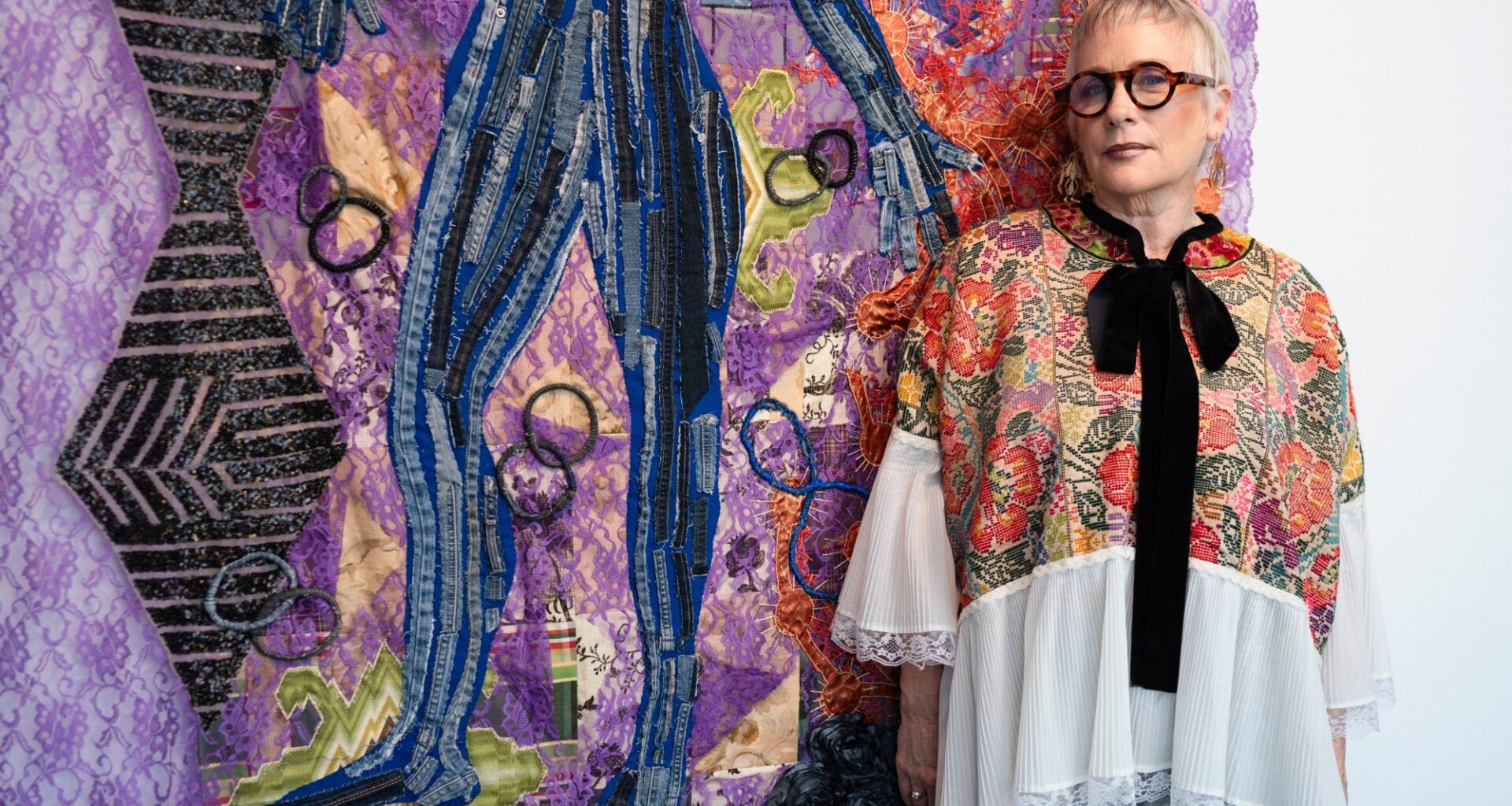
The story being told in artist Irma Sofia Poeter’s work is based on her life. In her use of all forms of textiles, she shares pieces of her family history, her personal transformation as an artist and her evolving observations and perspectives on the world around her.
“My work is autobiographical in the sense that it speaks to what I’m going through at the time, what interests me and what’s happening politically, socially and spiritually. I love to use textiles as a way of expressing those concerns and concepts that are in my mind and psyche,” she says. “For me, textiles are a material that, intrinsically, come with so much information. Physically, it comes with color and texture, but also how the material is made. Is it made by a machine, or by hand? Is it vintage, or contemporary? It has this very rich language, which I use to create what I need to say in my pieces.”
This month, she has something to say about dresses, and about sewing as a form of high art, in “A-Dress: Power and Belief,” at the San Diego Mesa College Art Gallery, from Monday through Oct. 29. (A reception is scheduled for 4 to 7 p.m. Wednesday, followed by an artist talk at 6 p.m. on Oct. 21.) The exhibition looks at “the dress as a sculptural language, a second skin where personal and collective narratives meet,” and includes dresses, capes and soft sculptures that explore how what we wear on our bodies is a form of expressing ourselves. The dress is a way to question ideas of identity, power, resistance and inclusion and exclusion.
Born in Arcadia and raised in Ensenada, Mexico, she was always drawing as a kid, but studied architecture after high school before putting her studies on hold when she got married and had children. While living in Tijuana in the early 1990s, she began working with a painter and engraver from Mexico City who’d opened a studio. He encouraged her to pursue her artistic hobbies and interests professionally, and began her journey as an artist at the age of 30. Dividing her time between San Diego and Tecate, Mexico, Poeter talks about the influence of seeing conservative and liberated women in her family, the research she did with migrants in Oaxaca, Mexico, in the early 2000s that created a love for the traditional huipil and becoming “the architect of my own life.” (This interview has been edited for length and clarity. )
Q: What kind of influence have your upbringing and culture had on the art that you create? Are there ways that you see them informing your art practice?
A: Definitely. The fact that I am both American and Mexican, I live on both sides of the border. Spanish is my first language, but I look very European – it’s like this hybrid situation. I feel that I’m a little bit from here, a little bit from there, and there’s this original kind of person coming along, so I think that my work has a lot to do with that. I love combining all these different textiles with different values. I think that everything has its place in this universe, so I like to use a lot of discarded materials. I love to also use very rich and very opulent textiles, so I like the combination of those two. I also like using textiles from around the world and textiles that are made by hand. I don’t make textiles, I’m not a textile artist in the sense that I create a textile; I work with a textile, so my methodology is construction, a collage. I take textiles from different parts of the world and create complex sculptures, or two-dimensional pieces and clothing.
The show at Mesa College is based on clothing, and I especially like used clothing. It’s very affordable and something that was very easy to work with. It already had the form of the body in the clothing, so I started using the clothing and the dress as an element to work with. I have a piece that is called “Three Disgraces,” which are three dogs and each of the dogs are made with different clothing – men’s suits, military uniforms and jeans. It’s a way of saying how, when women infiltrate a men’s field, like economics or the military, they have to become these b——, or these monsters that are aggressive. These three dogs are growling, but you see their underbelly is in pink satin, so the clothing has all of these rich connotations.
Q: Do you recall your earliest memories of dresses? Your interactions with them, wearing them and seeing them worn by others?
A: My grandmother, my mother’s mother, she used to sew. I never got the opportunity of knowing her, but my mom, who did not know how to sew, would describe how her mother would make this beautiful kind of suit, or a beautiful dress, from a very inexpensive piece of material that my mom would get. My mom would describe the dresses and the texture, how it felt and how she felt in it, how it looked and how people really praised how beautiful her garments were and it was very inexpensive. My grandmother was very creative. For me, fabric became this kind of magical material that you could transform into this beautiful garment. Who we are, what we think, what we feel is, obviously, how we wear what we wear. Everybody expresses themselves by dressing themselves. Even if you don’t consider yourself an artist or a creator, you are expressing yourself through what you wear, so it became very interesting to use the garment as a way of identifying who you are, your social, economic, or political status. If you had money, if you did not have money, or what did you think, or who you followed, your sense of who you are is very tied to how you present to the world through clothing.
Q: Your piece, “Baby Venus,” is described as “reimagin(ing) the Venus of Willendorf as a towering figure of infancy … symbolizing the potential and burden placed on female identity from birth.” What kind of potential have you found in female identity in your own life? What kind of burdens have you experienced because of it?
A: I’ve gone through a lot of transformations in my life. I started very conservatively with marriage, with kids and a husband and everything. Then, I separated, divorced, and I started my new journey. There is a time that, through my art, there was a way of really knowing who I was. When I work, it is very intuitive. There is a sense that I know what I’m doing; in very few cases, I have something very planned. During my process, which is very time consuming because everything is done by hand — there’s a lot of embroidery and everything — there comes a kind of knowing, or defining, of what I want to say. It’s like I receive this download and then I just start working. I know, in the back of my mind and my senses and my consciousness, I know what it is. Then, while I’m working, I’m starting to put the concept and the wording into what I am doing.
Like I say, my work is very autobiographical, so I try to understand who I am, and by understanding who I am, I understand what is around me, and that empowers me completely. It’s very difficult to understand what’s going on outside if we don’t know what’s going on inside.
Q: What you’re describing reminds me of the book, “Women Who Run with the Wolves,” about really tapping into your intuition as a woman.
A: Exactly, because we’ve been taught, as women, not to follow our intuition. The whole patriarchal system is saying we have to think everything has to have a reason, everything has to have logic and that intuitive aspect has been left behind and has been undervalued. For me, when I first started working and I explained my work and everything, I started saying those things 30 years ago, and people would look at me really strange. Now, more and more people understand the process, and I understand the importance of working in that way, too.
Q: What kinds of narratives around female identity did you inherit as you were growing up? How has your thinking about those narratives evolved over the years?
A: Yes, like I said, I started in a very traditional way because I come from a very conservative family. Having said that, my mother was a bank manager in Ensenada in the late 1950s when she was 26 to 28 years old. She was a very independent, self-sufficient woman who really worked very hard in overcoming all the obstacles that she had as a woman. She really managed to put herself in a very important position, as a woman, at the time. My grandmother was very conservative. She had six children, was very dependent on her husband, my grandfather; but my mother was this very liberated lady, so I grew up with these two images of women. I married very young and kind of followed that conservative path, but I also knew the self-sufficient, liberated woman that my mother was in between, so through my work and achievements, I have been consolidating that.
I’m an artist and I live in San Diego and also in Tecate, so I go back and forth. I have my studio in Tecate and I go back and forth every week. In Tecate, I’ve had the opportunity of building my own home and my own studio. In creating this space — that I call Arcadia, which is the name of the town where I was born, but also this idyllic, pastoral, romantic concept of a utopia—I am the architect of my own life, and I feel very empowered by that. I created my own housing, my own dwelling, my own studio, my own life, my own little world where I can create and invite people over. We’ve had residencies, and we have workshops, so it’s this other little world that I’ve created. I feel very, very proud of my achievements, and I really like my life. I consider myself a true creator of my realities.
Q: Do you wear dresses? Is there a style of dress you’re most drawn to?
A: Yes, I lived in Oaxaca from 2008 to 2010 and I worked on an exhibition with the Museum of Textiles in Oaxaca, where I interviewed more than 50 migrants that went from Mexico to the United States, and then they came back. I told their stories of transformation using their traditional clothing. In Oaxaca, they have 16 different ethnic groups, and each ethnic group has their own subgroups, and it’s very rich in textiles and in food. The culture is very diverse and it’s very rich. When I lived there, I really worked with the artisans, and I started wearing what they were wearing. All of these huipils, which is a Mexican blouse that they wear, and it’s all hand woven and embroidered. It’s beautiful, beautiful work. I’m wearing that clothing now, that’s the only thing that I wear. With most of my clothing, I kind of transform the basics. The huipil is a rectangular piece with a hole for the head, and then two holes for the arms, so it’s very basic. I love the idea that it’s very basic in form. And, it’s very inclusive. You can be skinny, you can be big — anybody can wear it, so I love that you don’t have to restrict yourself into the clothing, you just blend into it perfectly. I love loose clothing, especially if it’s handmade. For me, it’s very difficult to wear normal clothing anymore, so I basically wear the huipils, and I also transform them. I embellish them, or I make them a little bit more my style. Usually, the idea of this very large, very generous fabric, these textiles, I’m thinking of the women who have been embroidering that piece. All of the energy and all of the love that she had to put into it that is embedded into the garment. So, when I wear it, I feel all of that, too.
Living in Oaxaca was a complete turning point in my life, in many ways. I came back knowing about the ancestral knowledge because, in Oaxaca, the traditions, the history and everything, are so important for the people. Then, I came back here, to the frontera, the border, and I said, “Well, where is that ancestral knowledge here? Where is it?” I started to study about the Kumeyaay, the indigenous people that live in this area, and that’s why I went to live in Tecate, because there is a big community of Kumeyaay. Also, there is the sacred mountain of Mount Cuchama, which is the sacred mountain of the Kumeyaay. I built my studio right there at the skirt of Mount Cuchama.