
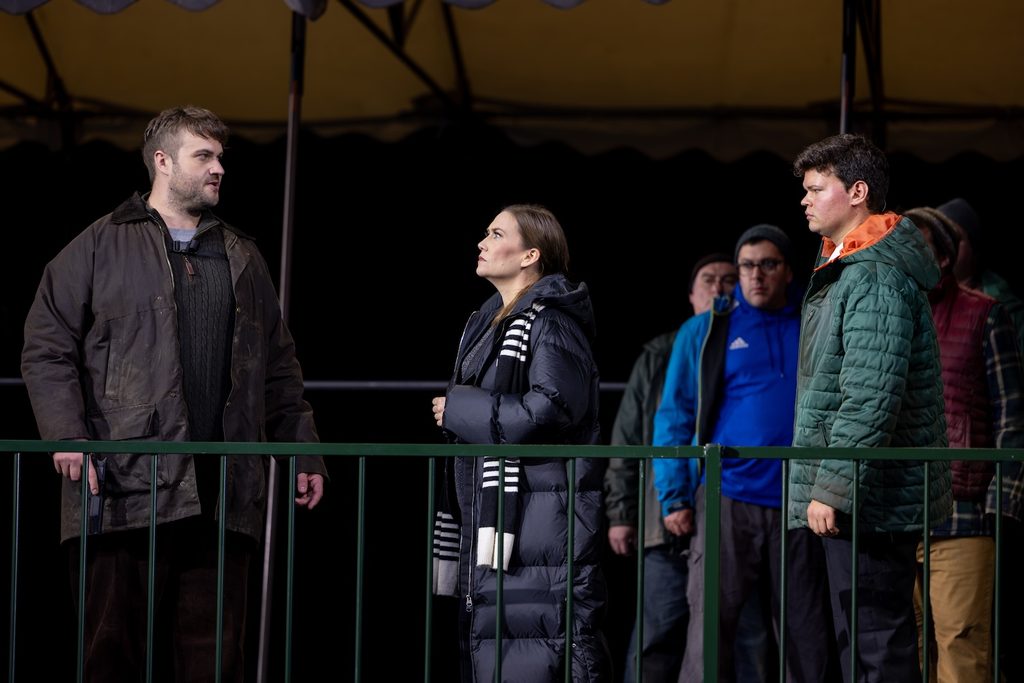
A 1977 opera by Thea Musgrave, not to be confused with Gaetano Donizetti’s 1835 Maria Stuarda. Unlike the bel canto execution of Mary (b. 1542, d. 1567), it is a careful, if dramaturgically modified history of her humiliation, and abdication as the queen of Scotland.
Thea Musgrave’s third opera is based on an unpublished play, Moray, written by Amalia Elguera, its libretto was made by Mme. Musgrave herself. Amerlia Elguera, a Peruvian playwright, was the librettist for Thea Musgrave’s second opera The Voice of Ariadne, little else is discoverable about her. The title of the Elguera play refers to the Earl of Moray James Stewart (Moray is a peerage in Scotland). James was the illegitimate son of Scottish king James V, also Mary’s father.
Scottish history was the literary and theatrical rage in early nineteenth century Europe, though these days Scotland’s history and destiny flash in and out of the interests of most Americans.
Mme. Musgrave, born in Scotland and now 98, came to the United States in 1970 where she met violist Peter Mark, now 86, whom she married in 1971. In 1975 Peter Mark, also a conductor, was one of the founders of Norfolk’s Virginia Opera. By not so strange coincidence Jamestown (Virginia), named after James Stewart, is not far from Norfolk.
Though premiered by Scottish Opera in Edinburgh in 1977, Mary, Queen of Scots had its American premiere at Virginia Opera in 1978, and its west coast premiere at San Francisco Opera’s Spring Opera in 1979 [those were the days when the San Francisco Opera season was comprised of 15 operas]. New York City Opera produced the opera in 1981, Leipzig (Germany) Opera in 2023.
Most recently, 2025, Mary Queen of Scots was revived at English National Opera in this joint production with San Francisco Opera. Scottish theater director Stewart Laing designed and directed the production, explaining its theatrical, as opposed to operatic realization. We entered the War Memorial Opera house to an open, bare stage, stagehands assembling some structure which had become, by the opera’s downbeat, a sort of a long pavilion tent. It was then lightly modified for each of the following two acts (three total acts, two intermissions). There was a metal fence traversing the stage apron.
Mary Queen of Scots is an historical drama, pure and simple. In cheeky theater fashion director Laing unabashedly set the opera in modern dress, in maybe a Scottish village, though it could have been anywhere. Mary was in upscale, bright garb, Its religious personages were identified by a priest’s collar (a Roman collar), its nobles by suits and ties, its soldiers and townsfolk in ordinary dress. Locale didn’t matter, we were there, caught up in theatrics, not history.
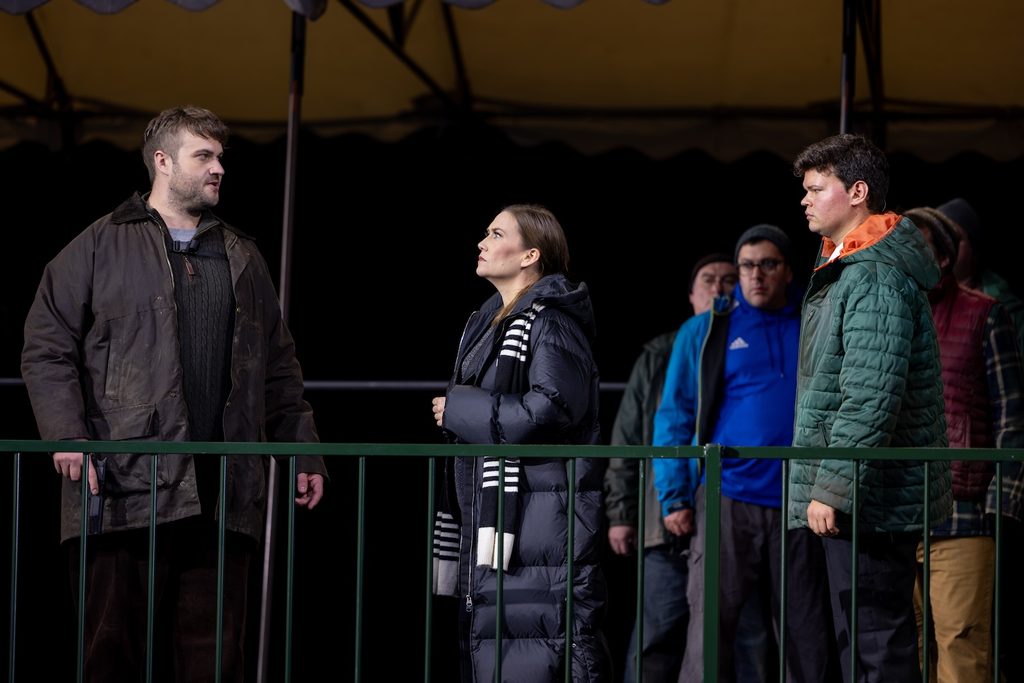 Left to right: Thomas Kinch as Bothwell, Heidi Stober as Mary, Thomas Mole as James Stewart
It is a text driven opera that owes much to Shakespeare’s histories, rendered in San Francisco in perfect, understandable diction. In a nutshell, the very young, widowed Mary has returned to Scotland from France. She makes a disastrous if understandably youthful choice among the men who are pursuing her (James, her illegitimate brother for power, the soldier Bothwell for sexual passion, and Darnley for their kindred, light-hearted spirits). She marries the dissolute Darnley who fathers the child we will see in the third act. Regal, strong willed and well able to stand alone, she is defeated by all these men. Ultimately she jumped over the fence onto the stage apron and ran off to England. Once there Donizetti takes over.
The only cast member carryover from the London production was Mary, Queen of Scots, herself, enacted by American soprano Heidi Stober, a stalwart soubrette well known to San Francisco audiences. Since last in San Francisco Mme. Stober, now 48, has vocally matured, newly possessing a deeper, richer voice. She remains a youthful presence, easily finding the impetuousness of the young Mary (historically about 18), the strength of the young mother, and the resolve of a sovereign. Mme. Stober’s performance, beautifully sung, was a tour de force.
As many recent San Francisco Opera productions the balance of the casting was near perfection. British baritone Thomas Mole sang James Stewart. Of handsome presence and fine voice Mr. Mole easily won the support of Protestant Scotland to become regent of Scotland after Mary’s abdication. Welsh tenor Thomas Kinch, a current Adler Fellow (SF Opera’s young artist program), sang Bothwell. A finished artist Mr. Kinch is of robust voice and stature making his rape of Mary terrifying. American tenor Christopher Sokolowski played Darnley. Mr. Sokolowski, a budding Parsifal and Lohengrin found the dapperness of Darnley, and well acted his insecurities, culminating in his brutal murder of Mary’s Italian confidant David Riccio, played by baritone Hadleigh Adams.
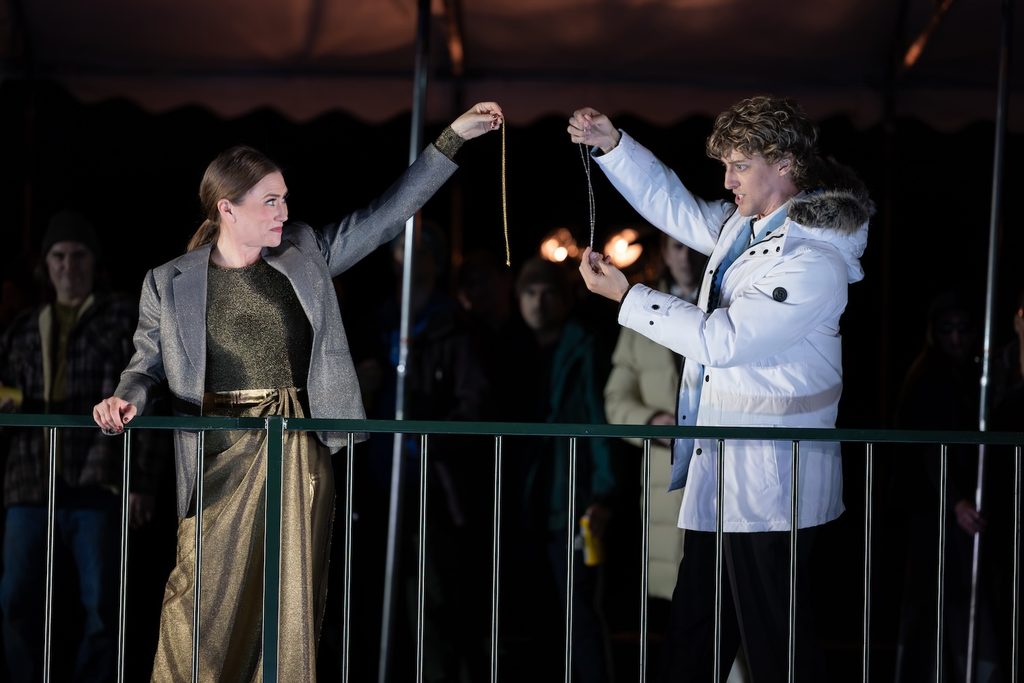 Heidi Stober as Mary, Christopher Sokotowski as Darnley
British bass David Soar enacted the Catholic cardinal Beaton who historically was already dead by 1561 (the year of Mary’s return to Scotland). San Franciso Opera regular, bass-baritone Philip Skinner, in fine voice, well portrayed the sympathetic Lord Gordon who historically did not exist.
The four attendants to Mary, all named Mary, were Sadie Cheslac, Sofia Gotch, Mary Hoskins, and Alexa Frankian, all Adler Fellows. Adler Fellows as well, baritone Olivier Zerouali sang the Earl of Morton and Chance Jonas-O’Toole sang the Earl of Ruthven, the men who fueled the fire of Darnley’s jealousy of Riccio.
Thea Musgrave’s score is of great musical craft, artfully interweaving Scottish tunes with the highly colorful musical support of the text, both tonal and atonal. The Shakespeare-like text, when not based on Scottish songs, is declaimed in obliquely formed vocal lines, with striking orchestral punctuation. The opera plays out in solidly plotted steps to Mary’s destruction. None of the characters are musically sympathetic, including the flawed, head-strong Mary, rendering the opera as a flat, if highly theatrical, experience.
The opera reads, finally, as an exercise in creating rather brutal colors for nasty, easily understandable situations.
Neapolitan conductor Clelia Cafiero presided over 52 players of the San Francisco Opera Orchestra in this well rehearsed production.
Michael Milenski
War Memorial Opera House, San Francisco, California, September 28, 2026.
All photos copyright Cory Weaver, courtesy of San Francisco Opera.