
The damage that recently occurred on the Long Beach Peninsula, city officials have said, was a “wake-up call” to the area’s future challenges – but for residents, it’s a reality they have been anticipating for some time.
But what does the future of the beachfront community look like, with coming weather events, particularly El Niño, expected to bring more high tides and accelerate erosion in the area?
The city has ramped up its efforts to evaluate different coastal protection measures to address these challenges. From the upcoming Alamitos Bay Channel Dredging Project to habitat mitigation banks, Long Beach is considering several shoreline erosion management strategies.
These strategies have been shared with Long Beach residents in a city memo released last week, and during a Peninsula community meeting on Monday, Sept. 28, at the Alamitos Bay Yacht Club.
Long Beach has continued working to address the significant damage to the Peninsula’s historic boardwalk and shoreline caused by the recent Hurricane Marie during Labor Day weekend.
The combination of an unusually large, long-period southerly swell, wave energy and elevated tides resulted in substantial beach erosion, exposed portions of the existing bulkhead that had been buried for years, and damaged portions of the boardwalk and bulkhead, according to the city memo. City staff have worked to assess conditions, protect public infrastructure and begin recovery efforts.
Yet, while the city is addressing the repairs needed to the boardwalk and bulkhead, they are also looking at shoreline erosion management strategies, which comprised near-term and mid-term efforts, as well as long-term strategies — climate change may make swells and elevated tides more common — surrounding planning and development, and considerations associated with advancing these efforts.
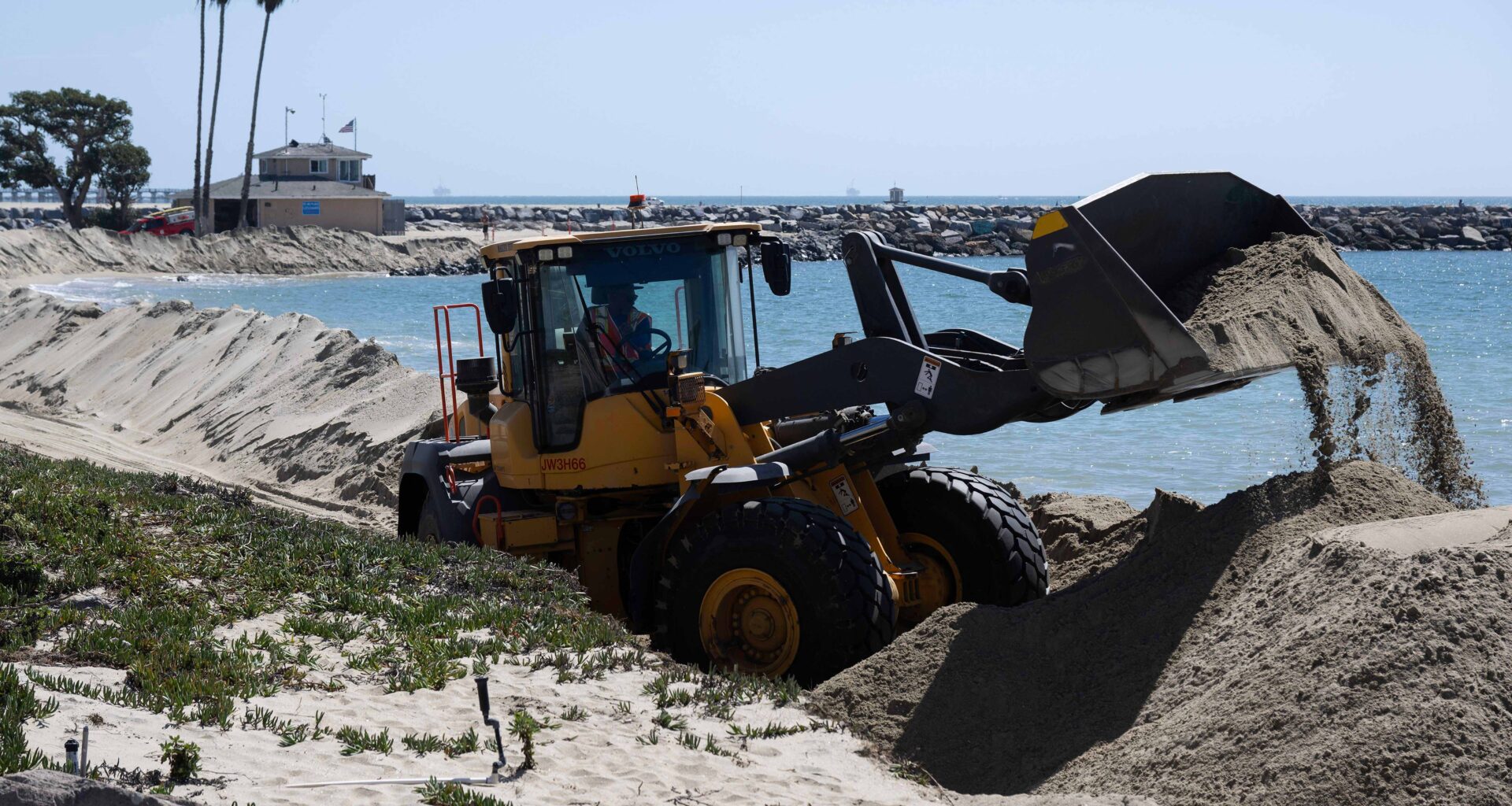
Long Beach’s typical erosion management includes routine sand back-passing by city crews, in which sand that has migrated west along the shoreline is mechanically moved east, back toward areas where additional beach width is needed, according to city officials. This is done five days a week throughout the year. And during inclement weather and high tide occurrences, the sand back-passing operation is conducted six or seven days per week.
The city spends about $1 million to $1.5 million annually to move harvested sand back to the eastern portion of the Peninsula, according to Todd Leland, manager of the Marine Bureau.
For several years, the city has been planning for a project to substantially build out the Peninsula beach, which is now slated to begin in mid-October.
In 2023, Long Beach started working on the Alamitos Bay Channel Dredging Project, which will restore about 415,000 cubic yards of sand back to the Peninsula, city officials said. The City Council approved the $9.27 million construction contract for this work, with an estimated total project cost of $11.4 million, in August.
“When we brought this item to City Council,” Josh Hickman, director of Public Works, said during the Monday meeting, “we had noted that we were anticipating about 200 feet or so of additional beach width. That has now changed, given the storm that has just recently passed – not this weekend, but Marie. So the numbers are going to be less than the 200 feet we had originally anticipated, and the engineers are going through that calculation analysis to determine exactly what that will be.”

A large swell slams into the pedestrian boardwalk along the Long Beach Peninsula on Tuesday, September 29, 2026. (Photo by Drew A. Kelley, Press-Telegram/SCNG)

Homes along the Long Beach Peninsula boardwalk stay prepared for large swells on Tuesday, September 29, 2026. (Photo by Drew A. Kelley, Press-Telegram/SCNG)

Crews work to reinforce vulnerable portions of the Long Beach Peninsula on Tuesday, September 29, 2026. (Photo by Drew A. Kelley, Press-Telegram/SCNG)

Holly McMullen and her three-year-old pyrenees mix Poppy watch as ocean swells crash into the Long Beach Peninsula boardwalk on Tuesday, September 29, 2026. (Photo by Drew A. Kelley, Press-Telegram/SCNG)

City Manager Tom Modica takes questions during a community meeting regarding storm mitigation and future plans for the peninsula at the Alamitos Bay Yacht Club in Long Beach on Monday, September 28, 2026. (Photo by Drew A. Kelley, Press-Telegram/SCNG)

Councilmember Kristina Duggan hosts a community meeting to provide an update on storm mitigation and future plans for the peninsula at the Alamitos Bay Yacht Club in Long Beach on Monday, September 28, 2026. (Photo by Drew A. Kelley, Press-Telegram/SCNG)

Councilmember Kristina Duggan hosts a community meeting to provide an update on storm mitigation and future plans for the peninsula at the Alamitos Bay Yacht Club in Long Beach on Monday, September 28, 2026. (Photo by Drew A. Kelley, Press-Telegram/SCNG)
Show Caption
1 of 7
A large swell slams into the pedestrian boardwalk along the Long Beach Peninsula on Tuesday, September 29, 2026. (Photo by Drew A. Kelley, Press-Telegram/SCNG)
While the expected completion was early 2027, the city worked with the contractor to expedite it, with a goal of finishing the project by the end of November, Hickman said. This effort is expected to help restore the eroded shoreline and provide a buffer before subsequent storms and anticipated El Niño conditions.
In addition to back-passing maintenance, and the upcoming dredging and beach nourishment project, Long Beach has also been working with Moffatt & Nichol – a consulting firm for coastal engineering expertise – to help evaluate both the immediate condition and potential interim protection measures for the Peninsula.
Moffatt & Nichol shared five alternative interim protection measures Long Beach could take. The measures include a full profile rock revetment, which is essentially a barricade to protect an embankment; low profile rock revetment by the bulkhead; low profile rock revetment further seaward from the timber bulkhead; large-scale beach nourishment and back-passing; or sheet piles installed to incorporate or reconstruct the existing bulkhead and boardwalk.
With these recommendations, the city decided to move forward with its Alamtios Bay Dredging Project. Future projects could include additional large-scale back-passing to maintain protective beach widths; and when criteria are met, rock revetment could be constructed to provide robust coastal protection, according to the city memo.
Nature-based solutions could also be implemented, city officials said, such as vegetated dunes over the revetment to support sand retention and an additional protective buffer for wave runup and overtopping.
In future planning, the city, in collaboration with the Port of Long Beach, is evaluating opportunities to leverage a future dredging project, dubbed the Deep Draft Navigation Project, which is expected to occur within the harbor district, according to City Manager Tom Modica.
A joint effort between the United States Army Corps of Engineers and the port plans to deepen and widen selected waterways to facilitate access and turning for large container ships and vessels to increase safety and efficiency, Modica said. That project will occur in phases over the next few years and is expected to generate more than 7 million cubic yards of dredge spoils. A portion of that, about 900,000 to 1 million cubic yards, was preliminarily determined to be compatible with the Peninsula sediment grain size envelope.
Initial phases of the work are expected to begin in 2029.
Funding, though, is necessary for environmental, design, sediment testing, characterization and biological studies, which could cost around $3 million. The added cost to accept the material and place it on the Peninsula is expected to be roughly $20-30 million. City staff are continuing discussions with the port to determine what regulatory approvals are necessary to facilitate the work, identify funding and look for opportunities to expedite the project.
While the port project is not expected to provide an immediate solution to the Peninsula’s current condition, city officials said, identifying a potentially compatible sand source represents a significant opportunity to address future erosion. If available, this material could substantially replenish the Peninsula beach and establish a stronger baseline condition from which longer-term shoreline protection measures can be developed.
Another project the city is considering is combining shoreline protection with a habitat mitigation bank, Modica said. Concepts include major beach nourishment, shoreline headlands, pier groin (a rigid aquatic structure), offshore rocky reefs staggering the headlands along with eelgrass and kelp habitat, and public access improvements. The cost for a project like this is on the higher end, Modica added, and is estimated to cost $150 million to $350 million.
The Colorado Laggon project could also be a potential funding model for this approach, Modica said. Mitigation credits and the established right-of-first-refusal of these credits at project inception nearly two decades ago helped secure early funding for studies, environmental review and design.
As part of the fiscal year 2027 budget hearings, Councilmember Kristina Duggan requested the Budget Oversight Committee add an additional $30,000 – funded by reallocating from a different project – to initiate an umbrella mitigation bank.
The money would be used to research and explore the establishment of an umbrella mitigation bank, including regulatory engagement and stakeholder coordination, according to the city memo. An umbrella mitigation bank could include the Peninsula, Los Cerritos Wetlands and other properties that could generate mitigation credits.
Long Beach will continue evaluating regional and long-term solutions for the Peninsula, city leaders said. These efforts have become even more important as the region enters the anticipated El Niño season and continues navigating the effects of climate change.
“We’ve got to replenish the beach while we’re also advancing interim protections and not betting on only this one strategy,” Modica said during the Monday meeting. “We have got to prepare for additional storms throughout the entire city – this is going to get really bad for the entire city – and then continue to monitor this and provide updates and engineering, and make sure you’re all in the loop on what’s going on out there.”