
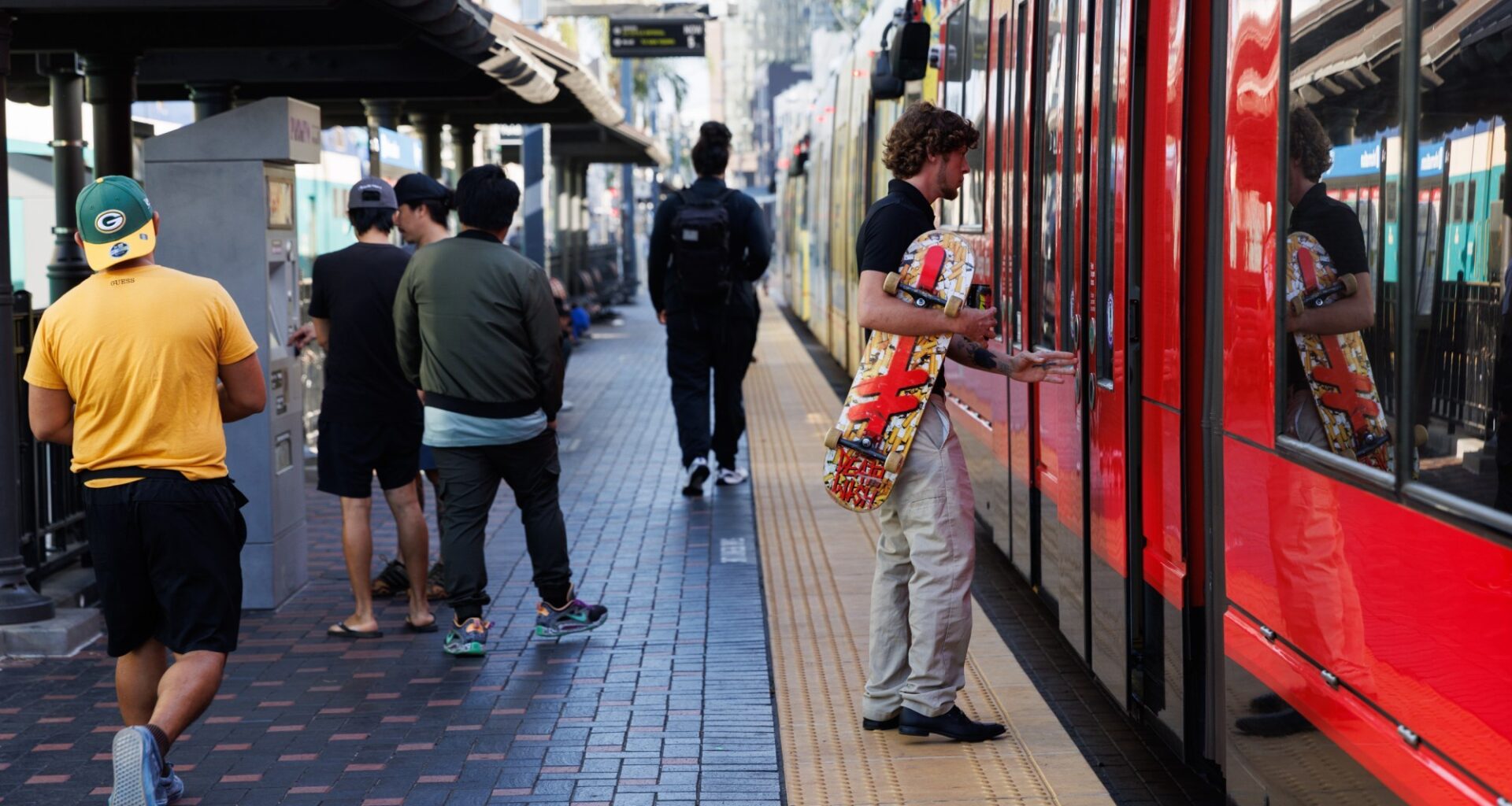
Trolley and bus riders across San Diego coped smoothly Thursday with their first big fare hike in many years, with most saying local transit is still relatively cheap and that the hike fits with other rising prices.
Many frequent riders said they’ve made peace with the cost of a monthly pass rising from $72 to $85, while occasional riders said the one-way fare increase from $2.50 to $3 won’t make much difference to them.
Some lower-income riders said the hike will make a difference in their lives but that local transit is too important to opt for an alternative.
Others expressed concern about the fare’s impact on people living paycheck to paycheck, but the hikes come with a fare freeze for anyone enrolled in CalFresh, CalWORKS or Medi-Cal.
Software on Metropolitan Transit System ticket machines and the Pronto smartphone app were successfully updated to reflect the new fares, and bus and trolley fare verification portals were handling the change smoothly.
Dustin Curran, a regular trolley rider who was taking the Green Line from the College Area to a new job at the downtown Cheesecake Factory on Thursday, said the higher fare spurred a range of emotions.
“It’s not really much of a difference for me,” Curran said of the increased cost of a monthly pass. “But it does kinda suck, because I’m just in the process of getting back on my feet and stuff. It is what it is.”
Pamela Palmer, another monthly pass user, said she was taking the hike in stride.
“I don’t mind — it’s inflation,” said Palmer, who takes an MTS bus every day from Rancho Bernardo downtown, where she then gets the trolley to her job in Old Town.
Occasional riders were also relatively unfazed.
“It’s still cheap,” said Bill Sharpe, who lives downtown and takes the trolley once or twice a week to places like Fashion Valley or East Village.
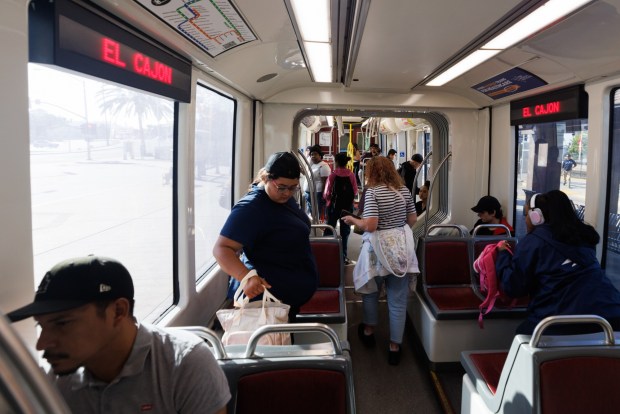 People ride the Green Line trolley toward El Cajon in San Diego on Thursday, Oct. 1, 2026. (Kristian Carreon / The San Diego Union-Tribune)
The hikes, which affect all rail and bus service provided by MTS and the North County Transit District, are the first significant jump since 2009 and the first increases of any kind since one-way fares rose from $2.25 to $2.50 in 2019.
Local officials say higher fares are needed to help cover rising costs and keep budgets balanced, but the hikes put the San Diego region at a higher price point than some comparable transit agencies across the nation.
On local buses, the San Diego Trolley and the Sprinter, the cost of a monthly pass rose from $72 to $85 on Thursday and will rise to $95 in fall 2027 — up nearly 31% overall.
One-way fares rose from $2.50 to $3 on Thursday and will rise to $3.25 in fall 2027. That will be a cumulative 30% hike.
Mike Dealy, 85, said he won’t be affected much because he rarely uses public transit.
“I think I’ve used the trolley twice in the last five years, so it doesn’t really affect me,” he said.
But he’s ridden the trolley three times this week to access the downtown state courthouse, and he’s decided local transit is useful and a great value.
“It got better each day, because I learned things — like where to park near the Old Town station and what time is a good time to come,” said Dealy, who lives in Point Loma. “Parking downtown is too expensive and too hard to find.”
Jan Susan, whose daily commute includes the free Coronado commuter ferry, said she’s fine with the hike because local transit is convenient and worth the money. After getting off the ferry, she takes the trolley three stops from Santa Fe Depot to the convention center.
Uma Bhatia said she’s not even annoyed at the fare hike.
“A 50-cent fare hike is not really a big deal in the long run to me,” said Bhatia, who lives in Mission Valley. “Public transportation in San Diego — the MTS — has been really great for me. It’s great for getting to work, especially since my current job doesn’t pay for parking and it’s downtown.”
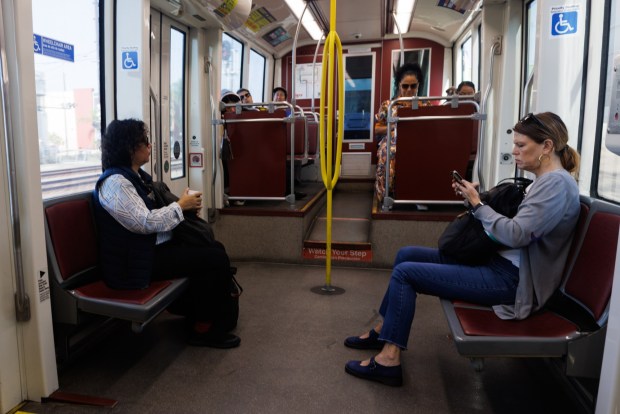 People ride the Green Line trolley toward El Cajon in San Diego on Thursday, Oct. 1, 2026. (Kristian Carreon / The San Diego Union-Tribune)
In addition to the fare hikes, NCTD eliminated zoned fares on the Coaster commuter rail line Thursday.
Those fares had charged passengers more for longer trips. Instead, all riders — no matter how far they’re traveling — will start paying the same one-way fare, which will rise from $6.50 to $7 in fall 2027.
In addition, a special monthly pass that can be used only on Sprinter trains and Breeze buses in North County rose in price Thursday from $59 to $65 and will rise to $70 in fall 2027.
Other transit systems charge less or the same for one-way fares and for most types of passes.
One-way fares are currently $3 in Dallas, $2.85 in San Francisco, $2.80 in Portland, Ore., $2.75 in Denver and $2.50 in Sacramento and Salt Lake City.
For both MTS and NCTD, discounts for seniors, disabled passengers and people on Medicare will be phased in. One-way fares rose from $1.25 to $1.50 Thursday and will not rise in 2027. Monthly passes will rise from $23 to $28 Thursday and then to $30 in fall 2027.
An MTS spokesperson said things were running smoothly Thursday.
“The rollout of the new fares has been seamless across the MTS transit network,” said the spokesperson, Hector Zermeno.
He said nearly 1,400 people has applied to for the fare freeze program as of Thursday morning. Riders can apply at RidePronto.com.
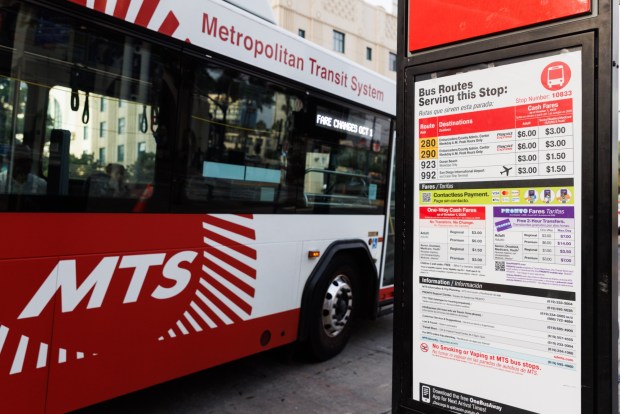 New fare rates are posted at a bus stop by the Santa Fe Depot in downtown San Diego on Thursday, Oct. 1, 2026. (Kristian Carreon / The San Diego Union-Tribune)