
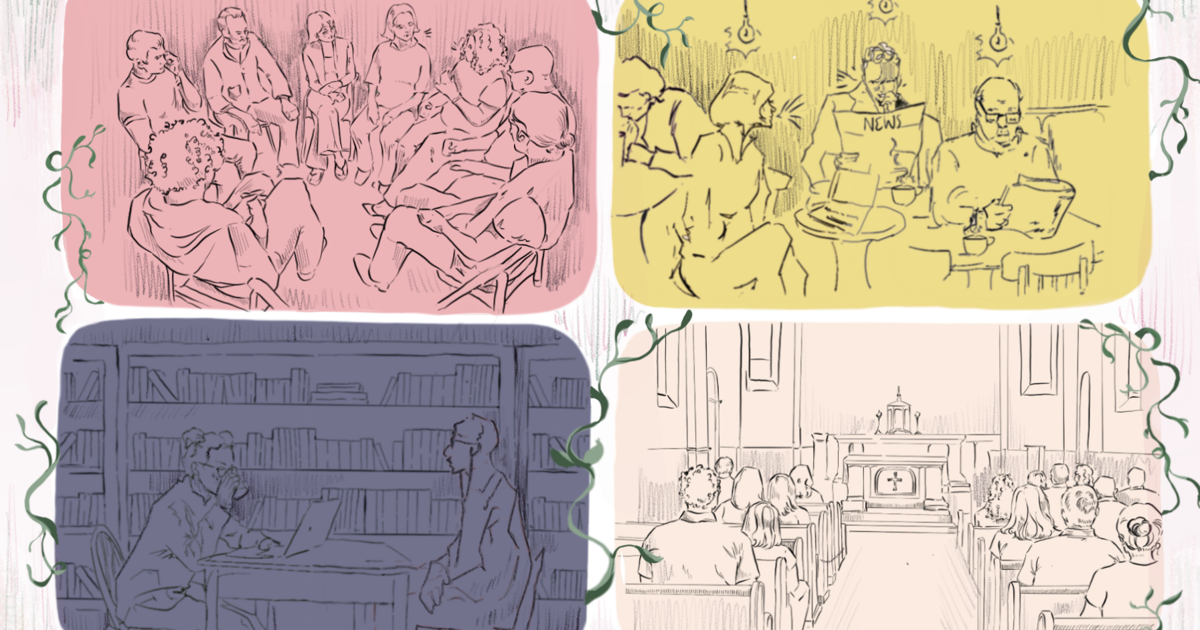
Home. School. Work. The drudgery of routine can eat away at a student’s morale. While we spend most of our time behind a desk in lecture halls or working for a minimum wage all across Berkeley, the most meaningful moments are found on the pickleball courts with friends, sprawled out on the grass in our favorite parks or cozily sat in the back corner of the cafe just a block from our apartments. These are what we call “third places,” environments that provide solace from the busyness and mundanity of everyday life. When not in your first place, your home, or your second place, your school or work, many people find themselves in accessible, open-to-the-public community gathering spaces: third places.
To warrant the title of a third place, the area in question must be a social environment that offers community, must be relatively inexpensive, have reduced barriers to entry and bring together strangers and peers alike. Initially introduced as a sociological term, third places have become ubiquitous in everyday vernacular.
For this special issue, we wanted to think more broadly about what a third place entails. Some are obvious, such as cafes or the gym, while others, such as grocery stores or support groups, become meaningful not for their offerings, but for the community they evoke. Central to this idea is the concept of being a local, being a member of a familiar environment.
We hope this issue encourages you to look more carefully at the spaces you might otherwise pass by without a second thought, and to think about what elevates a space to a “third place.” With that, ponder for a second: What are your third places, and where do you feel you most belong in Berkeley?
— Alana Basmajian, Esi Otoo & Myesha Phukan
Specialty markets carry not only the snacks people grew up eating but the spices that can make a kitchen smell like a grandmother’s cooking and the products that are never stocked at chains such as Trader Joe’s. The four ethnic grocery stories listed below are perfect demonstrations of how an often forced errand can also serve as one’s connection to their heritage and culture.
— Myesha Phukan
The Tang Center may be most commonly viewed as a place to go for immediate medical care, but ongoing beautification efforts are transforming the space into a center for greater health and holistic wellness.
— Elizabeth Goldman
Sociologist Ray Oldenburg coined the term “third place” to describe spaces outside of the home and work or school. As UC Berkeley students, we have a lot of access to third places, but we don’t often use them to their full potential.
— Eleanor Yu
Third places are all around us, but the best ones are often so naturally integrated into their environment that they can be nearly invisible. We made a map to see where members of The Daily Californian, as well as you, hang out.
— Yaelle Tang & Ajith Araiza-Singh
If the morning shift at Caffè Strada recognizes my face, will I have found my third place? If I schedule in 30 minutes for a weekly yoga class, surely I’ll have found my crowd. Please, let’s make Yogurt Park on Wednesday nights our thing!
— August Anderson
All I can ask or hope to do is be rooted and established in the love I’ve been shown, share that love with others and hope that the solace that I’ve seen finds its way to each and every one of you in one way or another.
— Esi Otoo
Without conscious intention, a support group quickly became my third space. Albeit somewhat nontraditional, I found a community that I resonated with on a profoundly deep level. We talked about our shared difficulty in maintaining friendships, learning how to stand up for our accommodations and necessary absences from school and work and what being disabled in academia entails.
— Alana Basmajian
I vow to opt for the in-person meeting option instead of Zoom, to go up to someone and ask them where their shirt is from, to just show up and talk to people. While online places can hold immeasurable value, taking the time to come offscreen can prove worthwhile.
— Mina Lavapies