
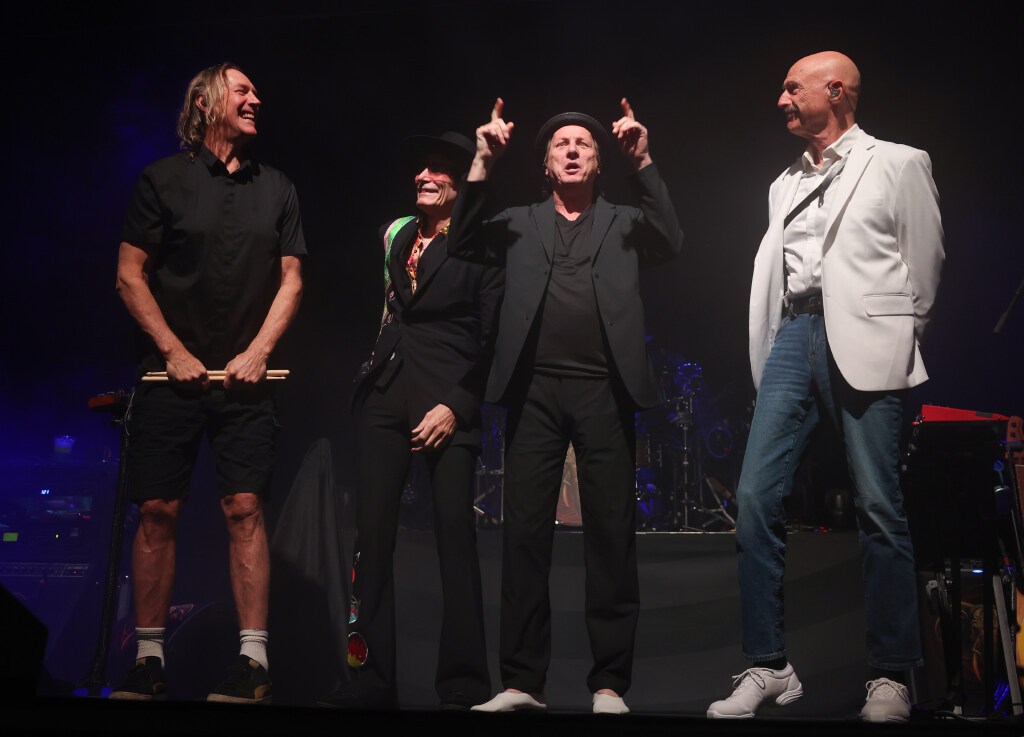
How many varied musical hats has Adrian Belew worn? His many credits include high-profile collaborations with King Crimson, David Bowie, Herbie Hancock, Talking Heads, Paul Simon, Cyndi Lauper, Joe Cocker, Laurie Anderson, Nine Inch Nails, Béla Fleck & The Flecktones, Joan Armatrading and former San Diegan Frank Zappa.
“I think the thread is simply that I can fit into so many different musical things, because what I offer is creativity,” said the versatile guitarist, singer and songwriter, now on a San Diego-bound tour with his King Crimson offshoot band, Beat. “I think people want me to bring the energy they expect from me into their music, and it works out easily. I’ve never been stumped.”
Perhaps not stumped, but challenged, certainly. At least, that was the case when it came to putting together Beat, a band that germinated for five years before becoming a reality in 2024.
Legendary King Crimson still making shape-shifting music
Named after the second of three King Crimson albums that featured Belew in the early 1980s, Belew put Beat together to salute and extend the legacy of that pioneering, constantly shape-shifting English art-rock band, whose first iteration counted Jimi Hendrix and Pete Townshend among its biggest early fans in the late 1960s.
The band’s 1969 debut album, “In The Court of The Crimson King,” was a singular blend of rock, classical and jazz. Its standout track, the still-harrowing “21st Century Schizoid Man,” was sampled by Kanye West for his 2010 song, “Power.” It has also been covered by everyone from Ozzy Osbourne and Todd Rundgren to Phish and Black Midi.
Original King Crimson bassist Greg Lake, who sang “21st Century Schizoid Man,” went on to cofound the progressive-rock band Emerson, Lake & Palmer. His eventual replacement — several band lineup changes later — was John Wetton, whose other credits ranged from Roxy Music and Asia to Wishbone Ash and Uriah Heep.
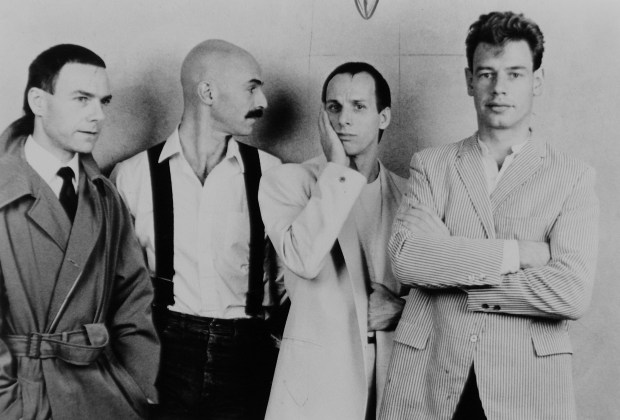 The members of King Crimson, circa 1981. Shown from left are guitarist Robert Fripp, bassist and Chapman Stick player Tony Levin, guitarist and singer Adrian Belew, and drummer Bill Bruford. (Warner Bros. Records)
‘A huge influence’
Beat teams two Crimson alums — Belew and bassist and stick player Tony Levin — with drum ace Terry Bozzio and guitar star (and Rancho Santa Fe resident) Steve Vai. By coincidence, Vai and Bozzio also first rose to prominence performing in Zappa’s bands.
“That’s true, but that’s not the point of it,” said Belew, speaking from his Tennessee home in Mt. Juliet, about 20 miles outside of Nashville.
Rather, the point is to showcase and breathe new life into the music King Crimson created on the three albums it made between 1981 and 1984. Those albums — “Discipline,” “Beat” and “Three of A Perfect Pair” — established a new sonic template that still sounds fresh and vital today.
Drawing from Balinese gamelan music, art-rock, punk-funk, the avant-garde and more, the early 1980s edition of King Crimson was the first edition of the band to feature both British and American members. It teamed Kentucky native Belew with fellow guitarist and King Crimson mastermind Robert Fripp, former Yes drummer Bill Bruford (who, like Fripp, is a native of England) and Boston native Tony Levin, who is equally dexterous on electric bass and the Chapman Stick, an all-neck, body-less instrument that has 13 strings and is played with all 10 fingers.
Fripp and Belew alternated between electric guitars and guitar synthesizers, while Bruford played a hybrid acoustic and electronic drum set. The music they made with Levin was dense and intricate, brainy and brawny, ferociously powerful one moment and moody and contemplative the next. Belew’s song lyrics added a surreal edge, especially on 1981’s “Elephant Talk,” which may still be the only rock song to include such words as brouhaha, balderdash, ballyhoo, chit-chat and diatribe.
“They’re a huge influence on us,” Tool singer Maynard James Keenan said in a 2001 San Diego Union-Tribune interview. “Hopefully, people who are responding to what we’re doing are hearing — with King Crimson — where we came from, (and) where we may end up.”
The proudly left-of-center music on “Discipline,” “Beat” and “Three of a Perfect Pair” has been also cited as a key inspiration by such bands as Nine Inch Nails, Primus, Rush, Nirvana, The Mars Volta and, especially Tool. Danny Carey, the drummer in Tool, was a member of Beat when the band made its San Diego debut in 2024 with two sold-out shows at Humphreys Concerts by the Bay.
When Beat returns for a concert next Sunday at San Diego Civic Theatre, it will be with Bozzio on drums. Carey, who has other obligations, had to bow out.
No matter the lineup, though, Belew has very specific guidelines for the Beat.
“When I put the band together,” he recalled, “I said to everyone that there are central things that have to be there, and that they have to be done exactly. For example, the interlocking guitar parts have to be (amplified) the same and have the same volume. But I want to hear their version of this music, because I know that’s what the fans want. I don’t want the band to feel like they have to duplicate the parts, note for note.”
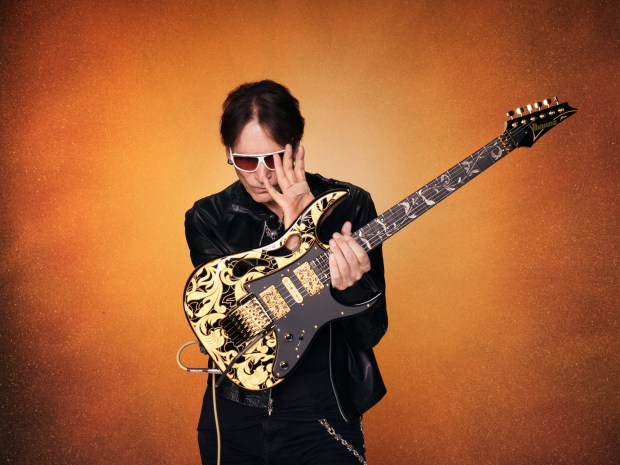 Beat guitarist Steve Vai is now a San Diego County resident. (Larry Dimarzio)
‘It’s polymetric’
Yet, even with creative latitude, the music of King Crimson is exacting and demanding. It requires exceptional precision, sensitivity and pinpoint dynamic command. It is not for beginners — or for anyone not willing to fully commit — be they members of the band or its audience.
Or, as Vai put it in an April Union-Tribune interview: “On King Crimson’s three ’80s records — ‘Discipline,’ ‘Beat’ ‘Three of a Perfect Pair’ — there’s a technique that Robert and Adrian employ that we call interlocking guitar parts. But what it is, is the merging of two time signatures; it’s polymetric. Adrian will play a line in 7/8, and Robert will play the same line, minus one note, in 6/8.
“So, you get this amazing kind of turnaround and these harmonies and things that just don’t repeat themselves until the whole line comes around. And this is the brilliant compositional technique that those guys used extensively throughout those three records.”
Steve Vai, a new San Diego County resident, reflects on music, Frank Zappa and more
Belew chuckled appreciatively as Vai’s comments were read to him.
“Robert came up with that technique and used it in his (short-lived 1980) band, The League of Crafty Gentlemen. But it was missing something, because what he really needed was a partner,” Belew said. “Because as Steve explained, there are two guitar players and they offset each other. So, when one drops a line, it comes around after a while and perfectly aligns with what the other guy is doing. Robert and I sounded perfectly in sync together, so that was an important element to bring to Beat.”
Vai, a longtime King Crimson fan, had to learn all the music Beat plays from scratch. In some instances, Belew had to re-learn the music — in some cases, online.
“Some of it I had played over the years, maybe a third of it,” he said. “The rest I learned by watching videos of myself playing, so I could at least at least remember the hand positions and fingering. Steve, on the other hand, used a very good book that has all of Robert’s parts written out. It has my parts in there, too, but not any of my solos because they couldn’t replicate them to figure out the notation. The stuff that is more straightforward is in the book.”
When Vai was stumped, Fripp stepped in — long distance from England — to offer insights and guidance.
“He worked with Steve to help him realize what it was to play Robert’s parts, without being Robert,” Belew said.
“It takes a lot to play those parts, using a metronome, for hours a day. Steve could have done that years ago. but he’s had some surgeries and his (guitar) picking hand can only endure so much of doing that same picking, very fast, for four minutes straight. So, Robert suggested he play hammer-ons instead, and that worked.”
Was Belew, 76, surprised by any of the King Crimson songs he co-wrote as a young buck back in the early 1980s?
“Well, I was youthful back then and it was easier,” he replied. “Now, it’s like: ‘Wow, that’s hard music to sing and play at the same time.’ But I worked through it. I mean, I wrote them! So, I figured I’d be able to do it again. I also wanted to have at least some of the ’80s sounds, like the guitar synth stuff, and that 1981 technology is very fragile and not reliable. And I only had two guitars that still had the plug-ins you could use for that.
“That was part of my challenge; Steve had his. Everybody had challenges.”
Belew stresses he would not have put Beat together had he not first received the notoriously prickly Fripp’s wholehearted approval.
While Fripp declined an invitation to join Beat, he did suggest the band’s name. And while it took from 2019 to 2024 for Belew to make the group a reality — the pandemic shutdown was one factor; coordinating each of the member’s schedules was another — Fripp came to see the band on opening night on its debut tour in England and again this summer at a concert stop in Estonia.
“Robert is very proud of what Steve and I have accomplished with the guitar parts,” Belew said.
When the band was forming, Belew invited former King Crimson drummer Bill Bruford to come on board. When Bruford — now on tour with a jazz trio led by German guitarist Pete Roth — declined, Belew reached out to Tool drummer Carey, who leaped at the opportunity.
For this tour, Carey has been replaced by Terry Bozzio, the drummer who played alongside Belew in Frank Zappa’s band for a 1977/78 tour.
“I had some protocols as to what I thought the drummer should be, because there aren’t a lot of drummers who can fit with this music,” Belew said. “Steve suggested Terry, but we couldn’t figure out where he was. No one had heard much of him for the past 5 years. Steve looked around and found Terry is living in Japan. He married a Japanese woman and is living there.
“Once we got a hold of him, he was very excited. I knew Terry knew and liked the music, because he came to at least five King Crimson concerts in the 1980s.”
Beat released a multi-disc live album last year. The band’s current tour is being advertised as its last. Is that accurate?
“It’s not the final one,” Belew said. “But everyone already had a lot of things booked for 2027, so there’s no timeframe now in which we could all get together and do more touring — or even sit down and try to write a record, which is what a lot of people would like to do.
“That’s the drawback to having a group like this — I hate to say ‘supergroup’ — but everyone has a lot of other obligations. That’s why I don’t know if we’ll ever get to the point of making our own music. Also, how far can we take this? For this fall tour, we’ll add a few songs from (the 1995 King Crimson album) ‘Thrak,’ and that’s because I wanted to make sure people who saw the band already would have an impetus to come back.
“Plus, we have one of the most incredible drummers in the world, Terry, doing this music his own way. So, I think people have a reason to come back. But beyond that, we do what we do. And the only thing that makes sense next is to come back, refreshed, and write a new record.”
BEAT: Belew/Vai/Levin/Bozzio performing the music of King Crimson
When: 8 p.m. next Sunday, Oct. 11
Where: San Diego Civic Theatre, 1100 Third Avenue, downtown
Tickets: $45-$239.55
Online: ticketmaster.com