
How can drones be used to help grow corn?
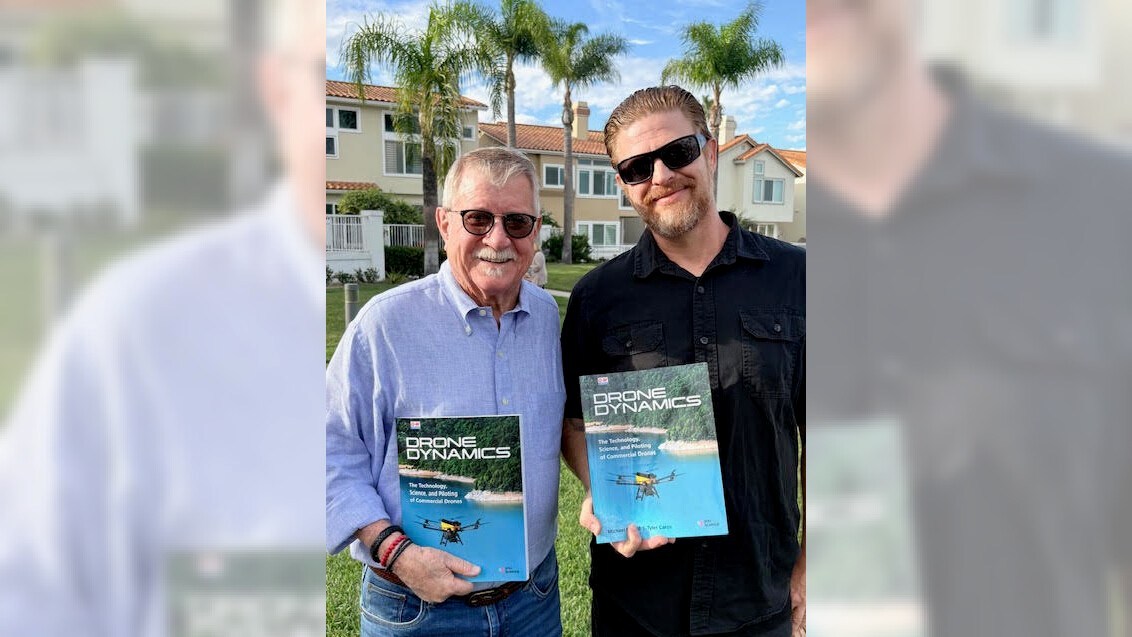
That’s just one of the many questions answered in a fascinating new textbook, “Drone Dynamics: The Technology, Science and Piloting of Commercial Drones,” co-authored by Mike Rivard of Long Beach and Tyler Caros of Lakewood. (See answer below.)
It is a classroom-ready textbook that provides a practical foundation for commercial drone operations, the first textbook of its kind in the United States aimed at high school and community college students, Rivard said.
It’s published by Goodheart-Wilcox, an Illinois company that has been printing textbooks and other educational resources since 1921.
“We are excited about what’s happening in the commercial drone business,” Rivard said. “This textbook will help students learn what they need to know to get a start in this growing field.”
The drone industry has grown dramatically, from a niche technical and hobby market into major business operations, with commercial, industrial, public safety, defense and other applications.
Rivard and Caros have been called drone visionaries for their work with drones in the past two decades.
Drones are remotely piloted vehicles and inventor Nikola Tesla is given credit for making the first one in 1898. But it was on water and not airborne. Tesla demonstrated a radio-controlled torpedo boat at Madison Square Garden and the audience couldn’t figure out how it moved without a pilot inside. Tesla patented his invention and called it “teleautomaton.”
His creation planted the seed for every remotely controlled aircraft, missile and drone that has since been invented.
In 2011, Rivard founded RadFlight, one of the first commercial drone companies in the United States. RadFlight has respected training courses for all levels of pilot skills.
Rivard is also past president and organizer of the Los Angeles/Orange County User Group, an organization for professional drone users.
Caros has worked with RadFlight since 2012 as a pilot and technical adviser. He currently is head of sales and marketing at A2Z Drone Delivery, Inc. He has an associate of science degree in computer animation design from the Art Institute of Los Angeles.
“Drones are more than flying gadgets,” Rivard and Caros write in their colorful book, filled with many photos, charts and graphs. “They are sophisticated systems in which hardware and software work together.”
In the preface, the books says drones have become “essential tools across many industries.”
As examples, the authors point out that drones are used in the following areas:
In public safety and disaster responses, supporting search operations, damage assessment and coordination of resources.
In construction and surveying, enabling the mapping, measurement and documentation of site conditions and monitoring progress.
In agriculture and environmental monitoring, assisting with observation of crops and land conditions.
In real estate and property management by capturing detailed aerial data, improving marketing, inspections, documentation and site condition assessments.
In photography, videography and entertainment, transforming visual storytelling across film, sports and marketing. “Once limited to big studios using cranes or helicopters, aerial cinematography is now accessible to independent creators and students,” they said.
Now, here’s the answer to how drones can help grow corn: Drones can monitor soil conditions and help irrigation over wide fields in short periods of time. With thermal imagery, drones can detect subtle signs of stress, like lack of water, long before they become visible. Thus, farmers can grow more and better corn. Crop dusting and spraying have also been transformed by using drones. It’s replacing expensive manned aircraft that are not as precise as drones in the application of chemicals.
Possibilities for commercial use are virtually limitless, Rivard said, and there will be a growing demand for drone pilots and drone-related services.
The textbook also has a chapter on how to get remote pilot certification from the Federal Aviation Administration.
“But whether you plan to pursue FAA certification, enter a technical workforce pathway or continue on to advanced study,” Rivard and Caros said, “this textbook is intended to establish a strong foundation.”
Next time you chomp on some corn on the cob, just think that there likely was a drone used in the growing of that corn.
For more information on the textbook, you can contact Mike Rivard at mikerivard@radflight.com.