
Good morning from Milwaukee,
The play that left everyone feeling a certain kind of way — frustrated or relieved, dejected or thrilled — was hardly what decided last night’s game.
The fly ball that hit a roof cable and was caught about six feet in front of the left field wall actually just provided a distraction from all the other ways the Padres fell short in Game 1 of the National League Division Series.
But, yeah, the Brewers might have gotten a completely random home field bounce that preserved their 3-2 victory.
“A little bit of luck going our way,” said Brewers closer Trevor Megill, who thought he had served up a home run that would have put the Padres ahead.
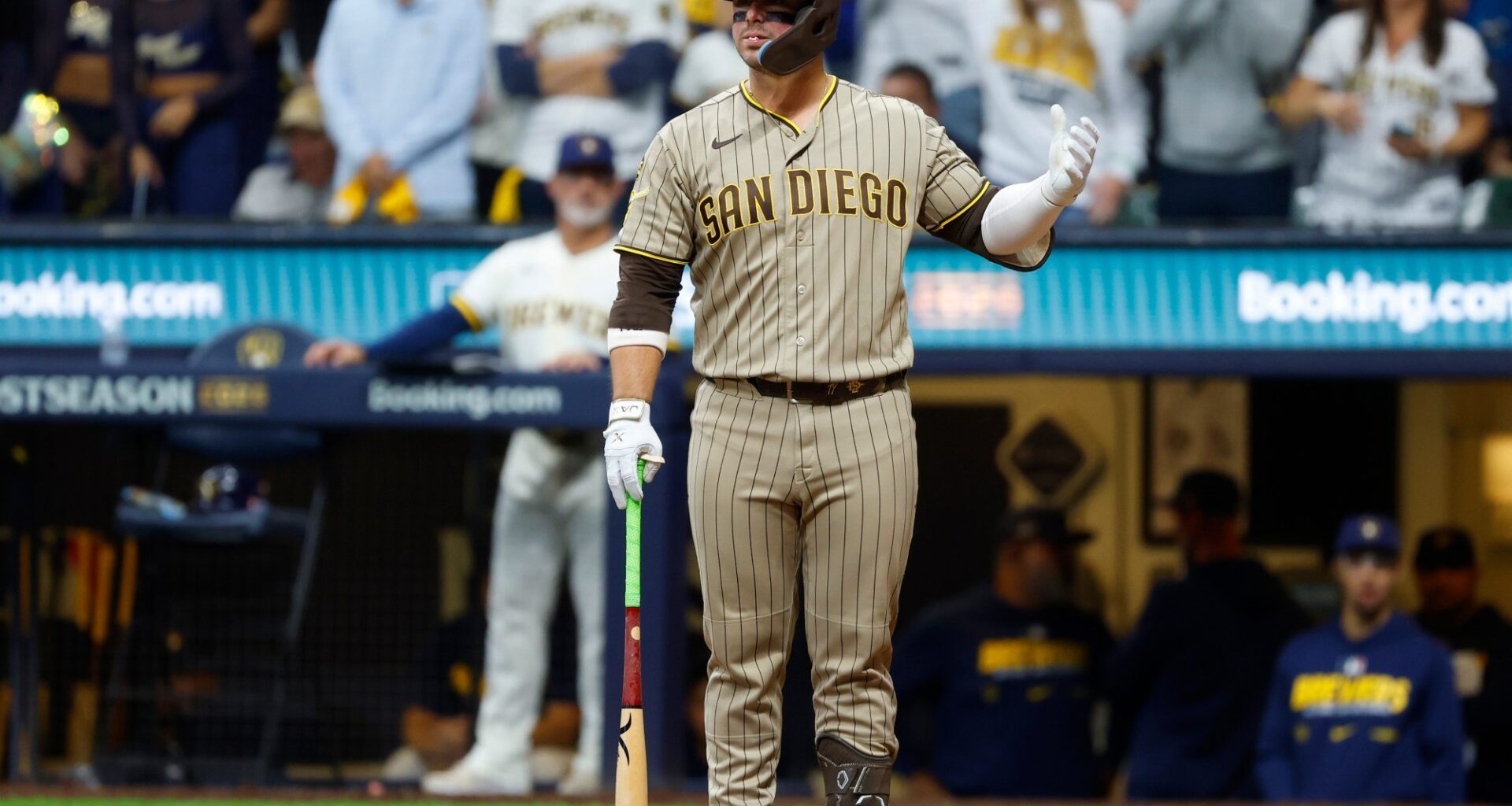
Depending on the vantage point, Ty France’s fly ball that sailed about 200 feet in the air might have been a homer or nothing more than strike one had it not hit that cable and shot down into left fielder Jackson Chourio’s glove for the second out of the ninth inning.
“It was going to be a foul ball,” Brewers manager Pat Murphy said. “It was going to be a foul ball, for sure. I’m standing right on that line.”
The Padres argued that as well during the game, because it was their only hope given the ground rules stating that any ball that hits the cable while above fair territory is live. But after the game, they were adamant it would have given them a lead.
“I thought it was a homer — for sure, 100%,” Manny Machado said.
France said he “knew it was going out.”
“I think if that ball doesn’t hit there it might break the glass up there at X-Golf,” Brewers catcher William Contreras said, referring to the golf facility located in the third deck beyond left field.
¡LO QUE PASÓ EN MILWAUKEE! 🤯
Ty France y lo que parecía el HR de la victoria en la novena entrada terminó pegando en el techo, la pelota fue atrapada por Jackson Chourio y declarado OUT 💥
Al final los Brewers ganaron el juego… pic.twitter.com/qQCGy4HdoY
— ESPN.com.mx (@ESPNmx) October 4, 2026
And Megill, whose 99 mph four-seam fastball France launched, recalled thinking this:
“Oh, crap.”
While Machado and France had solid suggestions about how all the technology in use at ballparks today could allow for rulings on such hits to be made differently, it wasn’t clear that would have helped this particular play swing in the Padres’ favor.
The projected distance on France’s fly ball, according to StatCast, was 325 feet. That makes it far different than the ball Xander Bogaerts hit that struck the catwalk at Tropicana Field on Aug. 28. That ball, which shot straight down and was caught in foul territory by Rays third baseman Junior Caminero, had a projected distance of 389 feet.
France’s ball was backspun and seemed to be carrying when it struck the cable, which suggests it would have made up the ground it needed had its flight not been interrupted.
But there has never been a home run at American Family Field with a launch angle higher than 46 degrees. Since StatCast began tracking launch angle in 2015, there have been just 10 home runs (not including inside-the-park homers) hit in any MLB ballpark with a launch angle of 49 degrees or higher.
The man who caught the ball — on the dirt about six feet in front of the white “342” on the left field wall — maintained it was never going to be a homer. A review of his route and the speed at which he was running support his contention that he did not consider it deep enough to clear the wall.
“I thought I had a chance on that ball kind of the whole time off the bat,” Chourio said. “Then the only thing I kind of realized (was that) it changed direction a little bit. But I thought I had a bead on it for the majority of the time.”
For the record, it was Major League Baseball that determined the roof would be closed since it was a postseason game. The Brewers make that call in the regular season.
Regardless, this was a random event.
No longtime observer of games at American Family Field could recall it happening.
“It has never even crossed my mind that a ball might hit something here,” Brewers first baseman Jake Bauers said.
When the ground rules were being discussed before the game and home plate umpire Nick Mahrley brought up rules about balls hitting any portion of roof apparatus, Brewers third base coach Matt Erickson said he had never seen such a thing in his six seasons.
The group laughed, according to Padres manager Craig Stammen, as a prediction was jokingly made that now it would happen in the game.
“And then it did,” Stammen said. “Unbelievable.”
It was crazy. It might have been unfortunate. It may have prevented the kind of late comeback the Padres pulled off so often this season.
But, as Machado said, “We didn’t lose the game there.”
There was a lot that happened before the ninth inning, including way back in the second when the Padres scored two runs off Jacob Misiorowski but failed in a chance to bury him.
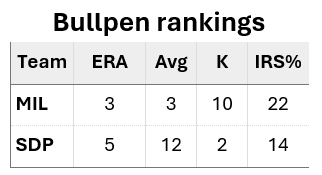
And, as is detailed in my game story (here), the Brewers’ really good bullpen outdueled the Padres’ really good bullpen while the Brewers got the big hits the Padres did not.
Good, but …
The Padres had an impressive approach against Misiorowski from the start.
After the 24-year-old right-hander began the game with the fastest pitch (104.8 mph) thrown in a postseason game since at least 2008 and struck out Fernando Tatis Jr. on four pitches, the Padres made Misiorowski work.
Dustin Harris fouled off three two-strike pitches before grounding out on the ninth pitch of his at-bat. Manny Machado fouled off two two-strike pitches before hitting a double on the eighth pitch of his at-bat. On Misiorowski’s 25th pitch of the inning, France struck out to strand Machado.
In the second inning, after the Padres had scored two runs on three singles and a fielder’s choice, it was Machado who couldn’t get a two-out hit.
With the bases loaded and Misiorowski 32 pitches into the inning and left-hander DL Hall warming up in the bullpen, Machado hit the first pitch he saw to shortstop for an inning-ending groundout.
“We kind of could have put a little dagger in it,” Machado said. “We could have put some more runs up on the board, and we didn’t and kind of gave him a little bit more adrenaline to come out there and he was kind of lights out after that.”
Misiorowski, who threw five pitches at 104 mph or faster in the first inning, topped 102 just three times among the 21 four-seam fastballs he threw in the second. Bogaerts singled on a slider. Ethan Salas and Luis Campusano singled on cutters.
“There’s no high thought with it,” Misiorowski said of his incorporating more breaking balls. “We’re trying to battle them. And they were fouling s— off. And you’ve kind of got to make an adjustment and try and go soft. And they’re fouling soft off. You kind of just do something until it sticks. … Those guys had an approach, and they stuck to it. They did their job, and I had to find a way to battle back.”
Miziorowski got through the third inning on nine pitches. And after the Brewers tied the game in the bottom of the third, he took another 14 pitches to get through the fourth.
The 88 pitches were the second most he had ever thrown in a start in which he did not make it past the fourth inning.
In all, the Padres fouled off 30 of Misiorowski’s pitches, the most in the first four innings of a postseason game since such things began being tracked in 2008.
“Obviously not the way I wanted it to go,” Misiorowski said. “Would have liked to go a little deeper for our bullpen. The job still got done. We still got a ‘W’ at the end of the day.”
Five Brewers relief pitchers covered the final five innings, and they made the pitches that saved the game.
Jackson Merrill made the third out on fly balls in three different innings — with runners at second and third in the fifth, with the bases loaded in the seventh and with a runner on first in the ninth. Tatis struck out with runners at second and third in the eighth.
In all, the Padres were 1-for-9 with runners in scoring position. The 12 runners they left on base were the third most they had ever stranded in a postseason game.
Surprise sock
Padres’ pitchers reward for getting past the Cubs, who led the major leagues in runs scored during the regular season, was to face the Brewers, who ranked second.
The Brewers just scored their abundance of runs differently. Their official slogan is ”Win Our Way.” And that means by forcing the action with bunts, plate discipline and aggressive baserunning.
They ranked first in on-base percentage, first in extra bases taken on a single, second in bunt hits, fifth in sacrifice bunts and fifth in stolen bases. And 29th in home runs.
Yet two home runs accounted for all their scoring in Game 1.
Jeff Sanders wrote about that in his notebook (here) from last night, which included quotes from Robbie Ray and Adrian Morejón, who surrendered the homers.
That was really the difference as two of the best bullpens went back and forth for more than half the game after Ray was lifted in the third inning and the Padres jettisoned Misiorowski after four innings.
“Anytime you score first in a playoff game you feel really good about it, especially the type of pitching staff we have,” Stammen said. “We just got beat by a couple home runs tonight.”
Michael King, who shut out the Cubs for seven innings on Tuesday after turning in 18 quality starts in the regular season, starts Game 2 for the Padres. Logan Henderson, who had seven quality starts among his 18 starts this season, goes today for the Brewers. Still, the nature of the postseason makes it likely we see plenty more of the two bullpens.
“You can look at the five-game series, you have the two off days in between if it goes five games,” Stammen said. “So you can use your best guys pretty often. They did the same thing. They had their best starter going today. We have our best starter going tomorrow. They’ve got a pretty good starter going also. But in the end, both teams feel like their strength is their bullpen, and I’m sure they’re going to use it the same way that we’re gonna use ours.”
King needed
Sanders wrote (here) about King starting Game 2. The story had quotes from King and Stammen from before yesterday’s game.
Afterward, it became even more important that the Padres have their No.1 starter going in a game in which they will be attempting to avoid returning home down 0-2.
“We’ve got King on the mound, and we’re confident in him,” Machado said. “We’ll go out there and try to get back to San Diego 1-1.”
King allowed one run in 5⅔ innings here on May 13.
Tidbits
Walker Buehler did not start yesterday because he was becoming a father for the second time. He was placed on the paternity list and replaced on the roster by Randy Vásquez. As explained in my story (here) from yesterday morning, Buehler will be back before Game 3.
Bogaerts was 1-for-3 with a walk last night and is 5-for-14 this postseason and 9-for-23 over the past two postseasons. You can read Sanders’ notebook from Friday (here) about what Bogaerts is doing differently at the plate and how it has helped.
Sanders’ game preview (here) from yesterday discussed the reasoning behind the decision to go with Campusano at designated hitter instead of Gavin Sheets. Campusano’s single in the second inning drove in the Padres’ first run.
Salas was 1-for-3 last night. After going hitless in his first 15 big-league at-bats, Salas has 11 hits in his past 28 at-bats (.393).
Machado and Harris, the Padres’ second and third hitters, were both 2-for-4 with a walk last night. France, the cleanup hitter, was 1-for-4 and was hit by a pitch. But the bookends for that trio was a combined 1-for-10, as Tatis went 1-for-5 and Merrill was 0-for-5.
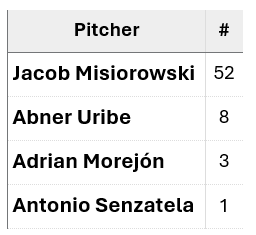
The 64 pitches thrown at least 100 mph last night are more than had been thrown in a postseason series since at least 2008. Yes, in a series. And Mason Miller didn’t even pitch.
All right, that’s it for me. Earlier game today (1 p.m. PT).
Talk to you tomorrow.