
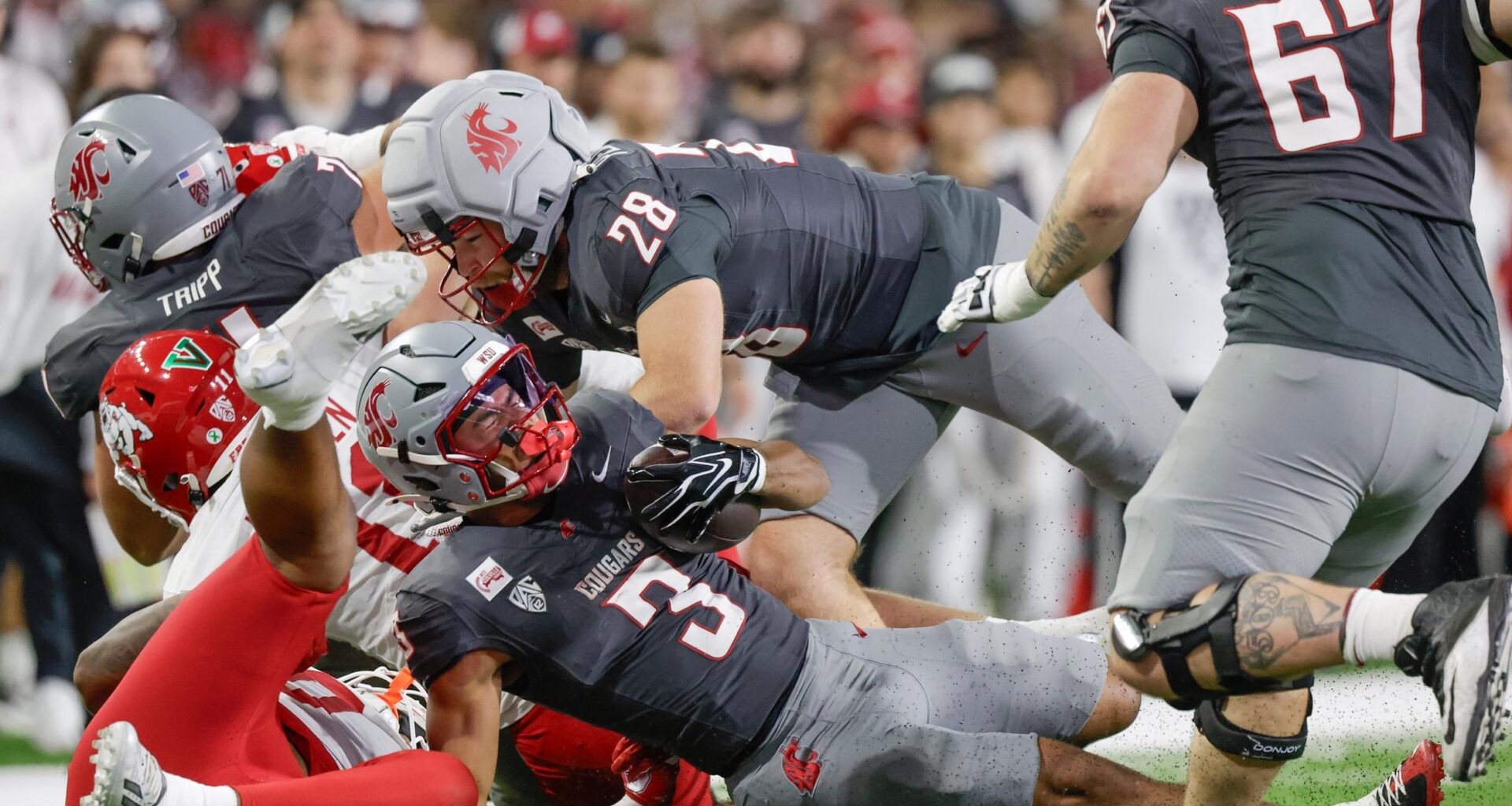
PULLMAN – At some point in the Gesa Field locker room, not long after his Washington State team managed just six points in an anemic loss to Fresno State on Saturday evening, Kirby Moore got his players together and left them with a message.
“We talked about, naturally, there’s gonna be noise, and rightfully so,” Moore said. “We gotta have a better product on the field. We all agree that we’re a better football team than that. The leadership group’s gotta step up, and the only way I know how to improve is to go back to work.”
Plenty of that will be in order for the Cougars, who are now 1-4 overall and 0-1 in Pac-12 play to begin Moore’s tenure. With this 26-6 setback, WSU’s offense now ranks near the bottom in the country in several key departments. With this sampling, keep in mind that there are 138 FBS teams this season.
• 11.8 points per game, No. 130
• 27% on third down, No. 133
• 287 yards per game, No. 133
• 18 sacks allowed, No. 129
• 11 red zone attempts, No. 125
Here two more statistics that might best capture the Cougars’ struggles on offense. They’re averaging 2.8 yards per rush, which is No. 128 nationally. They’re also averaging 5.6 yards per pass attempt, which is two spots up from dead last in the country.
The eye-test backs up those trends. Quarterback Caden Pinnick, who threw an interception to bring him to six total turnovers on the season, hasn’t shown much acumen with the deep ball. Credit WSU coaches for game-planning around that, but they also aren’t getting much out of their running game, which could play a key role in opening up the field for their quarterback.
In short, that’s how you end up with this WSU offense, which has now gone without an offensive touchdown twice in one season. For the Cougars, that’s the first time that has happened since 2008, the first season of former coach Paul Wulff’s tenure. Wulff actually did visit Moore and coaches back in August, but in terms of on-field results, that’s not company anyone with WSU’s program wants to keep.
Here are five lingering thoughts from WSU’s loss to Fresno State.
1. Caden Pinnick’s pocket presence leaves a lot to be desired: Pinnick’s list of issues is quite lengthy, but this problem ranks somewhere near the top: He doesn’t look entirely comfortable in the pocket, whether or not he’s seeing pressure. He may have taken five sacks, but Pro Football Focus only dinged the Cougars’ offensive line for one, which does a great job of crystallizing the issue.
On one play late in the first quarter, Fresno State brought a blitzer up to the line of scrimmage a few seconds before the snap, and Pinnick seemed to be aware of that. The WSU player he was lined up against, tight end Jack Pedersen, even pointed to him. But defensive back Loyall Mouzon came unblocked just the same, and even with a second to get the ball out to running back Maxwell Woods in the flat, Pinnick elected to hold on to the ball and take the sack.
USA Network
At the beginning of the third quarter, Pinnick also put on display what is becoming a bigger and bigger issue: He won’t throw the ball away. On this play, he does well to fake a handoff and make one defender miss, but he’s out of the pocket so he has a chance to throw it away and avoid a loss. Instead, he takes a sack for a loss of 10 yards. The Cougars punted three plays later.
USA Network
Let’s fast forward to the end of the third quarter, when WSU was facing a 13-6 deficit. Backed up deep in their own territory, the Cougars go with a shotgun dropback for Pinnick, who gets great protection from his O-line. He chose to scramble from the pocket, which looked unnecessary, and checked it down for a short gain.
On that play, it wasn’t just Pinnick’s decision to bail from a clean pocket that presented a problem. That choice spawned another: Pedersen was called for holding. That’s the kind of penalty that quarterbacks put their blockers at risk of when they scramble from the pocket, causing blockers to become more visible to officials.
USA Network
2. Matyus McLain turned in his best game yet: In his fifth game at the FBS level, the defensive end McLain looked like the best version of himself. For the game, he totaled four tackles, including a half-sack and two tackles for loss, playing a key role in the Cougar defense keeping the team in the game.
Late in the first quarter, McLain shot through the line of scrimmage and dragged down running back Rayshon Luke for a loss of four. Then, late in the third frame, he made back-to-back huge plays: He brought down Fresno State QB Jayden Mandal for his half-sack, sharing it with defensive tackle Jirah Leaupepetele.
Only moments later, he dropped back in coverage and made a key third-down tackle in space, highlighting the athleticism that makes him so dangerous in the pass-rush department.
3. Jack Stevens is back in business: It wasn’t long ago when WSU kicker Jack Stevens was mired in a long streak of misses, entering last week’s game against Arizona 1-for-5 on field goals. There was a lot wrong with the Cougars’ entire field goal operation, which caused one last week to get blocked, and a lot has changed since.
The most important centers on Stevens, who connected on two field goals in Saturday’s game, including a careerlong 50-yarder to tie the game right before halftime. He looked psyched afterwards. You can tell his confidence is returning, which could aid a struggling WSU offense.
Credit WSU coaches for making changes up front. They removed usual right tackle Jaylin Caldwell, whose failure to block anyone last week resulted in a blocked field goal, as well as offensive lineman Arion Williams, who were a part of that blocked field goal. They subbed in linemen Kyle Martin and Nick Bakken, which helped facilitate a cleaner operation.
4. Why did WSU almost completely abandon the running game in the second half? For the game, Cougar running backs Kirby Vorhees, Maxwell Woods and Leo Pulalasi combined for 45 yards on 12 carries. In the second half, those numbers dropped significantly: Those three combined for just 13 yards on five carries. As a team, the Cougars posted negative-4 rushing yards in the second half.
You read that right: In the second half of Saturday’s game, WSU’s stable of running backs – whose retention was hailed as one of Moore’s top offseason accomplishments – got only five tries to run the ball. The Cougars almost entirely shelved the running game, resulting in 18 passes for 70 total yards.
What’s even weirder is that Woods, who turned in a 7-yard carry early in the game, played only 12 snaps. In the second quarter, he ran backwards to look for more space, which became a 4-yard loss. Maybe that explains his low snap count, but considering his shiftiness and speed, there has to be a bigger role in the Cougs’ offense for Woods – and Vorhees and Pulalasi.
5. Did Julian Dugger or Owen Eshelman deserve a few garbage-time snaps? Pinnick never came out of Saturday’s game, not even in the final three minutes, when the game was out of reach. He had thrown an interception on the previous series, and with only minutes left in a blowout, it seemed possible for WSU coaches to give snaps to one of their other quarterbacks, Dugger or Eshelman.
Instead, Moore rolled with Pinnick, explaining that decision this way: “With where we were at, just the rhythm. Wanted to keep him going with the first group from an offensive line standpoint. But I think everything on offense, we gotta reevaluate.”
It’s clear that Moore wants to stick with his guy, wants to ensure that Pinnick feels like QB1. But Pinnick could still have been QB1 even if coaches gave the game’s final snaps to another quarterback, if only to demonstrate to fans that, yes, they are interested in trying new things.
As WSU prepares for its next game, a road test at Utah State on Friday, it’ll be fascinating to see how Moore talks about the way he’s handling Pinnick and the team’s QB situation.