
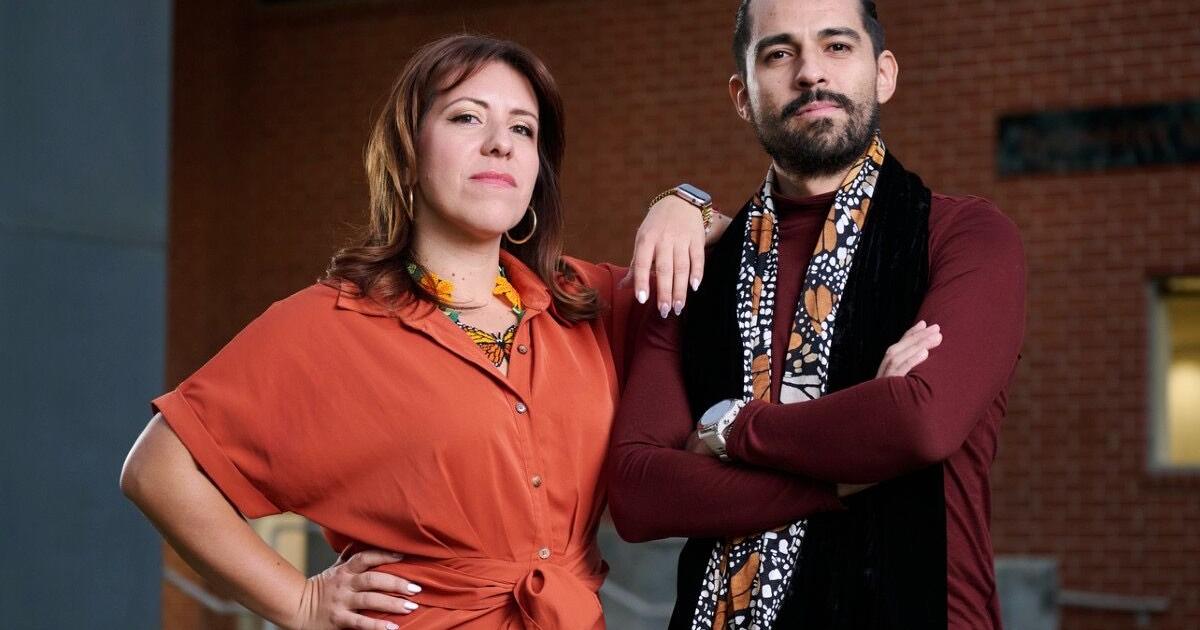
Marissa Montes, founding director of the Loyola Immigrant Justice Clinic, was born in Mexico and brought to the United States as a child. What she — and her community — experienced growing up is what motivated her to do the work she does today. Today, she is in Mexico, meeting with Eduardo Osornio, the director of the Guadalajara office of LMU Loyola Law School’s Binational Migrant Advocacy Project (BMAP), which was launched a year ago to support migrants and families navigating immigration systems on both sides of the border.
Since high school, Montes has known she wanted to do immigrant rights work. As an undergrad, she worked at USC Gould School of Law Immigration Clinic. When it was time to choose a law school, she picked LMU Loyola Law School in Downtown LA because of its focus on public interest and social justice work. At the time, it did not have an immigration clinic. Montes decided to start one. With the support of her mentor, Professor Kathleen Kim, Montes wrote up a fellowship project.
“Kim was the first person to educate me on the concept of community-based lawyering,” said Montes. “To switch up the power dynamic—instead of the attorney coming in and saying, this is what we want you to do. They listen to the community and are responsive to their needs. At the end of the day, the immigrant community better than any lawyer is going to know exactly how the laws impact them every day and often know the solutions.”
“That’s what I tell the students: We’re entering a place of privilege and power,” she continued. “How can we use those tools to grant access and a voice to the immigrant community? That’s been my philosophy as an educator and as a litigator; listening to the community and following their lead. Maybe I know how to get there legally, the legal strategy, but they’re the ones who inform me that this is the direction we need you to go.”
Although Montes knows that these are hard skills for lawyers, who might lack flexibility, they are what is needed right now.
“It’s incredibly effective and also humbling, which can also be hard for lawyers,” she said. “This is something I seek to instill in my students from day one. I hope that when they graduate, they continue that trend.”
Loyola Immigrant Justice Clinic is the result of Montes’ fellowship project. Launched in 2012, the community-based clinic provides legal services to the immigrant communities of Los Angeles County in partnership with Dolores Mission Parish and Homeboy Industries. It also engages in advocacy and client empowerment and trains law students so they can hit the ground running once they graduate.
The clinic has allowed Montes to have her dream job as a clinical professor.
“I always thought it was the coolest job because we get to teach and work with clients,” she explained.
In the early days, the clinic focused on Boyle Heights, because there was “a bit of a legal desert in the area, and it is considered our Ellis Island, the West Coast Island,” she relayed. “That’s where our work started, and our work has always responded to community needs, so it always changes from semester to semester depending on the issues we see.”
About nine years ago, the clinic began to engage in binational work. According to Montes, it was a response to the caravans that were arriving in LA.
“What we were noticing was the importance of information sharing before people crossed the border,” said Montes. “Many people were coming and seeking asylum, and we realized that many of them, unfortunately, either didn’t qualify, or even if they did qualify, the outlook was grim, and we realized the importance of sharing this information before they arrived.”
About a year ago, LMU Loyola Law School launched BMAP to address this issue. Loyola Immigrant Justice Clinic has partnered with ITESO, Universidad Jesuita de Guadalajara, to provide legal advocacy and student training to support migrants and families navigating complex immigration systems in the United States and Mexico.
“We’ve been focusing, on the U.S. side, on serving deportees in terms of reintegration efforts and in terms of pathways of potentially returning to the United States,” Montes explained. “While the Mexican director and the students have been working with asylum seekers that now have been forced to remain in Mexico.”
The law students who participate in BMAP have to apply to the course, which is highly competitive, and if accepted, they work on cases from start to finish under the supervision of Montes and her colleagues. This is the first and only law clinic of its kind housed at a U.S. law school.
“It’s an opportunity for law students to get hands-on experience representing clients before they graduate,” she said. “The idea is to train them in best practices. We’re trying to build awareness and interconnectedness between advocates in both countries because immigration policy goes beyond our physical borders. They’re able to work collaboratively because the U.S. attorney is limited to practicing U.S. law. The Mexican attorney is limited to Mexican law, but we can work collaboratively to make sure that we get the solutions we need.”
Montes’ work has always been heartbreaking. Deportation can result in family separation and even death. But the amount of violence she has witnessed recently against the immigrant community is something that she has never witnessed in her 14-year law career. Yet even so, there is something about the immigrant community — the perseverance, the resilience — that gives her hope.
“My binational work has shown us that there is a way that we can advocate for our clients,” she said. “I don’t mean to lessen the consequences of deportation. But there are ways that we can accompany our clients to make sure they reintegrate, and they’re able to live happily and successfully in their home country or in a third country. This binational work has been the silver lining to show me and my students that the government thinks the fight ends at deportation, but it doesn’t. We’re going to keep going.”