
Judy Gradwohl teems with enthusiasm as she opens a drawer of rare insects, carefully pulling out a tray holding a tiny brown bug. Beside it, a handwritten label reads, “C. Darwin.” Gradwohl guesses it dates to Charles Darwin’s 1836 expedition aboard the Beagle, the voyage that would help lay the foundation for his theory of evolution through natural selection.
As she watches the realization dawn on those she’s educating, Gradwohl’s eyes widen and her face blooms into a broad smile, savoring the moment of discovery unfolding around her in the back of the Entomology lab.
Moments like this are what make the museum feel like the world’s greatest amusement park for Gradwohl, who is celebrating her 10-year anniversary as chief executive officer of the San Diego Natural History Museum, commonly known as The Nat.
Behind the dinosaur skeletons, giant whale replicas and exhibition halls lies a world of scientific discovery. Paleontologists brush debris off centuries-old bison skulls and scientists examine rare bug species under microscopes. There are cases upon cases filled with the history of nature, all waiting to be explored and understood, right in the heart of Balboa Park.
Gradwohl is completely in her element.
“One of the greatest gifts about working in a museum is that you’re surrounded by people who share a real joy in discovery,” Gradwohl said as she walked through The Nat’s laboratory spaces, peeking into the rooms to chat with scientists and researchers. “What I try to do is figure out how we can share that with everybody else because that’s what motivates all of us and that’s what makes life rich.”
 Judy Gradwohl, president and CEO of The San Diego Natural History Museum in Balboa Park, talks about a fossil that was found at Snapdragon Stadium. (Kristian Carreon / The San Diego Union-Tribune)
‘Collaborative sensibility’
That curiosity has defined more than Gradwohl’s scientific career. It has shaped the way she leads.
Gradwohl walked into the museum in 2016, succeeding Michael Hager, who had led the institution for 25 years.
In science museum spaces where men have historically far outnumbered women, she brought an unconventional, collaborative approach to leadership. Rather than embracing a top-down model, she put listening to the community and staff at the center of her leadership, gathering feedback and ideas along the way.
“I brought collaborative sensibility. You have to come into any new situation with a good amount of humility and know that you’re going to be learning as much as you are going to be leading,” Gradwohl said. “It’s like running a small city.”
For Anita Busquets, a longtime board member and financial adviser since 2011 who also served on the hiring committee, Gradwohl’s arrival represented a new kind of scientific leadership.
“As an executive woman who’s worked in science for 50 years, it was so nice to be able to recruit a female scientist with management experience,” Busquets said. “She really wanted to transform what she came into, and she did.”
Busquets said Gradwohl spent her first six months listening and learning, launching a strategic planning process involving more than 400 community members, employees and contractors to identify the museum’s needs and bridge the gap between its behind-the-scenes science and the public.
“I learned early on how important it is to ask questions rather than to have all the answers,” Gradwoh said. “And also just the joy of being able to focus on something and try to understand what it’s doing and why it’s doing it.”
That emphasis on listening and staying curious became the foundation for how Gradwohl approached the museum: Not simply as a place that houses science, but as a place that invites people into it.
“One of the greatest gifts about working in a museum is that you’re surrounded by people who share a real joy in discovery. What I try to do is figure out how we can share that with everybody else because that’s what motivates all of us and that’s what makes life rich.”
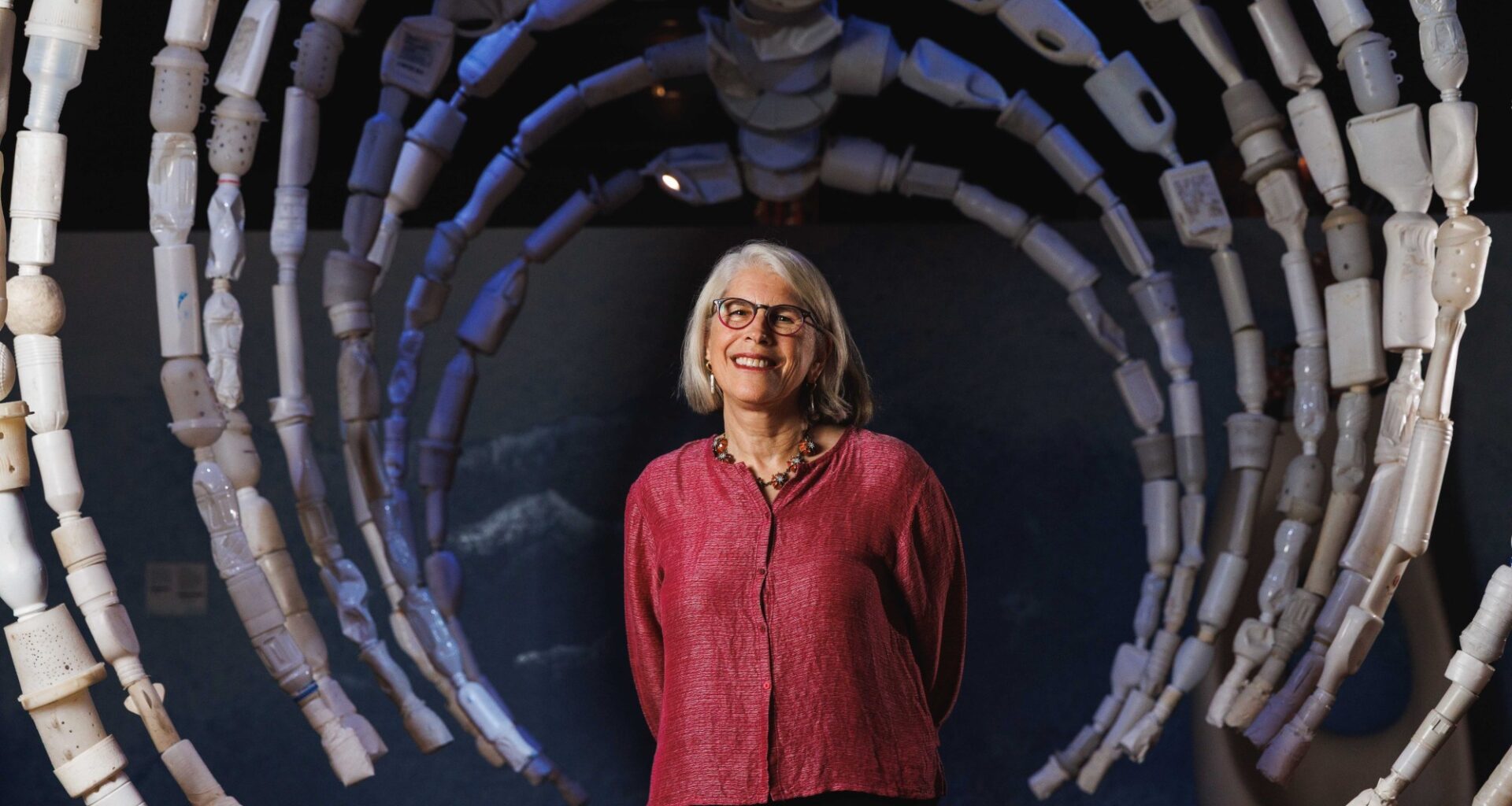
 Judy Gradwohl, president and CEO of The San Diego Natural History Museum, talks about the museum’s newest exhibit, “Washed Ashore.” (Kristian Carreon / The San Diego Union-Tribune)
‘Ahead of her time’
Gradwohl had spent 31 years at the Smithsonian in Washington, D.C., before arriving at The Nat, holding roles ranging from exhibition curator and web director to digital content developer and environmental specialist, ending as associate director for education and public engagement at the Natural Museum of American History.
“I learned a lot about narrative storytelling and got to see just amazing touchstones of American history,” Gradwohl said.
Her time at the Smithsonian also placed her at the forefront of a transformation museums were only beginning to navigate: the rise of the internet.
In 1993, she helped launch the Smithsonian’s first website, when museums were still debating whether a digital presence would enhance the museum experience or pull visitors away from it.
Gradwohl led initiatives exploring how museums could embrace the emerging digital landscape without losing the experience of being there in person.
“When recorded music came and when the wax cylinders came into existence, everybody was afraid that nobody would want to hear live music ever again,” Gradwohl said. “And yet what happened is it just created a thirst for it, and I think … that’s what the World Wide Web did for museums as well.”
That forward-thinking approach continues to shape how she views museums as social media once again raises questions about how technology can change the way audiences experience them.
 Judy Gradwohl, president and CEO of The San Diego Natural History Museum, looks through cases of specimens in the museum’s invertebrate zoology department. Kristian Carreon / The San Diego Union-Tribune)
Making science visible
Perhaps the most vibrant example of that philosophy is “Amazement in the Basement,” the museum’s subterranean 8,000-square-foot Paleontology Center, which transformed a former traveling exhibition space into a behind the scenes glimpse of the museum’s scientific work.
Rows of drawers hold fossils, including 12-million-year-old whale skulls and finds from San Diego’s underwater past, alongside scientists’ field notes. Through a glass wall, visitors can watch the lab in action and, at designated times, speak with researchers.
“We wanted it to not just be a museum, but to be able to show off how much science we really were doing. That completely transformed the way that the museum was being seen by other constituents,” Busquets said. “That’s something that has come out under her.”
Rather than keeping conservation work behind the walls of the lab, Gradwohl has found ways to make it impossible to overlook.
In The Nat’s newest exhibition, “Washed Ashore: Art to Save the Sea,” trash collected from West Coast beaches is transformed into large-scale works of art, including a life-size whale skeleton built from discarded bottles, canisters and plastic. The result is science and art meeting in the same place, turning the debris threatening the ocean into a visual reminder of why protecting it matters.
Gradwohl also led the Nat at Night initiative, inviting people onto the roof on Friday nights during the summer and continuing on the third Friday of every month throughout the year. The program opened the museum to an older audience while creating another source of revenue for the institution.
The goal is similar across each initiative: to bring people closer to the work happening inside the museum and make science something they can experience rather than simply observe.
“I learned early on how important it is to ask questions rather than to have all the answers. And also just the joy of being able to focus on something and try to understand what it’s doing and why it’s doing it.”
‘Muddy boots biologist’
For all of Gradwohl’s years spent leading museums, building digital programs and rethinking how audiences experience science, she still identifies most closely with a simpler title: “muddy boots biologist.”
“I was trained in muddy boots biology where you go out there with binoculars and a notebook,” Gradwohl said.
That instinct took root in her hometown of Venice, just up the coast, where the natural world became her first classroom. She spent her youth hiking the Sierras, backpacking and cross-country skiing, often lingering over field guides to identify the plants and species around her. What began as curiosity soon became a desire to understand the world more deeply.
She remembers it as a time of “the beautiful and unspoiled nature of her youth.”
That curiosity followed her to UC Berkeley, where an undergraduate fellowship took her to the Smithsonian Tropical Research Institute in Panama to study tropical birds. She went on to earn her bachelor’s and master’s degrees in zoology, beginning a career that would take her from California’s trails to some of the world’s most remote landscapes.
Gradwohl fondly recalls a 1986 adventure when she traveled to Mulu National Park in Borneo, Malaysia, as a curator for the Smithsonian’s rainforest exhibition. She jokingly remembers it as “19 days with 19 men in the forest of Borneo,” navigating the jungle by boat with a film crew. At one point, they even strapped a photographer to a Sikorsky helicopter flown by a Brunei Air Force pilot.
The difficulty and thrill of reaching those remote places was part of the reward.
“The longer it takes to get someplace, the better, the more pristine it’s likely to be,” she said.
Decades later, that same instinct to look closer is still visible in the way Gradwohl moves through The Nat. She leans into the details — a fossil uncovered at a construction site, a rare insect tucked inside a drawer, a scientist’s field notes — and seems just as eager to discover something as she is to share it.
Beneath the CEO, curator and museum innovator is still the person who lingered at the back of the hiking group, field guide in hand, wanting to understand what she was looking at. And after a career built around helping others discover the natural world, her favorite place to do it remains in the field.
“I used to say my best, my best day on the job was when I was out in the field with somebody,” Gradwohl said with a smile.
In many ways, she never really left the field.