
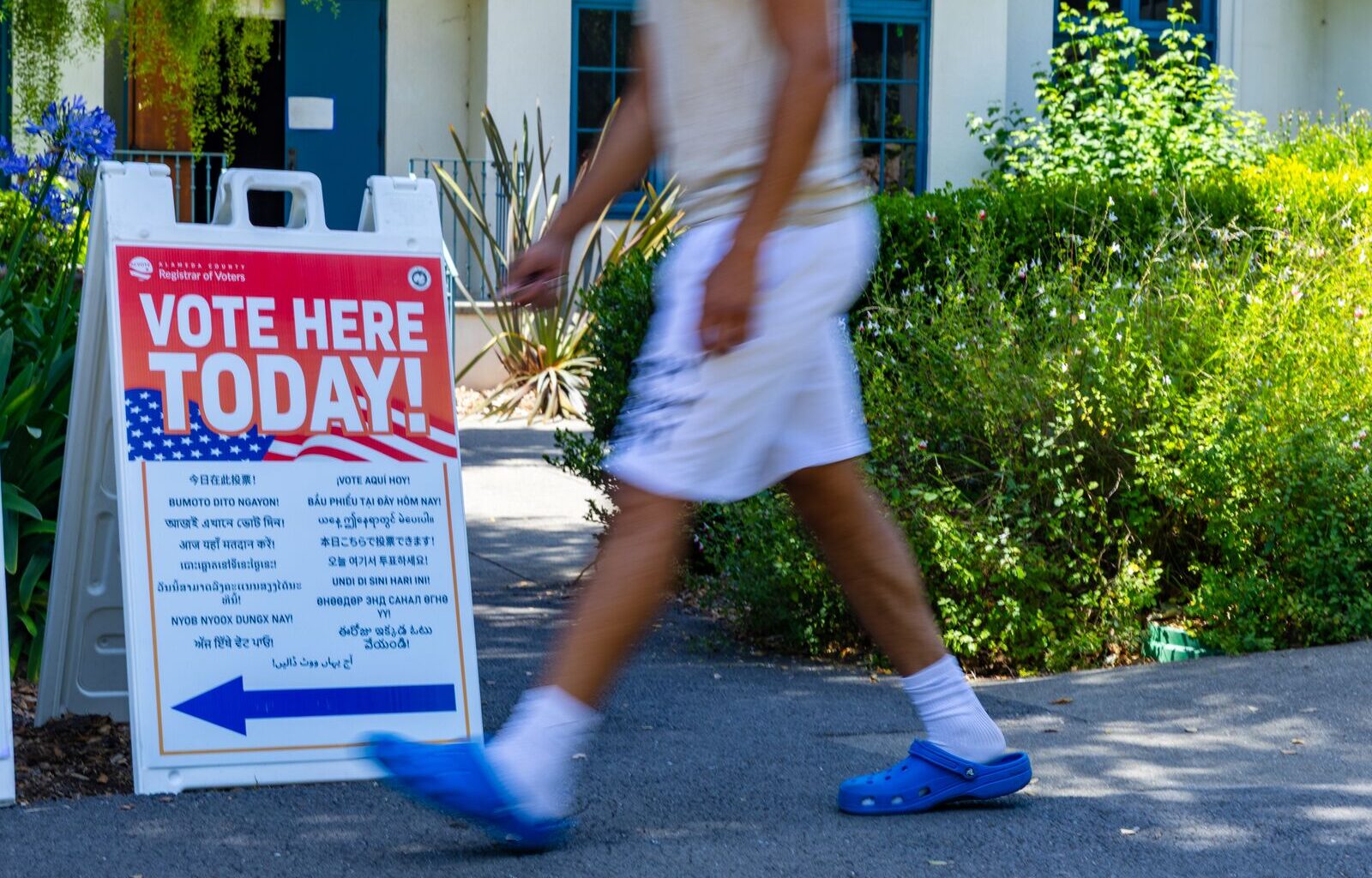
Oakland’s future could look distinctly different depending on who’s elected mayor or city councilmember on Nov. 3.
We sent all candidates detailed questionnaires about pressing issues like police staffing, homeless camps, government transparency, Flock, and AI. We’re printing their responses in full, below, so voters can compare and contrast their visions and qualifications. We made some minor formatting adjustments but otherwise did not edit what they wrote.
Two incumbents, District 6 Councilmember Kevin Jenkins and District 4 Councilmember Janani Ramachandran, did not submit responses. We’ll update this page if they do.
One note: When we sent out these questionnaires, the Oakland Police Department had not yet been released from federal oversight. We’re still publishing the candidates’ responses to a now-outdated question about this, because they reveal their ongoing stances on police accountability.
Click the candidates’ names to see their responses. They are listed in alphabetical order by last name for each office.
Mayor
Brenda Grisham
What’s your current or most recent job?
CEO
What neighborhood do you live in? And how long have you lived in Oakland?
Fruitvale District 1.5 years
Are you a renter or a homeowner?
Renter
Do you have experience working in government? Please describe briefly.
I have been Active in policy making in Oakland, CA and In Washington DC for 13 years
Are there any people or organizations you won’t accept campaign contributions from? If so, whom?
I am a Independent Candidate so the options are Low
Violent crime has dropped dramatically in Oakland over the past couple of years. But Oakland’s crime rate is still higher than many other peer cities’, and in some neighborhoods residents experience violence on a regular basis. Which neighborhoods in Oakland are most impacted by crime right now? Please describe some specific steps you’ll take to make sure they receive adequate public safety resources.
Violent crime has declined, but shootings and serious violence remain concentrated in parts of East Oakland—including Fruitvale, Seminary, Havenscourt, Eastmont, Elmhurst and Sobrante Park—and in parts of West Oakland, including Hoover and Acorn and International where my businesses are.
Use current crime and 911 data to direct resources where they are most needed.
Expand neighborhood patrols and improve police and dispatcher recruitment.
Strengthen violence interruption, and victim-support services.
Improve lighting and address abandoned vehicles, illegal dumping and vacant properties.
Create neighborhood safety plans with residents, businesses, schools
Oakland appears to be close to exiting the Negotiated Settlement Agreement that has kept OPD under federal oversight for more than 23 years. Assuming that happens, what will you do to ensure that OPD never falls under federal monitoring again?
Ending federal oversight must not mean ending accountability. As mayor, I will fully support independent civilian oversight, require transparent reporting on misconduct and use of force, strengthen officer training and early-warning systems, and hold OPD leadership accountable. These reforms must become permanent so Oakland never repeats the failures that led to federal monitoring.
Should Oakland invest more or less money in its civilian oversight bodies, including the Police Commission, Public Ethics Commission, City Auditor, and Privacy Advisory Commission? Which ones would you prioritize?
I would prioritize the Police Commission and its accountability agencies, followed by the City Auditor and Public Ethics Commission. They protect constitutional policing, uncover waste and misconduct, and strengthen public trust. The Privacy Advisory Commission must also remain adequately supported as technology and surveillance tools expand. Each entity should be fully funded to be able to provided quality services
OPD is unable to recruit, train, and retain police officers faster than they leave. This attrition problem keeps OPD’s ranks far below the number many think is needed to adequately staff patrol and other public safety jobs. Why do you think this is?
OPD’s attrition problem comes from a slow hiring process, competition from better-resourced departments, mandatory overtime, burnout, low morale and concerns about leadership and workplace culture. Recruitment alone will not solve it. Oakland must streamline hiring, expand local recruitment, strengthen training and supervision, improve working conditions, and give qualified officers clear reasons to build long-term careers here. We must provide a robust recruiting process which will excite new officers and include a incentive for current officers.
Do you oppose or support the construction of the proposed coal terminal in West Oakland? What will you do as an elected official to oppose or support it?
my answer is two fold the community is split on what they want, it is ouf duty to fully explain any threatens public health, air quality to neighborhoods already burdened by pollution. We must have rigorous environmental review, enforce every applicable health and permitting standard, work with state and regional agencies, and make the best decision with the community being involved in the fina decision
The city auditor recently conducted a survey about Oakland’s ethics climate. City employees gave Oakland’s government a middling score, and many participants shared negative feedback about Oakland’s ethical culture. If you’re an incumbent, name one thing you’ve done to make your office more transparent and corruption-proof. If you’re a challenger, name one thing you promise to do to make your elected office more transparent and accountable to residents.
As a challenger, I will publish my office’s spending, contracts, meetings and performance goals through a public dashboard so residents can clearly see how decisions are made, how money is spent and whether promises are being kept.
What are some of the most dangerous roads or intersections in Oakland — places where pedestrians, bicyclists, kids walking to school, and others risk being hit by traffic? How would you work to improve safety at these locations?
International Boulevard—especially near 35th, 73rd and 98th avenues—is among Oakland’s most dangerous corridors. Portions of MacArthur Boulevard, Foothill Boulevard and San Pablo Avenue are also on the city’s High Injury Network. Speeding on theses street is one of the biggest problems.
I will prioritize these locations for improved lighting, visible crosswalks, protected bicycle lanes, safer traffic signals, speed cameras and traffic-calming measures. I will also accelerate Safe Routes to School improvements and require public reporting on project timelines and traffic injuries
Where do you stand on the city charter amendments on the November ballot? Do you support the concept of a strong mayor system?
I am not in agreement with the charter amendments, amending a charter takes time to make sure equitable changes are made with more imput from community partners. I do not support the strong mayor system
Have you visited any of Oakland’s homeless shelters or homeless camps and spoken to people living there? If so, which, and what did you learn from the experience?
I have visited and supplied services to many homeless encampments for over 12 years. We hold conversations with the people living in these encampment spaces. I have learned that everyone is not on drugs or have mental issues, some have jobs and a decent education. Many have fell on hard times, where they lived was sold and they did not have resources to rehouse them.
Oakland has a new plan to cut unsheltered homelessness in half, but it’s billions of dollars short of achieving it. Do you have any out-of-the-box, shorter-term ideas for addressing the homelessness crisis?
Oakland cannot build enough housing quickly enough to meet the need, nor can the city solve this crisis through its budget alone. I will pursue outside funding, convert suitable city-owned buildings into temporary housing, expand safe-parking and modular shelter sites, and provide rental assistance to prevent homelessness. Every program must include clear placement goals, coordinated health and mental health services, and public reporting on costs and results.
Affordable housing development has increased in Oakland lately, but the funding sources — especially Measure U — are running out. Meanwhile, market-rate housing construction has also slowed down significantly in recent years and building costs are rising. How can the city attract more development?
We have to fill what we have first no being able to fill to capacity is a problem for the deveoper. Yes we do have a quota for how many developments we have to build but Oakland must make housing easier and less expensive to build. I will streamline permitting with firm deadlines, be concious of the affects of unnecessary delays and fees, use city-owned land, and pursue county, state, federal and private funding. Incentives should prioritize stalled projects, transit-oriented development and mixed-income housing while mandating clear affordability, local hiring and completion commitments. We have to partner with other Local, State and Federal programs to achieve our goal
The artificial intelligence industry has expanded rapidly and has begun to arrive in Oakland. Should Oakland embrace AI businesses? Should the city incorporate the tool into government work?
I believe in embracing AI to a point. The time is here for change but not at the expense of human bodies. We most definately have to review the intent if AI busineses coming to Oakland. Integrating AI to make certain services better is a advantage to both efficiency and providing jobs. Oversight, privacy protections, public safeguards and transaprency is a must the residents have to be clear about our intent.
Across the country, both liberal and conservative leaders are terminating contracts with Flock Safety, the license plate reader surveillance company. Last December, the City Council approved a two-year contract with Flock to pay for hundreds of cameras in Oakland. If elected, will you support or oppose renewing the contract with Flock? Why or why not?
Public safety is most important to me. I will support flock cameras 100% as I have in the past and would push for renewing the system. As a public safety advocate i hear the stories of the lives saved, guns found, criminals taken off of the street from real people, I see the results, nothing is perfect but flock is more intergratable and has more to offer than any of the other top 3 companies. We as a city have to make sure that we are doing our due diligence to use the system as intended and making the necessary changes to make the system better.
What’s one Oakland issue you personally care a lot about that isn’t discussed enough and isn’t represented in this questionnaire?
The questionaire has touched on all of the important issues that are important to me
Barbara Lee
What’s your current or most recent job?
Oakland Mayor
What neighborhood do you live in? And how long have you lived in Oakland?
I currently live in the Merriewood neighborhood of Oakland. I have been an Oakland resident since 1969.
Are you a renter or a homeowner?
Homeowner
Do you have experience working in government? Please describe briefly.
Yes. I have served as Oakland’s mayor since 2025, following more than three decades representing Oakland in the California Assembly, California Senate and U.S. House of Representatives. I was the first Black woman from Northern California elected to each of those bodies. I brought home investments in public safety, affordable housing, small businesses, transportation and the Port of Oakland.
Are there any people or organizations you won’t accept campaign contributions from? If so, whom?
I will not accept contributions from people or organizations whose actions fundamentally conflict with my record and values.
Violent crime has dropped dramatically in Oakland over the past couple of years. But Oakland’s crime rate is still higher than many other peer cities’, and in some neighborhoods residents experience violence on a regular basis. Which neighborhoods in Oakland are most impacted by crime right now? Please describe some specific steps you’ll take to make sure they receive adequate public safety resources.
Parts of East Oakland, including International Boulevard and the deep East Oakland flatlands, as well as parts of San Antonio and West Oakland, still face serious violence. I will use current data and residents’ experience to direct patrols and investigations where they are needed most. We must sustain Ceasefire, coordinate efforts against trafficking, and continue investing in police recruitment and community violence prevention. Oakland’s progress on public safety must reach every neighborhood.
Oakland appears to be close to exiting the Negotiated Settlement Agreement that has kept OPD under federal oversight for more than 23 years. Assuming that happens, what will you do to ensure that OPD never falls under federal monitoring again?
OPD exited federal oversight on September 29 after 23 years. My priority now is making those reforms permanent through constitutional policing and independent local oversight. I will protect the Police Commission, Inspector General and Community Police Review Agency; insist on timely misconduct investigations; and require regular reviews of stops, use of force and discipline. When audits identify problems, OPD must publish corrective actions and report its progress.
Should Oakland invest more or less money in its civilian oversight bodies, including the Police Commission, Public Ethics Commission, City Auditor, and Privacy Advisory Commission? Which ones would you prioritize?
I support targeted increases, prioritizing the Police Commission, Community Police Review Agency and Office of the Inspector General. They need independence and staffing to sustain police accountability after federal oversight ends. The Privacy Advisory Commission also needs resources to scrutinize surveillance and protect civil liberties.
OPD is unable to recruit, train, and retain police officers faster than they leave. This attrition problem keeps OPD’s ranks far below the number many think is needed to adequately staff patrol and other public safety jobs. Why do you think this is?
Heavy workloads and burnout, competition from other agencies, and lengthy training all make staffing difficult. We must understand why officers leave, improve supervision and wellness, and shift appropriate administrative work to civilian staff. My administration restored the Cadet Program and partnered with local educational institutions to recruit Oakland young people. I want a workforce rooted in Oakland while improving retention of experienced officers.
Do you oppose or support the construction of the proposed coal terminal in West Oakland? What will you do as an elected official to oppose or support it?
I opposed the coal terminal every step of the way. The California Supreme Court declined review of Oakland’s appeal, and I must respect the city’s legal obligations. More recently, the Kentucky federal lawsuit against Oakland was dismissed. Governor Newsom also signed Assemblymember Mia Bonta’s AB 40, requiring a full environmental impact report before discretionary approval of large coal handling, storage or export projects.
The city auditor recently conducted a survey about Oakland’s ethics climate. City employees gave Oakland’s government a middling score, and many participants shared negative feedback about Oakland’s ethical culture. If you’re an incumbent, name one thing you’ve done to make your office more transparent and corruption-proof. If you’re a challenger, name one thing you promise to do to make your elected office more transparent and accountable to residents.
I convened a charter reform working group, co-facilitated by the League of Women Voters of Oakland and SPUR, that held public meetings and published its recommendations. More than 750 Oaklanders participated. That public process led to Measure EE, which I championed to clarify responsibility for city operations and strengthen the Council’s independent oversight. Residents should be able to see how decisions are made and who is accountable.
What are some of the most dangerous roads or intersections in Oakland — places where pedestrians, bicyclists, kids walking to school, and others risk being hit by traffic? How would you work to improve safety at these locations?
I am particularly concerned about International Boulevard near 40th and 41st avenues, Bancroft Avenue near 86th Avenue, and 7th Street near Adeline and Linden streets. I will use Oakland’s High Injury Network and crash data to prioritize safer crossings, better visibility, signal changes and traffic calming, especially near schools and transit stops.
Where do you stand on the city charter amendments on the November ballot? Do you support the concept of a strong mayor system?
I support Measure EE and a strong mayor system with clear checks and balances. The mayor should be accountable for city operations, and the Council should have the tools to oversee that work. Measure EE provides an independent Budget and Legislative Analyst, confirmation of key appointments, stronger investigative authority, and a mayoral veto the Council can override. This reform will make responsibility clearer under future mayors and councils, too.
Have you visited any of Oakland’s homeless shelters or homeless camps and spoken to people living there? If so, which, and what did you learn from the experience?
I have met with unhoused Oaklanders, including people displaced by fires and staying in emergency shelters. Many residents live paycheck to paycheck, and timely help covering rent can keep them housed. Those conversations reinforced my commitment to comprehensive solutions, from prevention and interim shelter to permanent supportive and affordable housing. Our Homelessness Strategic Action Plan guides that work through the Office of Homelessness Solutions I created.
Oakland has a new plan to cut unsheltered homelessness in half, but it’s billions of dollars short of achieving it. Do you have any out-of-the-box, shorter-term ideas for addressing the homelessness crisis?
We created the Office of Homelessness Solutions and moved residents of major encampments into interim housing. I want to expand rapid diversion: one point of contact and flexible assistance to help newly homeless residents return to safe housing before homelessness becomes prolonged. Our five-year plan also calls for evaluating managed parking for people living in vehicles and improving the path from interim to permanent housing. We must keep building affordable housing and strengthen coordination with Alameda County.
Affordable housing development has increased in Oakland lately, but the funding sources — especially Measure U — are running out. Meanwhile, market-rate housing construction has also slowed down significantly in recent years and building costs are rising. How can the city attract more development?
I will keep fighting for more opportunity zones and develop a comprehensive plan to attract housing at every income level, with faster, more predictable approvals. We have streamlined reviews, begun modernizing permitting, and committed $63.5 million in Measure U funds to five affordable developments. I support incentives for developers and financial institutions to create homeownership pathways, especially for Black and Brown families facing housing discrimination. Our public-private partnership pairs local funding with private capital to preserve permanently affordable homes. I will pair remaining local funds with county, state, federal and private investment while protecting tenants from displacement.
The artificial intelligence industry has expanded rapidly and has begun to arrive in Oakland. Should Oakland embrace AI businesses? Should the city incorporate the tool into government work?
Tech is here to stay, and Oakland should be at the forefront of responsible AI. Our upcoming Oakland Tech Week is an opportunity to welcome businesses that create good local jobs and invest in our workforce. The city’s AI working group is developing responsible policies that will help shape future policies and programs. Our economic development plan includes AI, and the city has begun piloting AI tools. City workers and their unions should help shape implementation of these tools and policies. AI should strengthen public service and help solve pressing problems while protecting workers’ and residents’ rights.
Across the country, both liberal and conservative leaders are terminating contracts with Flock Safety, the license plate reader surveillance company. Last December, the City Council approved a two-year contract with Flock to pay for hundreds of cameras in Oakland. If elected, will you support or oppose renewing the contract with Flock? Why or why not?
Oaklanders deserve safe neighborhoods and protection of their privacy. An independent review must verify compliance with standards that limit data access, sharing and retention; prohibit use for immigration enforcement or monitoring lawful protest; and require public reporting and Privacy Advisory Commission review.
What’s one Oakland issue you personally care a lot about that isn’t discussed enough and isn’t represented in this questionnaire?
Illegal dumping is a public health and neighborhood equity issue. Since May 2025, Keep the Town Clean and city volunteer efforts have mobilized over 10,000 volunteers and removed more than 145 tons of trash. City crews cleared over 6,600 tons of debris, and average dumping work order closure times fell from 26 days to 5.5 days. We secured a $499,000 CalRecycle grant and championed Senator Jesse Arreguín’s SB 1218, now signed into law, allowing vehicle boots for repeat dumping violations with unpaid fines. We need reliable city crews, convenient free disposal and enforcement that keeps our streets clean.
Mindy Ruth Pechenuk
What’s your current or most recent job?
Educator and Researcher
What neighborhood do you live in? And how long have you lived in Oakland?
Glenview and I have lived in Oakland for 11 years
Are you a renter or a homeowner?
Renter
Do you have experience working in government? Please describe briefly.
No
Are there any people or organizations you won’t accept campaign contributions from? If so, whom?
Drug Cartels
Violent crime has dropped dramatically in Oakland over the past couple of years. But Oakland’s crime rate is still higher than many other peer cities’, and in some neighborhoods residents experience violence on a regular basis. Which neighborhoods in Oakland are most impacted by crime right now? Please describe some specific steps you’ll take to make sure they receive adequate public safety resources.
Too many Oaklanders are being shot in East and West Oakland. To stop the killing we need to rid Oakland of the open air drug markets and cartels. I would work with the Federal and State government agencies to do this. This means creating numerouse treatment first drug and mental health facilities. I would increase the police force, and change our city ordinances and get rid of the Federal Oversight so our officers can do their job. As Mayor I work to ensure criminals are not let right back out on our streets. Too many repeating offenders. This is just the start. Under President Trump crime nationally is reaching historic lows. Oakland deserves to be crime free, this is not a question of being being Democrat, Republican or NPP. It is a questions of stopping crime in Oakland.
Oakland appears to be close to exiting the Negotiated Settlement Agreement that has kept OPD under federal oversight for more than 23 years. Assuming that happens, what will you do to ensure that OPD never falls under federal monitoring again?
One thing to do. Work with the Federal government to ensure this moitoring does not happen again. It is also essential that we change the Oakland City Charter and replace the Police Commission. We need agencies that will actually work with the OPD, to ensure our officers can do their job. Right now we have created a nightmare of restrictions which keep our OPD from fully carrying out their duties. Tens of millions of dollars have been wasted on a corrupt Federal Monitor who is living on the gravy train that Oakland taxpayers are paying for.
Should Oakland invest more or less money in its civilian oversight bodies, including the Police Commission, Public Ethics Commission, City Auditor, and Privacy Advisory Commission? Which ones would you prioritize?
Civilian oversight bodies as constituted right now do not work. You need a body which actually is in dialogue with the OPD officers themselves. The Police Commission is too political weaponized. We have too much bureacracy in most of the above agencies. We need to bring an outside auditor into Oakland. The question is not money, it is organization and leadership
OPD is unable to recruit, train, and retain police officers faster than they leave. This attrition problem keeps OPD’s ranks far below the number many think is needed to adequately staff patrol and other public safety jobs. Why do you think this is?
The problem is NOT the OPD. The problem is Oakalnd’s political leadership and their political bias. I believe they failed and left us a mess to clean up. I believe there is too much undermining of our OPD. Other cities are backing up their officiers with better pay and equipment to do their job, We need to match this.
Do you oppose or support the construction of the proposed coal terminal in West Oakland? What will you do as an elected official to oppose or support it?
Yes, I support the coal terminal as it is called. It is a major assest to Oakland, not only will it ship coal, but many other dry goods. We are living in the 21st Century, the methods of shipping coal are safe today. The funds from the Federal Government and Utah will help build the terminal. The scare stories against the terminal come from the George Soros groups and Left funded organizations that are destroying our city. Time to stop the scare and bring in real science. Oakland deserves to create real revenue through expanding our ports and terminals. Build Baby Build, that is the way, not more taxes. That is the American way. By the way, look at all the money in law suits the leadership is costing Oakland by going back on their signed contract to build the terminal. Oakland is liable for hundreds of millions of dollars in fines and penalities. This could totally bankrupt Oakland.
The city auditor recently conducted a survey about Oakland’s ethics climate. City employees gave Oakland’s government a middling score, and many participants shared negative feedback about Oakland’s ethical culture. If you’re an incumbent, name one thing you’ve done to make your office more transparent and corruption-proof. If you’re a challenger, name one thing you promise to do to make your elected office more transparent and accountable to residents.
I would bring in outside agencies to audit every single agency, NGO and Non-profit. I would also set up Radical Transparency for all spending that is done in Oakland.
What are some of the most dangerous roads or intersections in Oakland — places where pedestrians, bicyclists, kids walking to school, and others risk being hit by traffic? How would you work to improve safety at these locations?
First of all we need to get drivers off the road who are using cannibis and liquor. We need to have strong enforcement against drivers running red lights. We need to get rid of the bus lanes in the middle of busy streets. This is just a few ideas of what needs to be done.
Where do you stand on the city charter amendments on the November ballot? Do you support the concept of a strong mayor system?
No, I do not support the strong mayor system. Oakland’s governing charter needs to go back to the mayor being on the city council, where dialogue and solutions to benefit all Oaklanders can happen.
Have you visited any of Oakland’s homeless shelters or homeless camps and spoken to people living there? If so, which, and what did you learn from the experience?
Yes, I have gone into some of the worst areas in East Oakland. What the Oaklanders who live in the encampments want if for the city to really solve the problem and not treat them like animals. The current approach of sweeping away encampent does not solve the problem. Taking away the porta potties and hand washing stations is inhuman. We need treatment first for drugs and mental health. We need apprentice programs for skilled jobs. People that I have spoken to want a future and an Oakland they can contribute to.
Oakland has a new plan to cut unsheltered homelessness in half, but it’s billions of dollars short of achieving it. Do you have any out-of-the-box, shorter-term ideas for addressing the homelessness crisis?
Yes, treament first in drug addication and mental health. Oakland needs tens of facilities. Oakalnd needs to create real jobs for people, this means apprentice training for those homeless who needs skills. For those with skills, the city needs to place them into jobs, business and industry. The problem right now is the leadership of Oakland rather raise taxes, keep people homeless and drive out any agency, business and industry that would not only create real revenue, but also give diginty to our Oaklanders and a future to Oakland.
Affordable housing development has increased in Oakland lately, but the funding sources — especially Measure U — are running out. Meanwhile, market-rate housing construction has also slowed down significantly in recent years and building costs are rising. How can the city attract more development?
Simple, stop this progressive ideology. Let us go the American way, bring in manufacturing, industry, open up our small and medium businesses. I would immediately cut down the permitting time to 30 days or less allowing our independent developers and construction companies to go right to work. We don’t have a housing and money problem. Oakland has a leadership problem.
The artificial intelligence industry has expanded rapidly and has begun to arrive in Oakland. Should Oakland embrace AI businesses? Should the city incorporate the tool into government work?
Yes, we are living in the 21st Century. AI and physical AI is revolutionizing the world and all of America. Oakland should not be left behind. There is a great hope and future for Oakland, Build Baby Build.
Across the country, both liberal and conservative leaders are terminating contracts with Flock Safety, the license plate reader surveillance company. Last December, the City Council approved a two-year contract with Flock to pay for hundreds of cameras in Oakland. If elected, will you support or oppose renewing the contract with Flock? Why or why not?
Once again, too much scare stories out there. The Flock cameras have been a great tool to our police. Like any technology in the hands of the good, they are good. In the hands of the bad, they are bad. So, to me the question is, let us make sure they are in the hands of the good.
What’s one Oakland issue you personally care a lot about that isn’t discussed enough and isn’t represented in this questionnaire?
Education and drugs on our streets. While education is not the offical job of the Mayor. The mayor should be encouraging our fellow Oaklanders, parents, families to get envolved in our children’s education. Our children are our future. Too many children in Oakland can not read and think at third grade level and are just being passed through our shools. We are destroying our future. What future does a child have when instead of developing their mind and soul that God has given them, we give them drugs and crime. Second, the fact that the open air drug markets and the drugs, fentanyl are not being addressed in this questionnaire.
Julius Robinson
What’s your current or most recent job?
President and CEO of Greenview Consulting LLC
What neighborhood do you live in? And how long have you lived in Oakland?
Sequoia Heights Neighborhood District 7, and lived in Oakland for 40+ years
Are you a renter or a homeowner?
I am a homeowner.
Do you have experience working in government? Please describe briefly.
Only tangentially. My prior professional work experience had me engaged with regulators from the OCC, FDIC, Federal Reserve Bank, and SBA.
Are there any people or organizations you won’t accept campaign contributions from? If so, whom?
I will refuse contributions that violate campaign finance rules or come with an expectation of favorable treatment in city contracts, appointments, or regulatory decisions. I would also reject or return a contribution if its circumstances reasonably compromised my independent judgment. I have not established blanket exclusions based on organizational affiliation. Everyone supporting my campaign must understand that their contribution buys no special access, influence, or exemption from accountability.
Violent crime has dropped dramatically in Oakland over the past couple of years. But Oakland’s crime rate is still higher than many other peer cities’, and in some neighborhoods residents experience violence on a regular basis. Which neighborhoods in Oakland are most impacted by crime right now? Please describe some specific steps you’ll take to make sure they receive adequate public safety resources.
East Oakland—including neighborhoods along International Boulevard and deeper East Oakland—deserves sustained attention, as do pockets of West Oakland and Fruitvale. Citywide improvements cannot obscure the violence residents still experience on particular blocks.
I would use current shooting, robbery, emergency-response, and resident-report data to direct resources where the harm is greatest. My plan combines adequately staffed patrol and investigations with Ceasefire, violence interruption, youth employment, improved lighting, and neighborhood safety councils. Restoring dispatchers, evidence technicians, and crime analysts would help officers respond faster and solve more cases. A public dashboard would show deployment, response times, and outcomes by area so residents can judge whether services are improving.
Oakland appears to be close to exiting the Negotiated Settlement Agreement that has kept OPD under federal oversight for more than 23 years. Assuming that happens, what will you do to ensure that OPD never falls under federal monitoring again?
Exiting federal oversight must mean Oakland has built the capacity to sustain reform. I would make constitutional policing, timely misconduct investigations, and compliance with department policies permanent management responsibilities.
I would support independent civilian oversight and regular audits of use of force, stops, complaints, and discipline, with public reporting that protects legally confidential information. The chief and command staff would be accountable for correcting problems promptly, including patterns identified through early-warning systems. Training and promotions should reinforce ethical conduct and sound supervision. No mayor can guarantee that federal intervention will never recur, but we can build a department that identifies and corrects failures before they become systemic.
Should Oakland invest more or less money in its civilian oversight bodies, including the Police Commission, Public Ethics Commission, City Auditor, and Privacy Advisory Commission? Which ones would you prioritize?
I support protecting—and, where demonstrated staffing gaps prevent effective oversight, increasing—funding for these bodies. Oakland’s fiscal constraints require disciplined budgeting, but weakening independent oversight can expose the city to far greater costs.
My first priorities would be the City Auditor and Public Ethics Commission because financial accountability and ethical government affect every department. I would also protect effective Police Commission oversight, especially following any end to federal monitoring, and ensure the Privacy Advisory Commission has the support needed to evaluate expanding surveillance and AI use. Funding should reflect workload, independence, and measurable results. Oversight recommendations must receive timely responses and corrective action.
OPD is unable to recruit, train, and retain police officers faster than they leave. This attrition problem keeps OPD’s ranks far below the number many think is needed to adequately staff patrol and other public safety jobs. Why do you think this is?
I believe the problem reflects a combination of retirements, competition from other departments, demanding working conditions, and uncertainty about staffing and leadership. Persistent vacancies and excessive overtime can create a cycle of fatigue and departures. We should verify the relative causes through confidential exit interviews and a clear review of recruitment and academy attrition.
I would pursue a credible plan toward the 700-officer benchmark, competitive compensation within our fiscal capacity, stronger supervision, and support for officer wellness. Restoring civilian positions would allow officers to focus on duties requiring sworn personnel. Retention also requires stable leadership, clear expectations, and consistent accountability. Lowering professional standards would undermine both recruitment and public trust.
Do you oppose or support the construction of the proposed coal terminal in West Oakland? What will you do as an elected official to oppose or support it?
I oppose coal as the terminal’s primary use, but the city has an obligation to honor its contractual commitments and comply with the court’s ruling. Unless a lawful basis exists to change the project’s direction, I would uphold those obligations and carefully weigh the financial consequences that breaching the contract could impose on Oakland’s already strained budget.
At the same time, I would work constructively with the developer to explore commercially viable alternative uses that lessen the facility’s reliance on coal. My “Coal to Gold” concept offers one potential direction: maritime technology, advanced manufacturing, and related industries that could create skilled jobs and investment.
My approach would protect residents’ health, respect the city’s legal obligations, and pursue a practical path toward a more diversified facility.
The city auditor recently conducted a survey about Oakland’s ethics climate. City employees gave Oakland’s government a middling score, and many participants shared negative feedback about Oakland’s ethical culture. If you’re an incumbent, name one thing you’ve done to make your office more transparent and corruption-proof. If you’re a challenger, name one thing you promise to do to make your elected office more transparent and accountable to residents.
During my first 100 days, I would establish public reporting of my administration’s commitments, responsible officials, deadlines, spending, and results. The City Auditor has already done constructive work developing transparent performance measures. I recently attended an Auditor-led public forum examining the city’s progress, setbacks, and areas needing further attention. I would encourage more focused forums on these critical issues, with opportunities for public feedback and clearly documented city follow-up actions.
Wherever possible, I would align our reporting with the Auditor’s dashboards and initiatives, building on existing work while preserving the office’s independence. Reports should be timely and easy to understand so residents can assess progress and corrective action is not delayed.
My office would also disclose substantive meetings with lobbyists and parties seeking city business, document recusals, and cooperate fully with independent audits and ethics investigations. Accountability requires clear records, measurable results, and prompt action when performance falls short.
What are some of the most dangerous roads or intersections in Oakland — places where pedestrians, bicyclists, kids walking to school, and others risk being hit by traffic? How would you work to improve safety at these locations?
International Boulevard and the stretch of 73rd Avenue between Hillmont Drive and MacArthur Boulevard are clear priorities. Although overdue repair work has recently begun on that stretch, it illustrates how communities with significant needs have too often waited too long for basic street improvements. Dangerous crossings on Foothill Boulevard and routes connecting homes to schools, transit, and neighborhood services also deserve attention.
I would direct investment using Oakland’s High Injury Network and current crash data, with particular attention to communities that have experienced longstanding underinvestment. Near-term improvements should include high-visibility crosswalks, better lighting, clearer sightlines at intersections, pedestrian refuge islands, and appropriate traffic-calming measures. Larger projects should improve sidewalks, protected bicycle routes, and intersection design.
I would coordinate with residents, schools, AC Transit, and transportation agencies, pursue available grants, and publish project timelines and results. Success should be measured by timely improvements and fewer serious injuries and deaths
Where do you stand on the city charter amendments on the November ballot? Do you support the concept of a strong mayor system?
I support Measure EE and the concept of a strong mayor system with meaningful checks and balances. Oakland’s current structure too often blurs responsibility and makes it difficult for residents to know who is accountable for results.
I favor clear executive authority, including a line-item budget veto, paired with the Council’s ability to override vetoes, exercise independent budget oversight, and scrutinize city operations. Independent ethics and auditing functions must remain protected.
Structural reform will succeed only if leadership uses that authority responsibly. My commitment is to combine clearer decision-making with transparent budgets, department performance standards, and public reporting.
Have you visited any of Oakland’s homeless shelters or homeless camps and spoken to people living there? If so, which, and what did you learn from the experience?
I have not visited encampments recently, but I have spoken with people experiencing homelessness and others affected by it. Those conversations have revealed concerns about personal safety, distrust of the system, and deep discouragement. Some described exhaustion with repeated relocations that disrupt their communities and support networks, and a feeling that too few people sincerely care about their circumstances.
What I heard was a desire for stability: a job paying a living wage, a safe place to live, and the ability to care for their children and pets. Some described circumstances beyond their control that contributed to losing their housing.
These conversations reinforced that acknowledgment, empathy, and respect matter. People deserve to be heard and treated with dignity, alongside practical assistance that creates a credible path to housing and economic stability.
Oakland has a new plan to cut unsheltered homelessness in half, but it’s billions of dollars short of achieving it. Do you have any out-of-the-box, shorter-term ideas for addressing the homelessness crisis?
I would focus first on moving people into existing housing faster through partnerships with willing landlords, targeted rental assistance, and reliable case management.
At the same time, I would work with Alameda County and affected neighborhoods to evaluate whether suitable county-owned properties could be converted into stable living quarters with on-site supportive services. These facilities should provide more than a place to eat and sleep: physical and mental health care, counseling, job training, and appropriate security would help residents build stability. Each proposal would require a realistic assessment of conversion costs, timelines, accessibility, and ongoing operating funds.
Successful housing and relocation plans require meaningful participation from unhoused residents, surrounding neighbors, service providers, and city and county officials—from initial design through ongoing evaluation.
I would establish one accountable city lead working with the County to coordinate placements and services. Success would mean sustained housing placements and fewer returns to homelessness.
Affordable housing development has increased in Oakland lately, but the funding sources — especially Measure U — are running out. Meanwhile, market-rate housing construction has also slowed down significantly in recent years and building costs are rising. How can the city attract more development?
Oakland must make development more predictable, timely, and financially workable. I would begin with permitting: clear requirements, coordinated departmental reviews, published processing timelines, and technology that identifies delays. Faster approvals must maintain safety and environmental standards.
For affordable housing, I would bring together developers, banks, CDFIs, employers, and public agencies to assemble financing, including appropriate CRA-aligned investment and available tax-credit programs. Public land should be evaluated for feasible housing partnerships.
For market-rate and mixed-income projects, I would examine fees and processing costs, support adaptive reuse where practical, and improve neighborhood safety and infrastructure. Any public subsidy or concession should have transparent criteria, enforceable benefits, and protections against displacement.
The artificial intelligence industry has expanded rapidly and has begun to arrive in Oakland. Should Oakland embrace AI businesses? Should the city incorporate the tool into government work?
Yes, Oakland should welcome responsible AI businesses and use AI where it demonstrably improves city services. We should connect that growth to local hiring, workforce training, small-business opportunities, and investment in Oakland’s neighborhoods.
Within government, promising applications include budget forecasting, identifying process bottlenecks, assisting permit review, and improving responses to illegal dumping and maintenance needs. Each pilot should have a defined purpose, cost, and measurable benefit.
Sensitive information must be protected, systems evaluated for bias and accuracy, and consequential decisions remain subject to accountable human judgment. I would involve employees in implementation and require public oversight of uses affecting civil rights, privacy, or access to services.
Across the country, both liberal and conservative leaders are terminating contracts with Flock Safety, the license plate reader surveillance company. Last December, the City Council approved a two-year contract with Flock to pay for hundreds of cameras in Oakland. If elected, will you support or oppose renewing the contract with Flock? Why or why not?
I would support renewing Flock’s contract only if an independent review demonstrates public-safety value and effective privacy protections. My support for license plate readers depends on a stringent data firewall and accountable use.
Before renewal, I would require evidence of investigative results, complete access and sharing logs, verified compliance with restrictions on federal and out-of-state access, and enforceable limits on retention and secondary use. The Privacy Advisory Commission should have a meaningful role in that review.
I consider responsibly deployed license plate readers an essential public-safety tool. Oakland must use effective, lawful technology to help deter crime, identify suspects, and solve cases faster. But support for this technology does not require accepting inadequate safeguards from any vendor. If Flock cannot demonstrate that Oakland’s protections work and are consistently followed, I would oppose renewal and evaluate alternatives. Contract promises alone are insufficient.
What’s one Oakland issue you personally care a lot about that isn’t discussed enough and isn’t represented in this questionnaire?
The survival of Oakland’s arts and cultural community. Artists, musicians, and cultural organizations help define this city, yet affordability pressures and displacement threaten the spaces where they work and gather.
My service on the SFJAZZ board and my former board service with the Museum of the African Diaspora have deepened my appreciation for the connection between cultural life, education, neighborhood vitality, and economic opportunity.
I would make arts preservation part of Oakland’s economic development strategy: support affordable creative spaces, address zoning conflicts that threaten established arts communities, improve the safety and appearance of cultural corridors, and connect organizations with philanthropic and private partners.
Oakland’s recovery should create room for the people and institutions that give the city its identity.
City Council
District 2
Nate Adams
What’s your current or most recent job?
I am a staff organizer at the Richmond Progressive Alliance, where I work with residents to organize around local issues, build community power, and advocate for change at City Hall in the City of Richmond.
What neighborhood do you live in? And how long have you lived in Oakland?
I live in Chinatown and have called Oakland home since 2018, but my family’s roots here go back generations. My grandmother immigrated from Japan to Oakland in search of opportunity and built a life here while raising four children. My grandfather was Japanese American, and our family lost their farm when they were forced into an incarceration camp during World War II. That history shaped my mom, who raised me as a single mother in a low-income neighborhood in Sacramento. I eventually transferred from community college to UC Berkeley, bringing me back to my family’s roots in the East Bay. After graduating, I made Oakland my home.
Are you a renter or a homeowner?
I’m a renter, and I don’t own property. Like many Oakland renters, I’ve experienced firsthand how much housing costs shape whether people can afford to stay in the communities they call home. That experience informs my commitment to making housing more affordable, strengthening tenant protections, and preventing corporate investors from crowding out first-time homebuyers.
Do you have experience working in government? Please describe briefly.
I have experience as a community organizer advocating for government to deliver for working people. The Richmond Progressive Alliance is a coalition that has helped elect the majority of city councilmembers in Richmond; as a staff organizer, I support a people-powered movement for progressive governance. Meanwhile, as an organizer with the Democratic Socialists of America, I was a core organizer in an advocacy campaign to push Alameda County to adopt an ethical investment policy that divests from apartheid. As a resident, I’ve engaged with Oakland City Council through reviewing agenda materials, attending meetings and making public comments.
Are there any people or organizations you won’t accept campaign contributions from? If so, whom?
I am the only corporate-free candidate in this race. I do not accept campaign contributions from corporations, real estate developers, or police unions. I’m running a corporate-free, grassroots campaign funded by people who believe in what we’re building, social workers, city workers, teachers, union organizers, students, and everyday Oakland neighbors. Our campaign has also built a broad base of volunteers and support from labor and community organizations.
Violent crime has dropped dramatically in Oakland over the past couple of years. But Oakland’s crime rate is still higher than many other peer cities’, and in some neighborhoods residents experience violence on a regular basis. Which neighborhood in your district is most impacted by crime right now? Please describe some specific steps you’ll take to make sure that neighborhood receives adequate public safety resources.
The Eastlake and San Antonio neighborhoods in my district are most impacted by crime, which reflects the structural disinvestment in these working-class communities. I believe in solutions that get to the root cause of violence in disinvested communities: stable housing, economic opportunity, and community-based violence prevention that interrupts harm before it escalates. Specifically, I would expand the Department of Violence Prevention and invest in trusted, community ambassador programs; expand Mobile Assistance Community Responders of Oakland (MACRO), our city’s crisis response team; and fill city vacancies for dispatchers to improve emergency response times. I also support investment into infrastructure improvements such as street lighting, facility upgrades, vacant land clean-up and park maintenance. There is a connection between community safety and the built environment; place-based interventions that target high-crime areas are a proven safety strategy.
Oakland appears to be close to exiting the Negotiated Settlement Agreement that has kept OPD under federal oversight for more than 23 years. Assuming that happens, what will you do to ensure that OPD never falls under federal monitoring again?
We must ensure OPD never returns to a culture of violence, abuse, and impunity. That is why federal monitoring was imposed in the first place.
Federal oversight ending cannot mean ending oversight entirely. Oakland voters have repeatedly demanded strong, independent civilian oversight through Measures LL and S1. As a Councilmember, I will protect and fully staff the Police Commission, Community Police Review Agency, and Office of the Inspector General so they can independently investigate misconduct, audit OPD practices, and make their findings public.
That means ensuring the Inspector General has the auditing capacity to identify problems before they become crises, alongside rigorous oversight of use of force, misconduct, and police spending. After 23 years of federal monitoring, accountability must be permanently built into how Oakland governs its police department.
Should Oakland invest more or less money in its civilian oversight bodies, including the Police Commission, Public Ethics Commission, City Auditor, and Privacy Advisory Commission? Which ones would you prioritize?
Oakland should invest more in civilian oversight. Oversight bodies cannot protect the public without the resources to do their jobs. Each of these bodies holds an important function. I would take seriously their advisory function. The Privacy Advisory Commission is tasked with protecting residents’ privacy rights related to the City’s use of surveillance technology and data collection- this is an increasingly important area for civilian oversight. The Public Ethics Commission plays a critical role in overseeing our government as a whole, and neutralizing the role of corporate money in elections.
I would prioritize the City Auditor and independent police oversight. Questions Oaklanders repeatedly raise about how their government works have been investigated by the Auditor, with concrete recommendations for improvement. City Council’s job is to act on those findings—adopting policy, funding implementation, and holding departments accountable for following through. That same principle applies to police oversight. As federal monitoring ends, we should adequately staff the Police Commission and Office of the Inspector General, including restoring independent auditing capacity.
OPD is unable to recruit, train, and retain police officers faster than they leave. This attrition problem keeps OPD’s ranks far below the number many think is needed to adequately staff patrol and other public safety jobs. Why do you think this is?
It’s important to note that this isn’t a unique Oakland problem; police departments nationwide are struggling with recruitment and retention.
Research by policing organizations themselves identifies declining interest in policing as a career, retirements and resignations, workload, and even the decline of the traditional military-to-police recruitment pipeline. (See: Police Executive Research Forum, Responding to the Staffing Crisis; International Association of Chiefs of Police, The State of Recruitment & Retention.)
Oakland, of course, has its own challenges within that national trend; OPD estimates it loses more than 60 officers a year.
But we can’t solve national trends by simply pouring money into recruitment. What we can change is the job we ask OPD to do. For decades, we have treated police as the default response to problems created by poverty, housing instability, behavioral health crises, and an inadequate social safety net. That is neither effective nor sustainable. Expanding alternatives like MACRO gets residents the right response while allowing OPD to focus on situations that actually require an armed law-enforcement response.
Do you oppose or support the construction of the proposed coal terminal in West Oakland? What will you do as an elected official to oppose or support it?
I absolutely oppose bringing coal through Oakland. West Oakland has already borne generations of environmental racism and industrial pollution. We should be cleaning up that legacy, not adding to it by bringing one of the dirtiest fossil fuels through the community.
As a Councilmember, I would use every legal and regulatory tool available to the City to stop coal from being stored, handled, or exported through Oakland. That includes supporting a new Environmental Impact Report that fully accounts for the health and environmental consequences of the project, pressing the Bay Area Air District for the strongest possible protections against coal dust and other pollution, and pursuing additional legal avenues available to the City.
Oaklanders have fought this project for years. I will stand with Oakland residents and continue that fight.
The city auditor recently conducted a survey about Oakland’s ethics climate. City employees gave Oakland’s government a middling score, and many participants shared negative feedback about Oakland’s ethical culture. If you’re an incumbent, name one thing you’ve done to make your office more transparent and corruption-proof. If you’re a challenger, name one thing you promise to do to make your elected office more transparent and accountable to residents.
Residents and journalists have a legal right to see the records their elected representatives and city government create and keep, with limited exceptions. That right is guaranteed by the California Public Records Act. These records allow the public to see how decisions are made, where public money goes, and whether officials are doing their jobs.
But Oakland has repeatedly fallen short of its legal obligations. The City’s Public Ethics Commission has documented lengthy delays and a lack of accountability for ensuring requests are fulfilled. In 2024, PEC staff reported that one public-records request took 2.5 years to complete.
My office will operate from a presumption of disclosure by responding promptly and completely, while l’ll more broadly push for adequate staffing and accountability for PRA compliance citywide. Transparency should be the default, not something Oaklanders fight City Hall to get.
What are the most dangerous roads or intersections in your district — places where pedestrians, bicyclists, kids walking to school, and others risk being hit by traffic? How would you work to improve safety at these locations?
The data is clear. Oakland’s High Injury Network (HIN) identifies the small share of streets where the most severe and fatal crashes are concentrated, and a significant portion runs through District 2. In Chinatown, Harrison & 12th, Harrison & 14th, and Webster & 7th had the highest numbers of injury crashes from 2013–2023. Half of Chinatown’s streets are on the HIN. Parts of Lakeshore Ave, Park Blvd, International, and Foothill, are also on the High Injury Network.
That’s why “Fix the Streets” is among my platform priorities. Dangerous streets are a major public safety issue, street and sidewalk conditions are consistently among the biggest concerns I hear. And this danger isn’t distributed equally: Black and Asian Oaklanders, seniors, and people with disabilities face disproportionate risks.
We need to focus resources where the most severe and fatal crashes are concentrated, & the neighborhoods that have received the least investment. This includes safer intersections, higher visibility crosswalks, speed humps, traffic circles, protected bike lanes, and accessible sidewalks and curb ramps. We know which streets are hurting people. Fixing them should be the priority.
Where do you stand on the city charter amendments on the November ballot? Do you support the concept of a strong mayor system?
I support the charter amendments and, generally, the concept of a strong mayor system. Oakland’s current structure too often makes it difficult for residents to know who is actually responsible when City government fails to deliver.
The Mayor should have clear responsibility for administering City government and delivering services. The Council should set policy, pass and balance the budget, provide strong oversight, and be responsive to constituents. The proposed reforms move us closer to that clearer division of responsibility while also strengthening Council’s oversight powers. In short, Oakland needs both clearer executive responsibility and a strong Council capable of providing an effective check on that power.
Of course, no governance structure guarantees good governance. A strong mayor system depends enormously on who occupies the office and how they use that authority. But it also makes responsibility clearer: if a mayor has clear roles and authorities, Oaklanders can hold that mayor accountable for the results.
Have you visited any of Oakland’s homeless shelters or homeless camps and spoken to people living there? If so, which, and what did you learn from the experience?
After visiting encampments on various occasions, I learned about the resilience people have in the face of sweeps that move them block to block and prevent them from developing the stability they need. As someone who faced homelessness, I know that getting off the streets means having a community that supports you at your lowest point, and stability to put together enough money for a deposit on rent.
I’ve listened to residents at the encampments in District 2 and in surrounding neighborhoods, and I’ve learned what policies work best in similar cities to get our neighbors off the streets. The status quo sweeps are ineffective, expensive, and inhumane. We must use our vacant properties for tiny homes, safe parking, and supportive sites—with stronger resident input and wraparound services.
Oakland has a new plan to cut unsheltered homelessness in half, but it’s billions of dollars short of achieving it. Do you have any out-of-the-box, shorter-term ideas for addressing the homelessness crisis?
Oakland’s own plan identifies the fundamental problem: roughly 2,550 Oaklanders lose their housing each year while only about 1,500 find permanent housing. We have to attack both sides of that equation.
First, keep people housed through emergency rental assistance and eviction prevention. But we should be much more aggressive about putting existing housing and vacant land to use. I want Oakland to identify residential properties that have sat vacant long-term and pursue acquisition, to convert them into permanently affordable housing, prioritizing unhoused families with children, our elders, and Black and brown Oaklanders who are being displaced.
This is a crisis. We cannot leave viable housing or outside funding on the table. Homekey has already allowed Oakland to acquire and convert existing properties far faster than building from scratch; we should aggressively pursue every opportunity like it.
Long term, we have to address the cause: housing costs. I will expand permanently affordable and social housing, strengthen tenant protections and establish a tenants right to organize, and curb corporate speculation in our housing market.
Affordable housing development has increased in Oakland lately, but the funding sources — especially Measure U — are running out. Meanwhile, market-rate housing construction has also slowed down significantly in recent years and building costs are rising. How can the city attract more development?
I believe replenishing public subsidies for affordable housing is absolutely crucial. Not only could this be done through bond financing, but I would also support increasing real estate transfer fees to fund permanently affordable housing. Such a tax could be structured progressively to generate more revenue from higher-value purchasers. I oppose the waiving of impact fees that would otherwise fund affordable housing. I support removing barriers that make homes—especially affordable ones—harder to build. Exactions should be optimized for affordable unit creation, while not being set so high that mixed-income developments are quashed altogether.
While some market dynamics are outside of the city’s control, I would strongly push the state legislature to pass a California Social Housing Authority that would finance and develop permanently affordable housing as scale—instead of merely relying on market dynamics to determine construction rates.
The artificial intelligence industry has expanded rapidly and has begun to arrive in Oakland. Should Oakland embrace AI businesses? Should the city incorporate the tool into government work?
I support a data center moratorium in Oakland, as they consume massive amounts of electricity and water, drive up local utility bills, and increase air and noise pollution. This will harm Oakland residents and property values, without delivering any real jobs. I would oppose a large development by a tech monopoly or AI giant in my district, given the immense gentrification risks that would come with such a development. When it comes to attracting new businesses, AI is not a priority for me. There are plenty of industries that offer more jobs, less environmental impact and more community benefit overall.
I oppose replacing essential functions of city workers with AI when it delivers error-prone results and reproduces biases against Black and brown people. When considering when to use AI, the decision should be led by the community members and city workers who would be most affected.
Across the country, both liberal and conservative leaders are terminating contracts with Flock Safety, the license plate reader surveillance company. Last December, the City Council approved a two-year contract with Flock to pay for hundreds of cameras in Oakland. If elected, will you support or oppose renewing the contract with Flock? Why or why not?
I do not support the City contracting with Flock and oppose renewal. I oppose this use of mass surveillance for which the effectiveness is unknown but the harms are well documented, and I oppose working with an unethical business like Flock that has provided data to ICE. Flock is an expensive technology that serves as a tool for the Trump administration to abduct our neighbors, and has had multiple data breaches that pose a threat to us all.
What’s one Oakland issue you personally care a lot about that isn’t discussed enough and isn’t represented in this questionnaire?
Many crises in Oakland are downstream of the corporate influence that exists in Oakland politics. While Oakland residents voted for Democracy Dollars, our current City Council has refused to prioritize it in the budget. The city has thousands of outstanding requests for public records that have not been released as required by law. Decisions in City Hall are being made behind closed doors, while public comment is being limited.
For us to have accountability in City Hall, we need transparency around how decisions are being made. As your city councilmember, it will be my highest priority to be accountable and responsive to constituents.
Charlene Wang
What’s your current or most recent job?
I’m proud to serve as District 2’s City Councilmember. Before that, I was an advisor for environmental justice and civil rights at the EPA, primarily working on Native American issues.
What neighborhood do you live in? And how long have you lived in Oakland?
I’ve rented my Eastlake apartment since 2023. Oakland was the formative city of my childhood. I had a difficult childhood and I felt safest staying at my grandparents’ West Oakland affordable housing on weekends.
Are you a renter or a homeowner?
I’m a renter. I’m pushing hard for housing affordability and expanding housing construction on the city council.
Do you have experience working in government? Please describe briefly.
As a Day 1 Biden administration appointee of the U.S. Department of Transportation, I shaped the Bipartisan Infrastructure Law, led the implementation of a $4 billion initiative, bringing the department’s first reparative justice program to restore communities harmed by highway construction through eminent domain, and standing up a pilot program for second-chance jobs in construction for people exiting prison. I advised communities on combatting pollution at the U.S. Environmental Protection Agency as a policy advisor in the Office of Environmental Justice and Civil Rights. I worked for the state of Massachusetts to assess and restructure their homelessness system, resulting in faster housing placements. I worked for Boston Mayor Michelle Wu on expanding free public transit, and New York City Mayor de Blasio on expanding universal free preschool and Head Start programs for low income children.
Are there any people or organizations you won’t accept campaign contributions from? If so, whom?
I don’t take money from big corporations, fossil fuel companies, gun and weapons manufacturers, AIPAC, private prisons, and foreign lobbies.
Violent crime has dropped dramatically in Oakland over the past couple of years. But Oakland’s crime rate is still higher than many other peer cities’, and in some neighborhoods residents experience violence on a regular basis. Which neighborhood in your district is most impacted by crime right now? Please describe some specific steps you’ll take to make sure that neighborhood receives adequate public safety resources.
District 2’s highest-violence area is San Antonio and Little Saigon, where the sex trade flourishes. The average age victims enter the sex trade is 12 to 15. This is child rape on International Boulevard. An organized, armed criminal economy is built around that exploitation. I refuse to look away, and have made this issue a city priority.
I’ve overseen a 50% increase in survivor services including street outreach to hotel vouchers to safe transitional housing. I have tripled the arrests of pimps and sex buyers, restoring undercover OPD operations on International Blvd. I received the Journey to Freedom award for authoring California’s first city survivor services fund, financed through penalties against pimps and buyers, modeled after Norway. I’m working to reform the child welfare system, exploited by traffickers to recruit young people, and setting up 211 so that victims and bystanders can call one line to access services. We’ve closed 4 smoke shops profiting from the trade– turning a former smoke shop into a community center, and converting a motel known for sex trafficking into shelter for the unhoused.
Oakland appears to be close to exiting the Negotiated Settlement Agreement that has kept OPD under federal oversight for more than 23 years. Assuming that happens, what will you do to ensure that OPD never falls under federal monitoring again?
This does not mean the end of police oversight, but rather the transfer of that responsibility going back to Oakland and its residents.
In order to leave the NSA, Oakland had to complete 51 different tasks. The tasks that took Oakland the longest to complete were Tasks 2 and 5 around the speed of police misconduct investigations, and Tasks 45, non-biased disciplinary practices. We recently fell backwards on the speed of police misconduct investigations again.
I will agendize the tasks we have struggled most with in the year ahead, using my role as Public Safety Chair to ensure that we sustain progress and avoid slipping backwards.
I am the first Public Safety Chair to bring charter-mandated Community Police Review Agency reports on police discipline to the committee, creating transparency into where we need to improve our police misconduct investigations. I support efforts to strengthen our independent police commission and to make sure that they can adequately review OPD policies, protect whistleblowers, and hold officers accountable for misconduct.
Should Oakland invest more or less money in its civilian oversight bodies, including the Police Commission, Public Ethics Commission, City Auditor, and Privacy Advisory Commission? Which ones would you prioritize?
I prioritize the City Auditor, Police Commission, and Public Ethics Commission. Our auditor consistently produces excellent work, assessing opportunities to save money by civilianizing police work, finding where the city is falling short of obligations for voter-approved ballot measures, and assessing program results. More is needed, but I’ve already funded a performance auditor position. I support strengthening the Police Commission, they need technical experts to build on our progress on police accountability.
My office is working closely with them to develop the Commission’s sanctuary city policy, which is based on the strengthened sanctuary city ordinance I wrote. I served on the budget team when we added amendments to fund two new Public Ethics Commission investigators. This work is absolutely critical, Oakland needs an independent watchdog to root out corruption.
OPD is unable to recruit, train, and retain police officers faster than they leave. This attrition problem keeps OPD’s ranks far below the number many think is needed to adequately staff patrol and other public safety jobs. Why do you think this is?
Recruitment has stagnated because we haven’t innovated enough.
I serve on Mayor Lee’s OPD recruiting task force and we’re making progress with a cadet program, preparing Oakland’s young adults for law enforcement careers.
I’ve partnered with Black churches, the NAACP, Black Cultural Zone, and Urban University to recruit Oaklanders to serve as officers or 911 dispatchers. Transgender servicemembers dismissed by the Trump administration applied to OPD because I reached out to Sparta Pride, a national transgender servicemember org. I’m establishing a free partnership with USC’s Social Work School so professionally supervised graduate-level social work students can improve services for victims of sexual assault, domestic violence and sex trafficking in the Special Victims Unit. This program feed people trained in social work to join OPD, and reshape the culture of policing into one of social work. I’m also working on legislation authorizing OPD to hire Deferred Child Action Arrivals with federal work authorization so we can provide better policing outreach into undocumented communities, who are not currently calling 911 out of fear. I’m just getting started here.
Do you oppose or support the construction of the proposed coal terminal in West Oakland? What will you do as an elected official to oppose or support it?
I strongly oppose the coal terminal. I used to work at the EPA on environmental justice–coal in Oakland will bring chemical pollution, asthma, and premature deaths to West Oakland.
As a councilmember, I push for vigorous environmental protection, work with the City Attorney to prevent coal handling at the site, and advocate for strong protections through the Bay Area Air District and state government. I oppose any settlement that allows coal operations and support an enforceable prohibition on coal.
Opposing coal is just the start, we need a Green New Deal in Oakland. I sponsored a resolution supporting natural gas standards by the Bay Area Air Quality District, accelerating the transition to renewable energy. We also applied for a $19 million EPA grant to support low-cost solar microgrids in Oakland, focused on environmental justice communities. My previous work standing up grant programs, uniquely positions me to go after the funding that a just transition requires.
The city auditor recently conducted a survey about Oakland’s ethics climate. City employees gave Oakland’s government a middling score, and many participants shared negative feedback about Oakland’s ethical culture. If you’re an incumbent, name one thing you’ve done to make your office more transparent and corruption-proof. If you’re a challenger, name one thing you promise to do to make your elected office more transparent and accountable to residents.
I funded 2 new investigator roles at the Public Ethics Commission because we can’t improve Oakland’s ethical culture without an independent watchdog. I’ve held 7 town halls so residents can hear from me, I respond to constituent inquiries, ensure I am constantly spending time outside of city hall on the streets, put out a regular newsletter, and have improved response times for Public Records Request determinations.
I make community partnership a core office mission because a publicly open, engaged office is more accountable, transparent, and effective. We brought constituents into the legislative process–inviting trafficking survivors to shape our response, working with the Oakland High community to press for pool repairs at Oakland High, helping nonprofits submit grant applications for benefits like parklets or community centers.
I think the city’s ethical climate would improve if the city overall prioritized improving community collaboration. Strengthening community partnerships–connected to action, not just talking–gets more voices for public good in the room.
What are the most dangerous roads or intersections in your district — places where pedestrians, bicyclists, kids walking to school, and others risk being hit by traffic? How would you work to improve safety at these locations?
Traffic safety is one of my top priorities. After a fatal crash on East 21st, I brought new speed bumps in Bella Vista. I helped open the Maia Correia protected bike lane on Lakeshore to prevent another tragic death, launched a dedicated fund for sideshow-prevention infrastructure, and set parking limits at the Lakeshore cul-de-sac to curb street takeovers. I authorized the sale of Measure U bonds to fund a street paving blitz that is already being seen across the district and Oakland.
Many roads still urgently need safety improvements. International and Foothill Blvds., 14th Ave, Lakeshore Ave, Park Blvd, the streets surrounding Oakland High and Lincoln Elementary, and E. 21st St. are some of our most dangerous. The 14th Ave redesign is well underway. We’re advocating for OakDOT to install traffic diverters at parts of Lakeshore to disrupt dangerous traffic. As part of the Oakland-Alameda Access Project, I negotiated community benefits, including angled parking to narrow roads and reduce speeds in Chinatown. This project has broken ground, and will reroute dangerous freeway ramps and tunnels away from Chinatown’s neighborhood streets where 60% of serious crashes occur.
Where do you stand on the city charter amendments on the November ballot? Do you support the concept of a strong mayor system?
Voters call mayoral and council offices when potholes grow, landlords mistreat tenants, abandoned boats leach chemicals into the estuary, and much more. Right now, unelected city administrators cannot receive direction from either the mayor or council. That leaves residents without a direct line to solutions. I support a strong mayor and strong council because clear authority lets residents hold city leadership accountable.
This measure does not undermine council, it provides subpoena power to hold a mayor, their officials, and department leadership accountable. Mayor Lee and I partnered to write amendments vesting council with the power to publicly confirm or reject department head appointments. These mimic the US Senate’s appointment and confirmation process, which enhances transparency and supports department accountability to representatives. Since day-to-day operations occur at the department level, confirmation hearings will help Oakland avoid unqualified or unprofessional directors.
Have you visited any of Oakland’s homeless shelters or homeless camps and spoken to people living there? If so, which, and what did you learn from the experience?
I frequently visit the encampment community at the Peralta District parking lot under the I-880, between Laney and the Estuary, including individuals from the Wood Street Commons. We’re working to bring necessities like potable water over there and have reached out to Laney to discuss ways we can better support this community, and connect them with services. I have also visited the individuals at Webster and 6th, including Father DeMaio who advocates for that community.
Speaking with unhoused people underscored how broken our current system is. People are trapped on housing wait lists for years. Since Oakland doesn’t have enough shelters, that means waiting in dangerous, traumatizing environments that make eventual recovery more difficult.
Because of my advocacy, the council reversed cuts to shelters that could have dramatically worsened the situation earlier this year. I am actively working to convert the crime-ridden motels in my district into homeless shelters and have already secured commitments from two motel owners that they are willing to work with a shelter provider.
Oakland has a new plan to cut unsheltered homelessness in half, but it’s billions of dollars short of achieving it. Do you have any out-of-the-box, shorter-term ideas for addressing the homelessness crisis?
The ballot measure I authored, Measure FF, is one of them. The measure closes a corporate tax loophole to bring in city funding but it exempts developments that convert unused properties into homeless shelters – so private funding not just public to convert offices and warehouses into shelter solves this issue.
We need to treat homelessness as a public health issue where early responses drastically improve outcomes. People get worse on the street while they wait, longer periods of unsheltered homelessness drastically reduce someone’s chances of getting better. I’m advocating that we focus on prevention and shelter, our fastest, most scalable solutions. By intervening early, we reduce the wait lists for permanent housing.
I also support a pilot program to test whether paying encampment residents to maintain sites can reduce city costs, benefit unhoused people, and prepare them for long-term jobs. Testing this could inform a shelter workforce model where a range of roles are filled by currently or formerly unhoused people. This would be a double dividend for shelter economics, reducing operating costs while improving support to unhoused people.
Affordable housing development has increased in Oakland lately, but the funding sources — especially Measure U — are running out. Meanwhile, market-rate housing construction has also slowed down significantly in recent years and building costs are rising. How can the city attract more development?
Study after study shows the way to bring down rents is building more housing at all income levels. I am leading efforts to reduce housing costs in Oakland, authoring amendments to approve new housing on transit and removing fees on housing that drove up rents. I wrote and passed a resolution advancing a San Antonio BART station feasibility study. This is a first step towards more homes, shopping, transit, and community spaces in this area.
We need to bring a unionized modular housing factory to Oakland. UC Berkeley’s Terner Center finds factory-built housing can cut construction costs 10 to 25% and build times 20 to 50%, while creating stable union jobs here.
I am running on a comprehensive Oakland housing plan to reduce time-consuming discretionary review of housing, end parking minimums, issue pre-approved design plans for fourplexes and townhomes, launch a social housing pilot on public land, and much more. I will protect renters by keeping rent stabilization and Just Cause protections strong, continue to fund tenant legal aid, and letting tenants with disabilities move to accessible units without losing rent control. https://www.charleneforoakland.com/oakland-housing-plan
The artificial intelligence industry has expanded rapidly and has begun to arrive in Oakland. Should Oakland embrace AI businesses? Should the city incorporate the tool into government work?
I support the data center moratorium and authored amendments to strengthen it–requiring a study of impacts to Oakland and closing a loophole that lets council end a moratorium earlier.
I’m very concerned by the lack of national regulation, safety, and job displacement. We need proactive, local regulations to AI’s risks. Oakland should only embrace AI businesses that align with our progressive values such as researching cures, optimizing clean energy, assisting people with disabilities.
City government should responsibly use AI to improve services. Many city departments are at capacity, and the city’s outdated technology undermines delivery of the basics. Furthermore, regulators need to keep pace with the private sector profit-driven AI use, such as corporate landlords algorithmically increasing rents. We should use AI to search databases, identifying patterns from abusive landlords. There are other applications, such as processing housing permits faster, and triaging our 311 backlog. Any deployment needs guardrails, humans in the loop, and no displacement of city workers.
Across the country, both liberal and conservative leaders are terminating contracts with Flock Safety, the license plate reader surveillance company. Last December, the City Council approved a two-year contract with Flock to pay for hundreds of cameras in Oakland. If elected, will you support or oppose renewing the contract with Flock? Why or why not?
OPD is severely understaffed. We have the country’s highest auto theft rate. That expense hits poor Oaklanders hardest. ALPRs have recovered those vehicles in real time. They supply evidence against traffickers and underage sex buyers.
I have concerns with Flock. I consulted with immigrant communities that have the most at stake. I authored what officials have called the strongest safeguards in the country: “hard coding off” the National Lookup feature that gave federal backdoor access; banning the use for enforcement related to immigration, abortions, or gender-affirming care; requiring security audits every 6 months to affirm that safeguards; setting the nation’s highest fines at $200k per violation. I am now working to ensure we share data with only Sanctuary cities. I authored Oakland’s new Sanctuary City law, clearing immigration data from our systems, establishing city property as ICE-free zones, and strengthening the ban of any city cooperation with immigration enforcement.
Now, I am actively pushing the city for an open bid to replace Flock. I’m working with Mayor Lee to press OPD to start that process now, so we can assess other safety camera options.
What’s one Oakland issue you personally care a lot about that isn’t discussed enough and isn’t represented in this questionnaire?
To tackle the outrageous cost of living, we must create jobs, especially for those without college degrees.
I launched Boarded 2 Bustling, getting 20 businesses fill storefront vacancies. We brought Grocery Outlet to the neighborhood, co-developing a safety plan with OPD, since that was a top concern. I fast-tracked a permit snag that almost stopped their launch. Now, they are looking to employ over 20 people. I’m supporting the Coliseum’s transformation into a music destination for tourism, affordable housing, and local jobs. I’ve invested in our LGBTQ+ cultural district, with the aim to build it into a hub for queer-owned small businesses.
I’m working to expand re-entry training and second-chance jobs for those exiting prison. These second-chance jobs include doing much-needed cleanup work. By reducing recidivism rates, we reduce peoples’ likelihood of committing crimes or becoming homeless.
We’ve seen the loss of unionized trades and manufacturing jobs, a critical path into the middle class for people without college degrees. Rebuilding that ladder will be my second term’s work: building a modular housing factory, creating maritime Port jobs, and jobs in clean energy.
District 4
Candidate Janani Ramachandran did not submit a response.
District 6
Candidate Kevin Jenkins did not submit a response.
Nancy S. Sidebotham
What’s your current or most recent job?
Tax Preparer
What neighborhood do you live in? And how long have you lived in Oakland?
Millsmont since 12/1980, Oakland since 9/1964
Are you a renter or a homeowner?
Homeowner
Do you have experience working in government? Please describe briefly.
My experience is working with government.
Are there any people or organizations you won’t accept campaign contributions from? If so, whom?
I don’t solicit campaign contributions as many campaigns have become money contest, not issues, moral or legal discussion among candidates. Campaign have become big business (printing, media, catering). There is also the issue of out-o-the-area money being raised, not those contributions from family and friends. If an individual provides a small contribution, it is accepted gracefully; however, I prefer votes to money.
Violent crime has dropped dramatically in Oakland over the past couple of years. But Oakland’s crime rate is still higher than many other peer cities’, and in some neighborhoods residents experience violence on a regular basis. Which neighborhood in your district is most impacted by crime right now? Please describe some specific steps you’ll take to make sure that neighborhood receives adequate public safety resources.
My NC is one of the ones with a commendable low crime rate. One of the reasons is that this is a neighborhood that communicates with itself. It is well known, though not publicized, that OPD only has 443 +/- active-duty officers wherein there should be 700. With appropriate manpower (coming up to standard) some pressure on existing personnel would be relieved and they could better do their jobs.
The growing number of Smoke, Gift, Market, Electronics Shops needs to be investigated Drugs, and paraphernalia are primary products not groceries and cigarettes etc.
Speeding and other reckless driving patterns are and have escalated. We Read About horrific accidents but not the “near misses”. Society is in a hurry, and many are stressed. The city could revise speed limits all over and with adequate patrol officers, enforce those limits. Three violations, take license away and forth impound vehicle.
Oakland appears to be close to exiting the Negotiated Settlement Agreement that has kept OPD under federal oversight for more than 23 years. Assuming that happens, what will you do to ensure that OPD never falls under federal monitoring again?
There are no guarantees! This should have been settled years ago but money played its usual role. I would love to know what 1M brought to the city!
Should Oakland invest more or less money in its civilian oversight bodies, including the Police Commission, Public Ethics Commission, City Auditor, and Privacy Advisory Commission? Which ones would you prioritize?
Oakland should first invest in its Charter responsibilities. While Commissions do add to governance, persons so appointed should be committed citizens contributing to their community, not seeking full employment. As I will mention elsewhere, the City Auditor needs a charter change to do Fiscal audits and not just PERFORMANCE audits.
OPD is unable to recruit, train, and retain police officers faster than they leave. This attrition problem keeps OPD’s ranks far below the number many think is needed to adequately staff patrol and other public safety jobs. Why do you think this is?
OPD never had this problem till Jerry Brown’s time and outsiders with their own personal problems started voicing hated speeches against OPD. The Strong Mayor change has been the beginning of the mess that has led us to where we are today. Oakland needs to go back to the City Manager form of government.
Do you oppose or support the construction of the proposed coal terminal in West Oakland? What will you do as an elected official to oppose or support it?
I oppose it. The community has been very vocal in its stance against it and it is now up to the Governor to make his decision of the issue.
The city auditor recently conducted a survey about Oakland’s ethics climate. City employees gave Oakland’s government a middling score, and many participants shared negative feedback about Oakland’s ethical culture. If you’re an incumbent, name one thing you’ve done to make your office more transparent and corruption-proof. If you’re a challenger, name one thing you promise to do to make your elected office more transparent and accountable to residents.
Unfortunately, most of Oaklands elected have been controlled by players behind the scenes mainly through contributions and power. I run to educate and represent and be the voice for the community. I unlike most, have no hidden agenda to put forth. During election time promises are made to the voters and once elected the hidden agendas come out and the citizens get forgot till the next election when promises are made etc.
What are the most dangerous roads or intersections in your district — places where pedestrians, bicyclists, kids walking to school, and others risk being hit by traffic? How would you work to improve safety at these locations?
Edwards Ave., 73rd, International, Hillmont, 580, Seminary, MacArthur, Bancroft, 55th and Foothill. OPD needs to increase its staffing of officers to 1000 or more. Stop signs and stop lights don’t phase most of the reckless drivers nor do the traffic laws.
Where do you stand on the city charter amendments on the November ballot? Do you support the concept of a strong mayor system?
No, I do not! The mayor has to right to break a tie and yes, use veto power as well. But after firing and laying off 90% of the knowledgeable staff that knew how to run a city government and knew Oakland history. Oakland has no knowledge on how to run good government and relies on newbies and certain groupies for direction which has shown how poorly the city is now functioning.
Making the Council full time while we are still financially in arrears is a joke!! They have no knowledge at running it already and are already way overpaid for part-time work.
Have you visited any of Oakland’s homeless shelters or homeless camps and spoken to people living there? If so, which, and what did you learn from the experience?
Ninety percent of the homeless are not from Oakland or California. Those with medical issue and drug problems should be taken off the streets. Oh! forgot then Governor Reagan shut down all the hospitals and programs that were set up to help these individuals. Money has flooded into Oakland and yet where is it? No governor since Reagan has seen fit to re- open the programs. Garbage, stolen items and animals……….
One cannot characterize “the homeless” as one. People have landed on the streets as a result of many issues, but simply, by choice, substance abuse, suffering mental health issues. poor life choices, and through unexpected medical expenses. They each demand different paths to “stability”.
Many reflect the condition of the country, economic policies, and often the result of the corporations that have been taking over housing, medical care, etc.
However, care and compassion are needed by all. Safe and sanitary shelter and basic nutrition are immediate to all. Many of the unsheltered have jobs.
Oakland has a new plan to cut unsheltered homelessness in half, but it’s billions of dollars short of achieving it. Do you have any out-of-the-box, shorter-term ideas for addressing the homelessness crisis?
State and County need to do their job!!!! Churches should create accommodations for 3-5 RVs in their parking facilities. Other entities should be explored to do the same. Packing large numbers in one space creates its own public health/safety danger.
Provide short term employment in under-staffed city jobs.
Affordable housing development has increased in Oakland lately, but the funding sources — especially Measure U — are running out. Meanwhile, market-rate housing construction has also slowed down significantly in recent years and building costs are rising. How can the city attract more development?
Is more “development” needed? How about more convergence of existing structures? How about prohibiting corporate ownership of single-family dwellings/duplexes, etc. so that the mom-and-pop providers can earn income and avoid homelessness themselves?
How about the raping of local economy with most rental dollars flowing out of the city….and one wonders why the city has declining income?
Where is Habitat for Humanity and/or like organizations? Where are high school electives that construct small houses? Where are the construction industries that with a model project? Where are the Unions with coffers that could be building housing for their members? As schools are closed why are they not converted into housing for teachers and support staff?
The artificial intelligence industry has expanded rapidly and has begun to arrive in Oakland. Should Oakland embrace AI businesses? Should the city incorporate the tool into government work?
We already have several AI businesses. Again, the term “AI” is like “homelessness”. Many people use it but have no understanding of how it is constructed and/or overseen. Some may recall “Hal” and also “the Terminator” and recently, national hysteria even has Congress discussing the issue. (Note: not addressing)
There are several steps the city can take. With licensing for businesses, answering questions like water consumption, electrical consumption, is there a kill switch? etc. should be answered before a business license is granted.
The entire (world) society has to determine if they wish to be served by robots and algorithms.
Across the country, both liberal and conservative leaders are terminating contracts with Flock Safety, the license plate reader surveillance company. Last December, the City Council approved a two-year contract with Flock to pay for hundreds of cameras in Oakland. If elected, will you support or oppose renewing the contract with Flock? Why or why not?
The main issue with Flock is sharing of data…we need more information about what our contracts says/allows. As a recorder of what’s up on the streets, this is inherently valuable to police, victims, insurance, and mechanics.
What’s one Oakland issue you personally care a lot about that isn’t discussed enough and isn’t represented in this questionnaire?
illegal fireworks
allowing mom and pops to provide housing through rentals and in-home rooms
Making Oakland Animal shelter a no kill shelter
“*” indicates required fields