
Summary
There is debate as to whether an Oakland County judge has cognitive difficulties and should be working. But what is to be done if officials believe both that there is some basis for concern with Judge Kirsten Nielsen Hartig’s psychological state and that she is not mentally disabled?
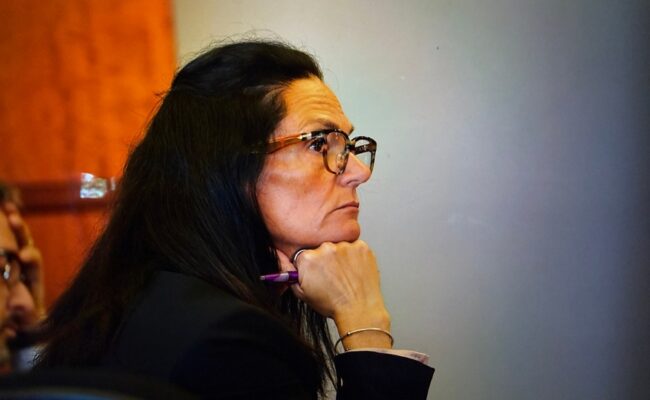
That was central to one question asked on Oct. 5 as the 52-4 District Court judge continued to fight for her job in front of the Judicial Tenure Commission. After weeks of testimony earlier this year on accusations that she behaved badly in office, Hartig appeared in front of the commission in a final plea before it sends her case to the Michigan Supreme Court.
Hartig’s lawyer Katharine Smith said at the arguments on Oct. 5 that Hartig is no longer fighting a professional misconduct claim that she mistreated courthouse staff, but said her punishment should be no more than a public censure by the state Supreme Court. She argued against Hartig’s removal from office — as called for by the disciplinary lawyers for the commission — and the other accusations against Hartig. She specifically disputed the accusation of mental disability tied to alleged cognitive decline.
To that end, Wayne County Third Circuit Court Judge Qiana Lillard asked Smith what the proper outcome should be if she and her fellow commission members still had lingering concerns over Hartig’s cognitive status.
Smith said that the question in front of them is about true, functional impairment, something she argued is not at play for Hartig.
“The correct disposition may be some sort of monitoring … but the question is, ‘what is her condition right now?’”
If the answer isn’t “mental disability,” the commission should reject that part of the case, Smith said.
Yet, lawyers for the commission argued that “mental disability” is, indeed, Hartig’s current state. That’s despite the conclusion of a judge who oversaw hearings in the matter at an earlier stage.
Hartig has continued to sit on the bench and hear cases throughout the process, though her chief judge moved her off felony cases. The commission has not invoked its ability to request Hartig be temporarily removed from her work.
At the hearings at the start of the year, two psychologists testified to Hartig having mild cognitive impairment and noted that high on the potential list of causes was behavioral variant frontotemporal dementia. Another psychologist did not agree and took issue with how the other experts reached their conclusions.
The three did agree that someone experiencing the conditions under scrutiny could be expected to get mentally stuck on a topic, be unable to appropriately control their behavior, and struggle with problem-solving, learning information, and organizing information.
Retired Marquette County Judge Jennifer Mazzuchi weighed this testimony along with that of fellow judges and staffers, recordings of court hearings and seeing Hartig herself in court for weeks on end.
Mazzuchi concluded that Hartig made “odd comments” during some court hearings and that some of her criminal procedures were “incomplete or imprecise,” according to a report she submitted to the commission. She also said “it seems unusual” that Hartig would be unfamiliar with certain court forms or at least not make a better effort to follow court rules with the commission bearing down on her.
Yet the retired judge said some reported errors attributed to Hartig weren’t actually errors when analyzed more closely or were the type of errors cognitively healthy people make, like forgetting a name or attaching the wrong document to an email.
Hartig was able to control her behavior at times — as evidenced by keeping some positive relationships — and some concerns raised by 52nd District Chief Judge Travis Reeds “appeared hypercritical,” Mazzuchi said.
The disciplinary lawyers for the commission didn’t agree with her conclusion, but pointed out that Mazzuchi still said “there is some basis for concern.”
Hartig is accused not only of mental disability, but of withholding a psychological report, making false statements to the commission while under investigation, improperly dismissing cases in a fight with the Oakland County Prosecutor’s Office, and mistreating her staff so badly it obstructed work at the 52-4 District Court.
Mazzuchi, for her part, rejected all the claims against Hartig except for her mistreatment of staff and her withholding of the psychological report — one that found her “unsafe to practice.”
Molly Kettler, staff attorney for the commission, asked commission members to find Hartig guilty of misconduct in all the accusations anyways, arguing that her team met their burden of proof and that Mazzuchi gave too much weight to certain evidence and too little to others.
Smith asked the commission to largely adopt Mazzuchi’s position on the accusations. Her exceptions: she argued Hartig’s mistreatment of others didn’t obstruct her Troy courthouse, which was considered exemplary, and that Hartig did not commit misconduct when she waited an extended period before turning over the psychological report.
Hartig has long argued that report was problematic, highlighting that it referred to her as a doctor and saying she was subjected to improper treatment while being assessed, including having a portion of her head shaved.
She’s also argued that the court rules required her to undergo testing when asked, but not to turn the subsequent report over.
Commission lawyers had told her they would go before a judge to get the report through a separate ruling, but didn’t.
Reporting by Darcie Moran, Detroit Free Press / Detroit Free Press
USA TODAY Network via Reuters Connect