
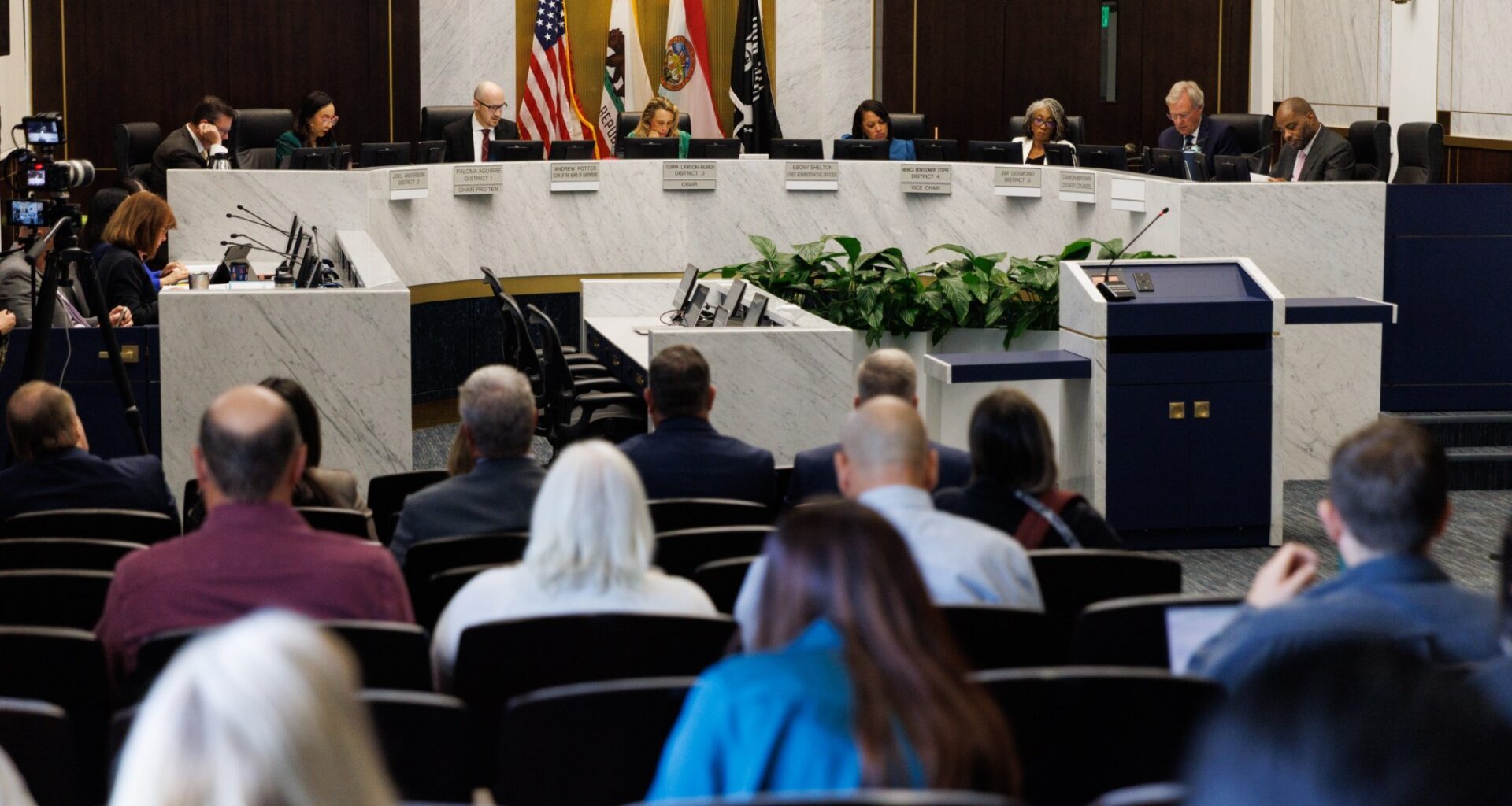
Anyone who has attended a meeting of the San Diego County Board of Supervisors has heard it.
At these meetings, a small cadre of people repeatedly take turns going to the podium during the window where members of the public can share their thoughts with elected officials.
But these speakers often don’t bring up anything to do with county government policies or programs. Instead, their comments have veered into outright racism, profanity and even descriptions of illegal sex acts or how county supervisors are the foot soldiers of global conspiracy theories.
Is it the place of elected officials to limit that sort of speech? Does it warrant curbing the ability of the wider public to comment on what their local government is doing?
For years, county supervisors have been narrowing the ability of the public to weigh in as their meetings have been increasingly marked by frequent disruptions and incendiary comments. Elected officials are now taking it a step further.
Under new rules passed on Tuesday, members of the public will only be allowed to speak to three agenda items per county meeting. The changes follow previous efforts to reduce the length of time people can speak from three minutes to just one. Other restrictions have looked to stop speakers from using threatening, profane, slanderous and abusive language.
Board Chair Terra Lawson-Remer, who authored the rules, said something had to be done to reduce the disproportionate amount of time a small group of speakers takes up at meetings.
Data shared by Lawson-Remer’s office shows five frequent speakers accounted for a third of all the public testimony heard at meetings this year. Ten speakers accounted for 44% of all testimony.
“That concentration, combined with repeated disruption, off-topic conversation and hostile conduct, undermine the entire environment of the meeting,” Lawson-Remer said on Tuesday.
To be sure, the environment at county meetings has become notorious.
It’s a common occurrence for sheriff’s deputies to escort disruptive members of the public out of meetings. On other occasions, county officials have been called expletives and Supervisor Monica Montgomery Steppe has been called racist slurs.
So far, efforts to reign in uncivil conduct at the meetings have involved imposing time limits on speakers, which is allowed under the Brown Act, California’s open meetings law.
David Loy, the legal director for the First Amendment Coalition, said he’s unaware of any local government that has put a limit on how many items a member of the public can speak to.
“This is a bridge too far,” Loy said of the new rules.
But County Counsel Damon Brown argued on Tuesday the new rules are legal.
“The Brown Act does not say that every member of the public has the ability or the right to speak on every single item on the agenda,” Brown said.
For Loy, it’s not the place for elected officials to pick what speech or political opinions should be used to justify a limit to public input on the government.
“One person’s nuisance and gadflies are another person’s zealous public advocate,” Loy said. “They’re saying the same group of people show up and take all the oxygen. Well, that’s called democracy.”
Some county supervisors agreed with that sentiment.
“I think it’s our duty to hear the public input, whether we like it or not, whether it’s the same five people or not. It’s their right to come and speak,” said Supervisor Jim Desmond, the lone vote against the new rules
Supervisor Joel Anderson also had misgivings over curbing public comment, though he ultimately supported new rules after language was added to give supervisors discretion to relax them on a case-by-case basis.
“I’m certainly not tickled to have to sit through hecklers’ vetoes,” Anderson said. “But by the same token, I think our work is far too important to let hecklers win the day.”
Supervisor Paloma Aguirre said public comment has discouraged local educators from bringing school children to county meetings to get a first-hand look at how local government works.
“You’ve got one caller talking about genitalia and another talking about racist and bigoted and misogynistic words. Of course they’re not going to expose their kids to that,” Aguirre said. “It’s very unfortunate that because of very few, the great many are losing.”
Regular public speakers targeted by the new rules expressed their opposition on Tuesday.
“This is a deprivation of rights, a conspiracy against rights,” said Audra Morgan, who frequently addresses the board as “Allegedly Audra.”
Another speaker, a woman who goes by the name “Truth Tonix,” has threatened to sue the county over the new rules.
The legislation backed by supervisors features other changes to county meetings.
Effective immediately, discussion items for land use will begin on 1 p.m. on Wednesdays instead of 9 a.m.
All items for closed session, which can involve discussions of lawsuits against the county and employee pay, will happen at 4:30 p.m. on Tuesdays or 11 a.m. on Wednesdays.